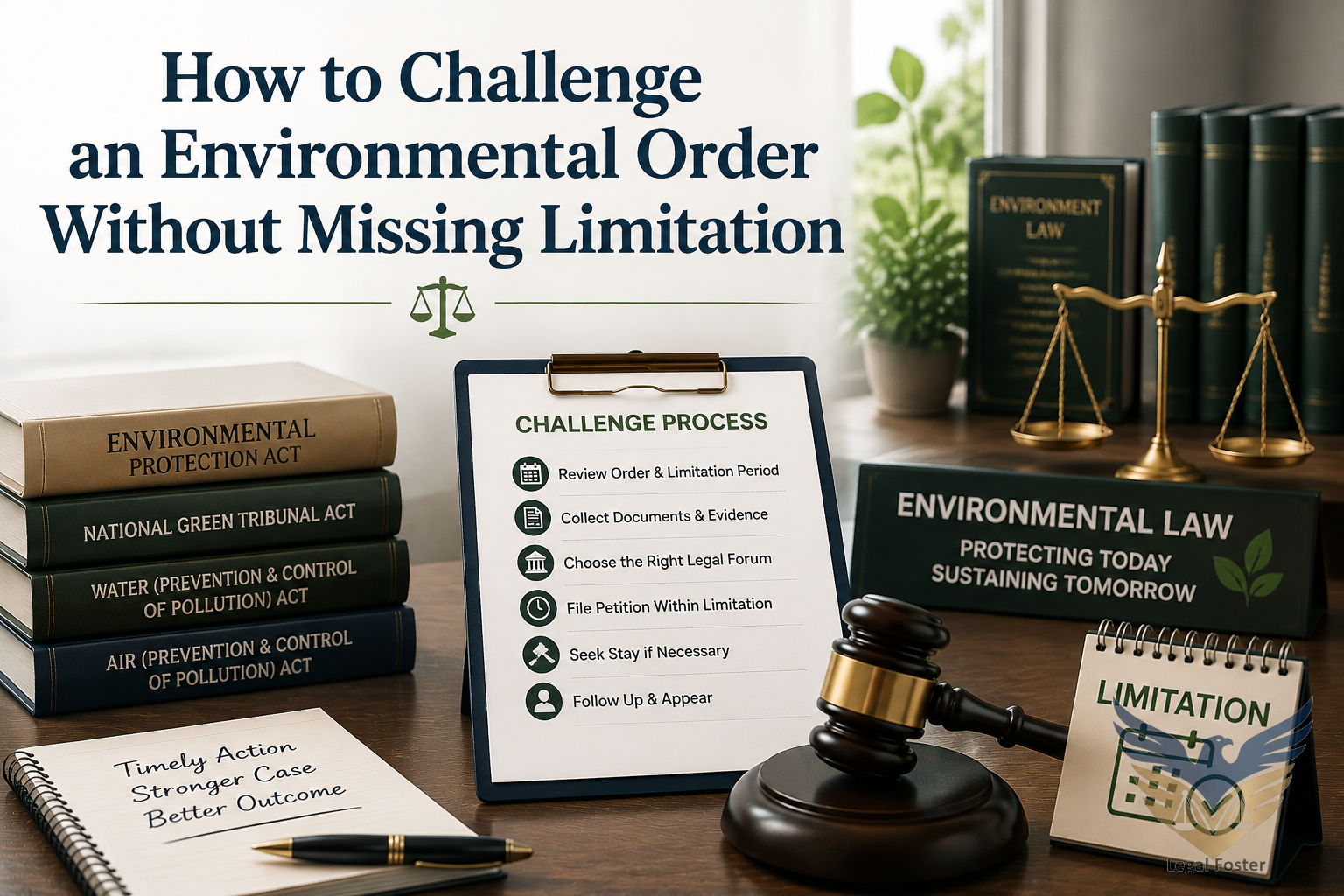
How to Challenge an Environmental Order Without Missing Limitation
Understanding limitation, environmental orders, NGT appeals, environmental clearance challenges and statutory timelines in India.
An environmental order has the power to alter the destiny of an entire project in just a matter of days. Directions may be issued for closure of a factory. Environmental clearance granted to a mining lease holder may be cancelled. A residential project may be halted after years of investment. Citizens may find out that approval has been given for a project that threatens to pollute local air or water bodies, harm forests or public health.
The instinctive response is often to assess whether the order is technically or legally flawed. But another question can become critical long before that point: when did the limitation period start?
This question is not usually as simple as reading the date on the order itself. The relevant date could depend on when it was received, communicated or made public. Did the order need to be uploaded on an official portal, or did mere public disclosure start the clock? Different environmental proceedings also have different limitation periods. Mistaking an appeal under Section 16 of the National Green Tribunal Act, 20 10 for an original environment dispute under Section 14 could lead to a significant jurisdictional error.
Businesses often lose precious time because they believe the environment department is still considering their reply or representation. Citizens sometimes delay filing until they receive the certified copy of the order or spend weeks compiling scientific data before reviewing limitation. Project proponents often believe that because there has been continuous correspondence with the authorities regarding the dispute, it is still valid. This may not be the case.
Advocate BK Singh deals with such matters on a daily basis. He has found that while the environmental grievance is often arguable, the delay itself becomes the first and sometimes insurmountable hurdle. This article aims to shed light on that issue, discuss the applicable legal principles and highlight the consequences of missing limitation. It does not intend to lay out a ‘fill-in-the-blank’ filing strategy.
Why Environmental Limitation Matters Across India in 2026
Environment rulings don’t only impact large power stations, mines or industries. Warehouses, construction sites, hospitals, hotels, stone crushers, recycling facilities and small-scale manufacturers have all faced consent orders, closure notices, demands for environmental compensation and clearance stipulations.
Air-pollution orders, falling groundwater levels, building regulations and industrial violations often intersect in Delhi NCR, Noida, Greater Noida, Ghaziabad, Gurugram and Faridabad, making the issue more evident. Authorities in Mumbai, Pune, Bengaluru, Hyderabad, Chennai, Kolkata, Ahmedabad, Jaipur, Lucknow and other cities also see disputes involving similar issues.
If an environmental claim is delayed it can impact more than just the claim itself. Financial institutions may question the viability of a project. Investors may withhold additional funds. Contractors may make claims. Employees’ job security is at risk. Buyers and local communities are left wondering if the project will be allowed to go forward.
This is why BK Singh Advocate spends time explaining the difference. Having a valid environmental claim doesn’t mean you have a maintainable claim. The two are not synonymous. You can’t always let the merits supersede a limitation defense.
Quick Facts About Environmental Order Limitation
- Appeals under Section 16 of NGT Act have a general limitation period of 30 days.
- Extended by another 60 days if sufficient cause is shown for delay.
- Appeals after 90 days will generally be considered as time barred absolutely jurisdictional issue.
- Applications under Section 14 normally have 6 months from the date cause of action arises. Plus another 60 days if sufficient cause is shown.
- Applications under Section 15 for compensation/restitution have 5 years from the date cause of action arises. Plus another 60 days if sufficient cause is shown.
- Appeals to the Supreme Court from the orders of NGT under Section 22 have 90 days ordinarily.
- Informal representations, correspondence etc. will not necessarily extend limitation.
What Does “Limitation” Mean in an Environmental Case?
Limitation means the period within which a proceeding should be brought before the appropriate forum as provided by law. If the prescribed time limit is allowed to lapse, the complaint may be dismissed without examining the merits of the environmental claims. Classification. Classification is the root of all confusion.
Not every environmental complaint is a Section 16 appeal. Not every communication received from the regulator is an appealable order. An action for continuing pollution may involve questions under Section 14.
An action challenging a specific environmental clearance, consent appellate order or statutory direction, however, would typically be a Section 16 matter. Misclassification could result in a double-whammy. Not only will the petitioner compute the incorrect limitation period, but he may also end up filing his application before a forum without jurisdiction to entertain that order.
One thing that BK Singh Advocate notices almost every day is people using the terms “complaint”, “appeal”, “petition” and “application” indiscriminately. Each of these terms has different legal ramifications under environmental law. The nature of the complaint, the agency passing the order and the statute under which the order was passed are all important.
Which Environmental Orders May Fall Under Section 16?
Section 16 of NGT Act confers appellate jurisdiction on the Tribunal in relation to the orders and decisions made under the environmental laws mentioned in that section. This could be orders relating to Environmental clearance, Forest clearance, consent processes etc. and directions passed under the Environment (Protection) Act, 1986 dealing with biodiversity.
The problem starts when an order-letter does not expressly specify the statute it is passed under. A letter may order closure/suspension of operation without articulating a reasoned appellate path. A project applicant can also receive a bundle of related orders – notice of show-cause, inspection report, final order and subsequent clarification. Picking up the wrong base order for computation of limitation can create problems.
Limitation for filing an appeal under Section 16 is normally 30 days from the date of the communication containing the order or decision. It can be accepted after the 30 days if “sufficient cause” for delay is made out, but not beyond a further period of 60 days. Hence, a maximum limit of 90 days applies in cases where section 16 is attracted.
This 90 day limit is where the landslides happen. BK Singh Advocate points out that “condonation is at the discretion of the Tribunal even during the extended period of 60 days”. Even though 60 days are added to the original 30 days, the 30 days are not automatically assumed to be extended to 90 days.
When Does the Limitation Clock Actually Begin?
The date of an environmental order is not always the same date from which limitation begins to run. Courts and tribunals look to the manner and time in which an order was sent, published or made available to the affected party or the public at large.
If a factory receives an email ordering it to close down, the metadata may readily indicate the date of communication. Environmental clearances can be trickier. Uploads could occur on a government portal. Publication could occur via another governmental channel. Display could occur on the ground weeks or months later. Notice could be sent to the project proponent at any of these times.
Courts have recently begun to consider that, for the purposes of an environmental- clearance challenge, publication to the public can have legal consequences. An individual should not always be able to delay the running of limitation by claiming that he or she first learned of the order long after its issuance.
Consider the following questions of fact that can arise:
- Did someone upload the full order or just a summary of the order?
- Was the order available for viewing on the date in question?
- Was the order properly published in the manner required by statute?
- Did the affected party receive an email, letter or notification on the government portal?
- Was the order available to the public at large before the villagers down the street first heard about it?
- Was a subsequent corrigendum issued that changed the substantive outcome of the decision?
- These issues should not be seen as mere technicalities. They can determine whether or not the Tribunal will hear the environmental merits of a case.
BK Singh Advocate takes statements of communication in seperat law point because such oral statements about late knowledge can be contradictory to what is shown in the portal, or through emails, postal dispatches, and public notices.
The Danger of Waiting for Departmental Reconsideration
The most frequent cause of this issue is usually suspending action on a representation submitted to the same governmental agency which issued the order. A company will write to revoke a closure order. The promoter of a project may seek review of the SEIAA or some other body to review the decision to cancel the clearance. Citizens may send their grievances to the Pollution Control Board and assume that it will reply.
The representation pending may lull the party into believing that limitation is suspended. If the statute or a contract does not cause that result, normal correspondence typically does not toll the statutory period within which an appeal must be filed.
A subsequent letter of denial may lead to even more confusion. A later denial letter is sometimes treated by parties as starting a new cause of action notwithstanding the fact that it merely reiterates or declines to review an original decision. The Tribunal may look through the form and find that limitation started on the earlier effective decision.
BK Singh Advocate has encountered instances where commercial teams carry on with meetings and email correspondences while the statutory limitation continues to run in the background. By the time management gets a definitive denial, the absolute limit may have passed.
Section 14, Section 15 and Section 16 Are Not Interchangeable
Section 14: Civil cases where a substantial question relating to the environment is involved and which arises out of the implementation of the enactments specified in Schedule I to the NGT Act.
Ordinary limitation period is 6 months from the date on which the cause of action first arises. Extendable by a further period not exceeding 60 days on sufficient cause.
Section 15: Relief, compensation and restitution.
Ordinary limitation period is 5 years from the date on which the cause for claiming compensation or restitution first arises. Extendable by a further period not exceeding 60 days on sufficient cause.
Section 16: Appeals.
Appeals against specified orders or decisions. Limitation is 30 days with extension up to 60 days.
Section 14 & Section 16 Trap: Problems arise when an appealable order is termed as a continuing environmental dispute in order to invoke the benefit of longer period under Section 14.
Does Continuing Pollution Create Continuing Limitation?
Continuing pollution or a lapsed statutory approval are separate legalities. Daily emissions of smoke, untreated discharge recurs or dumping persists may cause continuous or recurring environmental harm. Clearance dated August 1, for example is a discrete administrative act.
Plaintiffs have at times claimed that since construction activity/pollution continues, the statute of limitations for the original permit also restarts daily. Such claims might be resisted if the true relief sought is rescission of the prior order.
Notice too the words “cause of action first arose” in Section 14. Subsequent harm does not necessarily negate the term “first.” However, a truly ongoing or repetitive environmental injury may have a different legal nature than a single past occurrence.
BK Singh Advocate explores why this matters. A poorly pleaded continuing-cause argument can hurt credibility. The Tribunal can disconnect ongoing injury from a statute barred challenge to the original approval.
Documents That Commonly Expose a Limitation Problem
Environmental cases are paper intensive. Often the piece of paper that kills limitation is the one that is lost or does not match up.
Examples of important documents:
- The environmental approval, clearance, consent order or closure notice
- Email headers, website portal messages and official order service information
- Website upload and public display data
- Field inspection observations and show cause notices
- Response sent to the government agency
- SEAC, SEIAA or hearing minutes
- CTE and CTO
- Calculations for environmental offsets
- Letters and receipts
- Clarifications sent, received or filed later, or an erratum
- Prior litigation, arbitration or administrative hearing
- Affidavits or documents that show when actual knowledge was received.
If you take a screenshot of a website that doesn’t display the date, that will likely prove nothing. If the order is downloaded midway, you may hide the statute or appeal section. If you strip the email metadata, it may become more difficult to prove the date you allegedly received the order.
The other thought I have seen BK Singh Advocate highlight is company documents can impeach your public claim. Board of directors minutes, compliance documents or third party consultant emails may reflect knowledge of the order date before what is claimed in the litigation.
How Delay Affects Businesses and Local Communities
Limitation allows a company closure direction, consent refusal, demand for environmental compensation or clearance cancellation to stand. Production can be suspended indefinitely. Rent, salaries, loan EMIs and contract liabilities continue to accrue.
Small industry is affected more acutely. They may not have a separate environment cell and notices may come to a consultant, plant manager or the registered office. By the time it reaches the promoter, days could be lost.
Citizens and NGOs encounter other hurdles. They may not even be aware of a clearance that has been issued. Documents can be hard to pin down and project work can start before local communities know what has been permitted.
Evidence itself changes over time. Waste could be cleared, trees cut down or water samples compromised. Memories become distant. Websites get updated. Officials get transferred.
Limitation isn’t simply about following procedure. “It’s where legal rights intersect with environmental impact and business uncertainty.” Says BK Singh Advocate.
Warning Signs That Limitation May Already Be in Dispute
Another problematic situation is where the order appealed is several weeks old, different persons involved in the project mention different dates of receipt of the order, or where the representative writ submitted speaks only to the receipt of a representation. Equivalent danger exists when a project first files a response to a show-cause notice, but fails to account for the subsequent final order.
Limits have also been queried where the environmental clearance is uploaded on the web months before the person aggrieved claims to have received notice of it; where a direction to cease operations was sent to the registered office of the undertakings, but somehow not passed on; and where the respondent places reliance on continuing negotiations with the concerned authorities.
Finally, difficulty is seen in cases where a subsequent order purports to “clarify” a prior order. If the subsequent order does not affect substantive rights, it may not start the limitation period running anew.
BK Singh Advocate notes that chronology is particularly critical where there are multiple authorities in play. Suits pending before the Pollution Control Board, appellate authorities, SEIAA, MoEFCC, High Court and NGT do not necessarily stay or extend each other’s limitation periods.
Frequently Asked Questions
No. The Rules provide for 30 days in appeals, most notably in Section 16. Periods run under Section 14 environmental adjudications and Section 15 compensation or restitution applications are different. BK Singh Advocate suggests identifying the nature of proceeding first before computing limitation.
Section 16 allows condonation of further delay up to 60 days in addition to the basic period of 30 days. Filings beyond that outer limit may become barred as a jurisdictional defect.
Sending representations will not automatically pause a statutory limitation period. The effect will depend on what provision applies and the nature of any subsequent order. BK Singh Advocate cautions against thinking that your mail left unanswered will keep an appeal alive.
Not always. Delivery, official transmission, publication or public existence may become issues. Matters at the intersection of environmental-clearance and limitation have raised questions about what constitutes the earliest valid public notice.
Ongoing work on a project does not necessarily extend the limitation period for challenging the underlying clearance. There may be different considerations where there is a continuing environment violation vs. challenging an old statutory approval.
Erroneous service or disputed delivery may be relevant to the limitation issue, but is unlikely to change the analysis outright. What shows in the portals page, publication status, emails received and proof of knowledge may all become relevant facts.
Mislabeling a filing does not automatically change the nature of the proceeding. If the relief requested is to set aside an order which is specifically appealable under Section 16, the Tribunal may impose the Section 16 limitation period.
Not always. The clock may be running from official publication or such other communication recognized by law. BK Singh Advocate explains that sometimes clients telephonically learn of NGT orders and unnecessarily wait around.
The Tribunal may refuse to hear it and dismiss it as barred by limitation. The order being challenged would stand unless/until challenged some other way, subject to the facts and any other specific jurisdiction that may exist.
An environmental lawyer may first review dates to determine if NGT has jurisdiction to hear the matter. BK Singh Advocate views chronology as a threshold jurisdictional issue, independent of whether the order under challenge may actually be flawed.
Final Thoughts
The absence of limitation can convert a valid environmental cause of action into a matter beyond the jurisdiction of the Tribunal. There are many pitfalls if one is complacent: thinking that representation pauses the clock, that personal knowledge trumps all or that continuation of environmental impacts revive an aged appeal.
Every date will be important – date of order, upload date, public-notice date, date of receiving email, date of inspection, date of representation and subsequent rejection. They will have different legal importance depending upon the facts of each case.
BK Singh Advocate acts for Industries/Project Proponents/Residents/Companies and others affected throughout India in Environment Cases. He specializes in arguments relating to the statutory nature of the order, jurisdiction, dates for purposes of limitation and paper trail but does not guarantee a certain outcome.