How Can You Obtain Environmental Clearance for a New Construction Project in India?
Few things ruin project planning like environmental clearance requirements. You’ve secured land years in advance. You’ve appointed consultants. Funding is lined up. Marketing has begun.
But then construction can’t start because you’re told environmental clearance was required prior to breaking ground. That delay can put more than schedule at risk. Interest mounts, contractors file claims, purchasers become anxious and the entire project’s credibility can be compromised. Starting with one question can prevent those problems: Does this project require prior environmental clearance? The answer isn’t always clear-cut. Built-up area, total project area, location, surrounding ecology and other factors can determine if a project falls within or outside regulatory guidelines.
Working with our NGT lawyers online can give developers a clear understanding of environmental clearance early in the process. Advocate BK Singh and Advocate Sadhna Singh work with clients to identify potential EC concerns at the point where the project concept is still flexible. Something as simple as moving a drainage channel or the forest boundary, or adjusting wetlands, groundwater restrictions or built-up area can change the regulatory requirement.
New Construction Projects: Primer on Environmental Clearance in India
This guide introduces how environmental clearance applies to new construction projects. It lists who may review the proposal, highlights commonly needed records and identifies major compliance risks. The information is designed to help developers, owners, societies, institutions and businesses planning construction projects anywhere in India.
Identify the Potential Need for Environmental Clearance Now
Construction projects are subjected to a wide range of environmental requirements. Applications are scrutinised for water consumption, sewerage generation, traffic generation, dust, electricity use and effects on natural surface water drainage.
Air quality, groundwater pollution, waste production, flood risks and global warming all draw attention to how sensitively applicants have considered environmental impacts. Developers will find themselves having to justify why they want to increase environmental pressures on existing infrastructure.
Delhi NCR illustrates what happens when development density outstrips underlying services. Environmental clearance questions under the Environmental Impact Assessment Notification, 2006 intertwine with permissions from pollution-control boards, groundwater bodies, tree boards and other competent authorities. In Delhi itself, Noida, Greater Noida, Ghaziabad, Gurugram, Faridabad, Meerut and Hapur it is common to see projects affecting neighbouring roads, drains, residential colonies and parks.
Near Mumbai, Pune, Bengaluru, Hyderabad, Chennai and Kolkata the underlying hazards are often quite different. Coastal regulation, water scarcity, lake buffers or wetlands may drive clearance concerns. Projects within coastal regulation range, near forest land or protected areas, within eco-sensitive zones, hills or on city margins must answer far more careful location questions than typical real estate developments.
Later challenges to an environmental decision can complicate loan drawings and add cost to project holding. Starting too early can be worse. Financial institutions, investors, purchasers and even government agencies may question whether the project has valid environmental clearance or whether its developed plans breach the conditions of that clearance.
Clearance Is a Viability Question for Projects Now
Advocate BK Singh sees environmental clearance requirements as a fundamental viability question. Starting a project without clearance can harm bankability, not merely violates planning regulation. Advocate Sadhna Singh echoes this point: Owning land and getting building approval does not nullify environmental limits on a project’s size or its site location.
Five Quick Clearance Facts for Construction Projects
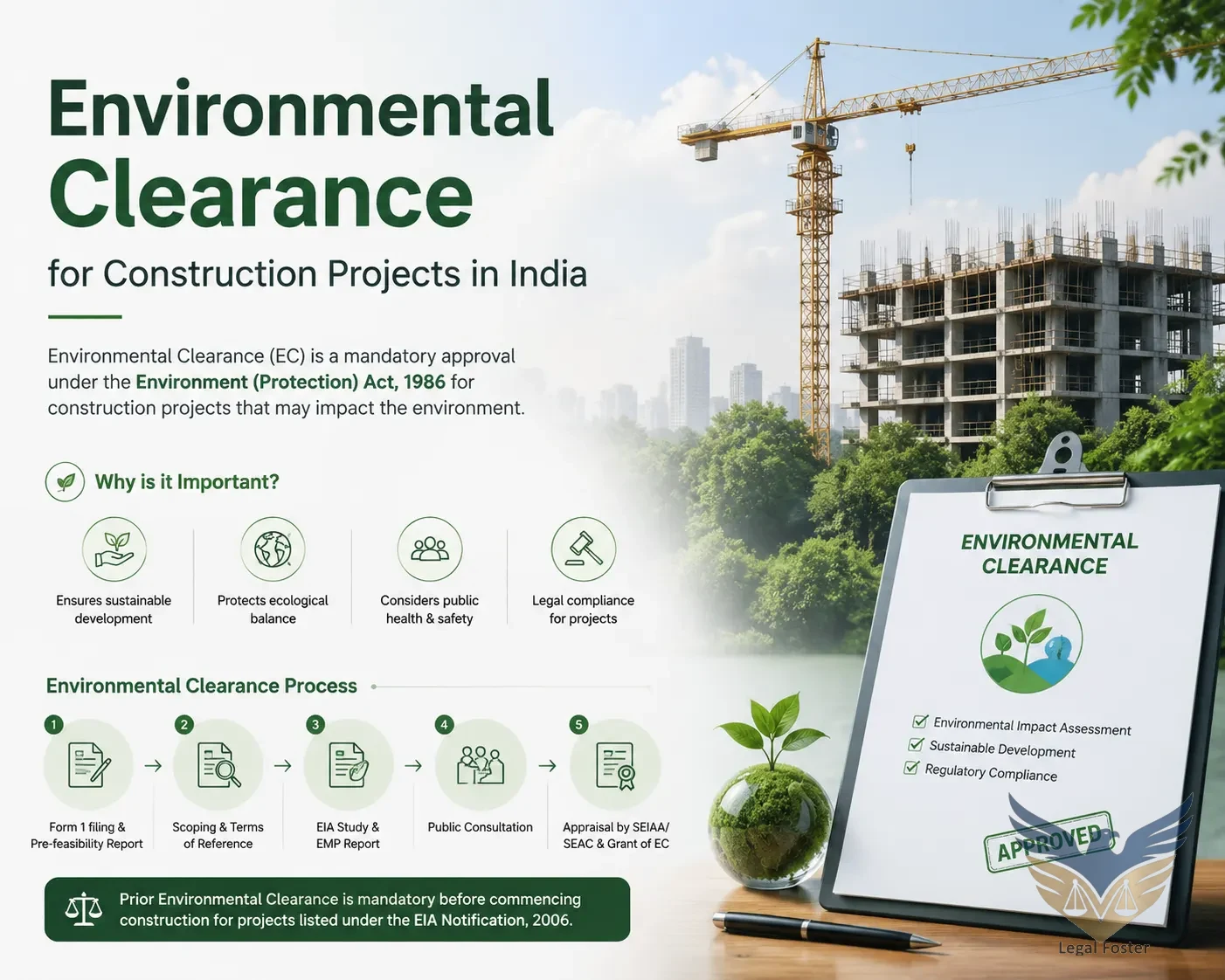
Environment clearance shall be required only when projects fall under EIA Notification or any other environmental law.
Projects under Building/ construction category notified under Item 8(a) are typically appraised by state-level environment agency once the threshold built-up area has been reached/exceeded. Such Township and area-development projects shall be appraised under Item 8(b) of schedule, if necessary.
Projects require prior environment clearance wherever specified under the enactment. Environment clearance is in addition to building permission, fire clearance, land-use conformity, or pollution consent.
Conditions are attached to clearance that restricts the configuration & operation of project. Any material changes may need amendment to project/ fresh environment appraisal.
Environmental Clearance: What’s it Mean for Construction?
Environmental clearance confirms the competent authority has assessed likely environmental impacts of a project. For building and construction proposals, review typically involves land use, water requirements, sewage treatment and disposal, solid waste management, construction and demolition waste, energy use, drainage and stormwater, traffic congestion, air emissions, noise, landscaping and fire/emergency response.
Clearance is not a blank cheque to build. Clearances typically include conditions that are enforceable during construction and operation of the project. The proponent must ensure that what is built corresponds with the approved proposal and studies submitted to the regulatory authorities.
One local authority may grant building plans from a planning and construction safety standpoint. Environmental authorities have a separate mandate: whether the project impacts were properly investigated and the limits of protective measures offered. One permission does not implicitly override the need for the other.
Project proponents are best served by mapping out every potential approval before committing funds or mobilising on site. Suppose a proposed residential development requires environmental clearance, building sanction, fire clearance, airport height clearance, groundwater permission, tree-felling permission and arrangements for municipal sewage connection or treated water supply. Its approval profile will differ based on location and project characteristics.
Still want a simplified overview? Prospective construction applicants can use the general information provided by NGT Lawyers to do a preliminary legal evaluation. However, website information cannot determine whether an EC is required for a specific site.
Projects Inside or Outside Regulatory Thresholds?
Building projects become subject to the Environmental Impact Assessment Notification when they meet a certain threshold of built- up area or involve certain activities specified under Schedule I or Schedule II of the notification.
Building and construction projects & area-developments are specified under Schedule I Items 8(a) & 8(b) respectively, if they exceed the set threshold of built- up area.
As a general rule, all building and construction projects with built-up area of ‘not less than 20,000 square metres but less than 150,000 square metres’ come under Item 8(a) of Schedule I; while all township or area-development projects with ‘total area of not less than 50 hectares or built- up area of not less than 150,000 square metres’ come under Item 8(b) of Schedule I.
A few judgments, amendments to notification and project specific facts can impact this general threshold limit.
Built-up area calculation should be conservative i.e. Projects should not only consider selling area and exclude basement, service areas or parking structures while calculating built-up area if it wishes to fall outside the threshold limit.
Connected projects/phases should be considered together for the threshold test. If a project can be connected through access, infrastructure, common ownership or geography, it cannot be considered in separate portions or parcels to avoid meeting the threshold limits.
Projects within proximity of coastal zones, protected-area boundaries, wetlands, forest areas, flood plains etc. may be subject to clearance requirements even if built-up area is above the thresholds.
BK Singh and Sadhna Singh suggest that it is best to put the threshold test analysis in writing. A memo can be produced noting down the relevant project category, method by which areas were calculated, location constraints, assumptions etc. Should any designs changes occur, the analysis should be performed again rather than assuming it to still be correct.
Reviewing Environmental Authorities and Applicable Rules
The Environment (Protection) Act, 1986 provides for the central legislation for environmental protection. The Projects which require clearance are enumerated in Schedule I of the Environmental Impact Assessment Notification, 2006 under the Environment Act.
Category A projects are sent to, and typically approved by the Ministry of Environment, Forest and Climate Change (MoEF&CC) centrally, via the relevant Expert Appraisal Committee.
Category B projects are typically approved by the State Environment Impact Assessment Authority and State Expert Appraisal Committee at the state level. Most building projects under Items 8(a) and 8(b) are Category B projects, and are dealt with at the state-level unless there are other considerations.
All records are submitted by applicants via the PARIVESH portal. Documents uploaded within PARIVESH form the official record for future compliance/enforcement or appeals. Applications should not contradict information given through other avenues.
Construction projects under Items 8(a) and 8(b) typically do not have a public consultation phase as part of the clearance process. Projects under Items 8(a) and 8(b) of the EIA Notification are considered separately from all other projects listed in the EIA Notification which are required to have a public hearing. However, the concerned clearance agency will likely ask questions of the applicant regarding access to water, traffic, drainage, solid waste management, and any sensitive ecosystems near the proposed development.
Other laws commonly connected to construction projects:
- The Water (Prevention and Control of Pollution) Act, 1974 speaks to sewage disposal and consent from the local pollution control board.
- The Air (Prevention and Control of Pollution) Act, 1981 applies to projects that will operate emission generating equipment or otherwise fall under the act’s rules.
- The Construction and Demolition Waste Management Rules apply to handling and disposal of construction waste.
- Rules on solid waste, plastic waste and hazardous waste may apply depending on project facilities and operations.
- Projects in coastal areas are subject to Coastal Regulation Zone Notifications.
Forest, wildlife protection, wetland, groundwater and tree preservation laws can impact proposed construction. These regimes are not exhausted by clearance under the EIA Notification.
Obtaining environmental clearance does not negate obligations under other environmental laws. Similarly, obtaining consent from the pollution control board does not validate construction started without a prior mandatory EC. Advocate Sadhna Singh recommends building a unified approvals list to confirm one consultant’s work does not obscure another permit.
Who Should Understand EC Requirements?
When is environmental clearance a project question? Developers should know before launching group housing schemes, commercial buildings, hospitality businesses, hospitals and educational facilities, warehouses, institutional structures, mixed-use developments and industrial-support services. Large enough projects may also require EC even if land will be leased rather than owned. Landowners who sign development agreements need clarity on whether density triggers environmental appraisal.
Investors and financiers understand clearance questions from a risk perspective. Exposure rises if construction begins without statutory approval or if the built configuration exceeds clearance. Diligence should include reviewing the actual environmental clearance letter, sanctioned capacity, amendments issued and compliance reports or complaints.
Homebuyers and commercial purchasers have a stake because project approvals affect possession schedules. Although buyers cannot dictate the developer’s clearance strategy, purchasers should review whether the proposed sale layout corresponds with the project as cleared by the environmental authorities.
Environmental thresholds should be flagged by architects, project-management consultants and other technical advisers before plans become contractually binding. Designs created without considering sewage treatment capacity, water balance, natural drainage patterns and waste storage may face redesign later during the government’s appraisal.
Government agencies, educational societies, hospitals and charities should not assume projects are exempt just because they serve a public purpose. Public interest is one factor used to classify projects under environmental laws. Projects must also meet legal exemptions based on their features.
Summary: When Should You Consult an NGT Lawyer?
Use our website information to do a preliminary review. For a more detailed assessment of clearance risks, Advocate BK Singh can review projects that engage his services. Technical conclusions should always be supported by an environmental professional.
Taking a project from Blueprint to Clearance
The best time to work through clearance questions is before the first shovel hits the ground. The process is about more than uploading forms on a web portal. Project descriptions, site conditions and environmental management promises should all tell the same factually supportable story.
Scrutinise the land and its surroundings
Site coordinates, title boundaries, existing land use and access are critical first checks. Developers should investigate nearby drains, water bodies, forest areas, protected monuments, aerodromes, coastlines, wetlands and eco-sensitive areas with reliable land records.
When possible, visit the site. Revenue records or Google maps may not capture an active natural drain, low-lying depression, informal dumping area or adjacent buildings accurately. Summer and monsoon seasons may also reveal what is not visible by foot during dry weather.
Advocate Sadhna Singh suggests developers photograph the site with dated signatures, geographic coordinates and supporting records before construction begins. Should questions arise later, the proponent should have evidence showing the natural site conditions present at outset.
Fix the project layout
Project area statements should match: from architect’s plans, to development application forms and environmental documents submitted to regulatory authorities. Plot area, built-up area, carpet area, basement, parking layout, residential units, commercial space and even project cost should match from one record to the next.
Projects that change design during regulatory appraisal confuse reviewers. Worse, construction carried out later under an expanded plan can create a compliance violation. Project marketers should avoid promoting layouts or square footage not covered under the government’s approved plans.
Determine category and authority correctly
With stable project parameters, developers should determine whether category Item 8(a), Item 8(b) or another schedule item applies. Some mixed-use projects need review under additional classifications besides “construction project”. Logistics parks, industrial estates or projects containing a specifically listed activity may not be categorised by square footage alone.
Documenting the category selection can avert internal disputes later. A short memo should summarise why the particular schedule item was chosen, how areas were calculated, which agency should receive the application and what parallel approvals might be necessary.
Populate the environmental assessment
Normally, construction projects require details about water source, estimated daily demand, wastewater generated and treated, solids reuse/disposal, stormwater drainage, solid waste management, construction debris management plans, electricity demand and emergency back-up generation, parking requirements, ingress/egress points, traffic contribution, landscaping plan and fire/emergency response.
Numbers should be realistic and inter-related. Calculated water demand should match water supply, sewage production, treatment capacity and reuse plans. Solid waste quantities should align with estimated occupancy and management plans. Landscaping squares claimed must match the built-up layout.
Promises made in support of an environmental application can become binding conditions of clearance. Understated impacts can harm the application’s credibility. Advocate BK Singh recommends clear and achievable commitments supported by project feasibility studies rather than vague promises that will fail once project units sell-out.
Prepare application forms and technical reports
Forms required will depend on the project category. At minimum, applicants should submit the prescribed application form, project description, concept plan, title plan, environmental management plan and technical studies supporting the claim for approval.
Information provided should be complete, readable and internally consistent. Any technical report should not be shared with multiple projects. Citing the wrong city, river, plot dimension or built-up area is more than harmless drafting error. Erroneous details suggest the environmental assessment was never site-specific.
Respond to agency queries promptly
Expert committees may ask for clarifications or additional information. Response letters should be careful to address the specific question raised, correct errors plainly and avoid changing numbers in one report without adjusting related figures elsewhere.
Comment summaries of committee meetings can provide valuable clues if issues remain unresolved. Project teams should track each comment, response provided and any corrections accepted in writing. Lack of response from the committee should not be treated as acceptance.
Read environmental clearance carefully
Once issued, clearance conditions should guide the project’s compliance plan. Responsibilities should be allocated to developer, contractor, environmental consultant, facility manager and supply partners as needed.
Site teams will require practical guidelines about barricading, dust/sand control measures during construction, debris handling, wastewater management, compliance monitoring and site restrictions. A clearance file kept only in a home office offers no protection if field staff lack familiarity.
Advocate Sadhna Singh suggests convening a pre-construction compliance meeting weeks before construction equipment arrives on site. That small step can resolve differences between contract documents and EC conditions before they become costly to correct.
Record List for Environmental Appraisal of Construction Projects
Record requirements differ slightly by project category, approval authority and local conditions. Developers should usually have ready: -
- Title to the land or evidence of lease, layout or development rights.
- Site plan, GPS coordinates and certified boundary wall details.
- Sanction for site-specific land use or records showing how much development is allowed.
- Concept plan and current architect’s area statement.
- Statement showing plot area, built-up area, basement area and parking area.
- Estimated project cost and project schedule.
- Detailed water requirement, source verification and water balance.
- Daily sewage generation and STP design/layout details.
- Disposal/reuse plans for treated water.
- Stormwater drainage and rainwater-harvesting design.
- Solid waste and construction debris management plan details.
- Traffic impact, access points and parking specifics (if any).
- Energy conservation plan and renewable energy provisions, if any.
- Green belt or landscaping plan with area mentioned.
- Fire and emergency services plan details.
- Gen diesel generator information, noise abatement and emission control features.
- Maps showing proximity to water bodies, forest, protected areas or vulnerable receptors.
A proposed sewage treatment plant will require physical space on the site, electrical power and routine maintenance planning. Mere paper capacity will not solve functional problems once occupants arrive.
Advocate BK Singh and Advocate Sadhna Singh recommend maintaining a master index of all project documents with version dates. This reduces the risk of submitting an outdated plan after the project configuration changes post-application.
Timeline for Getting Environmental Clearance
No ethical counsel will guarantee project approval by a fixed date. Actual timing depends on the project’s category, how well documents are prepared, when the committee meets to review proposals, whether the site has environmentally sensitive features and if the proposal changes during review.
Pre-filing research may take weeks or months because reliable statements of area, environmental calculations and supportive site records must be compiled. Applications filed prematurely often take just as long because they return with repeated queries.
Committee meetings and questions for clarification can prolong appraisal where water availability is in doubt, drainage plans are disputed, access is limited or the site’s adjacent to a sensitive waterbody or other environmentally sensitive feature.
Some completion dates can be planned backward from when finance is needed or construction must start. Developers should avoid contractually committing to suppliers or buyers based on a presumed clearance date unless the contracts account for this approval risk.
Loan draw periods, land option periods and contractor mobilisation clauses should all recognise project’s approval status. Buyers should not receive promised possession dates based on speculative construction starts.
Anyone who believes an EC was wrongly granted or denied can ask the National Green Tribunal to review that decision. Under section 16 of the NGT Act, 2010 interested parties have statutory rights to appeal certain orders. These include orders granting or rejecting environmental clearance. The normal time limit to file such an appeal is 30 days from when the decision is communicated to the affected person. A very limited condonable delay is available under the statute itself. Do not assume general civil court limitations apply to NGT appeals. Anyone affected by an EC dispute should consult a lawyer promptly.
Key Mistakes That Put Projects at Environmental Risk
Thinking building approval replaces environmental approval
Builders treat municipal permissions as though they also satisfy environmental law. Environmental clearance and building permission are independent requirements. Starting construction merely because local authorities approve the building plan can trigger legal action against the project.
Building plan approvals use carpet area to define project size. But environmental laws calculate threshold based on built-up area. Take note of basements, service areas and parking structures.
Dividing a single project into multiple sites
Creating several companies, licence agreements or project phases does not necessarily mean related development can be reviewed independently. Shared land, access roads, utilities, common owners and overall project planning can still draw regulator attention.
Buying land without understanding the location
Valuable land can have serious environmental obligations attached to it. Developers should check for nearby drains, wetlands, forest areas, coastal regulation zones, water bodies, flood risks and reserved forests before they buy or contract to buy land.
Copying technical studies from previous projects
Technical reports found online likely contain incorrect locations, rainfall data, water bodies, sewer facility details or project capacities. Inaccuracies suggest your team did not evaluate actual site conditions.
Modifying plans after receiving environmental clearance
Increasing built-up area, number of towers, dwelling units or commercial space may breach conditions of an environmental clearance. Changing parking area or planned water demand may also need amendment or fresh consideration by the regulator. Do not assume your existing EC can be interpreted to cover future expansion.
Making unrealistic commitments about water supply/sewerage plans
Authorities may confirm water source legality and adequacy at appraisal. Developers should plan for a sewage-treatment plant that can manage actual sewage volumes. Permissions granted based on false occupancy create operating pollution risks and enforcement problems down the road.
Neglecting existing natural drains
Flooding problems worsen if a natural drain is built over or diverted. Municipal permissions cannot excuse environmentally harmful drainage designs.
Thinking some construction activity is permitted before EC
Excavation, foundation work, piling activities and large-scale ground preparation might count as project commencement. Calling the work “preliminary” does not avoid the clearance requirement.
Misplacing project records
Numerous consultants may have different plans and understand different project square footage. Advocate BK Singh suggests appointing one responsible person on the project team to maintain document versions, track submissions to governments and ensure construction aligns with the cleared project.
How NGT Lawyers Supports Construction Clearance Matters
NGT Lawyers assists project proponents in understanding whether a new construction project falls within the environmental-clearance framework. The service may include reviewing the project category, area calculations, site restrictions, approval history and legal consistency of environmental documents.
The team can coordinate legal review with the work of architects, engineers and environmental consultants. Technical experts remain responsible for technical data, while legal scrutiny helps ensure that representations match the governing framework and do not create avoidable contradictions.
Advocate BK Singh advises developers, landowners, companies and institutions on environmental approval risks, EC conditions, expansion questions and regulatory notices. His approach centres on documentary clarity and practical compliance rather than unsupported assurances.
Advocate Sadhna Singh assists clients in understanding how environmental clearance interacts with planning permission, pollution-control requirements and possible NGT proceedings. Her review can be particularly useful where projects involve Delhi NCR, sensitive locations or several approval authorities.
NGT Lawyers may also help clients assess a project after an objection, committee observation or notice has emerged. The purpose is to identify the present legal position, preserve necessary evidence and choose a lawful response without worsening the violation.
Every project requires an individual assessment. Neither Advocate BK Singh nor Advocate Sadhna Singh can guarantee that an authority will grant clearance. Proper advice can, though, help the proponent avoid false assumptions and present a coherent, legally responsible proposal.
Frequently Asked Questions
1. What is environmental clearance in relation to construction projects?
Environmental clearance is approval in advance of a proposed activity from the relevant authority, after its likely impacts on air, water, land, waste, traffic, drainage and neighbouring areas and communities have been reviewed. It normally includes conditions to be met during construction and operation.
2. Do all new construction projects require environmental clearance?
No. The requirements are based on project category, built-up area, total area developed, location and associated activities. Smaller projects may be outside the scope of the EIA Notification but may still be subject to environmental and municipal clearance requirements.
3. What is the general threshold for environmental clearance for building projects?
Item 8(a) of Schedule I to the EIA Notification normally applies to building and construction projects with built-up areas between 20,000 sq.m. and less than 150,000 sq.m. Please review this with reference to any amendments pending at present and the specific facts of any proposed project.
4. At what point does a township project get included under Item 8(b)?
Township or area-development projects are normally listed in Item 8(b) of the Schedule to the EIA Notification if they meet the relevant threshold of land-area or built-up-area, often 50 hectares or 150,000 sq.m respectively. This should be double checked.
5. Can construction activities start prior to receiving environmental clearance if the EC application has been submitted?
If environmental clearance is required before starting construction then the submission of an application does not normally allow construction to commence. Starting construction prior to approval could open up the project to penalties for violations, stop-work orders and liability to pay environmental compensation.
6. Isn’t sanction of the building plans by the local authority sufficient to start construction?
No. Environmental clearance and building-plan sanction are separate legal requirements. Any project that requires prior environmental clearance is required to have that approval even if the building plans have been approved by the local municipal corporation or development authority.
7. Is environmental clearance with public hearing required for construction projects?
Building and construction projects under Items 8(a) and 8(b) of the Schedule to the EIA Notification have generally been considered exempt from the normal public hearing step of the environmental appraisal process. The presence of other aspects to the project or environment related laws should be reviewed.
8. Which government agency is responsible for granting environmental clearance for construction projects?
Most Category B construction projects will be assessed at the state level through the State Environment Impact Assessment Authority or SEIAA with technical clearance from the State Environment Impact Assessment Expert Panel or SEAC. The category and location should always be reviewed in addition to any associated activities which may be Scheduled.
9. What if the built-up area of a project increases after it has received environmental clearance?
Increasing the built-up area may trigger the need for an amendment to the EC or a re-appraisal or even a new decision before further construction is allowed. This will depend on what was approved, what is now proposed and the environmental impacts of that change.
10. Can a project be subdivided into stages so as to avoid requiring environmental clearance?
Projects can often be subdivided into stages or phases to reduce the need for prior environmental clearance. Artificial splitting of an otherwise integrated project to disguise its true nature can be challenged by the authority concerned. Shared ownership, access, infrastructure, servicing and planning may help to identify connected projects.
Closing the Approval Gap Before Construction Begins
Environmental clearance should be obtained when there is time to thoughtfully plan your project. Guessing happens after groundbreaking and those guesses become expensive errors. An inaccurate threshold determination affects your finance, contracts, buyer confidence and legal viability of your entire project.
Decide what EIA category your project falls in, conduct your site analysis, clarify area declarations and map out achievable plans for water supply sewage & treatment, storm water drainage, solid waste management, power needs and dust mitigation. Take your conditions for clearance and turn them into tasks on the ground.
BK Singh & Associates along with Advocate Sadhna Singh can assist builders, businesses, organizations, landowners and investors see environmental legal risks before they become stop work disputes. We offer precise legal analysis, syncing up your approval position and advising clients how to legally respond when pushed.
Starting with environmental clearance in mind you can be sure your build is more than budget driven or structurally designed. You have an environmental due diligence report that will stand up to scrutiny while under construction and when occupied. That upfront investment will ease your mind for the health of your land, investment and future tenants.
Disclaimer: This article has been written for general information purposes only. For legal advice on any subject matter relating to Indian Environment law please contact us directly.