Can Defects in an EIA Report Weaken Your Case Before the NGT?
An Environmental Impact Assessment report (EIA) typically forms the basis for granting an environmental clearance. But what happens when that basis is faulty due to outdated information, incomplete impact analysis or misrepresented project details? The consequences reach far beyond a procedural discrepancy. Residents can be affected by air pollution, dropping water table, noise pollution, unsafe traffic conditions or loss of agriculture.
Project developers can face pressure for reasons entirely unrelated to the environment. Allegations around an erroneous EIA report can come to question the environment clearance, funding, construction timeline and reputation of the business. Government officials could even have their performance called into question re: QC before granting approval.
The grey-area involved with these situations is considerable. An EIA document consists of scores of pages covering air pollution, water use, forests & wildlife, solid waste, safety risks and disaster management. One material discrepancy could be lost in tables, attachments or engineering parameters most readers won’t notice.
What Is a Defective EIA Report?
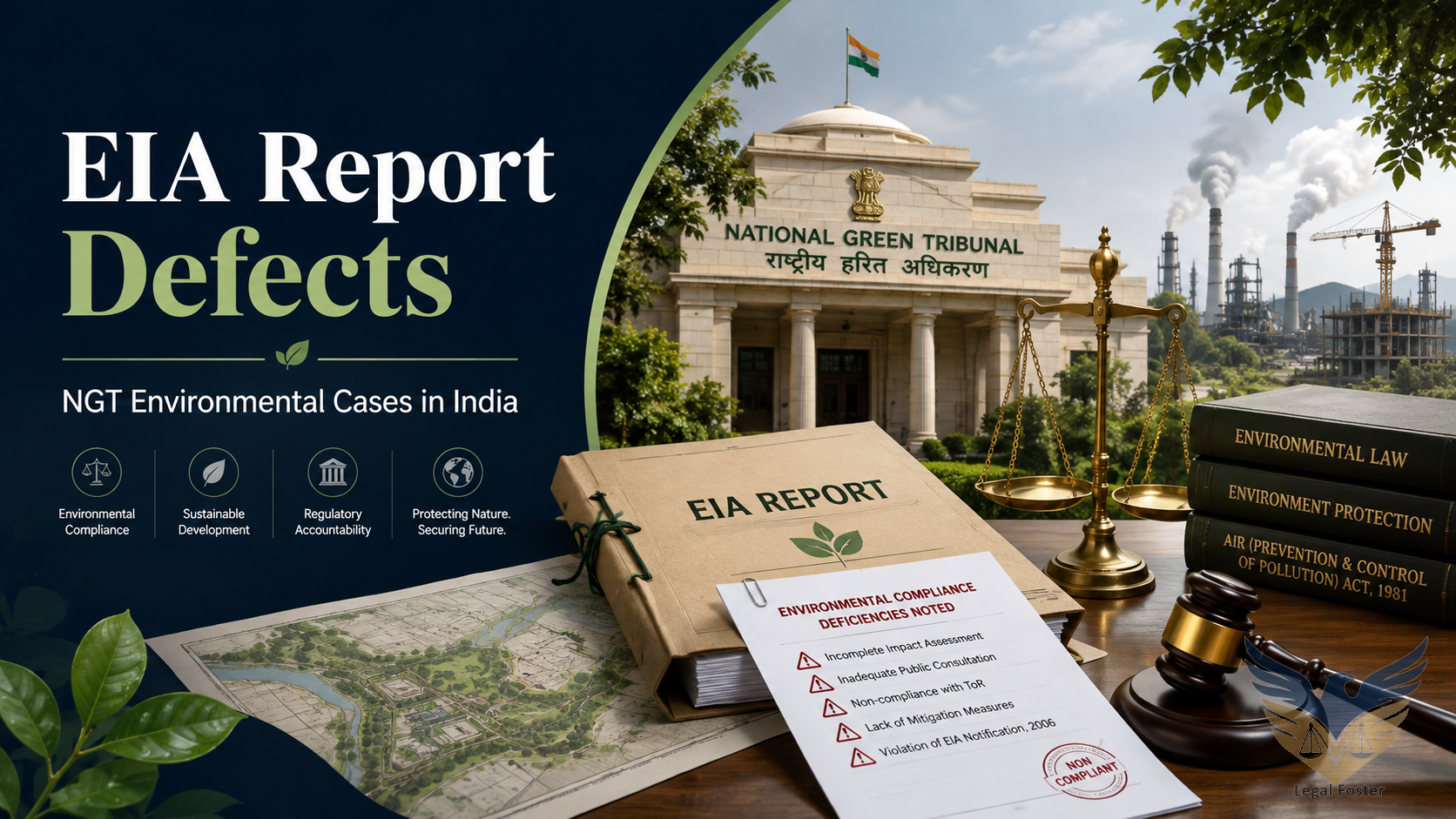
An inadequate EIA report could be described as any environmental impact assessment report which fails to consider, investigate or predict key impacts of a proposed development. It could refer to incorrect information about the proposed development itself, missing baseline information, overlooked ecological value, poor detailing of public consultation undertaken or an ineffective Environmental Management Plan.
Minor spelling errors or vague wording will not usually render a report inaccurate for legal purposes. However, the seriousness of an issue will usually depend on whether it compromised the overall prediction of environmental effects, concealed a foreseeable environmental risk or prevented members of the public or regulators from making fully informed judgements.
Problems also become more serious if the EIA report significantly under-predicts emissions or impacts associated with the development's size, amount of land required, water consumption, quantity of waste produced or amount of pollution it can create. An Environmental Impact Statement which fails to assess more than one part of a multi-component development will also produce an inadequate prediction of impacts.
Why Are Incorrect Project Details a Serious Defect?
Description of the project is where every environmental assessment begins. Any under-description of the scope of the proposed activity/process, production capacity, project land area, machinery & equipment to be installed, proposed/raw materials or support infrastructure like access roads etc., will make all ensuing calculations irrelevant or null.
Understating capacity factors may lead to lower anticipated levels of emissions to air and water, water drawal, vehicle movement and generation of solid waste. If certain supportive facilities like access roads, pipelines, crushers, storage yards or colonies for workers are left out of the description, their aggregate impacts to the surrounding area may not be considered.
Mismatch can also happen between what is stated in the EIA report and what is described on the application form/project feasibility report and project presentations made to the Expert Appraisal Committee (EAC)/State Expert Appraisal Committee (SEAC). Any of these scenarios can raise questions about what was truly evaluated in the EIA process.
For communities located close to a project site, the consequences are real. They could show up to a public hearing expecting 'x' amount of activity to take place in their backyard, only to have '2x' built instead. For the developer, being accused of a misdescription can bring into question whether its environmental clearance was approved based on erroneous analysis.
How Does Unreliable Baseline Data Weaken Environmental Assessment?
Baseline: what exists already within the natural and manmade environment. Ambient air quality, surface water quality, groundwater quality, soils, ambient noise, ecology and socioeconomic conditions can all be part of a baseline. Predictions start with assumed baseline conditions.
Ambient air sampling stations set up downwind of villages/residential colonies won’t pick up their exposure to pollution. Sampling during a season that doesn’t represent dusty days or flooding waters or local wind patterns could miss important parameters.
These errors cannot be fixed with fancy modelling software. You can put nice colors and contours on a dispersion model output but if your emission estimates are incorrect, if your meteorological data is wrong or if your ambient monitoring wasn't done properly then the entire model becomes suspect.
BK Singh Advocate has listened to scores of locals whose quality of life seems vastly different from the life described in the EIA. The NGT Lawyers see this as point of fact in contention as the judgment to give environmental clearance may have been influenced by this information.
What Happens When Cumulative Impacts Are Ignored?
“A project is very rarely, if ever, going to come up in an area that has no other uses on it,” advocate BK Singh explained. “It could be next to other industries, mines, roads, power plants, construction activities, dumping sites or built-up areas. Looking at just the incremental impact of that project on its own can obscure the cumulative pressure that the area is already under.”
The EIA of a power project might analyse emissions from one power station when there could be a hot mix operating next door. Similarly, demand for water from the project might look fine on paper even if there are numerous other projects taking water from the same aquifer or lake.
Examples of cumulative impact include developments around mines, industrial estates, congested urban corridors and riverfront projects. People who live along those stretches deal with cumulative dust, traffic, noise pollution and lowering of the water table – not the isolated impact of each individual project clearance document that has been studied in silos.
BK Singh points to fragmentation as one of the worst conflicts of interest. When multiple components of the same project are studied, or interconnected facilities, they are often treated as standalone developments. “The question for us as NGT Lawyers is were those agencies given a true representation of the pressure that project will place on the environment when they were clearing it?”
Why Does Incomplete Biodiversity Assessment Cause Legal Concern?
“Biodiversity is not something you can put in a checkbox or as a decorative chapter in an EIA report,” says the EIA expert. Habitat patches such as forests, wetlands, wildlife corridors, river corridors, nesting sites or even community conserves “can make or break the environmental viability of a project.” Often field visits are perfunctory, lasting a day or two.
“You may not see migratory animals or even seasonal aspects of ecological function.” Some EIAs rely heavily on published reports and may simply not document ground realities. Eco-sensitive distances from protected areas are often quoted wrongly or measured from an offset location convenient to the project boundary.
When this occurs, the impacts can be devastating on the ground, he explains. Road projects can cut off animal movement, mining projects can alter drainage lines, industries can eliminate flood-buffering wetlands or wetlands on which local communities depend.” Once the ground is broken and the ecology damaged, it is hard to put things right, he adds.
Can a Weak Public Hearing Affect the EIA Process?
Public hearing is intended to surface local concerns in front of the regulator. The stage can be sabotaged if, for instance, the EIA summary is not translated into the local language; if material facts are omitted or affected parties aren’t informed well in advance.
There can be a hearing, but without meaningful participation. It can be conducted at a place which is difficult for locals to access. The attendance register can be rigged. People’s concerns can be reduced to short paragraphs that don’t really capture what they said. Farmers can raise the issue of impacts on groundwater. Families can raise the issue of seasonal flooding.
Shopkeepers can raise the issue of heavy-vehicle traffic along a road. If these issues aren’t raised, or are responded to with stock answers, the final EIA—also called the appraisal report—may fail to disclose whether the risks of a project were properly scrutinised. Having people sign the minutes doesn’t make these problems disappear. Disclosure matters. How objections are raised and responded to also matters.
Advocate BK Singh, who has attended multiple hearings, tells me citizens are sometimes only informed about key details of a project after the hearing concludes. For those interested in the bigger procedural context, this summary of the EIA Notification and judgements related to it has been compiled by NGT Lawyers.
How Do Inadequate Risk and Disaster Studies Create Hidden Dangers?
Projects may pose risks that cannot be fully assessed using standard pollution indicators. Chemical storage; production of hazardous wastes; blasting operations; tailings dams; fuel storage and industrial operations can all create risks of catastrophic events for workers and those communities who live near project sites.
An incomplete EIA might be premised on best-case operating scenarios, with limited consideration given to equipment failure, fires, floods or leaks, transport accidents or human mistakes. Disaster response procedures may be unclear on details such as evacuation routes, vulnerable communities in surrounding areas or even the capacity of local communities to respond. Climate change can worsen these issues.
Sites considered safe in relation to historic flood records or rainfall patterns may find themselves at risk when the operation commences. Climate change can result in extreme heat, heavy rainfall, coastal flooding, water scarcity and more that can impact not only an operation's environmental footprint but its safety.
Why Is an Unrealistic Environmental Management Plan Problematic?
An Environmental Management Plan describes how predicted impacts will be managed. Commitments can be woolly and meaningless if they lack site detail, aren’t quantified or lack financial surety. Dust can be mitigated but where’s the water going to come from? You can commit to reuse wastewater but where will it go when it rains? A plan to plant a green belt sounds great but is there any land available to do this? Will the plant species even survive and who will ensure this happens?
Mitigation can be just as vague when it relies on future consent for something to happen, or infrastructure that is proposed but not built. If there is no waste treatment facility, sewer network or common effluent treatment plant then commitments to use that facility make the environmental impact assessment document pure speculation.
The disconnect between paper plans and reality on the ground can lead to many years of opposition. Locals may see effluent being pumped into adjacent fields or businesses crumbling because the street becomes a dust bowl on sunny days. Local businesses can be accused of non compliance with conditions they were required to agree at consent, but were impossible to meet.
Which Laws Make EIA Defects Relevant Before the NGT?
The Environment (Protection) Act, 1986 (EPA) is the umbrella statute under which EIA Notification, 2006 is made. The notification lays down project categorization, screening, scoping and public consultation/appraisal requirements for activities specified therein.
National Green Tribunal Act, 20l0 delegates powers to NGT to hear "any substantial question relating to the environment"(a) interpreted along with enactments specified in Schedule I to the NGT Act. Appeals of certain orders and decisions are incorporated under Section 16 and include certain orders relating to environmental clearances. Environmental disputes specially related to compensation, relief and restitution falls under the ambit of Section 14 and Section 15 within their respective legislature.
Violation under an EIA study can also have overlap under Water (Prevention and Control of Pollution) Act, 1974; Air (Prevention and Control of Pollution) Act, 1981; Forest (Conservation) Act, 1980 (also known as Van (Sanrakshan Evam Samvardhan) Adhiniyam, 1980) and corresponding rules regarding waste, hazardous material or coastal regulation zones etc. depending on the project.
Most importantly, the nature of the legal controversy in question. Contesting an environmental clearance is different than alleging that there are violations of the terms of the clearance knowingly allowed to continue. Forum (and corresponding limitation) and pleading differ in both cases.
Why Do EIA Defects Create Evidentiary Problems in NGT Proceedings?
Just because something is being reported as “false” doesn’t mean someone can prove what statement is false, what data was excluded, and how that one defect may have compromised the entire environmental review. You can have hundreds of scientific studies, lab notebooks, satellite photos, maps, government oversight documents and expert witnesses at trial.
Environmental experts will have a harder time squabbling over technical issues when data is withheld from them. Original monitoring sheets, instrument calibration information or sample logs may never see the light of day and the worried public will only be able to scrutinize finalized tables.
Then there’s the question of causation. Your neighbor may have asthma. Your neighbor may have lost crops or experienced vanishing groundwater. But showing that harm was definitively caused by one deficiency or activity related to the permitted project may take hours of expert testimony. By then, there could be numerous sources of pollution for every operator to blame on each other.
EPA officials have career wrinkles to lose as well. Contractors and consultants may not have worked on that particular section of the EIA, but false information can implicate the entire permit and project.
Permit advocate BK Singh says internal inconsistencies can make an entire document look shaky, even if the data is scientific. “At NGT Lawyers we have handled environmental cases that hinge on whether the official report matches up to what’s actually going on outside or what third party data is showing.”
How Can Defective EIA Reports Affect Communities and Businesses?
Hazards faced by local residents can range from contaminated air to water deprivation to noise impacts to ruined crops to more truck traffic to fear of long-term health risks. Economically, they can lose their property values and their way to make a living too – particularly near beaches or farm fields or residential areas.
Project owners aren’t always sure they’ll obtain their environmental approval. They might face delays in construction, or concern from lenders. Their reputation could suffer. They may face increased scrutiny from regulators down the road. Contractors, buyers, employees and suppliers can even be affected by a bad study – even if they had nothing to do with the study itself.
Government agencies aren’t immune from consequence either. If significant errors weren’t discovered during the review process, the entire regulatory system can be called into question. If allegations surface that consultants plagiarized information or used boilerplate text, it can reflect poorly on the entire review.
When an EIA is done poorly, everyone loses. Rather than pitting developers against locals or “jobs” against “environmentalists,” bad EIAs open up too many stakeholders to criticism. “Eventually when the project is allowed to proceed with construction and investment on a flawed environment record,” states BK Singh Advocate, “the social and commercial consequences become significant.”
Why Do Delays Make EIA Disputes More Complicated?
Environmental clearance documents are ideally challenged on four dates: the date of publication of the clearance itself, the date of knowledge of the result, the commencement of work and the date of continuing environmental violation. Time can affect the character and facts of the dispute.
A plaintiff may be unaware that a clearance and EIA report was issued and is now on public record. The digging of borewells, or dust or cutting of trees may not become apparent until construction begins. By that time the proponent may argue that work has started and investments made in expectation of the clearance.
Similarly, blatant violations at the site five years down the line will not necessarily address whether the EIA was adequately conducted in the first place. Environmental lawyer BK Singh points out this problem of delays/timing implicates many environmental conflicts.
Actual damage to citizens may not become evident until years after the industrial/environmental approvals that allowed the activity happened. NGT Lawyers therefore believes that timing is a crucial factor in the dispute. Though this article will not address aspects of procedural law.
Frequently Asked Questions
1. Can carbon copying lead to defect in an EIA report?
Yes. If information is copied from another document, especially one that refers to another site, ecology or project, it raises questions on the credibility of the report. However, from a legal standpoint, it would also depend on whether what was copied dealt with a material element of the environmental assessment.
2. Can old Environmental Information be acceptable?
Yes. If the old information was representative of the current conditions and met the regulations at the time of application. Changes in land use, contamination, population or weather could make old records deceptive.
3. Can inaccurate coordinates harm an NGT plea?
Yes. If coordinates show that the positions of proposed monitoring devices, project extents, distance calculations or environmental assessment are incorrect.
4. Does an inadequate public hearing make an EC invalid?
No, if the defect was immaterial. The materiality of any deficiency during the public hearing is determined by whether it failed to provide concerned local populations with a substantial chance to be heard or failed to provide important information about the project.
5. Does EIA Consultant’s mistake matter to the developer?
Yes. If the deficiency is material to the reliability of the environmental assessment and the clearance was granted based on such report, the fault could still be imputed to the owner.
6. Why is groundwater information often challenged?
Groundwater levels vary by season and location. Incorrect sampling, inaccurate abstraction numbers or failure to consider existing or neighbouring wells when calculating groundwater availability can mask the stress on local aquifers.
7.Why should ancillary industrial projects have been considered?
If they were not mentioned nor evaluated for their impact, it could result in a cumulative impact assessment that was not taken into consideration. That becomes a problem if air pollution, water availability, traffic or solid waste management were already strained in that region.
8. Are arguments over satellite images prevalent in EIA issues?
Contentions regarding satellite images are common. They can demonstrate deforestation, changes in land-use, water bodies, mining activity or project progress. But they have to be authentic and correlated to the concern raised.
9. Can every defect in an EIA report/result in project cancellation?
Violations that are noticed during the implementation of the proposal could lead to suspension or cancellation of environmental clearances. Whether an infraction in the EIA is enough to stop the project depends on the seriousness of the infraction, evidence presented, stage of completion, regulations that apply, and so forth. Ultimately it is for the NGT to accept or deny the proposal – the general public cannot do that by themselves.
10. What are the challenges with EIA related Legal Cases?
Environmental clearance appeals require one to have knowledge about the environment, reviewed permission files, be aware of environmental legislation, expertise reports and facts specific to the local region. One loophole can bring up several agencies and datasets.
Final Thoughts
Ground realities don’t reveal problems until environmental damage is done. Projects amp;Erroneous project details; incorrect baseline data, sham public consultations, ignored cumulative impacts and impractical offset commitments can lead to bad EIA approval decisions.
BK Singh and his team of NGT Lawyers approach EIA issues as paper-intensive environmental disputes where science, legitimacy and ground realities should be balanced. Documents Rule, dates matter, jurisdiction is key and every NGT case has its own facts; no case is guaranteed.