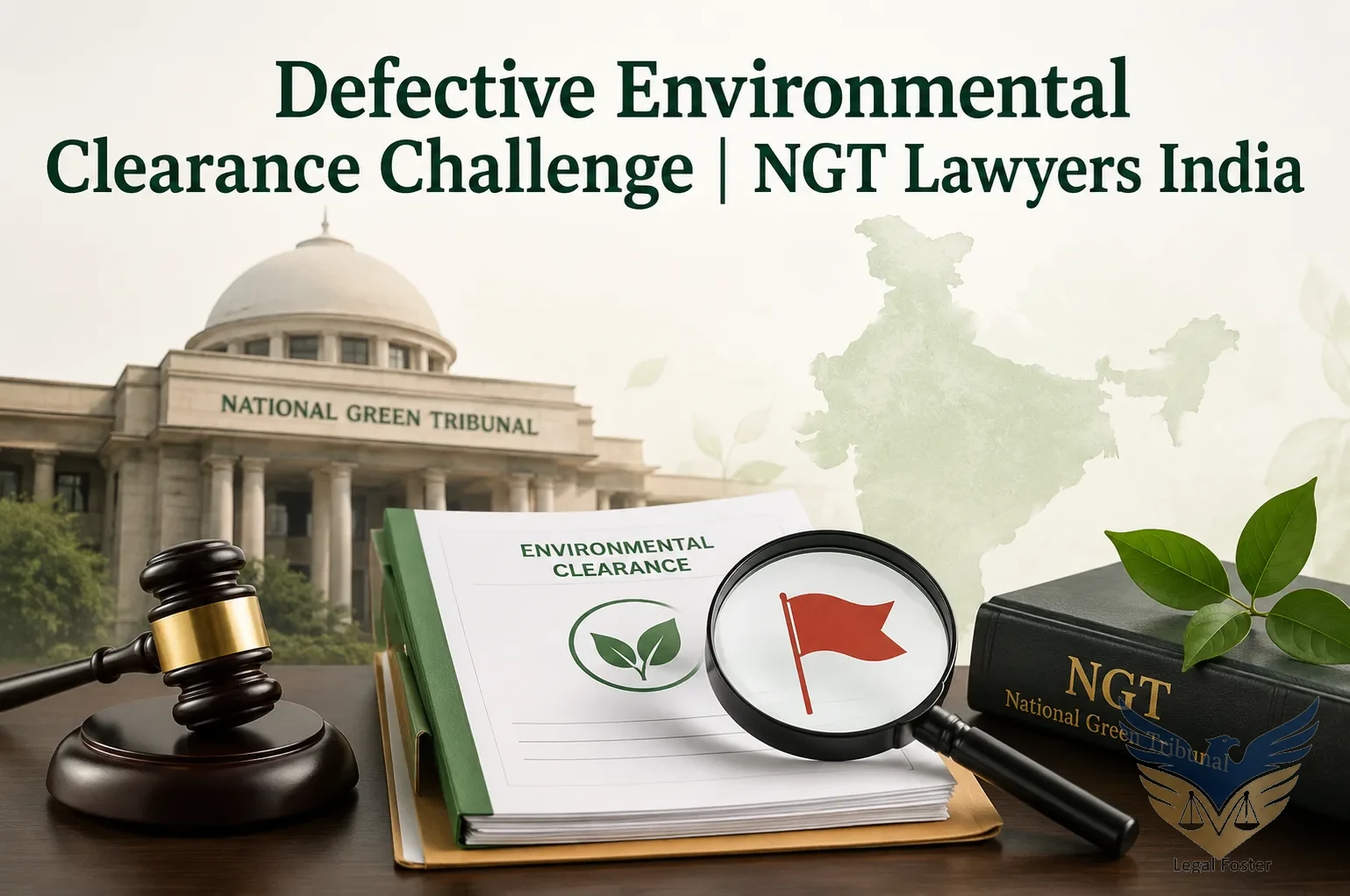
How Can You Challenge a Project Approval Based on Defective Environmental Clearance?
A letter of project approval can seem legitimate and may still be based on a flawed environmental clearance. Neighbours may realise something is amiss only when trenches are dug, trees are cut down, the water table drops, or construction traffic uses residential streets.
But dust and noise matter to people. Nighttime hours are disrupted for families, farmers, shopkeepers, and housing societies. Silt fills local drains. Farm productivity may be affected. Businesses may struggle if access remains obstructed. At this point, the project promoter can show the approval letter and state that all conditions have been met.
An invalid environmental clearance may be based on inaccurate project details, an incomplete study of potential environmental impacts, hidden ecological attributes, an ineffective public hearing process, wrong project classification, or non-substantive conditions that don’t adequately consider risks posed by the project. In many cases, the area approved for development and the development seen on the ground differ substantially.
By law, specifically the Environment (Protection) Act, 1986 and the EIA Notification, 2006, most projects on a designated list are required to obtain prior environmental clearance from the respective authority. The Ministry of Environment, Forest and Climate Change or State Environment Impact Assessment Authority (SEIAA), depending on the category of project, will make the decision.
Why Does a Defective Environmental Clearance Matter in India in 2026?
Infrastructure projects, as well as mining, industrial, township, waste- management and other large-scale construction projects can impact whole communities. This issue is of particular importance in Delhi NCR, Noida, Greater Noida, Gurugram, Faridabad, Ghaziabad and other areas where development has caused groundwater stress, air pollution and waste-management failures.
Equivalent issues prevail across mining belts in Rajasthan, Maharashtra and Karnataka; industrial corridors near Ahmedabad, Pune, Hyderabad and Chennai; river-adjacent and river-sensitive projects around Uttar Pradesh, West Bengal and other states.
The clearance may be defective and allow damage to the environment to start before those affected know what has been sanctioned. Once large areas have been cleared for construction, or years of operation have elapsed, it may become more difficult to quantify environmental damage or hold companies accountable. Commercial interests can also become entrenched: flats can be sold, contracts tendered, workers hired and public funds allocated.
Quick Facts
- Environmental clearance and local bodies/developmental permission/work/order are two separate approvals which are required by law.
- Projects which do not fulfil the prescribed criteria under the relevant EIA notification will not require prior EC.
- The appraisal of Category A projects is usually done at the central level whereas Category B projects are usually appraised at the state level.
- Projects receive the clearances in the following stages – Screening, Scoping, Public consultation and Appraisal (if these stages are applicable as per the category of project).
- A poor EIA study will taint the appraisal process and can be legally challenged.
- Appeals challenging certain environment clearance decisions are covered under Section 16 of the National Green Tribunal Act, 2010.
- Lengthy delays can bar you from getting your case heard on its merits, even if you have a valid environmental concern.
What Makes a Project’s Environmental Clearance Defective?
“A defective EC” means environmental clearance granted with material legal, factual or procedural error. Ideally, the defect should pertain to environmental considerations and not just opposition to the project per se.
A typographical mistake may not necessarily “vitiate” the approval. However, a misrepresented fact about forest land, water requirement, project site, solid waste generation or proximity to habitation can be egregious because such inaccuracies could have affected the evaluation of environmental impact.
When examining illegal constructions and allegations related to environmental clearance, it is also important to understand the difference between unauthorized construction and defective EC. Sometimes a project may have clearance from the municipal corporation but may lack the required EC. Sometimes it may have EC but may have deviated from the conditions of the approved building plan. Non compliance with one condition is not excuse for non-compliance with another.
Areas commonly associated with objections include:
- Misrepresentation of project site, capacity or investment;
- “Break-up” of a single large project into smaller ones;
- Denial of the existence of wetlands, water bodies, forests, etc. ;
- Baseline environmental parameters which are not site or season specific;
- Discrepancies between the proposal, EIA study and approved project layout;
- Failure to consider cumulative impacts;
- Expressions of public consent when bona fide objections were raised;
- Conditions of approval which are standardised and do not mitigate site-specific risks;
- Commencement of construction prior to receipt of first EC;
- Operating at a capacity greater than what was evaluated or approved.
However, lawyer BK Singh asks whether the purported defect could have realistically impacted the decision making process. A complaint becomes trivial if it does not relate the objectionable information to how the environmental decision was made.
Why Can a Defective EIA Report Undermine Project Approval?
An EIA is supposed to enable the authority to anticipate and understand potential environmental impacts before issuing approval. When its data is false or incomplete, the appraisal committee might clear a project “on paper,” rather than the project that will actually function on site.
Water use, traffic generation, solid waste generation, air emissions or tree cutting may be understated in an EIA. Nearby schools, villages, farms, colonies or streams may be omitted. Stormwater drains and seasonal streams may be absent from maps that don’t show them, even though they’re apparent during the monsoon season.
Materiality is usually what questions hinge on when it comes to defects in an EIA report in NGT cases. Just because there’s an error doesn’t mean EC is automatically invalid. It matters what was misstated, whether the appraisal committee was made aware of the facts and whether the error diluted environmental protection.
Most of the technical information is compiled by consultants, but the project proponent is directly linked to what’s presented before the authority. Contradictions between maps, applications, minutes and site realities are therefore treated as key evidentiary matters by Advocate BK Singh.
Was the Public Consultation Meaningful or Merely Formal?
Public consultation aims to surface local environmental knowledge that should be included in the appraisal record, if the EIA Notification demands it. Communities living with a proposed project know about seasonal flooding, drinking-water scarcity, livestock pathways and existing pollution sources that might not be revealed during short site visits. Did the hearing cover these topics?
The hearing might seem complete if full attendance sheets and minutes can be produced. The deeper questions are whether affected communities were given sufficient information about the hearing, whether material objections are faithfully captured in the minutes, and whether the final appraisal included consideration of those objections.
Distance, language and access barriers also skew who can participate. Often a village will be provided technical documents that no ordinary resident can understand. People living right next to a project site may not find out about the hearing until it's over.
Which Indian Laws Govern the Dispute?
The Environment (Protection) Act, 1986 (“EPA”) is the umbrella legislation dealing with environmental concerns. The EIA Notification, 2006 sets out the procedure for prior clearance for projects specified in its Schedule (see subject to specified categories, threshold modifications and amendments since).
The National Green Tribunal Act, 20 10 (“NGT Act”) delineates the jurisdiction of the Tribunal. Appeals from certain orders and decisions are entertained under Section 16 (including in respect of certain environmental clearances). A strict limitation period applies to such appeals. They must generally be filed within 30 days of the order being communicated, and only up to a further 60 days in cases where sufficient cause is demonstrated for the delay.
Civil suits in respect of a substantial question relating to the environment arising out of enactments specified in Schedule I are covered by Section 14. Limitation is triggered in a different manner from a Section 16 appeal. These jurisdictions are sometimes conflated, thereby raising a bar before the substantive issue is even assessed.
While Section 18 of the NGT Act casts the net of ‘standing’ widely, an individual or organization making an application to the Tribunal will need to prove that a genuine environmental harm, supported by facts, has occurred. The mere mention of the words “pollution” or “environment” in a plea against an environmental clearance will not transform it into a matter fit for adjudication by the NGT.
Why Is Limitation a Major Problem in EC Challenges?
Environmental clearance controversies are often time-sensitive. Complaints may not be initiated until after some actual construction work has started. But the clearance might have been granted – and published in the public domain – several months prior to breaking ground.
Weeks, sometimes years, of delay can be fatal. A Section 16 appeal cannot normally be maintained ad-infinitum simply because the petitioner became aware of the project at a late date. Queries may be raised as to when the decision was served, how and when it was published and when interested parties could reasonably have been expected to know about it.
Subsequent pollution will not necessarily restart the clock for appeals directly challenging the EC granted. An application complaining of subsequent non-compliance could well be seen as having a different juridical nature from an appeal challenging the very grant of EC.
BK Singh is familiar with meritorious factual grievances losing steam due to ambiguous timelines. An inability to produce a publication history, an outdated screenshot or unclear gap in correspondence can distract from environmental damage and towards issues with maintainability.
Which Documents Reveal the Real Problem?
Documents make or break environmental cases. Memories fade, and verbal allegations or statements seldom prove what the decision-making authority knew or relied upon when giving environmental clearance to a project.
Key documents may include the following:
- Environmental clearance letter with conditions annexed;
- Project application – Form 1 or other;
- Pre-feasibility study report & EIA/EMP report;
- Terms of Reference and responses to compliance obligations;
- Notice of public-hearing, attendance sheet and transcript of proceedings;
- Minutes of the Expert Appraisal Committee or State Environmental Advisory Council meetings;
- Site-plan, cadastral-map, drainage-map and land-use master plan;
- Forest records, wildlife records, Coastal Regulation Zone (CRZ) records or groundwater studies;
- Consent to Establish (CTE) & Consent to Operate (CTO);
- Subsequent approvals or modified project report (same project should match);
- Time-stamped photographs, videos and satellite images Google Earth;
- Sample analysis report of water, air, soil or noise-level monitoring;
- Complaints filed with public agencies and their response letters;
- Brochure of property sale or investor disclosure documents contradicting EC record.
BK Singh Advocate had this warning about using every screenshot/photo from the internet as evidence.
“Date, location, origin & continuity of digital information can be challenged.”
How Does the Defect Affect Residents, Buyers and Businesses?
The impact differs by project. A housing development may increase groundwater extraction and sewage load. A mine may affect agricultural land, village roads and surface-water flow. Industrial expansion can add emissions to an area already carrying serious pollution.
Homebuyers face a separate fear. If approval becomes disputed after they have paid instalments, they may be caught between environmental compliance, construction delay and financial liability. Local businesses may lose customers because of blocked roads or persistent dust, yet struggle to connect that loss with a specific approval defect.
Project proponents face reputational and financial consequences as well. Allegations of concealed data can affect financing, contracts and future approvals even before a final legal finding.
Advocate BK Singh assesses these competing interests without assuming that every project is unlawful or every objection is motivated. Environmental adjudication depends on evidence and statutory compliance.
When Does the Problem Require Legal Review?
Grounds for legal scrutiny can be mismatch between records and site activity, evidence that work commenced prior to the cut-off date for clearing as specified in permit, permit size seems artificially small to accommodate existing operations, no record of public protests during appraisals.
There may be reason to question whether environmental clearance was violated if an individual project is listed under several different names or phases as if they are different projects entirely; if distinctly separate clearances were given for two components of the same development; if wetlands or villages adjacent to the proposed site aren ’tdisplayed on the location map.
One who seeks to challenge an environmental clearance violation in the NGT should know that an illegally granted clearance and subsequent violation of conditions on a legitimate clearance are two different complaints. Different facts are at issue different timelines may be involved and the NGT may raise jurisdictional issues. As BK Singh Advocate ’sees it at this point, the job is to recognize what kind of legal issue is at hand. Doing so doesn’t ensure that an approval will be stalled,rejected or amended.
How Can NGT Lawyers Assess a Defective Project Approval?
Environmental issues like EC records, failing EIA, public-consultation issues, pollution clearances and project violations are topics addressed by NGT Lawyers website.
Advocate BK Singh measures the official record of approval against the project area and environmental damage claimed by the complainant. You may discover either a material flaw, a compliance issue with the conditions, a planning issue unrelated to the environment or a claim that is not supported reasonably.
If your infrastructure project receives public opposition, the objections could stand scrutiny under the environmental law for infrastructure. Important, because NGT authority is not the solution to every municipal, title, contract or land-acquisition issue.
BK Singh Advocate presents a balanced analysis of the information that is public. Ultimate remedies will always depend on the law, facts, limitation and findings of the court with jurisdiction.
Frequently Asked Questions
1. Can EC be challenged after project has been approved ?
Yes. To a certain extent, but the law, forum and limitation will depend upon the decision and defect in question. Disliking the project is not enough ground to challenge.
2. Is an erroneous EIA sufficient to cancel EC?
No. There needs to be generally a material error regarding impact, consultation, appraisal process or conditions of environment protection.
3. Can objections be made by people living nearby?
Affected citizens, RWA’s and other interested persons could have locus standi to challenge, depending on the NGT Act and their actual involvement in environmental damage caused.
4. Is municipal permission same as environmental clearance?
No. Permission to build/develop is not a substitute for obtaining necessary environmental clearance.
5. Does Consent to Establish mean EC is valid?
No. CTE certificate and environmental clearance are separate legal processes though information may be shared between them.
6. Can clearance be challenged on the grounds that no PH was conducted?
Yes. Wherever applicable, but only if the project category demanded public hearing and exemption was not granted or incorrectly applied.
7. What if area under project is more than stated under EC records?
Impact of environment damage could be questioned on grounds of misreporting, misclassification, appraisal and alignment to guidelines during grant of EC. BK Singh Advocate will review entire approval file to deduce a conclusion.
8. Can violations in construction phase invalidate EC granted ?
If there are violations during construction/construction permission stage, it would only point towards non-compliance but would not in itself indicate EC was wrongly granted. BK Singh Advocate takes such issues independent of EC validity.
9. If pollution is continuing, does that not create question of limitation?
Delayed pollution damage may not affect challenge of EC granted at beginning of project. Filing an appeal against grant of EC and filing a case for continuing pollution damage can be treated separately.
10. Can NGT order cancellation of all approvals for project?
No. NGT can adjudicate only on matters which are environmental disputes as per law listed under NGT Act. BK Singh Advocate will determine if decision challenged is within the powers of NGT.
Final Thoughts
Having an environmentally flawed clearance hangs like the Sword of Damocles over citizens, homebuyers, farmers and businesses exposing them to liabilities that may not have been considered or even analysed properly. However rushing in with slogans, visuals of destruction or accusations is not how serious cases should be treated.
Were material facts hidden from the regulator? Was the impact study flawed? Was the mandatory stakeholder consultation carried out? Did the regulator independently assess the risk? Statutes of Limitation and Limitations of Jurisdiction may impact if these questions ever get answered.
BK Singh Advocate & The NGT Lawyers team analyse such cases based on the clearance file, legal structure and objective ground reality. We cannot guarantee any specific result as each case is judged on its individual record and procedural history.
Author Bio
Advocate BK Singh deals with environment and NGT cases relating to environmental clearances, EIA reports, industrial pollution, construction activity & compliances with applicable environmental regulations. He analyses project files, appraisal notes, records of public-consultations held and the site inspections reports to determine if the complaint you file is eligible enough to create a 'significant environmental issue'. Advocate BK Singh, assists people, businesses, project owners and other stakeholders spread throughout India through NGT Lawyers. Each case is reviewed based on its own merits ie facts of the case, applicable laws, evidence available and the limitation period involved. No specific outcome or relief can be promised.