How Can You Respond to an SPCB Closure Notice Without Weakening Your Case?
An SPCB closure order is unexpected news for any running factory, hotel, infrastructure, warehouse, hospital, manufacturing unit or commercial establishment. Managers are suddenly faced with responding to shutting down threats, cutoff of electrical / water services, panicked employees and vendors, and looming financial losses.
Too often, businesses respond by rushing an email to the State Pollution Control Board. That could be dangerous.
A Response composed without understanding the specifics of the inspection, conditions of consent, laboratory results and exact regulations may inadvertently admit violations or create contradictions that can’t be explained later.
For that reason, if your business receives an SPCB order for closure it should treat the order as both a compliance matter and a legal risk matter.
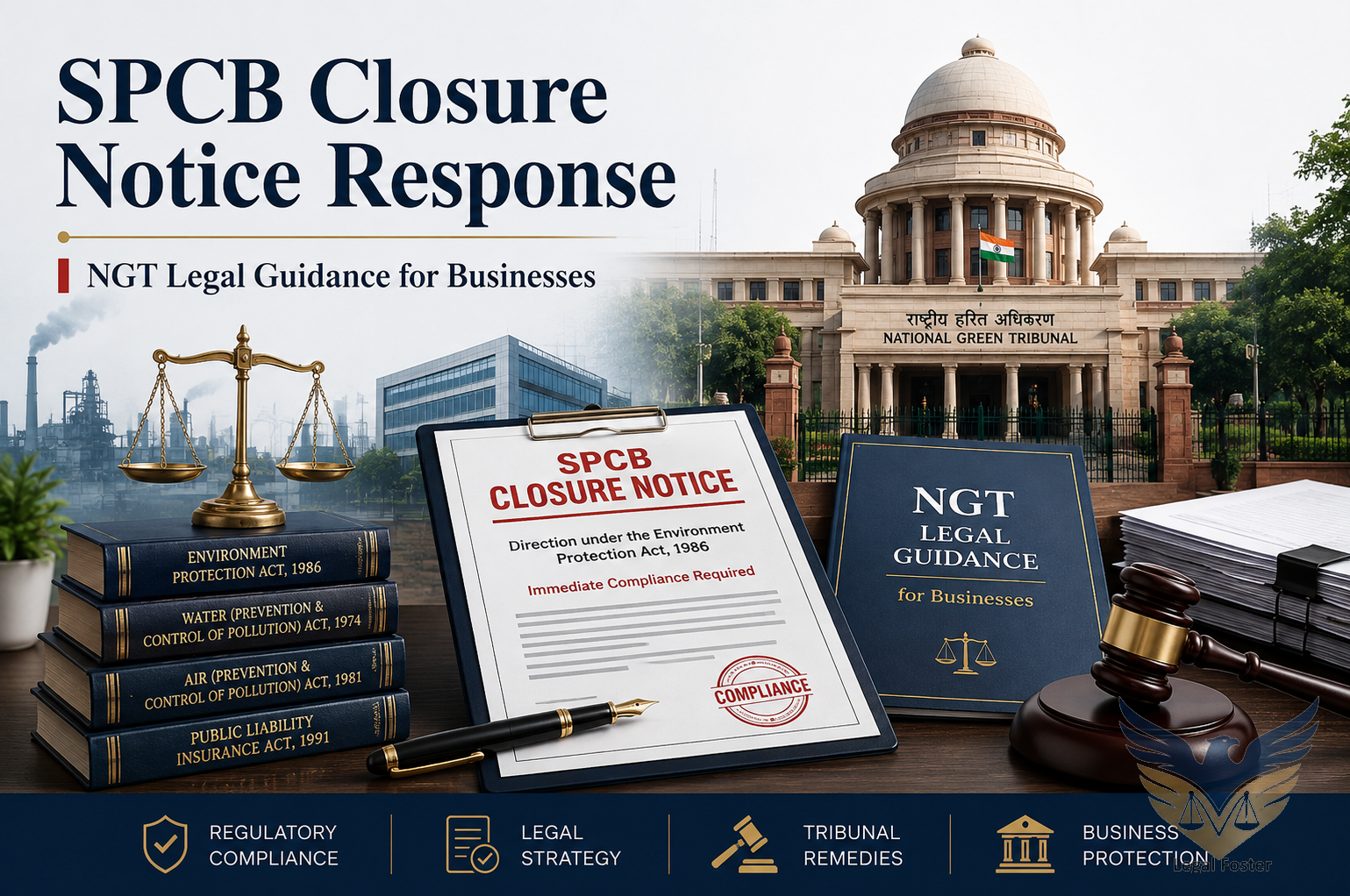
Under Water (Prevention and Control of Pollution) Act, 1974 Section 33A Boards are authorized to issue written orders containing directions to “close down, prohibit or regulate any industry”. The order may also require “stoppage or regulation of supply of electricity, water or other services to the industry”. Air (Prevention and Control of Pollution) Act, 1981 Section 31A similarly authorizes Boards to issue orders “which may require the closure of any industry and the stoppage or regulation of the supply of electricity, water or other services to that industry.”
Translation: Your business should not respond with a canned compliance letter.
NGT Lawyers’ environmental lawyers are led by Advocate BK Singh who will review the closure order, pertinent records and your facility’s regulatory history before your business risks waiving any legal rights by taking a position.
Why Can an SPCB Closure Direction Become a Serious Business ?
Closure Directions are not standard forms letters sent out by a regulator. Depending on the circumstances of the order, closure directions may affect manufacturing operations, production schedules, power sources, water sources, environmental permits and even the future of the business. For example, under the Water Act, a Board may issue Section 33A directions which can include directions to cease operations and stop or regulate supplies of water necessary for the support of life.
If you have a plant in Delhi NCR, Noida, Greater Noida, Ghaziabad, Gurugram, Faridabad, Mumbai, Pune, Bengaluru, Hyderabad, Ahmedabad, Chennai or at any other industrial city in India you understand how quickly a short period of closure can turn into commercial consequences that dwarf the underlying environmental issue in question. Customers may wish to terminate orders. Employees will be concerned. Banks and investors will want answers. Contracts may be on the line. Counsel who understand how to guide you through the technical analysis of NGT compliance can help management decide which allegations require an immediate factual response and which issues require further technical and legal analysis.
What Should You Know Immediately After Receiving an SPCB Closure Direction?
SPCB Closure Direction is not a normal Office letter.
The Act & section quoted in the order itself will point towards different course of legal remedy.
Whereas Section 33A of Water Act deals with closure and regulation of utilities; Section 31A of Air Act also authorises the Boards to issue directions in writing (including direction for closure).
Direction for closure issued under Section 33A of Water Act is covered under appellate jurisdiction of NGT in Section 16(c) of National Green Tribunal Act, 20 10 .
Reports of inspection, conditions of consent & proof of compliance would be very vital in assessing the subject dispute.
Unintentionally trapping yourself into admission or misstating facts can work against the position of the company at a later stage.
Scrutiny by NGT Lawyers before taking a call on responding would also help you assess if the closure direction is pertaining to violation of consent conditions / terms related to emission/ effluent/ waste management/environmental compensation / any or all of the alleged defaults.
Why Should You Avoid Sending a Casual Reply to the Pollution Control Board?
A closure direction is likely to contain technical observations along with legal conclusions.
There can be references to an ETP or STP, emission- control devices, stack testing, hazardous waste storage, consent terms, effluent limits or operating logs.
Management will likely need to agree with some of the observations and dispute others.
The difficulty is that an off -the- cuff response stating that " deficiencies have been rectified" can come back to haunt you if laboratory results, photographs or operating logs do not completely substantiate your statement.
Equally typical is the opposite error where you deny everything and then fail to substantiate records.
BK Singh can help you point out inconsistencies between the closure order, previous show cause notices, inspection remarks and your own records before you officially commit to a position.
Requesting to see documents first is another reason to consult NGT Lawyers before responding.
Who Should Take an SPCB Closure Notice Especially Seriously?
If your business is tied to an environmental consent/pollution-control permit of some kind, don't ignore a closure notice.
Some common types are:
- Factories and processing facilities
- Hotels and larger retailers
- Building/ construction operations
- Pharma/chemical manufacturing plants
- Hospitals/clinics
- Warehouses/distribution facilities
- Food-processing operations
- Dyeing/ textile manufacturing industries
- Real-estate / townships
- Waste processing/ recycling companies etc.
This can be critical for MSMEs as even a temporary closure can affect cash flow/ customer commitments.
For larger businesses, this can affect what you need to report to the Board/ lenders/ investors/ contract obligations/ your reputation etc.
Get NGT Lawyers involved at the outset so your business can understand these risks before taking an irreversible position in your response to the SPCB.
Which Documents Should Be Reviewed Before Any Important Reply?
Expect business to retain their full environmental compliance history even after receiving a closure order.
Typically this includes:
- The SPCB closure order itself and any prior show cause notices issued by the SPCB.
- COE and COf application and supporting documents
- Inspection reports, inspection photographs
- Lab reports, monitoring reports
- ETP, STP and other pollution-control equipment operating records
- Hazardous waste or other waste management documentation
- Prior correspondence with the Board
- Submitted compliance reports
- Any environmental clearances granted and conditions issued, if applicable.
- Correspondence from disconnection of electricity or water bills.
- Internal compliance reports and any third party technical consultant reports.
- Documentary evidence of any corrective action taken.
If a history of compliance is incomplete, your legal analysis will be as well. For this reason, NGT Lawyers will usually ask to review the timeline and corresponding documents, rather than accept a photocopy of the closure order.
When Should You Consult an SPCB Closure Direction Lawyer?
Stage for seeking Professional opinion :-
- Closure notice has been issued.
- Supply of power/ water is cut off.
- Unit has filed objections to observations/comments in inspection report.
- A grant of Environmental compensation is proposed.
- Repeat offences are being alleged by the Board.
- Reply to show cause notice has been disapproved.
- Units production/ business is immediately endangered.
- Management is unsure whether the matter should be referred to appellate authority/ NGT / some other forum.
- Invoking various environmental legislation is taking place.
- Technical experts and management have different views on what reply should be filed.
Advocate BK Singh can go through the agency file at any of the above stages and advise the house holder as to what legal course can be adopted. Results cannot be guaranteed buthelp can be provided.
Why Consider Advocate BK Singh and NGT Lawyers for an SPCB Closure Matter?
Environmental closure issues often involve both technical, legal and commercial issues.
The technical view may be oblivious to legal consequences of admissions. The legal reply may founder on its face if it doesn't conform to reality on the ground.
NGT Lawyers is a firm specializing in environmental law, including National Green Tribunal matters. Examples include PCB notices, closure notices, Air Act/Water Act issues, environmental compensation, environmental compliance, etc.
BK Singh can analyze the order, statute, documentary evidence and possible legal approach for clients.
The objective isn't to draft a canned letter response. Get assistance in figuring out what can safely be admitted, what must be said and supported with evidence and what problems need to be addressed immediately.
Businesses that need help with environmental-law issues can turn to NGT Lawyers.
Frequently Asked Questions
1. Should I speak to a Lawyer as soon as I get an SPCB Closure Notice?
Notice of Closing down directions affect your business, power lines and approvals from other agencies. Responding to the board in person can lead to accidental disclosures, unsupported claims or contradictory statements. Advocate BK Singh can review the closure notice so your business understands the notice, Board’s inspection observations and previous compliance history without prejudicing your rights in the response.
2. Has the SPCB the authority to issue Closure of Factory/Plant?
Yes. The Pollution Control Boards are empowered to order closure of your factory or Plant under various environmental laws if certain conditions are met. SPCB Closure orders can also direct disconnection of electricity or water. The validity of SPCB Closure Order depends on the provision relied upon, observations made during inspection, your previous compliance history and records maintained by the board.
3. Can you challenge SPCB Closure Notice before NGT?
NGT hears appeals in selected cases against SPCB Closure directions. The forum to file appeals depends on the provision of the environmental laws under which the show-cause notice was served. Directions served under Section 33A of Water Act are potentially appealable to NGT’s appellate authority. Attorney at NGT Law Offices can review the SPCB Closure Order to determine the appropriate forum.
4. Should Business Inform SPCB That All Violations are Corrected?
Yes. Your business can inform the SPCB that all violations are corrected if you have factual proof to back the statement. Some documents used as proof of_ pollution control compliance are photographs, monitoring data, laboratory analysis, invoices and operation manuals. Vague statements can lead to future complications. Verify that any statement you provide to the SPCB has documentary backup.
5. Why Preparation of Technical Documents are Crucial when SPCB Issues Closure Notice?
Closure directions are issued based on preliminary inspection by board followed by subsequent observations. Technical records can prove that you were in compliance with the terms of your consent when the inspection was carried out. Inspections records by SPCB cover emissions, effluent treatment plant performance, waste management practices and consent conditions. Lawyers at NGT Law Offices will correlate technical records with SPCB inspection report to identify: inconsistencies, violations which have been rectified and observations with no factual basis.
6. What if notice from SPCB also directs Disconnection of Electricity / Water Supply?
Closure notices which also directs disconnection of electricity or water needs to be addressed immediately. Without power or water, your business activities will come to a stop. Copies of the Closure direction issued by SPCB and notice received from electricity or water board should be reviewed. Consulting a lawyer sooner would enable your business understand the legal provisions under which action was initiated, stage of enforcement and all available options.
7. Can we use the fact that we have corrected all Violations after Board visited our premises as a Defense?
Yes. Corrections and improvements made after Board’s inspection can be used in your defense. Proof of repair, improvement in pollution control measures and changes to waste management methods may help your business. Advocate BK Singh can review whether measures taken by your company after inspections are sufficient to address issues mentioned in Closure Order.
8. Is it wise for the Company to wait till the Property is Ordered to be Closed to Engage an Environmental Lawyer?
Last-minute decisions can reduce your response options and affect commercial operation of your business. You should speak to a lawyer as soon as you learn about the SPCB’s action. Taking legal advice early would enable you understand what the SPCB is concerned about, help preserve all supporting documents and ensure that consistent statements are made on behalf of your company. You can consult an lawyer even at the stage of receiving a show-cause or closure-notice to understand potential implications of the order.
9. Can you Help Us if my Factory/Plant is based in State other than Delhi-NCR?
Yes. Advocate BK Singh helps clients located outside Delhi NCR with their SPCB notices, Closure Orders from State Pollution Control Boards and matters involving NGT. Right forum and strategy would be decided based on the State Pollution Control Board issuing the order, provisions of law invoked, jurisdictional authority, changes made by the company and facts of each situation.
10. Is it better for Businesses to get a Customized Legal Advice instead of Ready- Made response to SPCB Notice?
Prefabricated replies to show-cause notice may not take into account all legal and technical issues. Environmental laws invoked, observations during inspection, terms of your permit and evidence of compliance are some details that require thorough analysis. Environmental Lawyers at NGT Law Offices would ensure that you and your business reviews all the evidence before you send in a response or decide to move court.
Conclusion
You should never receive an SPCB closure direction and feel compelled to respond because "management wants something sent today".
Instead you should know and understand the legal basis for/, thoroughly review any allegations as compared to the actual inspection & compliance history and ensure each material allegation can be defended.
Additionally, if the order affects operations,utility/connectivity to the facility or ability to continue business, waiting too long can have serious commercial consequences as well.
NGT Lawyers - Advocate BK Singh can assist your business in reviewing SPCB closure orders, environmental notices and other NGT orders so that an innocent mistake does not cost you leverage.