Find Lawyers to Assist with Notarisation Support Legal Issues in India
Seeking legal advice on Notarisation Support matters early can protect rights, preserve business opportunities and minimise costs. Lawyer’s advice is time-sensitive because statutes of limitation, procedural deadlines and court powers change over time and depending on the status of a dispute. Legal Foster connects clients all over India with advocates that specialise in documentation and drafting work. Counsel reviews the facts, highlights feasible courses of action and drafts a response that protects the client’s rights under law and at the proper forum. Every legal matter is unique. Potential outcomes depend on the documents exchanged, factual events, parties’ conduct, applicable laws, procedural history and evidence. The outcome of any matter cannot be guaranteed until experienced counsel has reviewed all of the facts and evidence.
Notarisation Support Explained
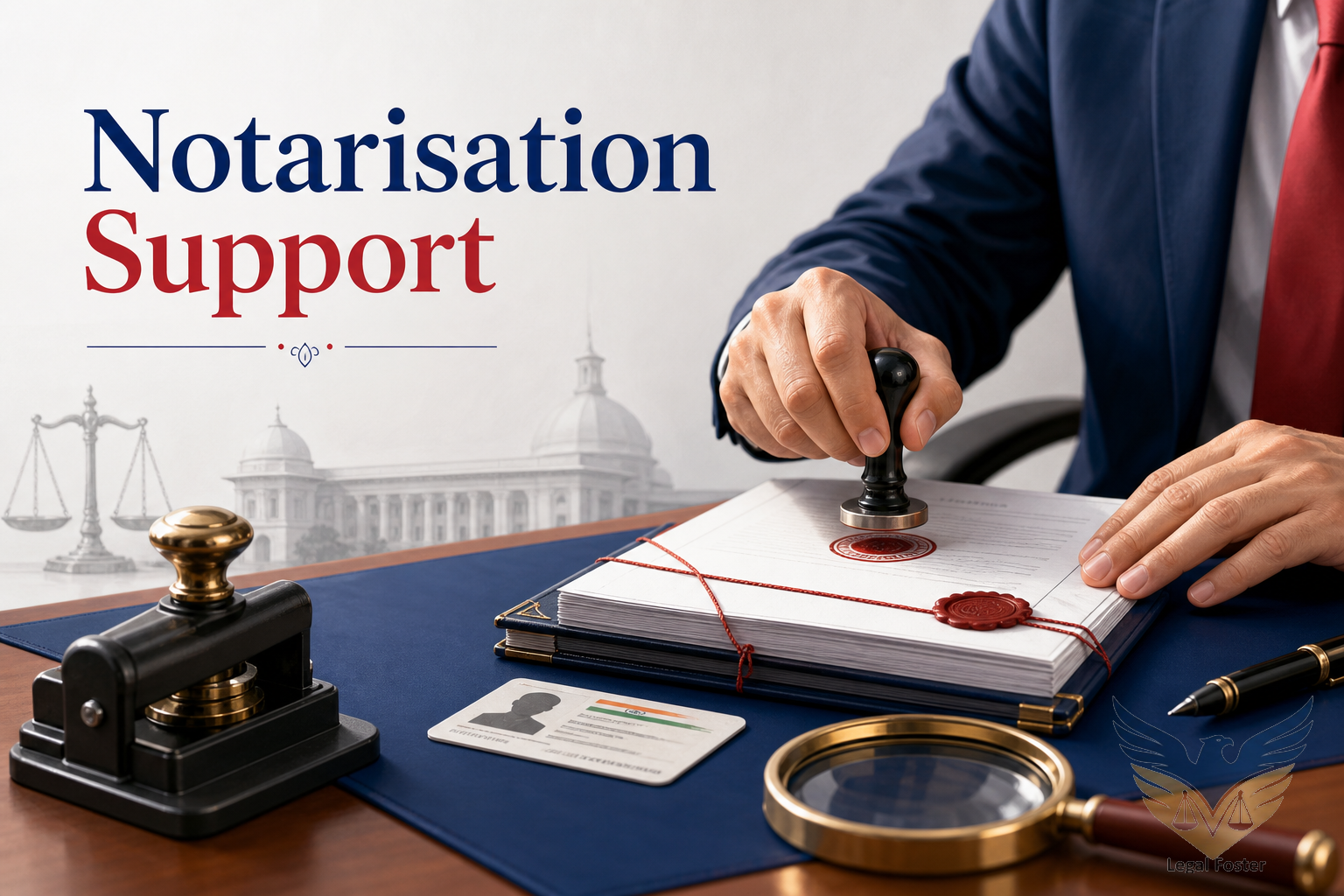
Notarisation Support typically involves witnessing signatures, administering oaths, certifying copies or performing another authorised act at the request of a governmental authority. An attorney will confirm whether the signer has capacity and identification, appears personally before the notary, executes a complete document and complies with any witness or photograph requirements. Notarisation does not rectify an illegal act or undermine the requirement to register or stamp a document, obtain an apostille certificate or have the parent document legalised by a consulate. Notarial process usually preserves the notary's register information and ensures dates, seals and exhibits are accurate.
Legal Counsel will first identify the underlying legal relationship, the cause of the dispute and the facts that might entitle the client to relief. Matters with similar facts may involve different laws, contracts and forums. Counsel will confirm which party has legal standing to initiate action, what specific obligation is disputed, whether corrective action has already been taken and where a judge can hear the case. Legal advice may be given at any stage. Notarisation Support services may prevent a problem, involve the drafting of new documents, respond to government notices, represent the client during proceedings or negotiate an agreement. Legal Foster matches clients with vetted lawyers. Specific advice and guidance is given directly by that advocate.
What to Expect During an Initial Review
Upon receipt of the engagement, counsel will usually review the client’s goals, timeline, chain of events and available evidence. Your lawyer may ask about dates material events occurred, documents and communications exchanged between the parties and if admissions were made or an settlement attempted. Your lawyer should identify critical deadlines and warn you about actions that could harm your position. The initial review is especially important when a deadline, court order, scheduled hearing, filing deadline, government investigation or transaction closing is imminent. Clients should not withhold facts that undermine their claims or that could benefit the other side. Incomplete information impairs your lawyer’s ability to provide advice. Similarly, evidence not produced until trial can upset your strategy.
Documents requested at the initial review may include:
- Copy of the final version to be notarised;
- Identifying information about the signer and evidence of the signer’s address
- Proof of Photographs, if required
- Witnesses present during signing
- originals that certified copies were made
- Instructions provided by the receiving authority
- Any stamp paper or e-Stamp purchased
- Apostille or consulate legalization, if known.
- Agreements, demand letters or replies
- Notice of payments or deliveries
- Email or text messages
- Official orders
- Copies of identity documents
- Prior registrations, if applicable
- Photographs that have been requested
- Expert analysis
- Exchange of pleadings.
Your advocate will arrange for legible copies and conserve the originals. Documents should be numbered and organised in chronological order. Electronic documents should retain metadata where available. Photos, scanned copies or emails should not be digitally altered. Documents are useless if their origin, trustworthiness or relevance to the disputed issues cannot be explained. Counsel may create a brief of evidence that lists when each document was created, who authored it, who received a copy and why it matters.
Legal Issues Involved
After reviewing the documents, counsel will usually identify which statutes, contracts and rules apply to the client’s situation. Legal research may cover jurisdiction, statutes of limitation, whether a claim is maintainable, authorities’ power to intervene, notice requirements, standard of proof, what evidence can be submitted and what remedies can be ordered. Correct procedure is often as important as the merits of a case. A favourable position on the facts can be lost if a party files too late, files in the wrong forum or fails to substantiate their allegations. Similarly, technical defences can often be raised against a lawsuit, but should be evaluated based on their legality and relevance to the case.
Planning Ahead
Avoiding court is often legal strategy. If you want to file paperwork, your advocate will prepare pleadings that set out all material facts, identify the legal cause of action and pray for the remedies you seek. Representations may require supporting affidavits or annexures. Procedures rules also require specific forms when filing or serving a notice. Draft pleadings should focus on material information and should avoid hyperbole. Fact allegations should be limited to what the client personally knows and should not be mixed with legal arguments or assumptions based on reviewing records. Every pleading should be tied to admissible evidence. Before filing pleadings, your advocate should verify that: jurisdiction, limitation, parties, valuation and fees are correct and procedural requirements for serving a notice have been met. Formats, fee structures and procedures vary from client to client and between courts, notice authorities, notaries public and registrars.
Summary Applications & Interim Orders
- In some cases, immediate relief is necessary before the substantive matter can be finally resolved.
- The client may seek to temporarily preserve property, restrain someone from taking an action, maintain a current situation, prevent evidence from being destroyed or access another form of urgent relief.
- The power to grant temporary relief is discretionary.
- Most courts will require proof of a prima facie case, urgency and specific detail about the injuries that would occur without protection.
- Filing a lawsuit does not automatically stay another proceeding.
- Clients should comply with all notices and orders until protection is granted by a written court order or settlement.
- Counsel cannot guarantee that an interim order will be granted.
Court hearings may involve preliminary issues, interim applications, exchange of evidence and witness lists, filing of written arguments and submission of legal authorities during final arguments. An advocate will confirm what the judge requires and advise you how to comply with court orders. Evidence should always remain consistent with the pleadings and previously submitted documents. Expert opinion testimony may be obtained if the judge permits questions of technical, financial or professional knowledge. Counsel will summarise the main facts, highlight relevant laws and state the relief you seek. Clients should avoid actions or statements that undermine the strategy agreed with counsel. Clients appearing before court should follow the advocate’s instructions.
Seeking a Settlement
Avoiding trial does not require a party to accept unfavourable terms. Parties can negotiate a solution, participate in mediation or enter into a written settlement to save time, minimise costs and avoid the risk of going to trial. A draft settlement should identify responsibilities, payment or performance due dates, mutual releases if allowed by law, discontinuance of pending proceedings, treatment of identity records or confidential information, terms of the underlying transaction and evidence of title, if applicable. Formal contracts should contain execution and authentication details. Clients should understand the tax, regulatory and reputational consequences of any agreement. Missing the deadline to file a lawsuit can rarely be extended.
Settlement negotiations do not automatically stop a limitation period, scheduled hearing date or enforcement action from proceeding. Clients should confirm whether time is tolled by law, agreement or by requesting a status conference.
Risks and how they can be managed
Clients should consider whether legal fees are affordable, how long the matter may take, whether evidence will be available, the impact on their business and what happens if they lose the case. Cases that cannot be settled may lead to court orders thatClients should also consider whether proceedings are public and whether negative publicity could impact your business. A pragmatic approach prevents frivolous applications and focuses energy on important issues. Preserving records, marking calendars and reserving counsel will help manage costs and minimize surprises. Clients should preserve documents, track deadlines and agree upon who will communicate with your counsel. Do not destroy evidence, lie to the court, intimidate another party or interfere with witnesses. Parties should continue to follow court orders unless a lawyer advises that the order has been stayed, discharged or a higher court has granted relief.
Clients' Responsibilities
Where legal Foster has introduced you to an advocate that lawyer alone is responsible for the advice given, the scope of the engagement and any fees payable. Legal Foster cannot and does not guarantee the competence or reliability of any advisor. The purpose of Legal Foster is to connect clients all over India with vetted advocates experienced in Notarisation Support services.
Getting Ready to Meet Your Lawyer
Write a timeline of events, make a list of parties and gather any official notices or court orders received. Organise copies of important agreements and supporting evidence of payments or performance. Consider what outcome you would like and where you got along negotiations. Include notices about deadlines in other proceedings. Fact should be documented and dates can be confirmed by your filing cabinet or electronic records. Write down your questions about jurisdiction, limitation periods, procedure, evidence, costs and settlement. Focus on what you want to achieve by meeting the lawyer.
Contact a Lawyer About Notarisation Support
Clients should get legal advice early by contacting a lawyer. Legal Foster will connect you to lawyers serving in every major city that provide Notarisation Support services. Counsel can review your documents, identify the proper forum and explain the next legal or commercial step. Do not wait to contact counsel. Seek legal advice when you receive a court order, learn about a enforcement action against you, must perform your obligations under a contract or believe your rights may be affected by waiting. Always discuss the current law, local procedure and all relevant facts before deciding on a strategy.
- Keep copies of all correspondence and request an acknowledgement receipt when handing documents to someone else.
- Double-check dates using original documents. An inaccurate timeline could impact your lawyers ability to plead jurisdiction, limitation or affect your credibility.
- A lawyer will usually provide a legal opinion that separates strong arguments from weak predictions. Make sure you understand the possible outcomes, including what can go wrong.
- Coordinate representation with counsel when there are multiple parties, venues or charges involved. This can prevent sending conflicting statements and overspending on legal fees.