A brilliant idea can get you customers. But if your business operates in the wrong way you will lose money. You may even lose your business or intellectual property/investors.
There is a grey area.
Most startups think of what product/service they want to sell. Then look into their legal needs when they need to incorporate their company or they invest in funding or have an issue with co-founder/employee/business contracts. What if something went wrong during the beginning of your startup? It could cost you more later on down the road.
That’s why Startup Advisory takes care of more than just incorporating your business.
From Founder’s Rights and Ownership. All the Legal Documents needed, Regulatory Compliance, Intellectual Property, Investments, Employee Contracts, Data, Privacy and Commercial Contracts.
When starting a business in Delhi NCR/Noida/Gurugram/Mumbai/Bengaluru/Hyderabad/Pune/Chennai/Kolkata/Ahmedabad/etc. you’ll encounter one if not all of these situations. 2 people may CO-FOUNDER a startup may think they are clear about their goals but when the money comes in, that’s when words are said. Your application is developed by an external source and he fails to give you ownership under a legal standing. The contracts/terms you have on your website for your customers don’t even apply to what your company does.
Startup Legal Advice can help you prevent these slipups.
BK Singh Advocate & Corporate Law Firm knows these situations. We don’t bombard you with unnecessary documents for your business. But we do make sure you have ALL the documents you’ll need for what stage your business is at.
You’re running a small consultancy with no investments. Or you may want to raise investment from Angels/VCS. There are many types of businesses that require different legalities.
Why Startup Advisory Matters in India in 2026
India’s start up environment over the last couple of years has become extremely regulated. Compared to what it was a few years back. A founder now may have to navigate through multiple company laws, taxes, employee laws, IP laws, contracts, FDI laws, data protection laws and even licences based on their industry.
Even the definition of what qualifies as a startup has changed under the Startup India initiative. According to the latest notifications by them any Startup(with exception of Deep-Tech Startups) can only be called a Startup for a maximum period of 10 Years(relying on certain conditions being fulfilled). They use a turnover of Rs 200 Crores to determine whether you qualify as a Startup or not. There are different thresholds for Deep-Tech startups.
Another myth we see is that if you are a Company you are a Startup India Startup.
Just because you are registered as a Company doesn’t mean the DPIIT recognizes you as a Startup. There is a whole other set of criteria you must fulfil to be called a recognized Startup India Startup. Please don’t presume to be 1 as soon as you incorporate your Pvt Ltd Company.
My last big kicker for most digital startups is around your user’s data. The Digital Personal Data Protection Rules, 2025 were issued on 14th Nov 20 and issued a definitive timeline of when the DPDP act will become active. Meity has confirmed they will meet these deadlines. Which means as a digital startup you need to be ready to handle your customer’s data right from day 1.
Hiring a legal expert at the early stages can have a beneficial impact on many areas of your startup.
Can you negotiate with a investor to accept your cap table? Can you sell your IP? Can your founder walk away with valuable knowledge earned from the business? Can you claim your money back from your customers? Will your trade secrets remain inside the company if your employees depart?
BK Singh Advocate can help you answer these.
Quick Facts
- Private Limited company incorporation will be done as per companies act 2013 and rules framed under it.
- Any minimum 2 persons can incorporate a private limited company under companies act provisions.
- LLP is another entity formed under Limited liability partnership act 2008, separate from companies act.
- Startup registration by DPIIT is totally different than usual incorporation/registration of your business entity.
- Here are some pointers to look for Startup India registration (as of 2026).
- Trademarks, patents, design copyrights etc. are all can play a part in deciding your IP.
- DPDP act 2023 and rules notified in 2025 will come into play for digital startups.
What Does Startup Advisory Actually Mean?
Startup Advisory 101: Setting up the correct Advisory for your startup
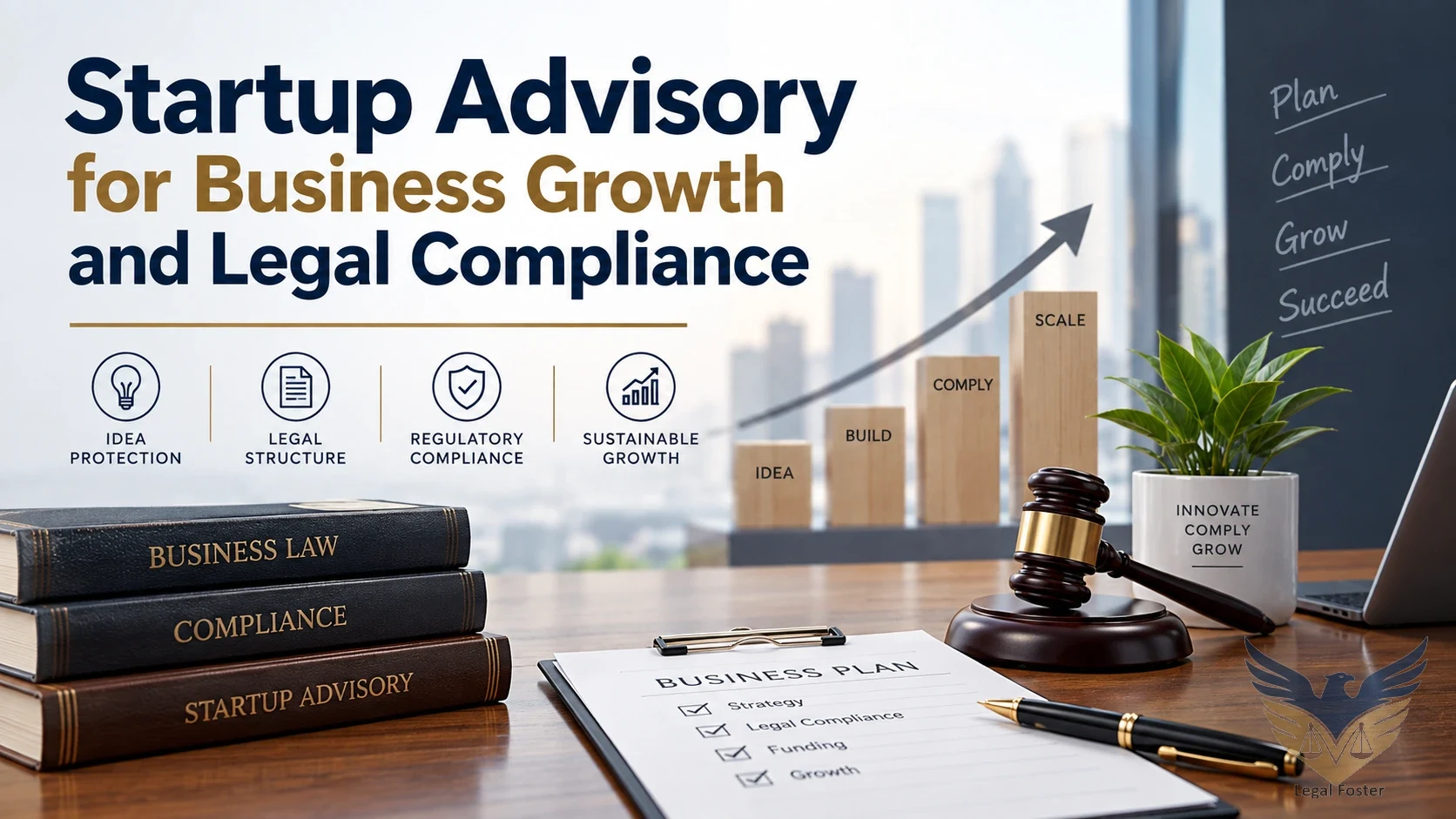
Startup Advisory simply means having the right help when you need it for your startup. This includes help from ideation to company formation agreemnets/funding to hiring employees to protecting yourself from potential pitfalls.
Startup Advisory isn’t about having a bunch of agreements ready to go on day 1.
Having the right advisory will help you know what you may need when you need it and what you can wait on. A Solo developer working on getting his first prototype off the ground is going to have different needs than a startup ready for their first round of institutional funding.
You may need help deciding on what type of structure you want for your company and have someone draft your documents for you. You also may want to protect your brand name. Six months down the road you may need help with employment agreements, vendors and contracts, investment documentation and even a privacy policy.
At BK Singh Advocate, we can work with you to see what your startup needs as it grows into each stage of its development.
Lets talk about..
Choosing what type of Company Structure you want
When starting your company, you will have a few questions. What kind of company do I register as?
- Do I want a Private Limited Company or LLC
- Do I want an LLP
- Do I want a Registered Partnership
- or anything else that allows me to do the things I want to do with my business
Each company structure has its pros and cons. There is no correct answer. Once you pick you generally cannot change your structure in the future.
For most startups, a Private Limited Company is the way to go if you plan on selling shares to investors, providing ESOPs to your team or raising multiple rounds of funding. Some businesses may benefit more from registering as an LLP.
There are a few things you should consider when deciding what structure you want. Do you want something with minimal taxations on profits, do you want something cheap to run. Do you want to bring on investors?. All these questions will help you determine what structure will work best for your startup.
You can always change your structure later down the road. but that comes with its own cost and may cause other questions to arise.
Indian Contract Act and Commercial Agreements
Contracts :
Almost every relationship you engage yourself into while running a startup will have a contract attached to it.
Contracts with customers, vendors, NDA’s, consulting, license, reseller and contracts between founders. All of these legal documents will require you to have an understanding of certain basics of contract law.
Contract law in India is governed by Indian Contract Act 1872. There could be other statutes which are applicable to certain transactions.
You will never be able to draft a fool proof contract which prevents all disputes.
You can however draft a contract which prevents certain disputes.
Preventing certain disputes can save you a lot of commercial time.
Intellectual Property Laws :
There are 4 main types of Intellectual Property which are protected under separate Acts.
Trademarks – Trademarks covers anything that defines a Brand/Name/Logo that identifies and distinguishes the source of your goods or services.
Copyright – Can protect any original work of yours that is in fixed form. This can be your code, writing or any other literary work.
Patents – Can protect inventions that meet certain set criteria under the Patents Act.
Design – Can protect your product design if meets certain criteria set out under the Designs Act.
So ensure you know what IP’s your startup owns. If there are any third parties who have contributed towards that IP. Do they have an Assignment/License agreement with your startup.
BK Singh Advocate can assist you in preparing the documents required by your startup in relation to IP’s.
Digital Personal Data Protection :
If your startup is running some sort of Apps, Websites, SaaS products, Marketplace, HR platform or any service which interacts with consumers. There’s a good chance you are collecting Personal Data.
This means Data Privacy law will apply to your startup.
Government of India has enacted DPDP Act 2023 which sets out rules and regulations for the collection of Digital Personal Data. MeitY notified DPDP Rules 2025 on 14th Nov 20 which has mentioned that these rules will be brought into force in phases.
Depending on the type of data, purpose of collecting the data and how your product operates. You might fall under certain clauses of the act.
Ensure you don’t plagiarize someone else privacy policy for your website.
Foreign Investment and Funding :
If you’re startup is receiving funds from an investor who is a foreign national. You might have to keep FEMA regulations, pricing rules, disclosures, industry caps/restrictions in mind.
List of documents you might require when fundraising;
- Term Sheet
- Share Subscription Agreement
- Shareholder Agreement
- Convertible Note
- Disclosure
- Company Approvals
Founders while fundraising usually obsess over how valuable is their startup. But don’t forget to pay attention to terms which mention what control you will have over your startup once you take the investment.
Terms like Matters Reserved, Board Representation, Liquidation Preference, Anti-Dilution, Founder Lock In, Exit terms can affect your business greatly.
BK Singh Advocate can help you understand the documents your company will be signing while fundraising.
What Documents Should a Startup Keep Ready?
Your Founder needs to have a clean legal track record.
.
Documents Required depends on the situation but some of the major documents you should have ready are:
Company Documents.
Keep all your company records organized. Certificate of Incorporation, Charter Docs, PAN, Tax Registrations etc. Maintain ROC records etc.
Do the same for your Shareholding structure and Directorship.
If your business is an LLP make sure your LLP Agreement (executed) along with amendments(if any) are in place.
Founder Documents.
There can be agreements between the Founders. These can define Division of Roles, Equity Split, Non Disclosure, IP assignment/copyright ownership, Transfer Restrictions and Exit Terms.
Many times there are only verbal understandings between Founders. Which becomes difficult to prove if things don’t work out.
Employee & Consultant Contracts
Just because they work for you, doesn’t mean your employees and contractors know what their role is.
They can have contracts that outline Salary, Role, Non Disclosure, IP Assignment, Notice Periods, Termination Terms and handover of Company Property.
Client & Vendor Contracts
Make sure you have the right contracts in place that outline how your company operates with Clients and Vendors.
This can be MSAs, SaaS agreements, SOWs, SLAs, or Licence Agreements for tech companies.
Supply chain agreements, Manufacturing agreements, Logistics and Distribution agreements etc. would be applicable for product companies.
IP Documents
Have all your Trademark Applications/Registrations, Copyright Documents, Patents/Designs(if any), Domain Name registration docs and IP assignment from founders/employees/
contractors.
Investment Documents
Term Sheets, Diligence Questionnaires, Investment Deeds, Board/shareholder approvals, Share Certificates, Statutory filings etc.
Investors may ask for historical records as well.
Having these documents ready will help speed things along.
At BK Singh Advocate we recommend Founders do a document check up before their next funding round to avoid such problems.
When Should a Startup Consult a Lawyer?
You don’t always need legal assistance until you receive a notice or are served a court document.
There are certain instances however where you will need legal guidance earlier on.
You may want to consult a startup lawyer if:
- there are more than one founders involved dividing up shares;
- you are bringing in an investor;
- an investor gives you a term sheet;
- a customer wants to enter into an agreement with you;
- you are having developers / consultants work on your project;
- a founder/director/key employee is exiting your startup;
- your startup wants to give equity to employees;
- you have an investor or transaction coming from outside of Canada;
- you are collecting information from your customers;
- you receive any type of notice (taxes, regulations, employee notices etc);
- shareholders start disagreeing; or
- someone owes your business money.
Get help as soon as possible. It’s always best to be proactive rather than reactive.
If you have already signed an agreement you are in slightly different position. Although not ideal, getting assistance now may allow you to negotiate.
BK Singh Advocate can assist you in reviewing these agreements before they become binding on your business.
How Can Startup Advisory Support Business Growth?
Allows law to work for you, not against you when making daily business decisions.
Have something to refer to when you need direction on what matters you can bring to your attorney and what matters you can execute on standard documents that have been pre-approved by your attorney.
Allows you to be more Investor ready.
Lets face it. When an investor puts you through diligence they are going to find things you think are ok, that are wrong.
IP not assigned, Stock awarded incorrectly, Loans not documented, Affiliate transaction not permitted, or employee documents not up to par.
If you have this cleaned up before an investor begins digging through your business it will make the process go smoother.
Negotiating Contracts will be faster.
If your startup has reliable commercial documents that have been prepared by an attorney. You won't need to draft every customer agreement from scratch.
You can have template agreements for most standard business transactions that can be modified when necessary.
This also allows your sales team to know their boundaries.
Decreases Founder Uncertainty.
Your business will never have to have legal council on everything that is done.
But your business should know when you are doing something that could have legal consequences.
BK Singh Advocate can guide you when you should proceed with caution and help you determine what you can do yourself and what you should speak with your attorney about.
Ownership Documentation.
During the process of raising money or selling your company. You will constantly be asked to prove that all major assets of your company are owned by the company.
IP, Domain, Software Developers, and Founders.
Helps prevent disputes.
No contract will ever stop a person from screwing you and not following their contract.
But they can let you know what you need to do in order to help prevent disputes. So if one does happen, whether it’s about payment, delivery, ownership, confidentiality, or terminating the agreement. You will be in a better position.
How Can Corporate Law Firm Help Startups?
Corporate Lawyer for startup. Corporate Law Firm covers every aspect of your startup right from its formation to its commercial needs. Whether it be founders agreements, company housekeeping,investments or disputes.
It can be customised to suit your needs depending on what stage your startup is in rather than having a one size fits all approach..
Early stage you might need help with the structure of the company, registration of the company and founders agreement..
Startup stage may be you have begun generating revenue and would want your sales/customer contracts, employee contracts and vendor agreements in place..
Investment stage maybe you have raised funds for your startup. You might want cap table amendments, due diligence, investment promissory notes /papers and company housekeeping..
BK Singh Advocate and his team try to understand your business and draft the documents suiting your needs. No need to have a clause in your agreement which your founding team have no clue about.
Corporate Lawyer can help you solve some of these problems if you have some loopholes in your company such as late filings or not having your main documents in place while trying to raise funds or do an exit. We will help you fix it if there is a way to fix it. We do not believe in hiding things from the investor or the government. We will analyze the situation based on the facts presented to us and the laws around it.
We provide services for startups and businesses located in Delhi, New Delhi, Noida, Greater Noida, Gurugram, Faridabad, Ghaziabad and other states in India through online consultation. You do not need to visit us.
Frequently Asked Questions
Startup Advisory are legal and commercial advisory services which are needed by start ups and founders. It includes Entity selection and choice, how to start up your company, founder agreement, contracts, company compliances, IPR, funding and much more. BK Singh Advocate can provide startup advisory services as per your startups needs.
Not necessarily. It depends on who you want to own your business, how you want to raise capital, how do you want taxation to be, compliances you wish to follow and what type of business you want to do. Private limited companies are the most common type of entity formed when start ups plan to raise money from investors. LLP is another form of entity which can be formed as per law and there are other options too. Corporate Law Firm can guide you in deciding what would be the best fit for your start up.
No. Registering your start up and getting it recognised from DPIIT are two seperate things. Any start up which is eligible can apply for recognition from DPIIT and avail benefits associated with being recognised as a start up by the government under Startup India. There are certain conditions which apply. Please refer to latest conditions for recognition as they have changed recently in 2026.
Founders should have a founders agreement among themselves before raising any funds. This helps set ground rules such as what roles each founder will perform, who will own how much shares, who will have control over what decisions, confidentiality during and after forming the business, ownership of intellectual property, leaving the company, what happens if someone wants to transfer shares etc. Situations like these can occur even before startups raise money from external parties. BK Singh Advocate can guide you through the process of drafting such agreements and help you understand how these agreements can work with your companies documents.
Contracts available online will not be specific to the services you provide to your customers. Also it may not include terms you wish to include regarding your fees, liability, intellectual property rights and may even have a clause for termination. Also contracting parties online may have included terms which would not even apply to your transaction since they have kept the laws of another country in mind. Corporate Law Firm will draft contracts for you and help you prepare important contracts for your business.
You should apply for trademark as early as when you feel your brand will be important to your business. You should also check if the trademark is available as soon as possible before investing a lot of money into developing that brand. Please keep in mind trademark applications would vary according to what trademark you would like to register, whether you want register the same trademark for multiple products or services. BK Singh Advocate can help you with not only trademark but other documents you require for your business.
Creating a privacy policy for your tech startup can be one of the several steps you need to take. If you own a digital business there are some questions you should ask yourself. What type of personal data will you be collecting, why do you need it? Are you taking consent from users to collect this data or are you processing this data under another condition specified in law. What will you do with this data? What security measures do you have in place to protect this data. How will you communicate all this to your users and how will you ensure vendors you work with have privacy measures in place. Now that DPDP law is applicable in India since 2023 act was passed and 2025 rules were released you must know the answer to these.
Founders should know what valuation is being assigned to the company and how much percentage of the company are they diluting by investing in the company. They should know what rights investors get, who all get to be on board of directors, what matters are reserved for who. What happens to founders shares if they leave, how will they be paid if company fails and what are founders liabilities towards investors and company. Founders should know about taxation and implications under FEMA. BK Singh Advocate can review such documents and go over the terms before you sign.
Yes certain aspects of startup legal advisory can be provided online. Documents such as contracts, company formation, filings for company compliances and meetings can be guided through online. Corporate Law Firm can provide legal services to startup founders in Delhi NCR and whole of India through online means.
Contact BK Singh Advocate when you want to start your business or divide your shares with your friends, enter into a major contract, raise money from investors, create esop for your employees, retain any key employees, transfer any IP and much more legal work. You should seek legal help at the earliest.
Final Thoughts
Doesn't mean that you need to go overboard and over legalise yourself as a founder. But understand what can be settled with a verbal handshake and what requires founders' equity to be assigned in writing. Where do regulations come into play and where should you refer to a lawyer before you initial on something that will legally bind your business.
Indian startups are also catching up. With introduction of latest changes in DPIIT recognition criteria in 2026 and Recent implementation of DPDP Act and rules.
It always helps to refer to current legal standpoint instead of reading templates that got printed when internet was dial up or random blog posts.
BK Singh Advocate can guide you through your incorporation, founders' documentation, commercial agreements, investment documentation, compliances and any business litigation through his Corporate Law Firm as per your requirements.