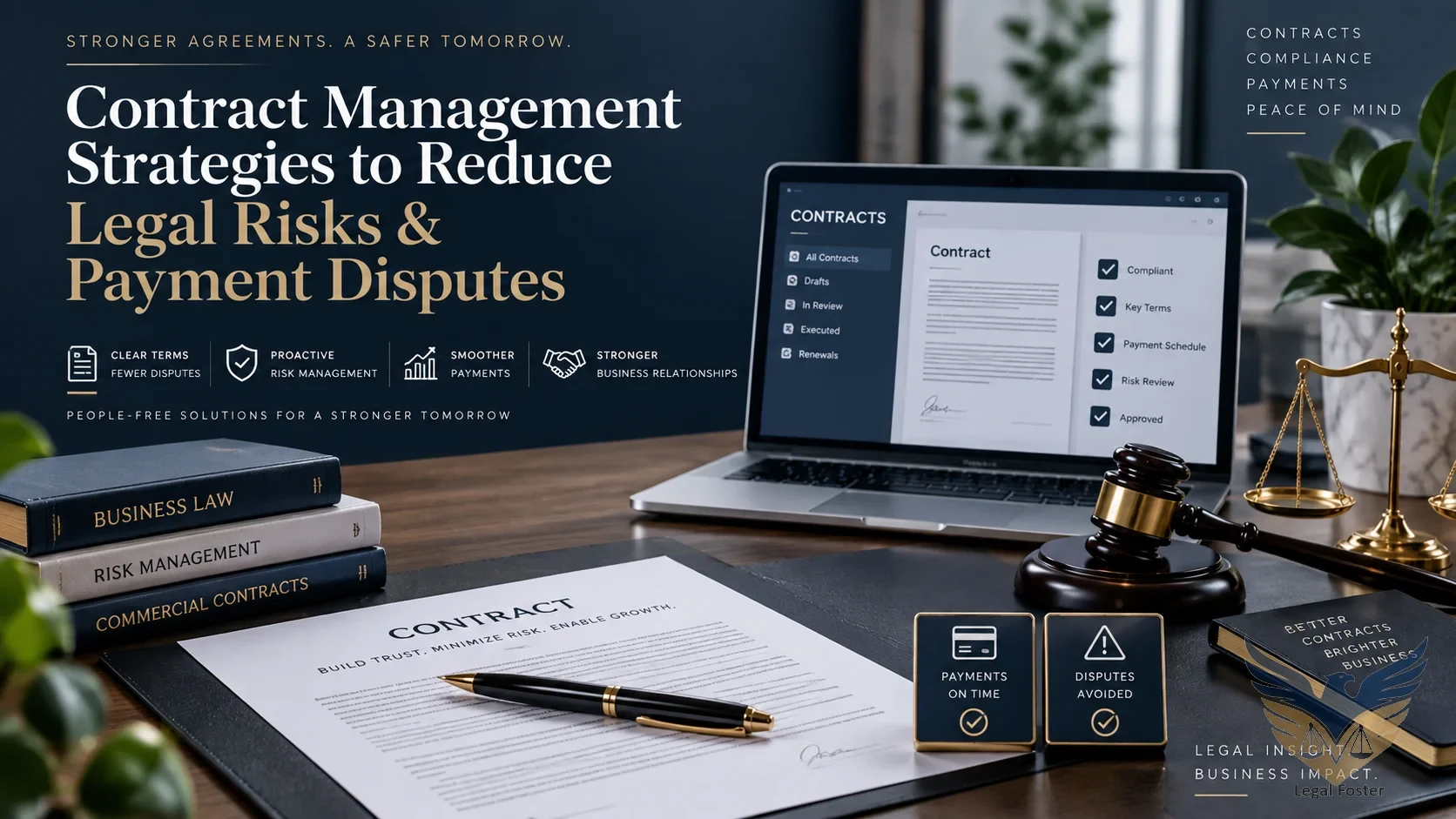
Contract Management Strategies to Reduce Legal Risks and Payment Disputes
Many business disputes don’t start off with fraud, bad faith or betrayal. They start with something seemingly harmless – an ambiguous purchase order; an unsigned scope change; a disputed invoice; a delivery milestone or payment condition that was never tracked. By the time the CEO gets involved the parties are already slugging it out in email, WhatsApp messages, invoices and multiple “versions” of the contract.
Contract management shouldn’t be an administrative afterthought. Contract management should be a practical legal-risk control system for doing business in India.
Negotiated contracts that are properly managed create a record of important terms. Terms that define:
- what each side has promised to do
- who has authority to approve changes
- when the performance of each side is considered complete
- what evidence will trigger payment
- what will constitute failure to perform by either side
- Indian Contract Law
India contract law focuses on the Indian Contract Act, 1872. The Indian Contract Act contains a number of provisions relating to the formation of a contract, performance of contract and breach of contract.
Things to Consider if You Need To Escalate a Payment Dispute
If you find yourself having to escalate a payment dispute you will often find that weaknesses existed before the invoice was due.
Sales may have orally agreed to add another deliverable without getting the contract amended.
Operations may have performed the work without getting formal acceptance.
Finance may have sent out an invoice even though a contractual milestone hadn’t been reached.
BK Singh Advocate Of Corporate Law Firm speaking to Businesses
BK Singh Advocate is associated with the firm Corporate Law Firm regularly advises clients on various issues related to commercial contracts and corporate agreements and dispute avoidance.
While an effective contract-management process won’t prevent every dispute, it can: (1) clarify obligations; (2) preserve evidence and (3) minimize needless disputes over scope, performance and payment.
Contract management is critical for startups, SMEs and even large businesses around Delhi NCR, Noida, Ghaziabad, Gurugram, Mumbai, Bengaluru, Hyderabad, Chennai and other business centers who negotiate, approve and perform contracts through hardcopy and digital communication.
Why Contract Management Matters for Indian Businesses in 2026
Contract disputes rarely stay within the legal department.
Late payment from a customer affects GST cashflow, vendor payments, wages. Unclear termination provisions can leave you paying for a product or service your company no longer wants. Improper indemnities can expose your business to liability worth multiples of the contract value.
Contracts are also part of increasingly paper heavy commercial processes.
Purchase orders may be generated from ERP systems. They may get approved via email. Delivers may be exchanged on a cloud system. Project variation orders may be accepted during a Zoom call, then discussed on WhatsApp.
Any contract entered into electronically is still valid and enforceable in India. Under Section 10A of the Information Technology Act, a contract shall not be deemed to be invalid or unenforceable, [solely] because the proposals, acceptances, agreements or any related communications were expressed in electronic form.
Legal recognition for electronic contracts means it’s important to manage your digital information.
BK Singh Advocate has for years recommended clients to consider emails, approval trails and version histories as part of the ‘contract record’ and not just transient communications.
A business which cannot produce the commercial terms finally accepted by the parties, could find itself in unnecessary hardship despite having an otherwise reasonable commercial position.
Quick Facts About Contract Management
- The Indian Contract Act, 1872 remains the primary legislation governing contracts in India. It deals with formation, performance and breach of contract.
- Electronic contracts are considered valid in India and are capable of being enforced by the courts. The mere fact that a contract is in electronic form will not make it unenforceable.
- Contracts with underlying payment disputes (which have a commercial flavour) may be governed by the Commercial Courts Act, subject to meeting certain conditions (including value and subject matter thresholds).
- Where commercial suits fall within the ambit of Section 12A of the Commercial Courts Act, they must first undergo mediation prior to being filed in court, if they do not seek urgent interim relief.
- If the parties agree to arbitration, contractual disputes are referable to arbitration in accordance with the Arbitration and Conciliation Act, 1996.
- Claims for late payment to Micro and Small Enterprises with turnovers below specified thresholds are entitled to special remedies under the MSMED Act sections 15 to 18.
- Contract and money claims are subject to limitation. Do not sleep on past due invoices and breaches.
What Does Contract Management Actually Mean?
Contract management is the process of administering a commercial agreement. Contract administration controls contracts from inception and approval through execution (including all variations, payments, renewals and terminations).
Contract Management Begins Prior to Signature.
Don’t view a contract as a PDF document that gets signed and filed.
If managed well, a contract will allow a business to know exactly at any moment:
- who approved what version;
- who has signed it;
- what each party is obliged to deliver;
- how acceptance is acknowledged;
- when invoices should be raised; When disputes should be notified; etc.
- When does the contract expire and can it be renewed?
- who has the authority to approve variations.
- Problems may arise when one dept understands the commercial deal but another dept holds the written contract.
Sales could have promised one thing, operations may do something different and finance will simply invoice on a regular cycle. Legal could be finding months down the track that the payment clause only stated delivery was due on a signed completion certificate being issued.
Contract management ties together the legal,commercial,finance and operational records. BK Singh Advocate says. Instead of departments having differing versions of events.
Why Do Payment Disputes Start Even After a Contract Is Signed?
Performance of a contract will not prevent disputes should the parties stop performing as promised.
Scope Creep.
The client asks consultant to do more work. Consultant performs work to keep the client happy. No change order is executed.
Billing time rolls around and client says they never requested the work.
Ambiguous Milestones.
Contract specifies payment upon “successful completion” but never defines who decides completion or what constitutes acceptable completion.
The consultant feels job is done. Client says testing isn’t completed.
Wait, they're both arguing about the same contract clause…
Incomplete Records
(neither party kept) help either party’s case.
BK Singh Advocate will examine the contract itself, PO’s, emailed directives, accepted work documentation, CR’s and invoices to determine what was put into writing.
Why Should Payment Terms Be More Detailed Than an Invoice Due Date?
A clause saying “payment to be made in 30 days” leaves much to be desired.
- Which day is Day 1?
- Day of invoice?
- Day of delivery?
- Day of acceptance?
- Day originals were received?
- Day buyer’s finance signed off on payment?
- Be clear what exactly triggers payment.
Applicable Taxes, withholding, disputed amounts, invoice formatting, supporting documents required, credit notes and interest/penalties for late payment are all important considerations that should be addressed in contract where commercially feasible.
For milestone based contracts – tie payment specifically to objective proof of completion. .a signed delivery challan, acceptance certificate, project-stage approval, written confirmation etc
And a company shouldn’t design a payment process that’s entirely dependent on the completion of a step in their buyer process the supplier has no visibility into.
BK Singh Advocate sees payment clauses from both a legal & operational perspective quite often. What good is a commercially ideal payment term if you cannot establish when that payment was due.
How Should Businesses Manage Purchase Orders and Master Agreements?
In India, it’s also very common for parties to enter into a Master Services Agreement and then execute standalone purchase orders or statements of work.
While this can be an effective structure, it’s important that the documents are aligned with each other. If your master agreement says Net 30 but your purchase order says Net 60, which term prevails?
Much depends on how your contracts are structured and the language your parties agree to. Ideally, your stack of contracts will include clear language on order of precedence. You also don’t want your employees blindly accepting vendor standard terms that negate your master agreement. Treat your procurement portal and PO templates like you would a contract.
What Should a Contract Say About Delay and Breach?
Termination is not always the appropriate remedy for every breach.
Negotiate contracts that distinguish between categories of non-performance.
A missed deadline due to an administrative error that results in a one day delay may merit the issuance of a cure notice.
The breach of a material confidentiality provision may deserve another response.
Three defaults under payment terms provisions may be remedied differently than one late payment.
There can be provisions for cure period, right to suspend performance, interest, damages, service credits or termination depending upon the transaction.
The Indian Contract Act addresses certain aspects of compensation for breach. All contractual remedies should be crafted with these provisions in mind.
The parties should avoid the inclusion of penalty clauses simply to “scare” the other party into compliance.
Penalty clauses are only of value if they permit a commercially reasonable response to breach.
Why Should Termination Clauses Be Planned Before Signing?
Termination is never considered until the relationship is going south.
Too late to engineer that mechanism at that point.
Here's why I believe an exit clause should address:
termination for breach;
termination for an uncured default;
termination for insolvency-related events to the extent allowable by law;
termination for convenience if the parties commercially agree to do so.
payment terms upon termination
return of property
confidential information
transition support.
Clauses that should continue after termination (e.g. confidentiality, intellectual property usage restrictions, retention of earned payments, dispute resolution) would need to be expressly stated within the clause.
An exit clause should expressly state what occurs to work completed and invoices issued prior to termination.
What Contract Documents Should a Business Maintain?
When complete, the contract file should tell the entire commercial story and not require someone to try and remember the transaction details.
Examples of records that could be included are:
- request for proposal/ commercial quotation;
- negotiated proposal;
- purchase order;
- executed agreement;
- statement of work;
- amendments/addenda;
- approved change orders;
- delivery challans;
- acceptance certificates;
- invoices;
- payment history;
- credit/debit notes;
- email approvals;
- termination/renewal notices;
- dispute notices;
- settlement correspondence.
Long term contracts should also have a one page contract summary included in the file.
This can include renewal dates, notice periods, payment triggers, price-review dates, insurance obligations and key approvals.
What Should Businesses Check Before Signing a Contract?
Contract review doesn’t just mean spell check.
Sales / commercial teams should review contracts to insure the content reflects the deal they approved.
- Check legal entity names
- Validate who can sign
- Does scope match the proposal?
- Payment terms / milestones
- Tax split
- Warranties and Acceptance.
- Termination provisions
- Liability exposure
- Governing law / dispute resolution
- Auto renewal provisions
- Confidentiality / IP clauses, etc…
- 9 out of 10 contract catastrophes are visible before you sign on the dotted line.
- They’re just often not caught in time.
Don’t let your Contracts Kill your Company.
BK Singh Advocate reminds us contracts with monetary or operational impact should be reviewed by Counsel prior to execution. Not after you have a payment dispute.
When Should a Business Consult a Contract Lawyer?
Legal review should be considered where: a contract involves significant sums of money; involves long term commitments; or contains unusual risk allocations.
Examples include where:
- a major customer insists on its standard contract;
- payment terms are unclear;
- large indemnities are being asked for;
- there is a demand for unlimited liability;
- ownership of intellectual property is assigned;
- exclusive dealing is required;
- termination is restricted;
- the other party is offshore;
- an arbitration clause is included;
- there are repeated claims of non-payment;
- variations are disputed; or
- termination is threatened.
Legal advice can also be useful where a business enters into a contract but different departments have different interpretations of its meaning.
Sometimes it can be better commercially to clarify matters at the start than to litigate after things go wrong.
How Corporate Law Firm Can Help
Corporate Lawyer offers assistance to businesses with respect to their corporate structures, commercial documentation, agreement reviews and disputes.
Documents can include: Supply agreements, service contracts, vendor agreements, NDAs, standard commercial conditions, payment terms, termination rights, liability limitations and dispute-resolution provisions.
BK Singh Advocate can review existing agreements if you've recently been faced with payment disputes.
Generally such a review would assess whether the payment is due as a matter of law, whether the supplier completed the contractual milestone, whether there was any variation to the milestone and if it was approved, and what dispute resolution process would apply.
We can also help businesses who enter into large volumes of contracts streamline their standard clauses, contract checklist and escalation points.
The objective is to ensure your important obligations are identifiable and provable, not to make every contract ten pages long.
Frequently Asked Questions
1. What is contract management in a business?
Contract management includes managing of contract creation to negotiation, execution, performance, monitoring, compliance, renewal, revision and ultimately termination.
2. Can a business contract made by email be valid in India?
Just because a contract is wholly or partly in electronic form, this does not mean it cannot be enforced.
Section 10A of the Information Technology Act expressly validates contracts created via electronic communication. However, enforceability would be determined based on the applicable laws and facts.
3. How can contracts prevent payment disputes from occurring?
Agreements should clearly define payment triggers, invoice requirements, acceptance process and dispute notification requirements to minimise confusion around when payment is due. Businesses should also retain evidence that work was performed at each stage.
4. The contract doesn’t define scope clearly, what should we do now?
Ambiguity around defined scope usually results in disputes around whether work was included in the original price or if variations were required. Unclear scope can also result in enforcement or interpretation problems depending on the contract and evidence. BK Singh Advocate can review the contract and correspondence to assess your position.
5. Do all commercial agreements require an arbitration clause?
No. In fact, arbitration clauses should only be used where it is commercially sensible to do so.
Arbitration is suitable for many commercial disputes. However, businesses should consider the costs associated with arbitration, the value of the transaction, the relationship with the counterparty and the nature of any foreseeable dispute before agreeing to arbitrate any disputes.
6. Our client hasn’t paid an invoice 3 years ago, can we still chase the debt?
The statutory limitation period would depend on what underlying transaction gave rise to the claim, when payment was due, any acknowledgements made, if any part-payment was made and what law applies to the contract. In many cases, contractual claims for payment will have a limitation period of three years. However, the specific date from which time would begin to run would need to be assessed based on the relevant facts.
7. Does registering as MSME affect payment terms?
If you have registered as a Micro or Small Enterprise and meet the definition of an SME under the MSMED Act to avail the benefit under the MSMED Act, then you may be shielded from late payments under Section 15 of the MSMED Act. This Section restricts the maximum time for payment to 45 days from the date of acceptance of goods/services for contracts which fall under the MSMED Act.
8. Can we terminate a company contract due to missed payment?
No. not necessarily. If a contract is terminated due to non-payment, it would depend on what your contract's termination clause states.
Have you satisfied all conditions to terminate the contract? Was the non-payment a repudiatory breach? Is there a cure period? What law governs the contract? BK Singh Advocate can review your contract to determine if you can terminate the contract.
9. Our contractor and we have been discussing things on WhatsApp. Will this be admissible?
Yes. WhatsApp chats can become part of the documentary evidence. If contracts are negotiated or executed via WhatsApp or commercial instructions are provided over WhatsApp and confirmed, these chats can be used as evidence in legal proceedings going forward.
Ideally businesses should have proper approval processes for agreeing to variations/amendments rather than relying on WhatsApp chats as proof of agreement.
10. When should I get BK Singh Advocate involved with reviewing a business contract?
BK Singh Advocate can review commercial contracts prior to signing where it’s a high-value transaction or high-risk contract or the clauses heavily favour the other party. We can also review contracts after a dispute has arisen in relation to scope of work to be performed under the contract, non-payment, termination, liability or under-performance.
Contract Management For Companies Doing Business In India
Final Thoughts
Contract Management isn’t just about the paperwork you sign when entering into agreements. It’s about making sure your business lives by the commercial promises it made when quantifiable. If the deal is well constructed the scope of the product/service, payment trigger, acceptance criteria, change procedure and consequences for breach will all be outlined. Effective contract management ensures your business lives by those terms.
This part is often overlooked. Even if you construct an iron-clad agreement. If your business doesn’t have Systems in place to track delivery, acceptance and approved changes. It will be very difficult (if not impossible) to prove breach. Moreover, your legal exposure changes as the agreement ages.
You may be concerned about liability when first signing the contract.
Scope and acceptance may be your biggest concern when performing under the contract.
When you send that invoice, payment terms and late payment consequences will be in front of your mind.
Years later you’l be looking at limitations, terminations, mediation/arbitration clauses and commercial litigation. BK Singh Advocate and Associates can help you with Commercial Contract Drafting, Contract Review, Contract-Risk Analysis and also represent clients in Payment Disputes with a focus on the underlying transaction. Contract Management for Companies Doing Business In India BK Singh Advocate can work with businesses across Delhi NCR, Noida, Ghaziabad, Gurugram and much more.. Allow us to help you identify ways to minimize uncertainty up front. And if a dispute does arise, disciplined contract management makes dispute resolution easier to manage.
Author Bio
BK Singh Advocate is at Corporate Law Firm. I help businesses with commercial contracts, corporate documents, payment disputes and contractual risk. This includes contract review services for service agreements, supply contracts, purchase orders, payment terms and conditions, indemnities, termination rights, arbitration clauses and business correspondence. I help clients review their agreements to determine if the obligations are captured correctly and whether rights to payment, termination and dispute resolution have arisen under the contract. I believe in straight- forward drafting, reliable record keeping of contracts and commercially viable legal structures, opposed to legalese created by other lawyers.