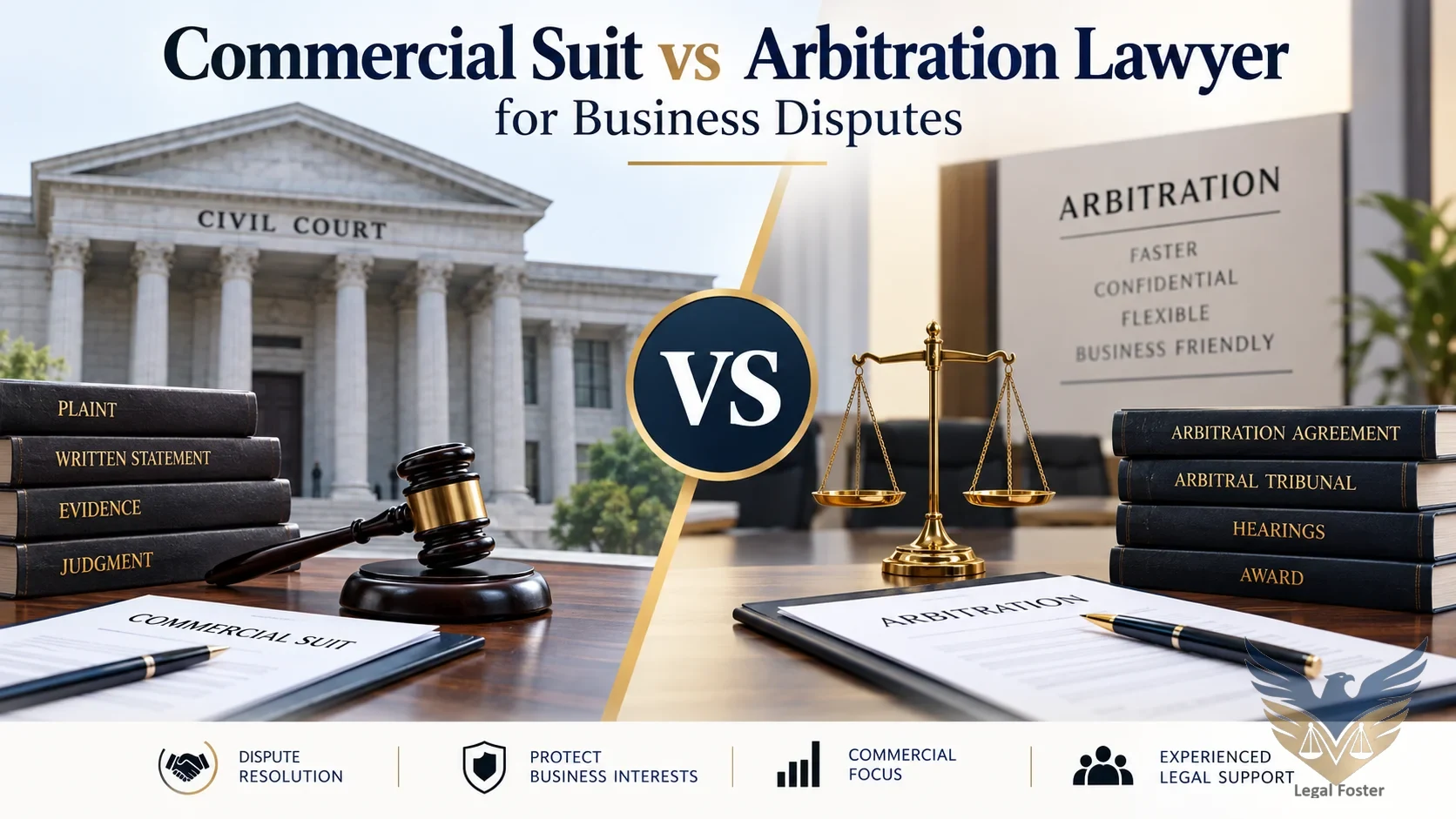
Commercial Suit vs Arbitration Choosing the Right Route for Business Disputes
A commercial contract looks great until something goes wrong. You buyer doesn’t pay. A supplier won’t ship. An IT vendor misses development deadlines. A joint venture partner disputes its obligations. Sound familiar? One of the first questions that comes up is: Do I sue in Commercial Court or do I start arbitration?
If you operate your business in Delhi NCR, Ghaziabad, Noida, Gurugram or anywhere else in India, this question can affect price, timing, interim relief and enforcement of the ultimate decision. It’s important to make the right choice from the beginning.
You may have an arbitration clause in your contract. But the existence of those two words won’t automatically determine the entire procedural landscape. The language of the clause, the facts of the dispute, the remedy you’re seeking and who is involved in the contract are just some considerations. So is the law
At Adv. BK Singh can help entrepreneurs, businesses, and individuals involved in a contract dispute evaluate the contract, correspondence, invoices, notices and dispute-resolution clause. Once we have completed our analysis, you can decide whether to litigate or arbitrate.
Why Should Commercial Suit vs Arbitration Matter in India in 2026?
When confronted with a commercial dispute, a business will want to analyze their options. Essentially two options present themselves. Commence a lawsuit in court, or begin arbitration. Although this may seem like courts vs arbitration, the decision you make can drastically alter where your dispute is litigated, who decides your dispute, what procedural rules will govern your dispute and how any award (or decision) can be enforced or vacated.
The Commercial Courts Act, 2015 ( “Commercial Courts Act”) speaks to establishment of Commercial Courts, Commercial Divisions, and Commercial Appellate Divisions of High Courts. This act pertains to Commercial Courts which adjudicate any disputes of a commercial nature of a specified amount (“Dispute”). “Commercial disputes” is defined broadly under the Commercial Courts Act and includes any dispute arising as to a contract or in relation to any subject matter which is of commercial nature, such as sales of goods or services, partnership disputes, technology agreements and several other enumerated transactions.
Arbitration is instead governed by The Arbitration and Conciliation Act, 1996, which applies to domestic arbitration, international commercial arbitration and international commercial arbitration related proceedings in Indian courts. Section 8 provides that when a valid arbitration agreement has been signed the competent judicial authority should refer parties to arbitration if certain statutory requirements are met.
For this reason, just because a situation has escalated into a fierce dispute doesn’t mean a business should agree to arbitrate (or litigate).
Quick Facts
- ♦ Commercial suit is adjudicated through formal court structure and has to meet various jurisdictional and procedural requirements under the court structure.
- ♦ Arbitration can be resorted to only if the parties have agreed to arbitration (have entered into an arbitration agreement) and is subject to Arbitration and Conciliation Act, 1996 (with some exceptions).
- ♦ Commercial disputes include disputes arising out of contracts for supply of goods and services; partnership agreements; technology agreements etc.
- ♦ However, if there is a valid arbitration clause in the agreement, the suit would either have to be stayed by the court under Section 8 of Arbitration and Conciliation Act or parties may even be asked to go for arbitration.
- ♦ Commercial suit filed does not contemplate any urgent interim relief, parties are obligated to try pre institution mediation First appellate authority in CPC order has been struck down by SC recently. Section 12A was introduced by Commercial Courts Act
- ♦ Arbitral award is challenged by filing an application before the court under Section 34 Arbitration and Conciliation Act, 1996 on very limited grounds which are mentioned in that section.
- ♦ It all depends on the contract, nature of dispute, nature of relief sought, parties to dispute, arbitrability of dispute etc. procedure to be followed as well.
What Is the Difference Between a Commercial Suit and Arbitration?
A commercial suit means Commercial litigation that takes place before a civil court. As the name suggests a commercial suit means litigation before a court of law involving a commercial dispute which falls within the jurisdiction of that court and governed by statutes.
Arbitration means that a dispute resolution mechanism where parties to a dispute agree to resolve the matters in dispute not before courts but before an arbitral tribunal.
Difference Between Commercial Suit and Arbitration
The difference between these two would be especially relevant if the commercial contract contains an arbitration clause which has been drafted properly.
As per Section 7 of Arbitration and Conciliation Act, there is an arbitration agreement if the parties to any proceedings agree to submit to arbitration any dispute which may arise between them or any matter specified in the agreement.
Suppose a company based out of Delhi enters into a contract with a manufacturer situated in Noida. The contract contains an arbitration clause. The clause has a provision wherein parties agreed that all disputes arising out of or in connection with the contract be settled by arbitration.
Now let’s say there’s a disagreement between parties with respect to payments. The company cannot take it for granted that they can initiate commercial suits first. They need to look at the arbitration clause first to identify the scope of the clause, any condition precedent mentioned, seat or place of arbitration, mechanism for appointment of arbitrators, nature of dispute and so on.
This would save you from a lot of procedural hassles at the initial stage itself.
What Laws Govern Commercial Suits and Arbitration?
Two major statutes would come into play.
Commercial Courts Act, 2015
The Commercial Courts Act would govern institution of commercial disputes of the said value. It sets up Commercial Courts and provides for commercial jurisdiction. The Act also provides a definition of commercial dispute which expressly includes several categories of business contract disputes.
Section 12A would come into play before institution of a commercial suit. Providing that the suit seeks urgent interim relief, parties are obliged to undergo mediation before institution of the suit. The statute specifies a prescribed period for mediation. This period may be extended by another period upon consent of the parties.
Arbitration and Conciliation Act, 1996
The Arbitration and Conciliation Act governs arbitration and court intervention in support of the arbitration process.
Sections to note are:
- Section 7 — arbitration agreement
- Section 8 — court refers parties to arbitration if statutory requirements are met
- Section 9 — interim measures by court
- Section 11 — appointment of arbitrators
- Section 16 — power of the arbitral tribunal to decide its own jurisdiction
- Section 21 — commencement of arbitral proceedings
- Section 29A — Limitation within which award should be made
- Section 34 — application for setting aside award
- Section 36 — enforcement of award
- Section 37 — Orders from which appeal lies
Courts can intervene in matters provided under the Act only. There have also been recent Supreme Court judgements emphasizing the limited scope of judicial review at the Section 11 stage and the power of the arbitration tribunal itself under Section 16.
Who Should Consider This Guidance?
Typically, a Commercial Arbitration involves:
- Clients disputing against invoices, supply mandates or service contracts.
- Startups having disputes against suppliers, investors or software agreements
- Manufacturers/Distributors
- Construction and contracting companies
- IT and Software companies
- Consulting Firms & Professional service companies.
- Partnerships & business alliances
- Tenants & Leases, when one party feels the contract has been breached.
- If your company has been affected by slow paying invoices or poor job performances.
Although two companies can be in a dispute with one another, this does not necessarily make it an arbitration case. Because you have a commercial dispute does not automatically allow you to only file a commercial claim.
How Should a Business Decide Between a Commercial Suit and Arbitration?
Fight!Fight!Fight! Not… Settle: 4 Rounds of Assessment before Initiating Dispute Resolution Proceedings
Round 1: Master Agreement & Documentary Evidence Round- up
Have all the documents evidencing the contract ready. Starting from the contract and its amendments. Purchases orders/work orders/invoices. Email communications. Evidence of payments made.Acceptances.Noting of receivals/ deliveries.Delivery Challans. Notices & any other form of correspondence between the parties. WhatsApp conversations these days can also turn out to be very important evidence if it relates to performance or any admissions made by the parties. These would have a different evidentiary value depending on the facts.
Round 2: Dispute-Resolution Clause Close-Quarters
The next round would be to determine if the dispute- resolution clause is operative.What disputes fall under that clause.Did the parties agree to any precondition/pre-arbitration procedure.Modes of appointing the Tribunal.Seat/place of arbitration.
Round 3: Claim(S)/ Relief Round- up
Whether you want the other party to pay you money owed to you.Damages for breach of contract. Specific performance of contract. Injunction against the other party.Acts of the other party.Protection of confidential information or any other form of relief. These are the next important steps to ascertain.
Note that while all kinds of claims are arbitrable, some claims would require you to file a court proceeding in order to get interim relief. This would be decided based on facts of each case.
Round 4: Invoke Clause Mechanism
Invoking the clause and dealing with appointment of Tribunal if needed.
If the dispute is to be resolved through courts, considerations like jurisdiction, value pleaded, framing of pleadings, limitation, pre- institution mediation(if applicable) would need to be analysed before filing a suit.
Document and Evidence Requirements
Although Hardy may want to focus on knowledge as the key to victory, commercial disputes are usually decided as much by the weight of the documentary evidence as by the strength of the legal argument.
Documents that should be preserved together are:
- • The original agreement and any amendments
- • The arbitration / dispute-resolution clause
- • Purchase orders, work orders and invoices
- • Bank statements and records of payment
- • Delivery records, inspection reports or certificates of completion
- • Emails and other business correspondence
- • Notices given by either party
- • Accounts statements and reconciliations
- • Any other documents that constitute evidence of breach, delay or defective performance
- • Board resolutions or other evidence of authority, if relevant.
Do not edit old correspondence to make the chronology tidy. Retain original documents.
Electronic documents should be preserved in a form that allows their source and context to be explained if they are later disputed.
When do you need to speak to a Commercial Lawyer?
It often makes sense to seek legal advice at the outset where:
- an arbitration clause is contained in the contract
- you have received a legal letter from the other party
- a substantial payment is late
- the contract is threatened to be terminated
- a contractual deadline approaches
- the other side have commenced arbitration/court proceedings
- you may need to apply urgently for an injunction/protective order
- the business dispute spans a number of interconnected agreements
- the value of the claim is sufficient for procedural mistakes to become commercially significant.
That said, you do not need to wait until a dispute has been filed.
Legal contract reviews can often be undertaken to advise you on your next course of action before the business has become committed to a particular course.
How Can BK Singh Advocate Help With Commercial Contract Disputes?
Commercial disputes are not just about sending a readymade legal notice.
Examining commercial contracts, spotting arbitration agreements, reviewing cause of action for breach of contract and collecting evidence are few of the steps Lawyer BK Singh can do to analyse the facts and ascertain the appropriate forum to settle the dispute.
Filing a commercial litigation, arbitration related court proceedings, sending legal notices on contracts, interim applications for relief, negotiating and/or discussing settlement are some of the services that may be required.
Precise assistance would be based on the contract and the commercial dispute. There are no sure-fire results in any commercial dispute as these are a lot dependent on the facts and circumstances of the case, the contract, supportive documents, the law and proceedings in the particular case.
BK Singh Advocate has clientele across Delhi NCR and India. Please go through our website to understand how we can assist you.
Frequently Asked Questions
Q1. Should I prefer arbitration over a commercial suit for my business dispute?
Ans. There is no right or wrong way to resolve a dispute. In some circumstances, either form of dispute resolution will be appropriate. In others, neither may be available to you. It depends on the contract, arbitration agreement, subject-matter of the dispute, relief demanded, jurisdiction of and procedure in each forum amongst other issues.
Q2. Should I be able to file a commercial suit if my contract has an arbitration clause?
Ans. The arbitration agreement may have a bearing on whether court proceedings can be instituted/maintained. Reference to arbitration is also provided for under Section 8 Arbitration and Conciliation Act, if certain statutory requirements are fulfilled.
Q3. What happens if my contract is silent i.e. does not have an arbitration clause?
Ans. If there is no valid arbitration agreement, you cannot force the other party to go to arbitration if they are unwilling simply because you want to. Instead, you will have to determine, based on the contract and applicable law, the appropriate court/other forum to resolve the dispute.
Q4. What is Section 12A of the Commercial Courts Act? Do I have to mediate my dispute before filing a commercial suit?
Ans. Section 12A provides for mandatory pre-institution mediation in cases where the commercial dispute does not involve urgent relief in the form of interim measures. The Supreme Court has affirmed that this provision must be complied with mandatorily except where the statutory exception applies.
Q5. Can’t I just file a suit in the Commercial Court praying for urgent interim relief?
Ans. Whether you are eligible to obtain interim relief depends on the facts and the law. Ordinarily, the requirement for urgent relief would only arise under section 12A. Commercial suits that seek urgent interim relief are exempt from the mandatory mediation process.
Q6. Can I go to court during an arbitration to seek assistance?
Ans. Yes. The Arbitration and Conciliation Act provides the opportunity to approach courts in India in limited circumstances. These include, but are not limited to, requests relating to interim measures, appointment of arbitrators, setting aside of awards, and enforcement of awards.
Q7. Can an arbitral award be challenged?
Ans. Yes. Section 34 of the Arbitration and Conciliation Act provides a mechanism to set aside arbitral awards on limited grounds and in the manner specified in the Act.
Q8. How much would a commercial dispute lawyer charge me?
Ans. Costs vary from lawyer to lawyer based on the value/complexity of the dispute, facts, documents, forum, number of hearings, urgency, and extent of legal services required. No one can say accurately without knowing the specifics of the matter.
Q9. Can I avoid all legal processes and litigations and settle my business dispute instead?
Ans. Yes. The parties to a dispute are free to negotiate at any stage or avail of alternative dispute settlement mechanisms (like mediation/settlement) if available. Please note that deciding to settle a dispute is wholly different from the commercial decision of enforcing a court judgement/ arbitral award through legal processes.
Q10. Should I send a legal notice to the other party before starting arbitration or filing a commercial suit?
Ans. This would depend on your contract and the dispute resolution process provided therein. Some contracts provide for notice or escalation clauses. Some commercial suits have pre-institution requirements. Please refer to the contract before issuing a legal notice.
Conclusion
The fastest horse at a fast horse racing track- Commercial suit or arbitration ? is not the right question when faced with a business contract dispute.
The right question to ask yourself would be- what does the contract say, what is the dispute, what relief is sought and which legal forum is available to the parties?
Well, if the contract has a well drafted arbitration clause, then that changes the game altogether. However, commercial court proceedings remain an important remedy for seeking relief under the Commercial Courts Act, provided you have satisfied the jurisdictional prerequisites.
If you are a businessman/company facing a contract dispute in Delhi NCR, Ghaziabad, Noida, Gurugram or anywhere else in India, the earlier you get the agreement & evidence reviewed, the less likely you are to fall into procedural pitfalls.
Contact Advocate BK Singh to review the contract, dispute resolution provision, evidence and the legal remedies available to you at the earliest.