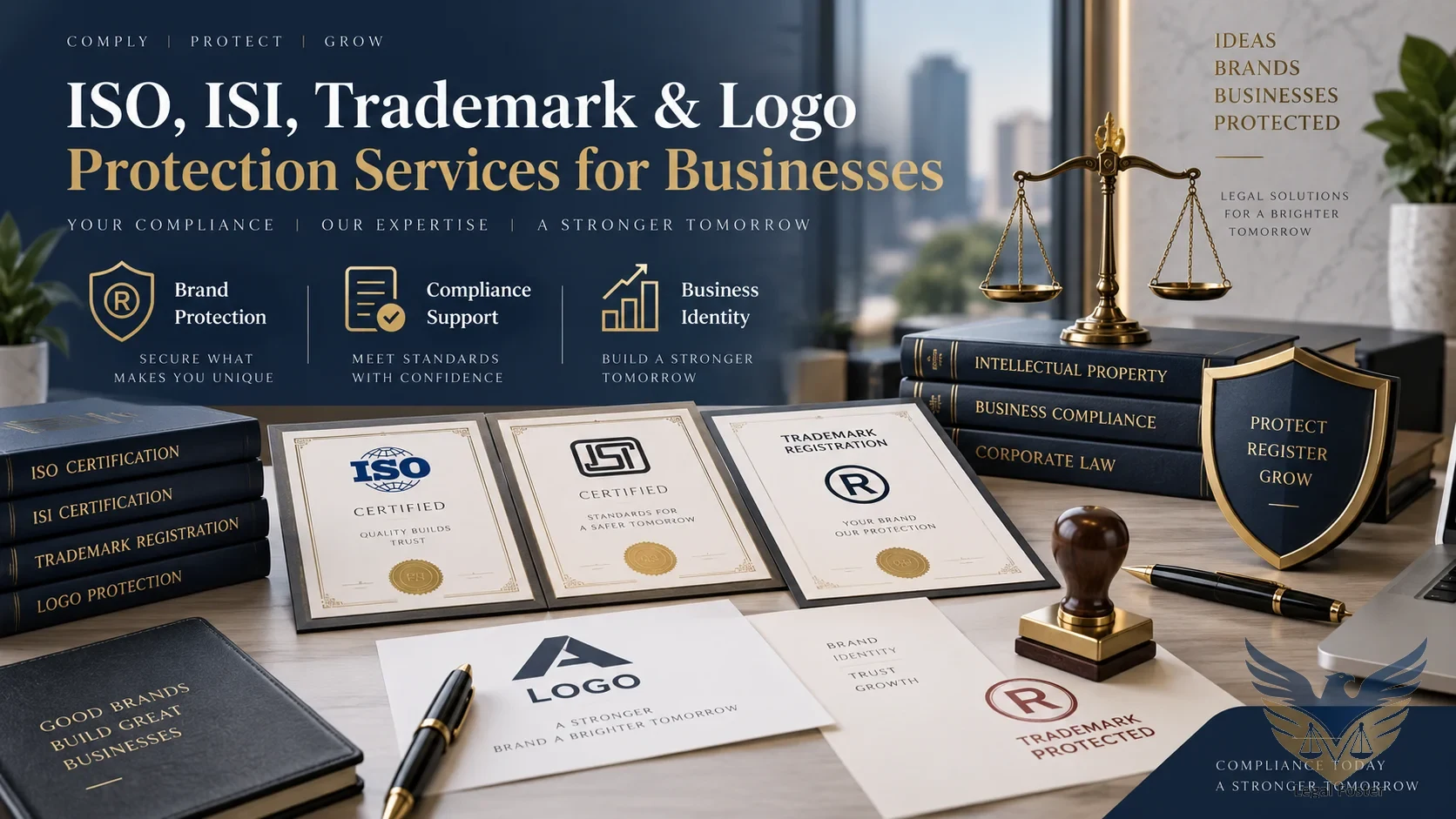
Why Do Businesses Need ISO, ISI, Trademark and Logo Protection Services?
A company can spend years working on product development, choosing a brand name, creating packaging, developing a logo and establishing trust with consumers. However intellectual property protection and certification are often left until something goes wrong for many businesses.
The manufacturer invests heavily in machinery and begins selling, only to find out the category has an Indian mandatory quality certification. The entrepreneur builds up his brand over two years, only to be told by the Trademark Office that another business owns a similar trademark. The importer places his first order, only to be told he cannot legally bring his products into India without conformity permission. Another business owner has a really unique technical invention but commercially launches it without properly considering patent protection.
These are four completely different issues. Though they are all commonly referred to as “ISO, ISI, Trademark and Patent Services for logos”.
“ITEServices” can be misunderstood.
ISO certification is typically about proving your product conforms to a particular international standard. ISO does not actually do certification but awards accreditation to independent organizations who are able to. ISI Mark is a certification scheme managed by the Bureau of Indian Standards. Products in India also use this but it applies to notified goods categories where it may be compulsory. Trademarks apply to words, logos and devices used by traders to identify their goods and services from others. Patents apply to inventions (ordinary trade logos would not qualify). Copyright can also apply to logos as the artistic elements can constitute an artistic work.
For businesses, semantics can have a real impact. Mistaken beliefs about one of the above can affect product launches, investment, manufacturing, imports, contracts, branding and growth.
BK Singh Advocate and Corporate Law Firm can help your business understand what, if any, of these certifications, regulatory approvals or intellectual property protections actually apply to your goods or brand. Before you spend any money.
If your business is looking for corporate lawyers get in touch with Corporate Law Firm to discuss not only law but also regulatory, commercial and intellectual property matters affecting your business.
Lets understand exactly what it is you need protected or need to comply with. Rather than throwing one term at four distinct legal concepts.
Why Do ISO, ISI, Trademark and Patent Issues Matter for Businesses in 2026?
Businesses operate on markets that stretch across the country and beyond. The small manufacturer in Noida sells to wholesale customers in Mumbai and Bengaluru. A Delhi based startup sells digital products online to customers all over India. A Gurugram company imports parts from overseas vendors, manufactures in India and wholesales to retailers under its own brand.
With every stage of business comes new compliance to consider.
Manufacturers should know about Indian Standards and Quality Control Orders applicable to their goods. These standards can impact your ability to legally manufacture, import, store, sell, or distribute certain products in India. For example, the BIS explains that while certification is voluntary for most products, “compulsory certification” is required for those products which have been added to the ‘mandatory certification list’ by the government issuing a Quality Control Order.
Distributors selling under their own brand name should watch out for trademark conflict. The best made product can encounter severe obstacles to conducting business if your company’s name or logo infringes on someone else’s prior rights.
Creators need to be aware of intellectual property issues. That technical invention you’ve developed? That new process you designed? That improvement to an existing product you manufactured? Each could have commercial value. But first you’ll need a thorough patent analysis to figure out if public disclosure would kill any chance at protecting your invention.
And then there’s ISO certification. Just as there are standards specific to certain industries and products, there are also ISO certifications. But they’re completely different. ISO isn’t an organization that certifies companies… they are the organization that establishes global standards and accredits the certifiers who examine companies.
There’s a lot of overlap in terminology. To save yourself unnecessary costs and delays, it helps to know the difference. Not knowing can lead even the well-intentioned company to file for things their business doesn’t need. Or worse – skip important protections or required approvals.
At CLegal and BK Singh Advocate we try to learn about your business first. We may ask about your business model, intended product or service, planned brand name, technology utilized, and commercial objectives. Once we have a good idea of how your company plans to make money we can guide you toward the necessary compliance measures or intellectual property protections.
Taking the time to understand your business up front is crucial. Especially if you plan to scale like you have envisioned for 20/26. Will your products be manufactured in large quantities? Imported or exported? Licensed or franchised? Will you sell on big online marketplaces? Or plan to sell directly to consumers from your own ecommerce store?
Quick Facts
- ISO develops International standards. But they do not issue ISO certificate to any companies directly.
- Product conformity assessment scheme like Scheme- I Standard Mark- commonly known as ISI Mark is administered by BIS in India.
- Certification scheme by BIS is voluntary in nature except for the products which fall under notified Quality Control Orders(QCO's) and become compulsory for the concerned products.
- Trademark helps you register distinctive words, names logos, devices, get up/ shapes/symbols, package or get up and some other elements of branding if they meet the requirements set out in the law.
- You cannot patent logo as such only because it is logo.
- Patent law protects only those inventions which are patentable under the Patents Act, 19 seventy.
- If there is any original creative content in logo then copyright law will come into picture of logo creation as per Copyright Act, 19 fifty seven.
What Is the Difference Between ISO, ISI, Trademark and Patent Protection?
ISO, ISI, trademarks and patents are different. They provide different commercial benefits.
ISO means international standards. BIS/ISI means your product conforms to applicable Indian Standards for that particular product. Trademarks protect brandings that are used to indicate commercial source. Patents “protect inventions”.
Business owners should understand this before sending an email to have one prepared.
“We want an ISO trademark registered/ ISI registration on our logo” or “Can you patent our brand?” are some of the questions I hear.
Business owners group all four terms together believing they’re the same type of registration that can be used interchangeably.
They can’t.
Qualification and certification – ISO explained.
ISO is the International Organization for Standardization. It doesn’t certify companies; it develops international standards. Covering many industry sectors.
If a business wishes it can apply for certification against a relevant ISO controlled management system or another certifiable standard. The standard being applied for should meet the companies commercial needs.
One mistake people make when saying they have “ISO certified” their business is believing that the ISO comes and conducts the inspection then issues the certificate.
On its website the organization is clear that it doesn’t certify companies; it provides standards. There are many independent external certification bodies that provide certification to ISO standards.
Obtaining an ISO certificate can benefit a company in many ways. It could help reassure customers, form part of your tender requirements, help meet contractual obligations, underpin your internal quality management or help strengthen your brands position within the marketplace. All dependant on the standard applied for and awarded.
What the certificate should do is define what your business has certified to, it should not be brandished about suggesting something more.
ISI Mark vs BIS Certification of Products.
ISI Mark accreditation and BIS Scheme-1 certification of products go hand in hand.
BIS will not allow a manufacturer to use a Standard Mark until it has tested the products and is satisfied they conform to the Indian Standard. Assessment looks at the manufacture infrastructure, quality controls and testing facilities.
“My product needs an ISI Mark”?.
No.
Does your product need to be BIS certified? Maybe.
This is very important for business owners to understand.
Some products fall under mandatory certification schemes. Some fall under alternate BIS schemes. Others are governed by voluntary standards.
BK Singh Advocate can assist you with understanding the legal position if you’re unsure about mandatory certification requirements, product categorization or liability under contracts with suppliers and customers.
Registration of Trademarks.
Trademarks are used to distinguish the commercial source of goods or services from others.
Trademarks. The definition of a “mark” is broad. Section 2 (1)m) of the Trade Marks Act, 1999 even states a “mark” can mean a device, brand, heading, label, name, signature, word, letter, numeral, shape of goods, get up, packaging or combination of colours.
Just because something may fall under the definition of a “mark”. It still must pass other statutory tests to qualify for registration.
You don’t need to register every element of your brand. Some of them may be eligible for copyright registration. This doesn’t mean you shouldn’t apply for trademark registration where necessary.
The business name is only one element of your brand that may need to be registered. Other aspects of the brands make up may need to be protected on their own.
The name of a product you sell may need registering. Your logo will most likely need protection. Maybe you use a special device when packaging or identifying the product. That may need protecting too.
Ask yourself these questions and more. It’s for this reason you should have a trademark strategy when developing your commercial branding.
Patents.
Patents have nothing to do with commercial branding. They’re there to protect inventions.
Patents Act, 1970 is the primary legislation that covers patents in India. Similar to the trademark legislation an invention must meet the definition and pass other statutory tests. Meaning you can’t just patent anything you come up with. Devices used for packaging or branding can be patented. But your logo won’t automatically be patentable.
Some inventions are specifically defined and excluded from being patented. Just because you have a novel business idea doesn’t make it an invention.
Yes, you should try and think of unique ways to market your business. You’ll become more competitive that way.
But coming up with a unique marketing plan isn’t an invention just because your plan is unique. Having a unique business name doesn’t make it automatically patentable. Same rules apply for your logo.
Its the technical substance of your product that could be patentable.
Why Is ISO Certification Important for a Business?
ISO certification can be used as evidence that your system, product or service meets the requirements of the chosen standard.
Whether certification is required or important will depend on your business.
You may need to provide products to institutional buyers who will only purchase from companies that have a certain management system certificate. Service companies can commonly face contractual requirements dealing with quality management systems. An organisation may seek environmental or information- security certification because their clients demand it.
Just ensure there is a valid business reason for you to be certified.
Certification can be taken advantage of. Certificates have been sold by companies purely based on the vendor promising an “ISO certificate” that can be delivered quickly.
That is bad news for you as the consumer.
Not only do you need to be aware of the certification body, scope, standard and agreements with whoever is accrediting the certification body. But, ISO also recommends you evaluate certification bodies AND confirm accreditation yourself. You also want to ensure the certificate matches your business and doesn't promise more than you are doing.
Don't tell everyone the government certifies your business in every aspect because you have one certificate that certifies your business for one specific scope.
BK Singh Advocate and Corporate Law Firm can help review commercial statements, agreements and compliance documentation when ISO certification is included in supplier qualification questionnaires, tenders or contracts.
Which Documents Should a Business Have Ready?
Documentation will change based on your specific service requirements.
A company looking for assistance with ISO related certificates would require very different records than another business who is in the middle of a trademark dispute or wants help determining ownership of a patent.
With that being said, a general business document pack may include:
ISO Certification Related Documentation
- Registration / Incorporation documents
- Description of business activity / operations
- Copies of current policies and management-system documents.
- Licences which relate to your business operations.
- Customer or tender specifications you are trying to meet.
- Proposed Scope that you would like to certify to.
- Previous certification (if already ISO certified).
- Correspondence with Certification Bodies.
BIS or ISI Related Documentation
- Product description and technical specifications.
- Copy of relevant Indian Standard ( if already determined).
- Detail of manufacturing process.
- Records of your factory.
- QC Records.
- Reports of any tests you have performed.
- List/specifications of machines and tools used in manufacturing.
- Examples of product labels /packaging your products are in.
- Import paperwork if your products are being imported.
- Copy of existing BIS licence /correspondence (if already obtained).
- Copy of relevant QCO.
Trademark / Logo Registration
- Proposed Brand name you wish to trade under.
- Logo images.
- Who owns the trademark.
- Description of the goods or services.
- Do you have an existing Use? If so, provide examples.
- Examples of Packaging.
- Website screenshots / Advertising material.
- Invoice(s) that show use of the brand.
- Designer contract. (if someone designed your logo)
- Assignment of Trademark. (This is needed if the trademark was designed by someone else)
Any conflicting Mark details if applicable.
Patent Filings
- Description of Invention.
- Drawings / diagrams of the invention.
- Records showing development process of invention.
- Who created the invention. (Inventor details)
- Contracts related to invention. (Employment contracts, Consultant Contracts)
- Research that was used.
- Did you publicly disclose the invention? Details of previous disclosure.
- Do you have any existing non disclosure agreements?
- Previous patent searches you had done. Or previous Applications (if any were done).
Not every business will need every document listed above.
BK Singh Advocate can review your corporate and contractual documents to help you establish ownership, who should be the applicant and what rights your business has before you commit to a particular course of legal action.
When Should a Business Consult a Lawyer?
Consult a lawyer before launching your lucrative brand. Before launching your regulated product. Before signing a technology-development agreement. Before purchasing intellectual property. Or making any substantial claims about certifications.
The process doesn’t necessarily have to start once you’re in a conflict.
- Here are some scenarios in which businesses may want to seek legal advice:
- If they get a trademark refusal or opposition.
- If another company is utilizing a confusingly similar trademark.
- If a manufacturer wants to know if they need BIS certification.
- If an importer accidentally discovers a related QCO
- If they are requested to supply an ISO certificate per request for quotation/specification or buyer agreement.
- If your company wants to know who owns intellectual property created by a consultant or employee.
- If your business gets a cease and desist letter.
- If your technology is being shared with another company.
- If investors are doing intellectual property due diligence.
- If someone wants to protect technical know-how with a patent.
Commercial decisions are often harder to reverse once a product launches. So act quickly.
BK Singh Advocate and Corporate Lawyer provides legal help to businesses, entrepreneurs and manufacturers in Delhi NCR and India who want to evaluate their options.
How Can Corporate Law Firm Help Businesses?
Sometimes intellectual-property issues and corporate compliance issues find their way into garden variety commercial contracts.
Your right to use a trademark may be conditioned on a franchise agreement.
Assignment of the subject of a patent may occur under a technology-transfer agreement.
ISO certification may be guaranteed as a condition of vendor prerequalification.
BIS compliance may be made a condition of supply under a contract.
When buying or selling a company sometimes we need to unwind who really owns the target company’s brand and technology.
That’s why we don’t always limit legal due diligence to the 3-page face of the registration certificate.
Corporate Law Firm will review the commercial transactions surrounding your certification, trademarks, logos, intellectual property, etc. This includes any licensing, company ownership and commercial agreements.
BK Singh Advocate will help you understand your rights under your contracts, company records, intellectual property ownership and any regulatory exposure you may face prior to a transaction or dispute spiraling out of control.
Our goal is not to promise your brand will be registered, your product certified or your invention patented.
Every situation will be evaluated based on the standard applied. The legal criteria, any prior rights, technical facts and documentation.
Why Should Startups Consider Brand and IP Protection Early?
Startups often focus on sales, fundraising and product development.
Lawyer up? Not usually.
Legal ownership is often an afterthought.
That can come at a price.
The founder may own the domain in his name, but it’s the company that’s using the brand. The logo may have been designed by a freelancer without any written agreement with an assignment clause. Software or technical content may have been created by a consultant under a vague contract.
An investor performing their due diligence will want to know more.
- Who actually owns the trademark?
- Does the company actually have rights to the logo?
- Are key technology rights assigned to the company?
- Are there any required certifications and are they valid?
- Is the business reliant on licenses that can be terminated?
These all have a direct impact on value.
Corporate Law Firm and BK Singh Advocate can help companies clean up legal ownership and commercial agreements such that your branding and IP align with the legal entity that’s actually using them.
Frequently Asked Questions
1. Is ISO and ISI certificate same?
No. ISO is the International Organization for Standardization that sets International standards. Bureau of Indian Standards (BIS) is the National Standards Body of India which has framed product conformity assessment schemes like ISI Mark Scheme .
Many people believe that companies get ISO certificate from ISO. But ISO creates standards, and certification bodies certify companies according to applicable ISO standards.
2. Do I need ISI certificate for all my products before selling in India?
No.
Certification to Standards of Bureau of Indian Standards is voluntary for most products unless made mandatory for a product through government order or notified under another regulatory requirement. Check with your supplier/manufacturer what applies to their product.
3. Can I patent my business logo?
In most cases, the mere fact that a logo identifies your business won’t be the type of thing that can be protected by patent law.
The first type of intellectual property protection you will usually want to think about for a logo is trademark registration. Secondly, copyright may apply to artwork. Speak to BK Singh Advocate to find out if your logo can be patented.
4. Can I register the company logo as a trademark?
Yes. It may be possible for a logo to function as a trademark if it meets legal requirements to do so.
“ A trademark can be a word or set of words, an advertisement slogan, a logo, a symbol, a design or a combination of these. A device is another form of a trademark.” Says IP India.
Whether registration is possible will depend on the specific mark and goods/services being considered, any potentially conflicting prior rights, among other legal requirements. BK Singh Advocate can help you determine if your logo can be registered as trademark.
5. If I register my company name, do I automatically get trademark protection on that name?
Not necessarily. The process of registering your company is different from registering a trademark. Each process has different requirements.
You may be able to incorporate aspects of trademark into your company name. But if you want trademark protection for your company name or your brand name you should register your trademark. BK Singh Advocate can help you determine if your company name should be registered as trademark.
6. Does ISO certify the companies for ISO certificate?
No.
According to ISO website , “ISO does not itself certify that companies meet particular standards. Each certification body is responsible for its own certification activities.”
7. Why do I need to check a trademark before launching my brand?
Someone else may have registered a similar trademark before you. That earlier trademark may impact your ability to use your desired brand. Discovering this information before spending money on packaging, advertising, website creation and distribution can save you money and trouble.
BK Singh Advocate can help you understand potential risks to your brand and if earlier trademarks may impact your ability to use your new brand.
8. If I am a foreign manufacturer do I need BIS certificate to sell my products in India?
Maybe. The official site of BIS says products that have been made subject to compulsory certification by notification cannot be imported into India except in accordance with the BIS requirements that are applicable to those products.
BK Singh Advocate adds that there is a certification scheme for foreign manufacturers for some products. Please contact us to find out if you need BIS certificate.
9. Can I patent any new idea?
No. Just because an idea is new to you or novel in a business sense does not mean it can obtain patent protection.
The Patents Act clearly mentions what can or cannot be patented in India. If you think you have an invention you want to patent contact an attorney to have it evaluated. BK Singh Advocate can help you determine if your idea is patentable.
10. When should I contact BK Singh Advocate about ISO, ISI Mark, trademark or patent issues?
BK Singh Advocate can help you if you’re about to launch a major brand or logo, plan to manufacture/import a product that requires certification or has been regulated by the government, license technology from another company, receive a notice from someone claiming you are infringing their intellectual property or enter into any kind of deal where valuable intellectual property is involved.
BK Singh knows how corporate structure, contracts and intellectual property can impact your business. Speak to BK Singh about your business. BK Singh Advocate and our Business Lawyers can assist you with any issues your business faces.
Final Thoughts
ISO certification, ISI mark, trademarks, logo registration and patents are NOT all the same type of registrations.
Neither do they provide protection from the same things.
ISO certification shows compliance against a particular international standard. ISO certifications are administered by third party certification bodies.
BIS and ISI are standards and product compliance requirements that are Indian standards. Compliance with those standards can be mandatory for certain notified products.
Trademark registrations protect brand names, logos and other identifiers of commercial origin.
Patents protect inventions. Copyrights can protect original artistic elements that make up a logo.
Instead of approaching registrations with a mindset of "What certificates can we get?" businesses should be asking,
"What do we actually need to legally protect or comply with for this product/brand/invention?"
Figuring out that answer can be the difference between being able to sell your product or not. Figuring that out can determine if you can protect your brand or if your intellectual property actually belongs to you. It can help ensure your contracts for your business actually reflect the rights you are buying or selling.
At Corporate Law Firm our clients range from startups to well established businesses. BK Singh Advocate can help you better understand these issues for your business in Delhi NCR and all over India.