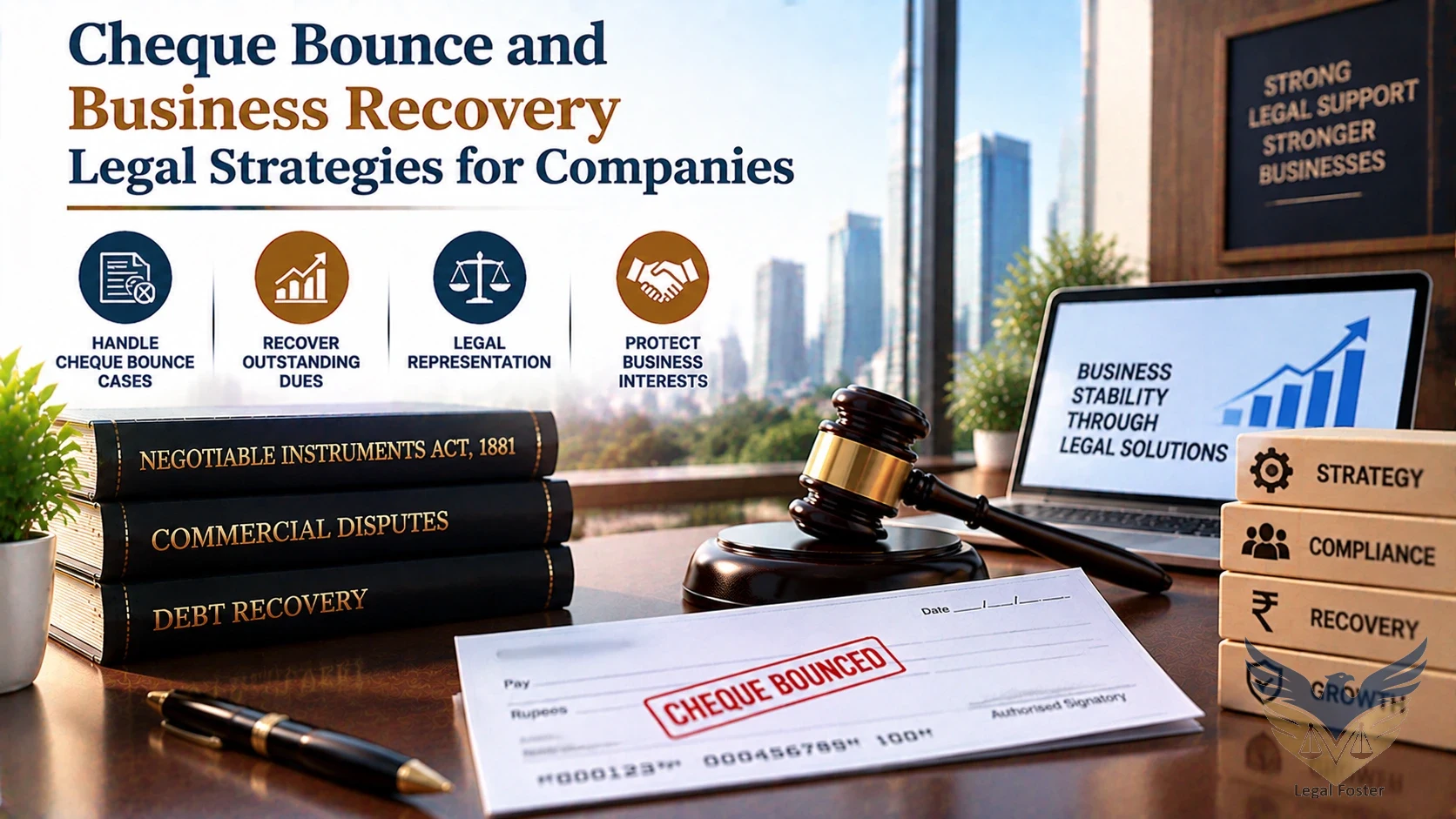
Cheque Bounce and Business Recovery Legal Strategies for Companies to Recover Payments
Cheque bounce can put a business transaction at risk. Cheque bounce is not just a banking issue faced by businesses. It affects their cashflow, payroll, payments to suppliers and future transactions with the defaulting customer. Businesses spend a lot of time thinking whether they should file cheque bounce cases against their customers or start recovery or settlement discussions. Issuing a legal notice for cheque bounce and recovering your money are two separate issues.
Our Cheque Bounce Lawyers will help businesses understand that they may have various remedies available to them based on the facts. Cheque dishonour complaint under Section 138 of the NI Act, 1881 and the recovery route may address different aspects of a dispute. We go through the contract, evidence of payment, correspondence and reason for dishonour to decide the right remedy for you.
If you are a business owner based in Delhi NCR, Mumbai, Bengaluru, Hyderabad, Chennai or anywhere else in India, you must have faced customers, distributors, contractors or clients who have not paid you despite following up with them many times. After a point you can’t wait any longer and you need to send them a legal notice to build more financial pressure along with evidence. The bankruptcy issues become very technical here and you need to approach a Cheque Bounce Lawyer to understand your options.
While cheque bounce cases are very straightforward in terms of sending a legal notice immediately after cheque dishonour and complying with the timelines under Section 138 of NI Act, businesses also need to consider the other recovery mechanism available to them. This could be through the contract, civil courts or arbitration (if included in the contract) or a settlement depending on the business relationship.
Many businesses think that stopping payment of cheque is the only option they have. It is always best to look at the larger dispute. Was a cheque received by you for a valid and enforceable debt? Do you have the invoices, POs, contract and proof of delivery? Is the other side calling you to settle the dispute before you commence further action? These are a few questions you should consider.
Balance is very important in Cheque Bounce and Business Recovery disputes. Understanding your legal rights and analyzing the commercial realities allow you to protect your financial interests and also keep settlements as an option open.
Why Does Combining Legal Remedies Matter for Businesses in India?
Companies lose valuable time when they focus on one solution. Say a cheque bounce complaint presses for criminal prosecution. Debt recovery or contract remedy may directly resolve the financial issue. One needs to decide what suits the best depending on the transaction documents and liability/defaulting behaviour of parties involved.
Filing the proper lawsuit for recovery is just the beginning. Companies must assess evidence, limitation period, record maintenance, and forum selection. Instituting litigation at the onset allows companies to course correct should there be issues that weaken their position down the road.
For businesses dealing with contractual payment obligations, Corporate Commercial legal services can be relevant where the dispute involves commercial contracts, business transactions and related legal rights.
Quick Facts About Cheque Bounce and Commercial Recovery
- Cases related to dishonour of cheque come under Negotiable Instruments Act, 1881.
- Section 138 can be attracted only when cheque is dishonoured for legally valid reasons and other conditions/statutory compliances are satisfied.
- There is a prescribed format and timeframe within which a cheque bounce notice should be served.
- Modes of recovery depend upon contract, documents executed & nature of business transaction.
- Invoices, agreements, bank statements and correspondence may turn out to be critical evidence. They should be preserved.
- Settlement can be done at any time till the end of proceedings as per law.
- Every cheque bounce case is decided based on facts and documents.
What Is the Legal Meaning of Cheque Bounce in Business Transactions?
Cheque bounce occurs when bank dishonours a cheque presented by the payee. Either the drawer has not made funds available or his account is closed /stop payment or any other reason why bank will not pay. Dishonored cheques by banks indicate payment default of business entities and may require legal attention. Cheque can be dishonoured under section 138 NI act, 18 81 and may become criminal if the transaction meets the threshold of legal parameters. The purpose of this statute was to enforce trust in dealings which are executed by cheque and allow legal action to be taken by the payee.
Not every cheque bounce is prosecutable. Each set of facts and circumstances are considered. Businesses should ask if the cheque was provided for an existing obligation, conduct due diligence of supporting documents to establish the transaction occurred and whether all statutory requirements were met.
Businesses should consult a Cheque Bounce Lawyer to review relevant transaction documents, underlying payment promises and available legal remedies before deciding to take any further action. This is especially important in commercial disputes where large amounts of money, multiple invoices, ongoing contracts or repetitive defaults are involved.
Where the dispute also involves borrowing, lending, guarantees or other financial arrangements, businesses may review the available Banking and Finance legal services relevant to the transaction.
Which Laws Govern Cheque Bounce and Recovery Proceedings in India?
Cheque bounce complaints are usually filed under Section 138 of Negotiable Instruments Act, 18 81 ("NI Act") which talks about the dishonour of cheque due to insufficiency of funds in the account or it over amounts which can become payable to the person who is issuing such cheque if it is considered as a valid liability. The established jurisprudence suggests that proceedings under Section 138 of NI Act can only be initiated after fulfilling the precondition of serving a demand notice within a time-frame from the date of receiving information about the cheque dishonour.
There may be alternative remedies available with the companies other than instituting cheque bounce case depending on the facts of the case in hand. For instance, if the claim for recovery is based on a contract, unpaid invoices, supply contract, service agreement, based on commercial transactions etc then some of these documents might also have arbitration clauses.
One thing to keep in mind that criminal proceeding under Section 138 of NI Act and Civil recovery suits serve different purposes. While former is to provide relief as per the statute for dishonour of cheque, later one is for recovery of the due amount.
You could negotiate, file for recovery proceedings, arbitration proceeding or initiate cheque bounce proceedings based on facts specific to your case. Consult a Corporate Lawyer to know more.
Where arbitration, mediation, negotiation or other dispute-resolution mechanisms are relevant, businesses can also review Litigation and Alternative Dispute Resolution services.
What Documents Help Strengthen a Cheque Bounce Recovery Case?
Documents play a crucial role in deciding a business case. Make sure to keep every documents related to sale and undertaking to pay.
Following are some of the documents that you must save.
- Cheque and bank return slip or cancelled cheque
- Invoice, POs and Delivery slips
- Contract/ agreement/ work order
- Receipt of payment/Account ledgers
- Email/text message/ any written communication
- Legal notices and reply served by you/ the opposite party.
If your records are poor you will be at a disadvantage if the matter is taken to Court. Many businessmen focus only on the bounced cheque rather than proving the liability.
Good record-keeping enables BK Singh Advocate to look at the dispute from a wider legal perspective and identify possible remedies.
Where the underlying agreement, work order or commercial arrangement is central to the payment dispute, Contract Management legal services may also be relevant to reviewing the contractual framework.
When Should a Company Consult a Lawyer?
It is advisable to take legal opinion when a party has defaulted multiple times, the amount is large, there is any dispute on liability or doubt on the appropriate legal forum to approach.
You should take legal opinion before sending notices and initiating proceedings as mistakes in documents, timelines or legal rights involved can affect your dispute. A lawyer can guide you on evaluating whether the dispute necessitates cheque bounce proceedings, recovery suits, settlement discussions or a combination of all the remedies available to you.
If your business is located in Delhi NCR, Noida, Gurugram, Mumbai, Bengaluru or any other business city, contact us and let us protect your business interests without needless delay.
Businesses that need continuing legal assistance across contracts, disputes and day-to-day legal issues may also consider General Counsel Services.
How Can Corporate Law Firm Help Businesses Recover Outstanding Payments?
When cheques bounce or payment disputes arise, it occurs to businesses of all sizes. Whether you operate a small business / startup / MSME or you have commercial contracts with larger corporations. The right legal approach takes into account transaction history, evidence you have available, payment terms and intent of the parties.
Clients reaching out to Corporate Law Firm have their cheques dishonour disputes assessed. This includes disputes related to commercial contracts, unpaid invoices and what remedies may be available. Instead of rushing to file a lawsuit, we first want to assess what remedies are available for a particular dispute.
Lawyer review includes: Was a cheque issued for a legally enforceable debt? Were notices drafted properly? Are there contractual remedies that can be triggered? If needed, we can also discuss the possibility of settling the matter to prevent future delays.
Facing payment issues from your client's or suppliers? BK Singh Advocate / Lawyer / Firm Name (DRT LAWYER) can assist you with your commercial payment disputes. We go over the documentation, whether there is compliance with the legal requirements and impacts it may have on your business. Since each case is different, legal advice would involve the attorney reviewing the specific matter. The facts, evidence and laws will determine what course of action would be best for any particular matter.
Give us a call to find out more about cheque dishonour, debt recovery, commercial disputes and legal notice. Always consult a professional before taking action.
For businesses reviewing regulatory records and supporting documents alongside a commercial dispute, Audit Diligence and Compliance services can also be relevant.
Frequently Asked Questions :
1.Can companies initiate legal proceedings for cheque bounce?
Yes. Legal action can be initiated in case a cheque bounces, under Section 138 of the Negotiable Instruments Act, 1881 when certain legal conditions are met. Additionally, there could be other remedies available for recovery depending on the nature of the transaction and documents executed between parties.
2.Can a cheque bounce case and recovery suit filed together?
Yes. Cheque bounce Proceedings and filing for recovery remedy different causes of action arising out of failure to pay. However, the availability of multiple remedies would depend on the facts of the transaction, the contract and the governing law.
3.What is the time required for cheque bounce case to get over?
This would differ on a case to case basis. Depending on the availability of the court’s calendar, evidence, cooperation of parties and numerous other procedural matters which may or may not arise during the course of litigation, it’s difficult to determine how long it would take to get a resolution.
4.Is it necessary to send legal notice before filing cheque bounce case?
Yes. Sending a legal notice before initiating legal proceedings for cheque bounce is mandated under Section 138 of the NI Act.
5.What documents are required to file a case for cheque bounce from company?
The documents which help establish the transaction would be useful. This includes the cheque itself, bank return memo, invoices, agreement, delivery (if any), account statements and correspondence between the parties.
6.Can a cheque bounce be settled after a case is filed?
Disputes can be settled between parties at various stages of litigation. But please keep in mind that there are certain laws which govern settlement in such matters and the procedure as set forth by the courts also has to be complied with. You can contact a lawyer to understand the implications of settling a cheque bounce dispute in your specific matter.
7.What happens if the cheque is issued as a security cheque?
The facts and evidence would determine the legal standing in cases where cheque have been issued as security. Whether there is any liability would also be a question of fact depending on the transaction. These situations are very fact specific and would have to be analyzed accordingly.
8.Can startup and MSME file a case if cheque is not cleared?
Yes. All businesses (including startups and MSMEs) have legal options they can pursue in order to recover unpaid payments. The agreement between the parties, history of payment, nature of the transaction would help determine what course of action is best suited for your specific situation.
9.What is the importance of maintenance of invoice/payment by businesses?
Just like keeping records of any important matter is important, businesses should maintain invoices/payments made. This helps establish the nature of relationship between the parties, liability due and the payment history. This may be useful in any future legal proceedings or negotiations.
10.How Can BK Singh Advocate / Lawyer / Firm Name (DRT LAWYER) assist you?
BK Singh Advocate / Lawyer / Firm Name (DRT LAWYER) can help you by going over the facts surrounding your cheque bounce situation, reviewing your commercial agreements, documents related to the recovery of funds and what legal options are available for you to pursue.
Final Thoughts :
Cheque bounce cases have financial hardships like no other on your business when payments aren’t received on time. Late payments affect your day-to-day operations as well as your business’ contractual obligations. Learn about your statutory remedies for recovery and settlement options. Knowledge is power and can help you make the best decisions for your business.
Go over your paperwork, statutes of limitation, and transaction details immediately to avoid expensive errors. Exercise caution moving forward with a dispute, especially if it’s moved past sending several payment notices.
BK Singh Advocate / Lawyer / Firm Name (DRT LAWYER) can assist you with your cheque bounce/recovery problems by advising you on a realistic legal game plan. Every case is different so let us review your commercial dispute.
Businesses with funding or financial technology-related legal requirements can also explore Fintech legal services where relevant.