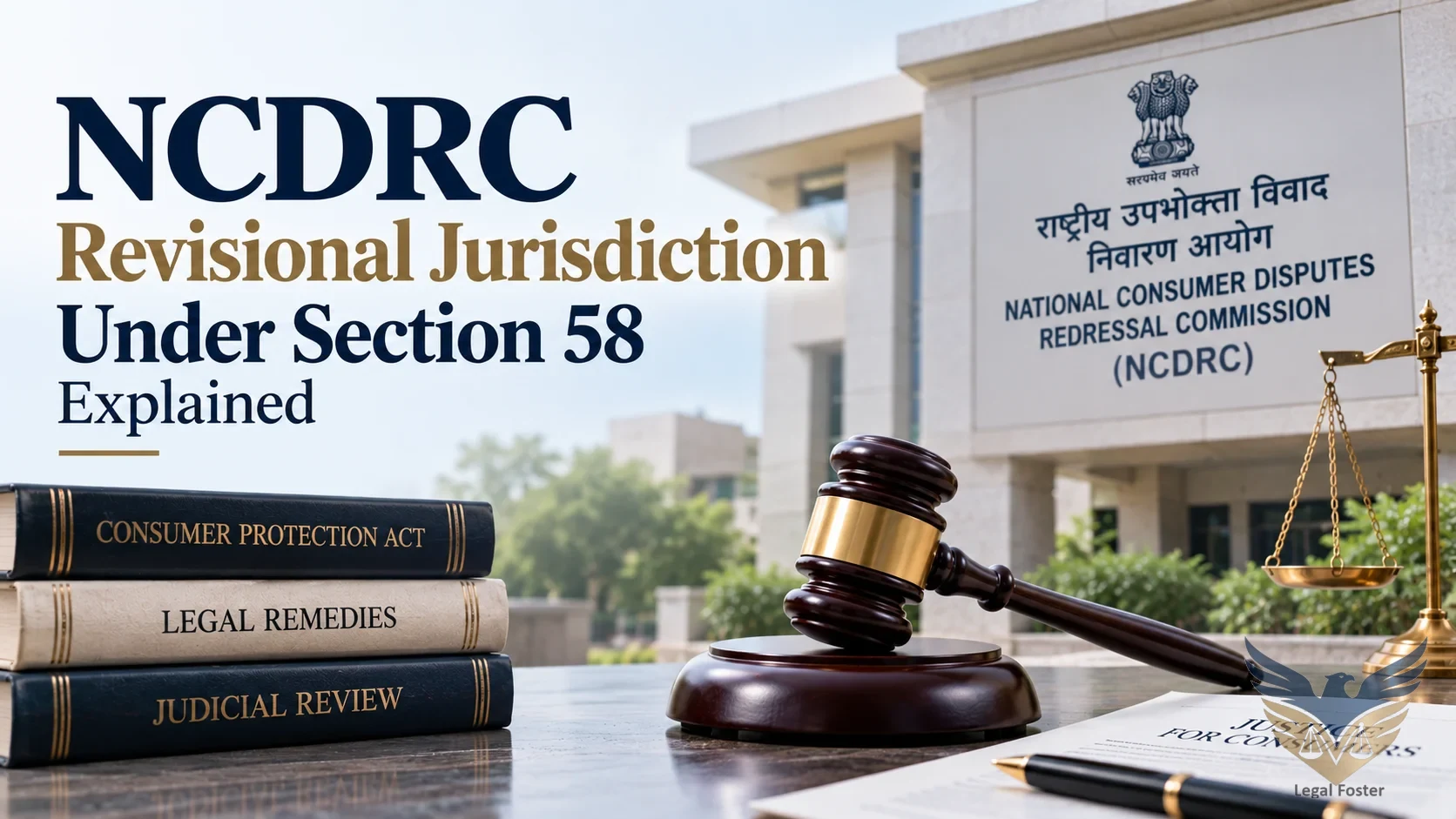
Understanding NCDRC Revisional Jurisdiction Under Section 58
When you receive an order by the State Consumer Commission that you're unhappy about whether you are a customer/builder/insurer/bank/service provider. Your first question would probably be "what can I do?". A Revision Petition under section 58 before the National Consumer Disputes Redressal Commission ("NCDRC") may lie in some instances. However a revision petition under section 58 is not meant to be treated as a second appeal.
Under section 58(1)(b) of Consumer Protection Act 2019 provides for the power of the NCDRC to call for the records of any proceeding of consumer complaint before or decided by the State Commission. Where it appears to the NCDRC that the State Commission has exercised jurisdiction not vested in it by law, or has failed to exercise jurisdiction so vested in it by law, or has acted illegally or with material irregularity in the exercise of its jurisdiction.
There lies the rub. When a party is not satisfied with the decision made by the State Commission, it does not automatically translate into a revision. Many judgments by the Supreme Court have taken a view that the Revision Jurisdiction of the NCDRC is very limited and should not be used as a substitute to appreciate evidence or interfere with concurrent finding of facts.
Therefore when you receive such an order whether it may be in Delhi NCR/Noida/Ghaziabad/Gurugram/Mumbai/Bengaluru/Hyderabad or any part of the country. The first question that should pop in your mind is not how will I challenge this order but rather by what mode can I challenge this order.
Why Does NCDRC Revision Matter in India in 2026?
Sometimes there could be situations where the Consumer Complaint is transferred from District Consumer Commission to State Commission and then to the National Commission. At the time of passing order by State Commission you will find a lot of records. The record may contain complaints,replies,rejoinders,affidavits,evidence,documents,orders and other applications filed.
Many times Consumers/ Defendants are confused about how to identify what is a simple dispute and what is a jurisdictional dispute that should be contested on bona fide basis. This is a common dilemma faced across India.
The NCDRC which is located at New Delhi works as the National Consumer Commission. Under section 58 the court is vested with original and appellate jurisdiction. Also with the required Revisional jurisdiction in this case.
If the Case falls under Delhi NCR ( Cases arising from Delhi, Noida, Greater Noida, Ghaziabad, Gurugram and Faridabad). Studying the Order by State Commission might come in handy if you are planning to challenge the Order on grounds of Jurisdiction/ Material Irregularity.
Quick Facts
- Section 58(1)(b) Consumer Protection Act, 2019 talks about the revisional jurisdiction of NCDRC.
- It says that any order passed by State Commission or any appeal that is still pending before a State Commission can be revised.
- Either the court did not exercise it's jurisdiction when it should've or exercised its jurisdiction when it shouldnt of. Or if it was exercised in a illegal manner or with material irregularity.
- As you can see revisional jurisdiction is very lesser when compared to an appellate scrutiny.
- The Supreme Court has held on many occasions that courts should not indulge in revisional jurisdiction in order to re-appreciate evidence or find fault with concurrent findings of facts.
- Even according to NCDRC's own website "Time Limit: A petition of revision may generally be preferred within a period of 90 days from the date of receipt of certified copy of order of State Commission."
- So as you can see there will only be scrutiny on the case and the orders of the State commission.
What Are the Main Grounds for Revision Before NCDRC?
There are 3 types of situations that would meet these statutory provisions.
1. State Commission exercised a jurisdiction which was not vested in them by Law.
This would mean that they acted outside there jurisdiction that was allowed by law.
2. State Commission failed to exercise a jurisdiction which was vested in them by law.
Here you would argue that they did not act upon a jurisdiction that was allowed by law.
3. Acted illegally or with material irregularity in exercise of their jurisdiction.
As you can see with the wording in the law we are talking about how they used there jurisdiction. You do not have the right to challenge every finding of fact.
If any amendment is going to be made it needs to be looked at in reference to what the statute says not your feelings about the order.
Someone could always feel as if they were not served when they lost their consumer case. But we need to look at the law.
How Is Revision Different From an Appeal?
One of the issues which frequently come up while dealing with NCDRC is knowing the difference between a Revision Petition and Appeal.
As mentioned above under section 58(1)(a)(iii) provides jurisdiction to the National Commission to hear Appeals from decisions/order by the State Commissions. Whereas Section 58(1)(b) deals with Revisional Jurisdiction as explained above.
So there arises a question as to what constitutes an Appeal and Revision. You would want to file an appeal from an order of a State Commission (Ordinary Bench). Just because you may want to invoke revision do not term it as such.
When the Supreme Court has been exercising its revisional jurisdiction under Consumer protection laws they have always made a distinction. It cannot go into the concurrent findings of fact by the State Commission by going through the evidence placed before them.
Therefore always look at the Order which you are challenging first while understanding the issue before you with NCDRC and then move on to what relief your client wants. If you need assistance with Drafting Revision Petition before NCDRC please visit our Revision Petition before NCDRC Page.
What Documents Are Usually Important for an NCDRC Revision?
One should not look into last page/order to assess a revision petition.
Order of State commission, District Commission Order, Complaint filed before DC, Written version/reply, Rejoinder if submitted, Affidavits and evidences/documents which party has placed their reliance upon are all the records. Have a look at the material filed by NCDRC itself while passing their order they have mentioned about such records being record of revision.
These are few which comes to my mind:
- Certified Copy of impugned order of State Commission
- District Commission order
- Complaint filed by Consumer
- Written Version/ Reply
- Rejoinder if any
- Evidences and affidavits
- Documents placed on record before consumer commissions
- Any Interim order passed (if related)
- If there is any appeal/ revision filed then its details.
- Document showing limitation and service of order.
We in BK Singh Advocate will take up the matter after analysing the complete procedural history not looking at the para which is challenged. Using this history you will come to know whether it's about Jurisdiction or material Irregularity or what is being contended.
What Problems Can Arise While Preparing a Revision?
As soon as they get an adverse order they start searching for an "NCDRC revision lawyer". They should know whether their case is appeal able revision able review able or has any other remedies available.
Lack of pleadings and evidence is another problem. If evidence is absent then you might not be able to understand why the State Commission came to that decision. Another thing you would have to figure out is whether your grievance is one of jurisdiction or merits.
Third you have limitation period. There is only 90 days given by the NCDRC rule book to move a revision petition. So act fast.
Overstating your issues. Just calling all your issues material irregularities is not going to help if your grievance lies within facts.
This is where BK Singh Advocate tries to decipher what the actual issue at hand is with the State Commission order.
When Should You Consult an NCDRC Lawyer?
Will help when it appears that the State Commission has taken up a cause which was beyond its scope. Or they did not take up any powers that were available to them. Also if procedure/jurisdiction is grossly irregular.
You may want to talk to us at the time of receiving the order as well to know your limitation period.
For consumers please bring along the order and past documents in your case. If you are a Business/Insurer/Builder/Hospital etc we would also ask that you have any internal files/data pertaining to your facts available.
If you live outside Delhi you can initially speak to us on the phone. We will advise you on what you can bring/do when coming from another city.
We represent clients across Delhi NCR & all over India on matters that are heard before the NCDRC. Please visit our website to learn more about us being a NCDRC Lawyer and our practice.
How Can NCDRC Lawyers Help With a Section 58 Matter?
This process is technically known as revision. Your attorney will begin with legal research by studying the order of the state commission you wish to revise and your consumer file.
You will need to conduct legal research to see if your complaint qualifies under section 58(1)(b). Is there any other relief available to bar your claim or a limitation period that applies. What information do you need to lay before the commission to establish the facts in your case.
Your attorney can assist you with compiling your petition, affidavit, evidence and history of the proceedings. As mentioned earlier the NCDRC website explains the information that is required to file a revision. Make sure you have all your material properly indexed and paginated.
You want to be as informative as possible in your statement of facts but do not overstate the situation. A lawyer that will tell you for certain that the NCDRC will accept your revision against a State Commission order is not practicing ethical law.
Contact BK Singh Advocate if you would like more info on Revision vs an Appeal.
Frequently Asked Questions
1. Revisional Jurisdiction of NCDRC u/s 58
When can the National Commission call for records of the State Commission? Under section 58 of the Consumer Protection Act 2019.
2. Are all orders of the State Commission challengeable through Revision to the National Commission?
Every order which is adverse to you cannot be challenged by way of revision to NCDRC. Your proposed facts should fall under Section 58(1)(b) grounds for revision. You might have to challenge by way of appeal in some other cases.
3. Will NCDRC consider revision petition and appreciate evidence?
The power of NCDRC on revision petition is limited. It was clearly mentioned by Hon'ble Supreme Court that it cannot resort to revision petition to interfere with concurrent finding of facts and appreciate evidence.
4. Time period to file Revision Petition before National Commission?
According to Consumer Protection Regulations issued by NCDRC, there is limitation of 90 days to file a revision petition with them. Limitation starts from the date you receive the certified copy of the order.
5. What all needs to be filed for revision to NCDRC?
Record generally contains order of State Commission and District Commission. Also consumer's complaint, reply and rejoinder, evidence filed by parties and documents. As per filing material given by NCDRC they also consider affidavit and applications filed by parties as a part of the record.
6. Is there any difference between filing a appeal to National Commission and filing a revision?
Yes. There is an option of both Appellate jurisdiction and Revision jurisdiction under section 58 of CPA 2019. Depending on the nature of your case you may want to proceed with either filing an appeal or revision petition.
7. If finding of facts by State Commission is incorrect can the consumer move for a revision?
If you feel the state commission made a finding of facts which is incorrect you may not be able to challenge it on revision. You need to look at section 58(1)(b) of the act to challenge their order. Power of NCDRC is limited in light of various judgments by the Supreme Court.
8. Can we move to National Commission for dispute arising from Delhi NCR area?
National Commission is situated at New Delhi so they have the jurisdiction to entertain cases across India as per Consumer Protection Act 2019. If the conditions are fulfilled then yes parties from Delhi NCR can approach National Commission.
9. Can I seek a stay of order while filing revision to National Commission?
You can seek stay by way of interim reliefs subject to law. But merely filing a revision doesn't mean that a stay will be given.
10. How can BK Singh Advocate assist you with your revision to NCDRC?
BK Singh Advocate can assess your order of state commission, case record, limitation and ground on which you wish to proceed. From that he can guide you whether to proceed with a revision petition or you may have some other remedy available.
Conclusion
This revisional jurisdiction cannot be exercised for every kind of case under section 58. Its not some super body which can try all cases afresh. Nor does it have the authority to provide second chance on every decision of consumer commission which goes against the interest of consumer.
If the above facts falls under section 58(1)(b) will it amount to invocation of revisional power of state commission. This would need perusal of entire records and the said order. Keep in mind about limitation and difference between an appeal and revision.
Whether you are a consumer or a business. From Delhi NCR or rest of india. You should get your case assessed at the earliest so that you can resolve the issue within time limit. We at BK Singh Advocate - NCDRC handle revision petition against orders of consumer commission.
Hence in case you have received an adverse order from your respective state commission. And want to know if its appropriate to invoke revision power of NCDRC. Please feel free to get an opinion over your case documents.
Also read about how NCDRC Timelines and Hearings work here.