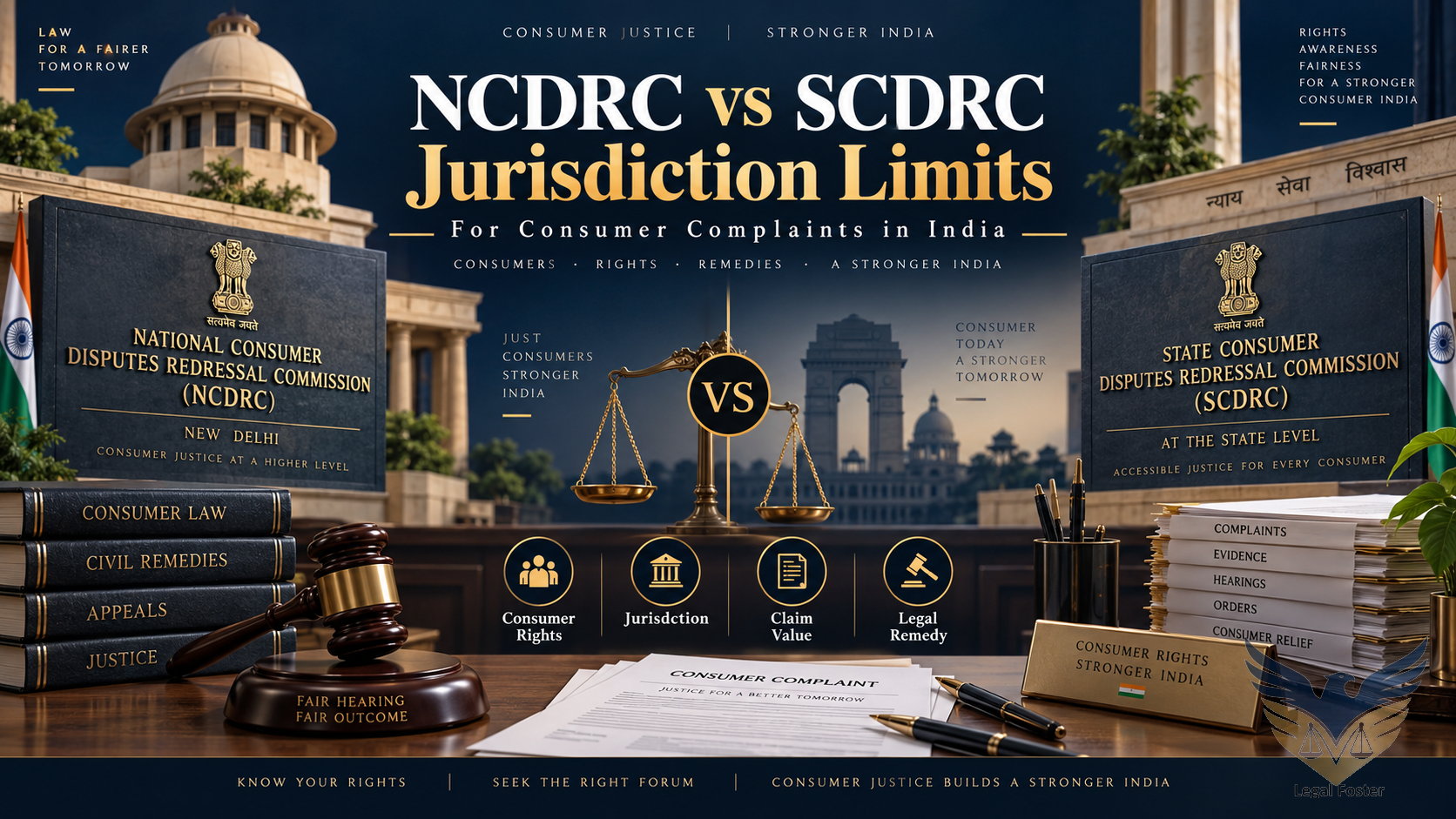
NCDRC vs SCDRC Jurisdiction Which Consumer Commission Has the Right Authority?
The most asked question is typically asked after a dispute has already arisen. E.g., A homebuyer has advanced ₹70 lakh to the builder; A policyholder has a claim disputed/ denied by the insurance company; A customer purchased a defective high-value item.
A simple question that consumers ask is – whether the complaint can be filed before the District Consumer Commission / State Consumer Commission / National Consumer Disputes Redressal Commission (NCDRC).
However, the answer does not depend only on how much compensation is sought by the consumer. Pecuniary jurisdiction today depends primarily on the value of goods/services for which payment was made. As per Consumer Protection Jurisdiction Rules, 2021 (“jurisdiction rules”), District Commission can entertain claims where consideration is up to ₹50 lakh; State Commission for ₹50 lakh to ₹2 crore; NCDRC for claims over ₹2 crore.
The significance of this new change is lost on many articles written until last year and many websites that still mention ₹1 crore and ₹2 crore limits under Consumer Protection Act, 2019. This is because while Section 34 of the 2019 Act does begin with District Commission having jurisdiction for ₹1 crore; it also goes on to allow the Central Government to prescribe a different amount. The government has since then used the 2021 jurisdiction rules to change the pecuniary jurisdiction effectively.
Consumers anywhere, whether in Delhi NCR, Mumbai, Bengaluru, Hyderabad, Chennai, Kolkata, Pune, Ahmedabad, Jaipur, Lucknow or elsewhere in India will benefit from knowing the correct forum at the beginning itself. This can help avoid unnecessary jurisdictional objections and save time during proceedings. The lawyers at NCDRC can help consumers determine whether a matter would fall under the District Commission, State Commission or the NCDRC exclusively, depending on the facts, consideration paid and applicable territorial jurisdiction.
Why Does the NCDRC vs SCDRC Jurisdiction Limit Matter in 2026?
You see why this distinction matters? Consumer forums have territorial jurisdiction only to such extent as is provided by statute. File a complaint in a wrong forum and your entire application may be rejected just by raising a jurisdictional objection. What happens then? Cost, delay and additional remedial procedural steps are what happens then.
Just to give you a simple example, suppose a consumer has paid ₹35 lakh for availment of services. He wishes to file a complaint for claiming substantial compensation against alleged deficiency in services. ₹2 crore is therefore not going to be your starting point for determining pecuniary jurisdiction.
Read the jurisdiction rule applicable. It speaks of value of “goods or services” over which the consideration is paid.
That’s why figure of ₹2 crore in an old blog post of ours is not going to cut it if you want to file a complaint in year 2026.
Second big misconception we see here is – People treat NCDRC as if it were a Consumer court for everything high-value. It isn’t. National Commission has original jurisdiction in respect of complaints beyond the pecuniary jurisdiction of the District Consumer Disputes Redressal Commissions.
Remember National Commission also has appellate and revisional jurisdiction over orders passed by State Commissions and District Forums respectively.
Here’ issue number two with regard to Territorial Jurisdiction. The consumer also needs to understand where he can actually file after figuring out the appropriate forum level.
Section 34 specifies multiple territorial connecting factors for District Commissions. These are – residence or place of business of opposite party, where cause of action arose, and residence or place of work of complainant.
Quick Facts
- District Consumer Commission: If value of goods/services & compensation claimed does not exceed Rs.50 lakh, i.e., consideration up to Rs.50 lakh.
- State Consumer Commission: If value of goods/services & compensation claimed exceeds Rs.50 lakh but does not exceed Rs.2 crore i.e., consideration exceeding Rs.50 lakh and up to Rs.2 crore.
- NCDRC: Value of goods/services paid as consideration exceeds Rs.2 crore, only for filing of original complaint by a consumer.
- Value of goods or services paid as consideration is the parameter for determining pecuniary jurisdiction.
- Claimed compensation will not be automatically considered as jurisdictional value.
- State Commissions have jurisdiction only at the appellate stage i.e., appeals against the orders of District Commissions under their jurisdiction.
- National Commission has jurisdiction at both appellate and revisional stage in consumer matters where it has appellate jurisdiction.
- There’s also place based jurisdiction, also referred to as territorial jurisdiction. We will learn separately.
What Documents Help Establish Consumer Court Jurisdiction?
Step 1: Documentation creating a clean undisputed factual record.
It doesn’t matter if the consumer dispute is with a builder, insurer, bank, hospital, college, manufacturer, e-commerce portal, developer, service provider or any other trader.
Important documents include (but may not limited to)
- Agreement/purchase order/service agreement
- Invoice/receipts
- Bank statements/payments made
- Allotment letter/possession documents
- Insurance policy and correspondence regarding claim
- Warranty/service records
- Emails/Messages/complaints made in writing
- Legal notice and reply if any.
- Photographs/inspection/inspection report/technical documents.
- Demand for refund/reply
- Proof to show that cause of action arose where alleged. (place where transaction took place)
- Identity/address proof if necessary.
You will have documents based on your facts. Our Lawyers at NCDRC can review the documents you have and advise whether the paperwork supports the forum you have approached as well the claim for relief you seek as a consumer.
When Should a Consumer Consult a Lawyer?
Need not wait till the consumer complaint is completed. Advise seeking such review in advance makes sense if say, the value of the transaction is hovering around a jurisdictional limit :
Dispute of ₹48 lakh & ₹52 lakh value may get caught in two different Original Forums. A ₹1.9 crore dispute also materially differs from a ₹2 crore+ dispute, for pecuniary jurisdiction purposes.
Engaging a Lawyer is especially advisable when:
- Dispute Value is about ₹50 lakh or ₹2 crore.
- There are More than One Products or Services concerned in the dispute.
- There are multiple Consumers involved in the dispute.
- Builder / Insurer / Bank / Large Service Provider raising a jurisdictional objection.
- Uncertain about filing your matter as an Original Complaint or Appeal.
- The consumer dispute is across two or more States.
- Old website information showing different jurisdictional limits.
- Are the documents required to support your consumer complaint.
What Consumer Disputes Can Reach the NCDRC?
NCDRC deals with consumer disputes of such nature (value) which fall within its pecuniary jurisdiction.
Typically disputes related to real estate, insurance, finance/loan services, motor vehicles, purchases of high valued consumer goods and others goods/services.
Even if case is filed in NCDRC,consumer is not automatically entitled to get relief on all grounds he has claimed in his complaint. Consumer must prove the deficiency/service defect/unfair trade practice or some other valid ground as the law recognises and substantiate the claims he makes.
NCDRC does not entertain ONLY original complaints. Its appellate and revisional jurisdiction is talked about even on the official website and in the material they publish.
So Consumer should not treat "NCDRC case" as some different kind of consumer right.
Its more of a forum/jurisdiction issue within Consumer Disputes Redressal system.
What Should Consumers Check Before Filing a Complaint?
There are some basic questions a rational pre-filing analysis would attempt to answer.
What did the consumer actually buy/pay for? Secondly, how much consideration was offered? Thirdly, what act of the counter- party is the consumer complaining about? Fourthly, where did the transaction/arise cause happen?
Does the Complaint fall within limitation? Are there any statutory/procedural red flags you should know about? Please do not treat Consumer Complaints like hypotheticals where the only issue of law is forum shopping.
Ask your NCDRC Lawyers to assist you in organizing these questions into a sensible forum analysis. This is particularly useful where the consumer has already sent several notices or letters to the opposite party.
How Can NCDRC Lawyers Help With Consumer Commission Matters?
Typically, customers approach NCDRC Lawyers when they have received a defective good/service, experienced delayed service, been denied insurance claim, received sub-standard professional service, delayed possession or any other consumer complaint.
From facts, lawyers are typically able to determine the likely forum (District, State or National), monetary jurisdiction, territorial connection, documentary evidence and overall relief structure.
We represent customers across Delhi NCR and other cities in India. We have helped customers determine if their dispute belongs in the District Commission, State Commission or NCDRC.
Our service isn't just valuable for high-value complaints. Whether a matter can be filed in the District Commission vs. State Commission vs. National Commission based on jurisdiction can play an important factor in smaller matters too. Limitation, Evidence and jurisdiction issues can arise in claims of all sizes.
Frequently Asked Questions
1. What is NCDRC limit?
The pecuniary jurisdiction of NCDRC generally would have original jurisdiction for filing complaints where value of goods or services paid as consideration exceeds ₹2 crore. These jurisdictional limits are as on 20twenty1 and are published by NCDRC in their NCDRC Practice Directions.
2. What is SCDRC limit?
The pecuniary jurisdiction of State Consumer Commission generally would have original jurisdiction for filing complaints where value of goods or services paid as consideration exceeds ₹50 lakh and up to ₹2 crore. State Commission also has appellate jurisdiction for entertaining appeals from orders passed by the respective District Commission.
3. What is District Consumer Commission consumer complaint limit?
The District Consumer Commission generally has original pecuniary jurisdiction for matters where value of goods or services paid as consideration does not exceed ₹50 lakh.
4. Does consumer court limit depend on compensation claimed?
No. Value of goods or services paid as consideration is the primary pecuniary criteria used to determine at which Commission a consumer complaint can be filed. Under current jurisdictional limits mentioned above, a consumer should not expect that his complaint would qualify for filing before a higher commission just because he demands a high compensation amount.
5. Can I file ₹1 crore consumer complaint before State Commission?
Yes, generally speaking if the value of goods or services paid as consideration is more than ₹50 lakh but up to ₹2 crore you can file complaint before the State Commission. Of course, territorial as well all other jurisdictional aspects would need to be satisfied.
6. Can ₹2 crore consumer complaint go to NCDRC?
No, not generally as original complaint. ₹2 crore value of goods or services would fall within jurisdiction of State Commission as NCDRC pecuniary limit starts for cases where consideration paid is more than ₹2 crore. However you should look into the underlying transaction and rules applicable before approaching any consumer commission.
7. Can I file ₹3 crore consumer complaint before NCDRC?
Yes, as an original consumer complaint where consideration paid is more than ₹2 crore would generally qualify to file case in NCDRC. Of course all other requirements under Consumer Protection Act and rules would need to be satisfied.
8. Can I file a complaint under ₹2 crore before NCDRC?
No, not as original complaint. Matters beyond ₹2 crore are generally entertained by NCDRC as per pecuniary jurisdictional limits mentioned. However please note that NCDRC has appellate and revisional jurisdiction as well. Hence technically a matter filed before any lower consumer forum has the ability to reach NCDRC via these routes.
9. What is the full form of SCDRC?
SCDRC stands for State Consumer Disputes Redressal Commission. State Consumer Commission is established under Consumer Protection Act, 2019 and has pecuniary jurisdiction as well original and appellate jurisdiction as specified in the statute.
10. What is the full form of NCDRC?
NCDRC stands for National Consumer Disputes Redressal Commission. It is India’s apex consumer dispute redressal body. NCDRC has headquarters in New Delhi and has original, appellate and revisional jurisdiction as per consumer law.
Conclusion
In order to determine whether your consumer dispute should be filed in NCDRC or SCDRC first mentally wipe out the old consumer law limits you will still see posted all over the web. Under the current scheme effective at time of writing, for original filings the monetary jurisdiction of the District Commission generally extends to ₹50 lakh, that of the State Commission to claims more than ₹50 lakh and up to ₹2 crore, and the NCDRC hears claims exceeding ₹2 crore.
(Of course there is more to the analysis than money. Questions of territorial jurisdiction, nature of proceeding (consumer complaint or appeal), limitation, documents, and the merits of the underlying consumer law claims are other factors to consider.)
Consumers located in Delhi NCR as well as in other parts of India can avail themselves of the NCDRC Lawyers ‘services for forum determination, drafting of consumer complaints, and appearances before the appropriate consumer forum. If you are in doubt about filing your case in the District Commission vs State Commission vs NCDRC, spend the money for a limited legal review before you file, and rest easier knowing you are on the right track.