How to Build Strong Evidence for Consumer Court Litigation Cases
A consumer dispute can look very straightforward. Of course, the product you purchased was defective. Of course, the builder refused to give possession on schedule. Of course, the insurer denied a valid claim. Of course, the service provider did not render the promised services. But when you present your complaint before a Consumer Commission, you can’t simply tell your story. The facts will have to be supported by an organized documentary record.
Documents that you will use to prove what was purchased, what was promised, what went wrong, what loss was suffered and how the other party responded are called evidence in consumer court cases. Evidence before consumers can include bills, agreements, payment information, email conversations, photographs, service records, warranty cards, notices, replies and screenshots of websites or computers.
The Consumer Protection Act, 2019 is the Indian law that governs consumer disputes. The Consumer Commissions have the power to rely on the evidence placed before them in resolving the dispute. The Act also contains special provisions relating to the procedure which will be followed from the date of admission of the complaint.
A problem that I have seen many NCDRC Lawyers deal with, over the years is that consumers often have a lot of documents but have not organized them relative to the dispute in question. Just because you have a folder full of 200 pages of WhatsApp chats doesn’t mean you have a strong claim. You will have a better record if you map each material fact to a document which supports those facts.
If you have a consumer dispute with a builder, bank, insurance company, hospital, college, e-commerce seller, car company or any other service provider get your evidence in order right at the start. This can help you understand your legal position clearly.
This advice applies whether your consumer dispute is in Delhi NCR itself (whether Noida, Ghaziabad or Gurugram) or elsewhere in India e.g. Mumbai, Bengaluru, Hyderabad, Chennai, Kolkata or any other city. The actual forum and procedure will change depending on the facts and value of your claim. What will not change is the need to have your evidence in order.
Why Does Evidence Matter in Consumer Litigation?
The better and complete evidence you provide, the less work Consumer Commission needs to do to understand what happened. Evidence should help create a narrative of the transaction, obligation the other party agreed to, alleged deficiency/unfair trade practice and consumer response and relief sought.
Take for example a homebuyer complaining about non-possession of flat. He cannot simply state that "builder kept delaying the project". Sale agreement, payments received, date of possession promised, correspondence with builder, demand letters, project status updates etc are all information which helps build the facts history.
NCDRC Lawyers can guide consumers on going through the information you have and identifying what evidence directly supports your claim and what is irrelevant. You should not think of litigation as a numbers game where you produce maximum documents.
You should aim to file affidavits and documentary evidence which can be definitely relied upon to establish the facts that are plead in your complaint. Going through the evidence you have can also help identify shortcomings even before you file a complaint.
Why Is Evidence Preparation Important Across India in 2026?
Digital technology has become ubiquitous and evidence in consumer disputes can now also be found in digital form. Purchases made through websites, payments made through bank apps, complaints sent through email/chat or claim filings, warranty/ servicing could all be happening online.
Need for preservation of digital evidence is therefore key for consumers in Delhi NCR as well as metro commercial centers as well as small towns. Online marketplace order confirmations, transaction reference numbers, chat or email conversation with customer-care, anything which can be relied upon shall become part of evidence on record.
Consumer disputes are still referred to the statute Consumer Protection Act, 2019 and electronic records will fall under the ambit of law which specifically deals with Electronic records. Bharya Sakshya Adhiniyam, 2023 which came into effect on 1 July 20 24 has various provisions dealing with electronic and digital records. Section 63 of the Act specifically talks about Admissibility of electronic records.
Therefore it is advisable that consumers should not casually delete emails/ chats or invoices/ account statements after dispute has arisen says NCDRC Lawyers. Consumers should try to preserve digital evidence in its original/native form. Avoid screenshots but cropped ones.
Quick Facts About Consumer Court Evidence
- Documents produced before Consumer Court must preferably be such documents that support the material facts that have been pleaded in the complaint.
- Examples: Purchase invoices/receipts and evidence of payment to prove the underlying consumer transaction.
- Agreement / Warranty and written terms to establish the contract that the other party has agreed to.
- Emails/messages and other computerized records which may become crucial evidence if preserved properly at the time of transaction.
- Photos/videos to prove physical defects / conditions if any applicable to facts.
- Compile your evidence such that it narrates the story of your consumer dispute instead of you placing a bunch of documents before the Court.
- Remember that issues pertaining to limitation, jurisdiction and filings in appropriate Consumer Commission are to be treated separately.
Which Documents Should You Preserve Before Filing?
Documentation related to:
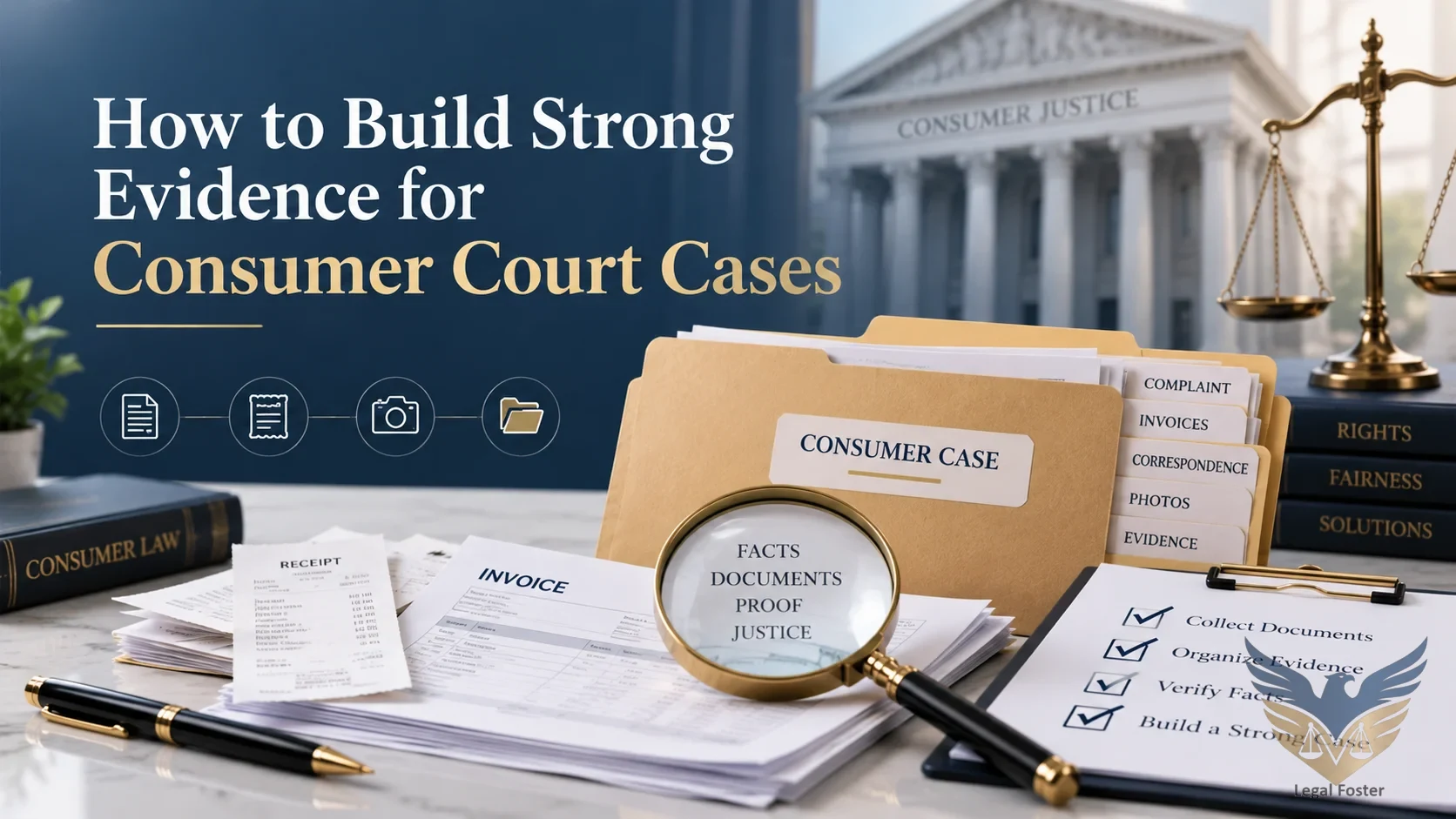
- Transaction itself - Based on what your issue is you should begin by safely storing the Sales invoice/receipt, agreement/order confirmation/ quotation/warranty/ policy document /booking form, proof of payment, service contract.
- Your complaint experience. Email trails, Letters, Customer-care ticket/ Response numbers, Whatsapp conversation, SMS screenshots, any written communication from the other party etc.
- The factual position itself. Take screenshots, photographs or videos of whatever your issue is related to. For eg. : Defective product/ service. VSR ( Vehicle inspection report). Service records if suing for a defective product. Correspondence regarding possession & site photographs if your issue is related to delayed construction work. Claim letters / documents, The written rejection letter by the insurance company if your issue is related to insurance.
- Any documents that will help establish your loss/ relief you have claimed for. Bank statement if you’ve claimed monetary compensation. Any additional expenses you’ve incurred and can provide bills/invoices for. Cancellation confirmations & forfeiture receipts. Medical bills, Repair bills or any other monetary proof.
NCDRC Lawyers typically advice clients to store the originals of source documents and keep a record of the entire communication rather than relying on selective copies.
How Should You Organise Evidence for a Consumer Complaint?
How you present evidence can mean much more than most consumers understand.
Start with a short chronology. Date of purchase or contract, payments, delivery or promised performance, date of first complaint, follow up correspondence, failure to fix/problem persists and current status.
Now organize your documents by this general timeline. Reference the evidence that supports each material statement in your complaint.
Indexes help to make the record clear. Rather than simply bundle your documents together, take a moment and identify each document by type and date. An invoice can show you purchased. A bank statement can show you paid. A written complaint can show you notified the seller of the problem.
Rules on Procedure that the NCDRC themselves have authored recognize the need for pleadings to be indexed and paginated.
Consumers who are considering representing themselves in a matter where affidavits or documentary evidence will be involved should read this site's Evidence and Affidavits in Consumer Cases page for lawyer service information as well. This will help you decide what type of assistance you may need.
When Should You Consult a Consumer Lawyer?
You do not necessarily have to speak to a lawyer the moment you decide to file a complaint. It might make sense to consult a lawyer if a large sum of money is at stake; if complex contracts are at issue; if documents need to be interpreted; or if there is a limitation issue or a serious factual dispute regarding what happened.
Another situation where it would be beneficial to seek advice sooner rather than later is where the other side has already responded with a legal letter or where more than one party is involved. Construction defects, insurance claims, bank complaints, medical negligence suits and consumer lawsuits against companies can involve several documents that need to be read in conjunction with one another.
A final scenario where speaking to a lawyer might be useful is if you are unsure where to file a complaint. You might know that your case should be heard at the Consumer Commission but be unsure whether that is the District Commission, State Commission or National Commission based on the monetary or territorial jurisdiction criteria.
An NCDRC Lawyer can help you understand the facts of your case, identify any missing evidence and know what legal steps you will need to take before you spend time and money pursuing litigation.
How Can NCDRC Lawyers Help With Evidence Preparation?
Consumer Complaints, Complaint filing woes, legal notice drafting,appeals from orders passed against you by state commissions or NCDRC itself. Evidence & Affidavits Help, Limitation & Jurisdiction help etc. Here is our NCDRC Lawyers List out spread across various page which are devoted to Consumer complaint filing, legal notice drafting, jurisdiction check, limitation check, evidence and affidavits, interim relief and appearing and representing clients at NCDRC.
Initial step that would be useful in any matter would be to sit down and review what documents you already have. Lawyers at National Consumer Disputes Redressal Commission can help you organize the facts in chronological order, identify key documents and evaluate whether the relief you are seeking is supported by the facts on record.
Website also provides you a separate service page listing Consumer Court Lawyer in Delhi who specializes in consumer disputes and Consumer compensation claims. We have clients from Delhi NCR, Noida, Ghaziabad, Gurugram, Faridabad and all over India visiting us or coming to us for legal consultation on nature of dispute and forum.
Where even more extensive preparation is required, NCDRC Lawyers can assist you with Consumer Legal Notice Drafting even before the commencement of proceedings, where such a notice would be legally/ commercially recommended.
Frequently Asked Questions
1. What documents serve as best evidence in consumer case?
The evidence will depend on the facts of the claim. In general, keep the agreement/invoice, proof of payment, correspondence about the dispute and proof of the alleged deficiency or damage.
2. Can i submit WhatsApp chats as evidence in consumer court?
WhatsApp messages can constitute important electronic evidence. However, their legal weight will depend on the facts and requirements to admit electronic records as evidence. Preserve the entire chat and metadata if possible instead of submitting cropped screenshots. Speak to NCDRC Lawyers if clients have specific instant messages or chats they believe may be relevant to their dispute.
3. Are screenshots acceptable as evidence in consumer forum?
Screenshots may help to prove something was said or done but they may not necessarily constitute a complete record by themselves. Where possible try to preserve the underlying email, chat message, downloaded document/report or other file.
4. What documents are needed for consumer complaint?
This will depend on the facts of the dispute but can include bills, contracts, receipts,warranties, emails, complaint acknowledgements and any other paperwork that supports the alleged loss or relief requested.
5. Should I send legal notice before filing consumer complaint?
Legal notice can be useful in certain situations to put the other party on notice of the grievance. However, sending a legal notice is no substitute for researching limitation, jurisdictional bars and other procedural requirements to initiate a consumer dispute. Speak to NCDRC Lawyers if you would like assistance determining whether you should send a notice based on the specific facts at issue.
6. Can I lodge consumer complaint for online order?
Online purchase disputes may be covered by consumer protection laws depending on the facts. Keeping records of the order, invoice, proof of payment, product information and correspondence regarding refund/complaint can help prove your case.
7. How can I prove that goods are defective?
Showing proof of defect can include providing the invoice/warranty, photos/video, service reports, repair documents and any correspondence with the seller/service provider. Different defects may require different evidence.
8. For how many years should I keep documents for filing consumer complaint?
You should keep documents for as long as the dispute is active. If you need to file a complaint, start with the dispute history, if you receive a dismissal you should keep documents for the appeals stage. Execution proceedings and related legal matters should be kept until resolved. Store original documents somewhere safe and keep electronic records backed up.
9. Can I file in consumer court without a lawyer?
Consumers have the right to represent themselves at consumer forums subject to the applicable rules and regulations. Having a lawyer can help with complicated issues such as evidence, jurisdictional challenges, limitation defenses, technical documents or if there are plans to appeal. Clients can always contact NCDRC Lawyers to learn more about their legal rights and factual issues involved in their dispute before deciding whether to hire a lawyer.
10. I lost my original document, can I still file a complaint in consumer forum?
Losing an original document can have different impacts depending on the importance of the document and how it was lost. Section 62 of Bharatiya Sakshya Adhiniyam, 20 23 enumerates documents which are deemed to be primary evidence and Section 63 allows for secondary evidence when documents mentioned in Section 62 cannot be produced before the Court. Section 63(4) makes it clear that when a document which would otherwise be admissible in evidence has been lost or destroyed, proof of its contents may be given in any manner. Clients can contact NCDRC Lawyers if an important document has been lost to see if the complaint can still be proved instead of assuming it cannot.
Conclusion
Don’t go to war with your facts confused. What I said above about gathering evidence for consumer forum simplifies things a bit. The best way to prepare your evidence typically requires preserving the record of the transaction took place, all related communication, organizing your documents by date and linking your material allegations to your evidence.
Reviewing your evidence early can also help consumers living in Delhi NCR and across India understand important limitations, jurisdictional issues and documentation requirements before filing a consumer complaint. NCDRC Lawyers can review your evidence, prepare your affidavits, draft consumer complaints and represent you before the appropriate Consumer Commission. If you find yourself in a consumer dispute start gathering these documents now instead of having to go back and dig through your paperwork later during the proceedings.
Contact NCDRC Lawyers to have all your documents reviewed and understand all the viable legal options available to you. Further, we can prepare your matter based on its specific facts.
NCDRC Lawyers makes no guarantee of any specific outcome in Court. Every Consumer Case is different and will depend on the facts of the case, evidence available, applicable law and the interpretation of the Consumer Forum hearing your dispute.