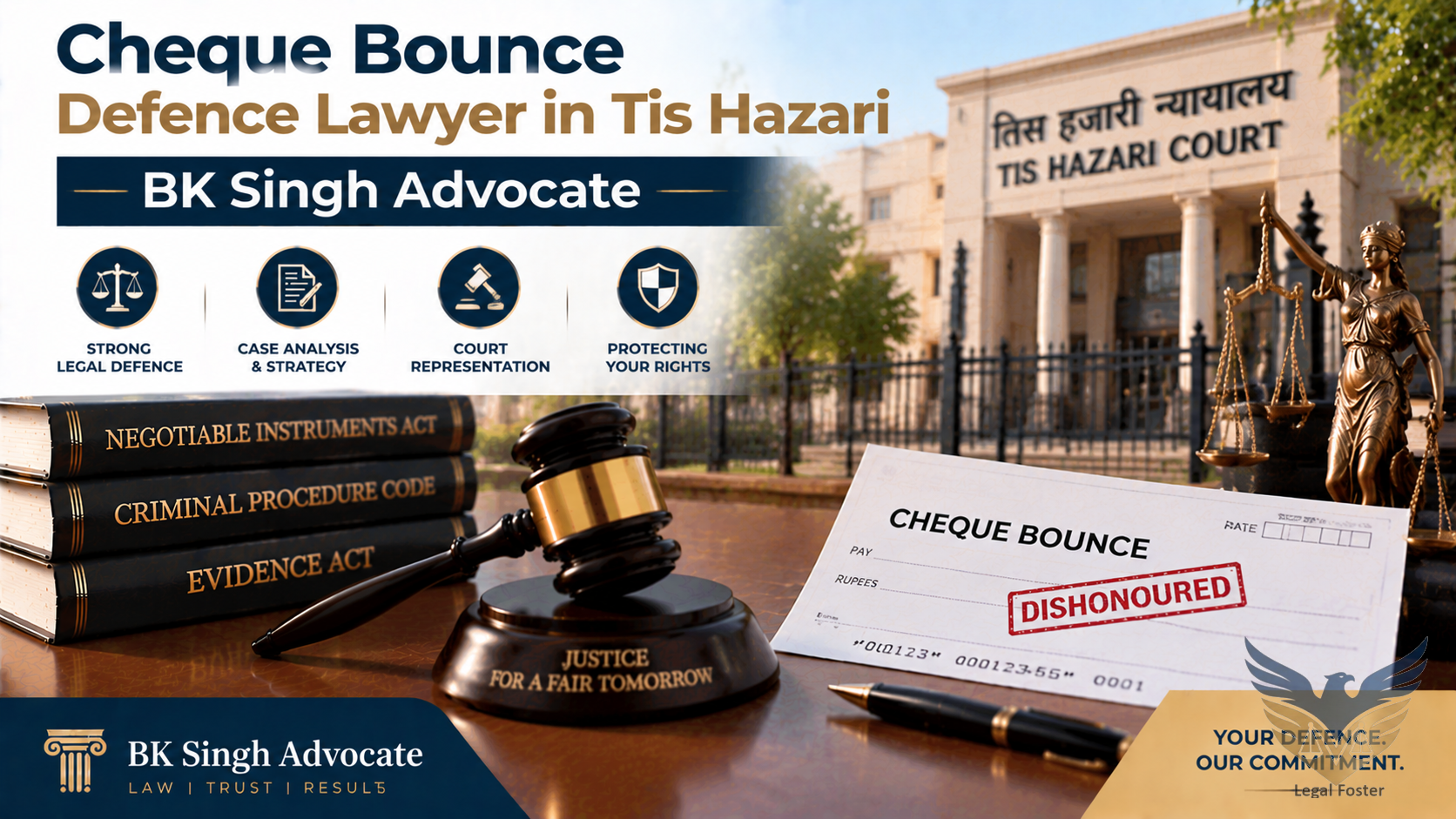
Need a Lawyer in Tis Hazari for Cheque Bounce Defence and Settlement Options for the Accused?
Clients often ask me about Cheque bounce cases. These cases can turn into a stressful situation in a matter of seconds. One bank return memo, one legal notice and suddenly the drawer is afraid of court cases, recovery of the cheque amount, loss of reputation, valuable business relationships and even criminal liability.
If you are an accused looking for advice on a Section 138 NI matter near Tis Hazari Courts then STOP. Take a deep breath. Before you panic, take time to review the complaint, cheque, bank records, statutory notice, underlying transaction for the cheque and history of any payments made.
An experienced Cheque Bounce Case Lawyer in Tis Hazari will go over with the accused what exactly the complaint is alleging, if it looks like the statutory requirements were met, what evidence exists to support the accused’ defense and if settlement makes sense commercially.
BK Singh Advocate takes time to analyze each matter based on the allegations, facts and details rather than reacting to just hear that a cheque was dishonoured. Just because a cheque bounced, does not solve many of the legal issues in the case. The facts of the underlying transaction that gave rise to the liability, the statutory requirements and the evidence that exists will always be important.
While some accused may need to fight the allegations made against them, some accused may just need to discuss the possibility of an early settlement. You should never choose a path just because someone told you “this is how these cases are handled.” Lets handle your case based on the facts.
Cheque Bounce Case Registrations still matter at Tis Hazari – in 2026?
The Courts at Tis Hazari remain a busy district-court complex with Judicial Magistrates handling the NI Act and even having dedicated NI Act courtroom setups.
Delhi District Courts themselves maintain Digital NI Act Court facilities and court orders & daily court rotas still specify NI Act courts being situated at Tis Hazari.
Cheque bounce cases matter to the accused person for a few reasons. Coming to Tis Hazari Courts where the accused may know the lay of the land matters. The accused person is not just involved in a financial dispute. They are involved in a statutory criminal proceeding for the alleged offence of cheque dishonour and may have to respond to court summons, attend court, deal with discovery of evidence and evaluate settlement or defence considerations.
Cheque bounce cases matter to a person based on real life concerns. Business owners are going to be concerned about how legal proceedings affect their business. Employees have concerns about missing work to keep having to attend court. Family finances are at stake. Perhaps the person who wrote a cheque during a business dispute just wants to know whether the payee has the lawful ability to recover any amount at all.
Advocate BK Singh can look at a case from that personal perspective and separate the legal interests of an accused person from the facts involved in negotiating a settlement.
Quick Facts
- Under Section 138, there are specified cases of dishonour of cheque. When cheque bounces because of insufficiency of funds in the account or it amounts to more than what was agreed to be paid from that account.
- Cheque must be presented within the time period mentioned under section 138.
- Cheque holder/payee must issue a statutory notice within 30 days of his knowledge of the fact of dishonour of cheque.
- Drawer of cheque will ordinarily have 15 days from the date of receipt of notice to make good on the amount demanded.
- Offence under Section 138 is triable ordinarily by Metropolitan Magistrate or Judicial Magistrate First Class.
- Section 139 provides for statutory presumption in favour of holder which can be rebutted by the accused.
- Offences under NI Act are compoundable as per Section 147.
What Is a Cheque Bounce Case Against an Accused?
Generally, a cheque bounce case u/s 138 is sought to be filed when a cheque was issued for the discharge of a legal debt or other liability and it got returned unpaid for one or more of the reasons mentioned in that section.
Section 138 does not hit every cheque returned by the bank. There are statutory requirements under Section 138 of NI Act with regards to presentation, sending of demand notice and failure to make payment within the statutory period.
A complainant can always make an allegation that there was money due and payable to him and he issued his cheque for the said liability. The accused would have his own version of facts. Maybe some earlier payments were made, there was dispute about the amount due or maybe there was a business compromise, the transaction was disputed or maybe it was a ‘security cheque’ case or anything else.
The defence has to be mounted on the facts of the record rather than making an unrealistic statement that “the cheque was only a security cheque” or “there was no liability”.
Advocate BK Singh can examine your documents and point out the factual matrices which would require legal analysis.
What Is the Legal Framework for a Section 138 Defence?
Negotiable Instruments Act, 18 81 sections 138, 139, 140, 141, 142, 143, 143A, 145, 147 and 148 (only those provisions which are applicable to the facts and stage of the proceedings).
What kind of clients need Cheque Bounce Defence In Tis Hazari?
Every accused individual’s situation is different. While one accused person may have received a statutory notice served but no case registered against him, another accused person may have received summons issued by a Magistrate. Yet another accused person has already appeared in Court and needs assistance with evidence / settlement / or future proceedings.
Here are some examples of common situations we encounter:
- The cheque was deposited for payment towards a business deal which is being disputed.
- The accused informs us that the claim amount has been settled/paid (either partially or in full).
- The cheque was provided as so called “security” and the deal it concerns is being disputed.
- The complainant is claiming a different amount than what is owed.
- Multiple cheques have been issued and there are several complaints in respect of them.
- You want to settle the matter instead of continuing the fight.
- Someone from your group of companies/business is accused and you have queries regarding who can be blamed
- You’ve received summons but aren’t sure what to do next.
An early intervention can prevent a poor defence from becoming recorded on paper as the only defence.
What follows is the process for defending a cheque bounce.
Advocate BK Singh can guide the Accused person to understand whether the matter is appropriate to defend, settle or both at various stages.
Documents which should be preserved by the accused.
A good defense start’s with Paperwork.
Preserve any and all documents that were used in the issuance of the cheque/transaction. Preserve originals if available. If not preserve copies.
This would include documents such as:-
- Copy of the cheque and Bank return memo.
- Notice under section 138 sent to you along with the envelope /record of delivery.
- Copy of Complaint and summons if already initiated.
- Bank statements that reflect the relevant payments/transactions.
- Invoice/ Agreement/ Purchase order/ Account statements.
- Whatsapp chats/email/written correspondence talking about the transaction.
- Proof of any previous payments made. (receipts,bank statements etc.)
- Copy of Settlement sent/received from the other party. Written allegations.
- Record of company if transaction was with a company.
- Copies of Previous order if the case is already pending.
Don’t delete chats/conversations if they seem incriminating. Often a volumentric piece of evidence can help rather than picking and choosing screenshots.
Have a lawyer review all the documents in person before throwing something out that you think will hurt your defense.
When should you consult a Cheque Bounce Lawyer?
Reach out to a lawyer at the earliest if you have received a statutory notice; or if summons have been issued against you; or if you have more than 1 cheque bounce complaint filed against you; or if the complainant is asking for an unfair amount which you feel doesn’t tally with the transactions made between the 2 of you.
Legal advice is beneficial when the accused wants to settle. That settlement amount might seem fair until you consider the total number of complaints pending against him, the time required to payback, the number of times he has to visit court and comply with paperwork.
Legal advice becomes more beneficial earlier if the accused is a firm or company, or if cheques have been signed by partners, or if there are multiple signatories to the account, or multiple transactions related to each other.
Advocate BK Singh can review the case documents of someone looking for lawyer for cheque bounce case in Tis Hazari court and help you understand the various courses of legal action you can take in simple terms.
How Can Cheque Bounce Lawyer Help?
Cheque Bounce Lawyer provides legal advice for defending cheque dishonour claims and related proceedings. So when reading this article remember we are talking law and practise. Stay tuned…Keep focused. Read the complaint and see what the plaintiff has alleged. Look at the documents that were filed with the complaint. Identify what issues of law are presented. Work on a response that is tailored to the facts and circumstances. And always consider settlement if it’s in your client’s best interest.
Criminal law that you handle are from a specific Court it helps to have practiced in that Court. For example if you handle most of your cheque bounce lawsuit at Tis Hazari Courts ,it helps to know the practicing lawyers and judges there. But once again do not advise your client something because you practice at one Court. Everyone goes to civil court, Criminal Court, revenue court etc. Look at the record and advise accordingly.
If you need advice from an Advocate on defending against cheque bounce lawyer. Advocate BK Singh can help you with advice on consultation, document review, helping you to understand the options for defending a cheque bounce lawsuit at a high level. Talking through potential settlement options if it is appropriate based on the facts and stage of the proceeding.
No lawyer should ever be able to promise you that someone will be acquitted or convicted. No lawyer should ever predict that a claim will be won or lost. But a responsible lawyer can review the evidence against your client and the law that applies to those facts. We can help you understand your legal rights and make an educated decision.
Faq’s
Q1. What is the meaning of cheque bounce case in India?
Ans. In India, a cheque bounce case is generally initiated under Section 138 of the Negotiable Instruments Act when a cheque is dishonoured for insufficiency of funds or if it exceeds the amount arranged to be paid by the drawer thereof. However, for Section 138 to apply the cheque should have been issued for the discharge of any legally enforceable debt or liability and the transaction should also not meet certain statutory requirements under Section 138.
Q2. Can a accused person defend against Section 138 cheque bounce case?
Ans. Yes. The accused has a right to defend the said complaint as per the provision of law. The appropriate defense would depend on the allegations made in the complaint, the nature of transaction underlying the said complaint, the supporting documents, statutory requirements and the evidence available.
Q3. Is every cheque bounce a criminal offence?
Ans. No. Section 138 would only be applicable if the statutory requirements as mentioned therein are satisfied. The cheque should also come within the ambit of Section 138 and all other statutory formalities should be complied with.
Q4. What is the 15 days notice mentioned in a cheque bounce case?
Ans. The drawer of the cheque upon receiving the statutory demand notice has 15 days to deposit the cheque amount to avoid the consequences stipulated under Section 138.
Q5. Can one settle a cheque bounce case?
Ans. Yes. Offences under Chapter XI which deals with dishonor of cheque are compoundable under Section 147 of the NI Act. The stage and manner in which the settlement takes place would determine the appropriate court proceedings.
Q6. Is giving a security cheque always a defense?
Ans. Not really. It would have to be established that the cheque was indeed given as a security. Also what was the nature of liability which was existing at the time when the cheque was presented to the bank. These would be questions of both fact and law which can be determined only upon going through the record of the transaction.
Q7. Which court has jurisdiction to try a Section 138 cheque case?
Ans. As per Section 142 of the NI Act, No Court inferior to the Court of a Metropolitan Magistrate or a Judicial Magistrate of the First Class shall try any offence punishable under Section 138. Moreover territorial jurisdiction would be decided based on facts like where the bank account was held by the drawer and the place where the cheque was deposited as per Section 142(2).
Q8. Will a person living in Noida or Ghaziabad get a cheque case in Delhi?
Ans. Depends. It would depend on the facts and the statute jurisdictional rules. The fact that the accused happens to stay in Delhi is not enough to say that a Delhi court would have jurisdiction. Section 142(2) would have to be read in connection with the facts to reach a conclusion.
Q9. Should I settle my cheque bounce case or fight the law suit?
Ans. It all depends on your situation. There can be benefits in settling a case from a commercial perspective, however there can be legitimate defenses on facts or legal grounds to fight back the complaint. You would have to go through the documents and understand the financial implications before taking a decision.
Q10. Will Advocate BK Singh review my cheque bounce case?
Ans. Yes. Advocate BK Singh would be able to provide you legal consultation tailored to your case’s facts upon reviewing the documents provided to him and the stage of the proceedings. The decision to fight or settle the case or even another available option would have to be taken by you depending on the facts.
Conclusion
Cheque bounce complaint is not a sure shot conviction nor something you can blow off. Complaint, statutory notice, underlying liability and documents need to be read in concert. Accused persons involved in a Tis Hazari matter have rights to know the true nature of allegations, procedural posture & options early on. Often settlement makes commercial sense and should be entered into, with proper paperwork drafted. Deny the allegations and prepare a defense based on the available evidence and the law. Advocate BK Singh can walk you through those options in a practical manner and in a legally conservative manner. The sooner we get the paperwork in front of us the sooner we can make a strategic decision rather than reacting to pressure on your court date.
There's no reason for concern. There is no difficult-to-understand legalese.
Someone who has helped many people with the same problems gives you clear, honest advice. We want to make the legal process easy to understand and use for everyone.
+91-9811561566