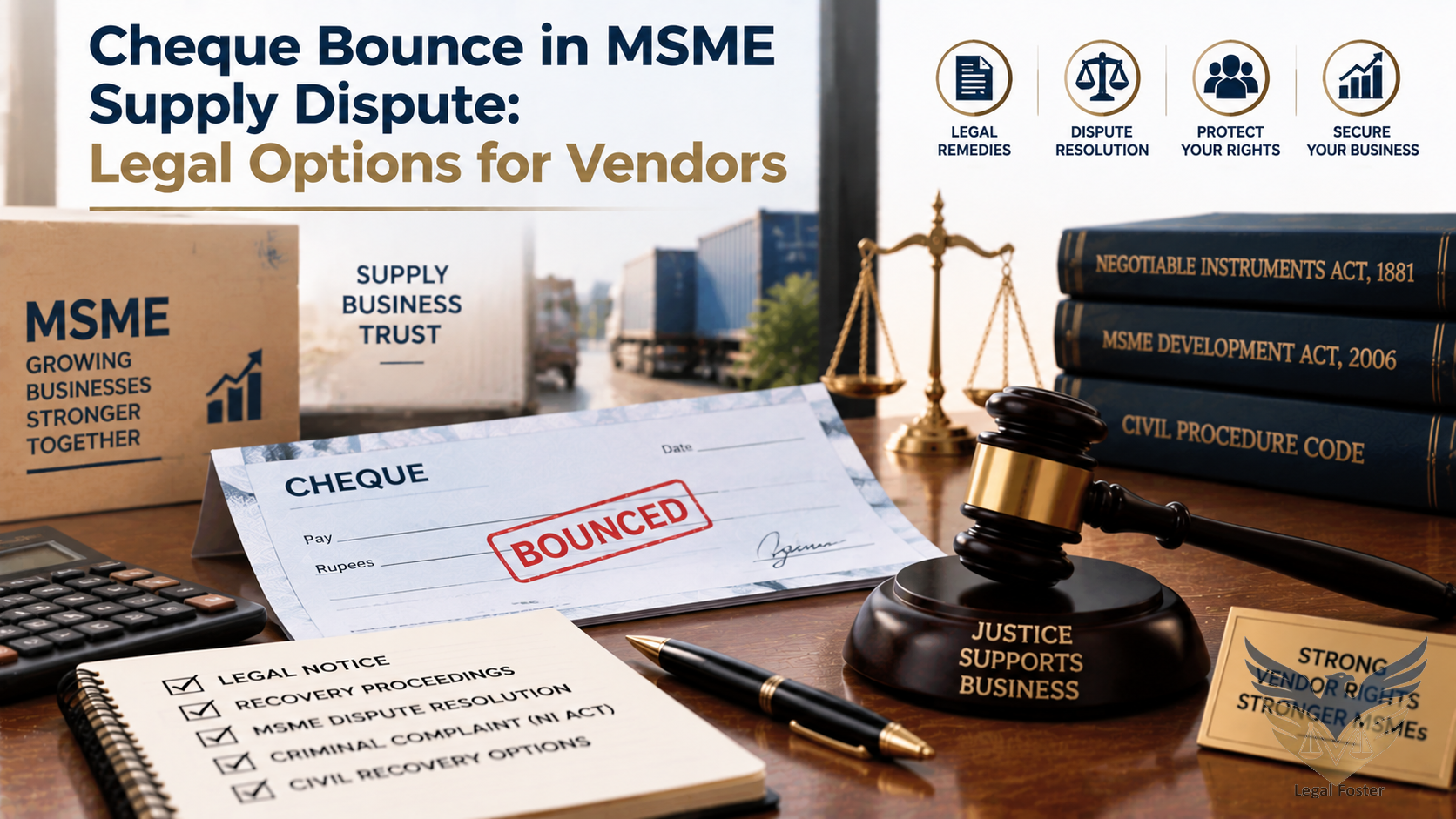
Cheque Bounce In MSME Supply Dispute: Legal Options For Vendors
If you’re a small supplier who sold stock and got issued a cheque that’s bounced, it may mean more to you than an inconvenienced banking problem. Especially if the issuer of the cheque is now asking you “just a few more days” to settle the payment, you may already be under financial distress. Is Your MSME Prepared With Correct Documents?
Your position as an MSME supplier is stronger if you have purchase orders, invoices, delivery slips/challans, account statements and a dishonoured cheque that can prove the amount hasn’t been paid. But that is just one legal remedy. You may also have a remedy under the Micro, Small and Medium Enterprises Development Act, 2006 (MSMED Act) depending on the facts of your case.
Although related, the dishonor of cheque when supplied goods to an MSME raises two distinct legal points:
- The recovery of the commercial dues that form the underlying basis of the transaction; and
- The effect of the cheque that was issued towards the settlement of those dues bouncing.
Don’t Assume Every Cheque Case Is Simple Section 138 Litigation
Just because a cheque that was issued to you bounces, doesn’t mean you should file a cheque bounce case under Section 138 of the NI Act right away. Vendors need to consider the facts of the transaction that resulted in the cheque being issued. Your MSME registration, when it was obtained, the nature of the underlying liability, your documents and the relevant limitation periods can all play a role.
Why Should A MSME Care About Cheque Bounce?
If you own a small business, late payments shouldn’t just be another line item in your balance sheet. The invoice that your buyer hasn’t paid affects your salaries, gst liabilities, the suppliers you owe payment to, your working capital, ability to take that next order and more.
The MSMED Act has a specific statutory remedy for delayed payments to micro and small businesses. Under Sections 15 to 24, the MSMED Act lays out the legal framework for late payments. It specifies the buyer’s payment obligations, the statutory interest that is payable, recovery and reference to the Micro and Small Enterprises Facilitation Council (“MSEFC”).
You can also initiate a separate cheque dishonor proceeding under Section 138 of the Negotiable Instruments Act, if all the statutory conditions are satisfied. Section 138 even goes on to specify provisions related to presumption, company’s liability, taking cognizance, interim compensation and trial.
However, if you supply goods or services to buyers in Delhi NCR, Delhi, Ghaziabad, Noida, Greater Noida, Gurugram, Faridabad or essentially any other commercial center in India. The question isn’t really “Should I file a cheque bounce case?”, it’s which of the multiple legally available remedies is applicable to your documents, what liability you’re trying to recover and what your commercial goal is.
Quick Facts
Remember, cheque bounce legal proceedings and MSME delayed-payment legal proceedings are two separate legal remedies for two related legal issues.
What is the Underlying Legal Issue in MSME Supply Transactions?
At its core, it comes down to proof of an existent legally enforceable liability and what law you can use to recover that debt.
Here is an example. A supplier sells ₹8 lakh worth of goods to a buyer. Buyer accepts the goods, issues are raised, invoices are generated, the due date is over, and a cheque is issued against the amount. The cheque bounces.
The supplier has a host of documents along with the cheque. From purchase orders, delivery challans, GST invoices, e-way bills, correspondence through email or WhatsApp, ledger or account statement entries, acknowledgements you name it.
This paperwork becomes relevant if the buyer ever denies the existence of said underlying transaction. While you do have a separate remedy under Section 138, your underlying commercial claim is also important.
Legal Expert Weighs-In on MSMED & Cheque Bounce Claims
Advocate BK Singh advises suppliers to look beyond just the cheque that was issued. “Look into the entire transaction. You can use the cheque for your Section 138 proceedings. But also use the underlying invoices & supplier ledger to asses your commercial claim.”
Which statute would apply to a cheque issued to an MSME vendor?
If you had to guess, both? That is correct. Both laws apply to dishonoured cheques issued to MSME suppliers.
Here is a breakdown of the laws that would apply under both the MSMED Act and the NI Act.
Negotiable Instruments Act, 1881
Section 138 punishes the cheque’s dishonor for insufficiency of funds, or if it exceeds the amount agreed with the bank. Subject to a host of statutory requirements being satisfied. Section 139 creates a rebuttable presumption in favour of the payee holder of cheque. Sections 141 and 142 respectively deal with liability of company and taking cognizance by the courts.
The process is sending notice → response/ settlement → filing a complaint within prescribed limitation from the date cause of action arises (subject to law relating to condonation of delay) is the legal procedure to be followed. Section 142 even goes on to lay down limits on court-level and territorial jurisdiction for filing complaints under Section 138.
Given this, suppliers should preserve the original cheque, bank return memo, notice sent and proof of service of notice. Book evidence such as account ledgers would be useful here as well.
MSMED Act, 2006
Sections 15 to 18 provide you with an alternate statute under which you can claim recovery of your delayed payment. Applicable only to eligible micro or small supplier companies.
Section 15 lays down the payment obligations of a buyer. Section 16 specifies that statutory interest is payable if payment is late. Section 17 lays out recovery of the due amount. Section 18 lets you refer the due amount to MSEFC.
This delayed-payment complaint mechanism has been recently clarified by the MSME ministry to be applicable to micro and small enterprises who had a valid Udyam Registration at the time of the transaction. The MSEFC mechanism would be invoked in accordance with the mechanism prescribed.
The Apex Court has interpreted Section 18 to provide a special statutory dispute-resolution mechanism (conciliation first, arbitration if needed). The court has allowed disputes challenging the status as supplier and even prospective application of subsequent MSMED registrations.
Remember from the above, you should first check MSME status & date of registration before presuming MSMED Act applies to a past transaction.
Who Needs To Read This?
Any supplier who has slow paying customers. This would include suppliers who are manufacturers, wholesalers, traders, contractors, services suppliers and commercial suppliers.
You could very well fit into any of the below scenarios.
The buyer could have written you a cheque and now suddenly doesn’t respond to your calls or messages. The cheque you deposited could have bounced against you after you sent them months’ worth of invoices unbeknownst to the customer. The buyer might even threaten you about quality or quantity of goods after you’ve sent them a legal notice.
Small startups and family businesses have found themselves in this situation too. Just because your customer is bigger than you, doesn’t mean they will pay you on time. Often these large buyers have more negotiating power while you as the small supplier are left high and dry with the pressure of requiring positive cash-flow.
If you are looking for a cheque bounce lawyer near me in Delhi NCR, Ghaziabad, Noida, Gurugram, Mumbai, Bengaluru, Hyderabad or anywhere else in India. Ask your lawyer about the facts and timeline of your transaction vs. expecting a particular outcome.
Documents You Should Have
Typically, a cheque bounce file contains:
- Copy of original dishonoured cheque and bank return memo.
- Copies of purchase orders, quotations.
- Tax invoices, delivery challans.
- Transport bills/ e-way bills etc. if any.
- Ledger/account statement.
- Bank statement highlighting previous payments made by the buyer.
- Emails/Whatsapp conversations, any written acknowledgements.
- Copy of credit terms / paid terms and any written agreement on payment.
- MSME/Udyam certificate document.
- PAN Card or GST details of the buyer’s legal entity.
- Copies and proof of dispatch/service of any legal notices sent.
- Any settlement offer letter or written acknowledgement of dues by the buyer.
Remember, consistency is key when preserving documents. The notice amount should match your accounts and any subsequent legal proceedings should be able to be mapped from the transaction documents.
When Should You Talk To A Lawyer?
If your lawyer needs to review anything, it would be the chronology of events. You should speak to a lawyer when:
- The cheque that bounced was issued for multiple invoices and payments.
- The buyer is returning/rejecting goods supplied.
- Buyer has issued more than one cheque to you.
- The buyer may raise a defence that the cheque was provided as security. (See Below)
- Drawer of the cheque is a company.
- The amount involved is large.
- The vendor wants to initiate MSME delayed-payment proceedings along with other remedies.
See the below point about limitation dates, that’s another instance where you should speak to a lawyer.
Consulting a lawyer early on is helpful when fact timelines are not clear. The best course of legal action is typically the one which is supported by the documents you have, not the remedy which may look most “painful” to the other party in abstract.
What Can Cheque Bounce Lawyer Do For You?
When you contact Cheque Bounce Lawyer for a legal consultation regarding your cheque bounce dispute, we can help you with the actionable legal work and review of documents that support your claim. Advocate BK Singh will first understand what commercial transaction gave rise to the claim.
He will analyze the cheque, bank return memo, invoices, delivery documents, correspondence between the parties, account statements and any response from the buyer. For MSME suppliers, he would also analyze if the MSMED delayed-payment mechanism is available to you.
Once he understands the facts of the transaction, you will know exactly what you’re signing off on. Want to send a legal notice? Cheque Bounce Lawyer can draft you a notice. Want to file a Section 138 complaint? We can file it on your behalf. You decide how you want to handle your legal matter once you know your options.
Yes, we can even help you if you’re located in Delhi NCR or anywhere else in India through online consultations. If you have the necessary documents in soft/pdfs copies we can help. The forum (court) and procedure would be decided based on the facts of the transaction.
FAQs
Q1. Can I sue the buyer as an MSME vendor for cheque bounce?
Ans. Yes, you can initiate legal action against the buyer for cheque bounce provided you satisfy the statutory requirements of Section 138. You would need to analyze the cheque, underlying liability, cheque dishonor, notice requirements and limitation period.
Q2. Can an MSME use the MSMED Act to sue for delayed payment as well?
Ans. Yes, as long as the statutory conditions are met. If you’re an eligible micro or small enterprise, you can initiate a delayed- payment claim under Sections 15–18 of the MSMED Act. Keep in mind Section 18 mentions the MSEFC referral.
Q3. If my cheque bounces, does that mean I’ll get my money?
Ans. Not exactly. The cheque bounce allows you to initiate a statutory remedy when conditions under Section 138 are met. But the facts, evidence, pleadings, defenses and procedures followed will determine the eventual outcome.
Q4. Can the buyer just say that the cheque was given as a security cheque?
Ans. A cheque can be designated any name. But that doesn’t determine the legal outcome. The facts surrounding when the cheque was issued and the intent of the underlying liability should be reviewed depending on the transaction documents.
Q5. Is Udyam Registration mandatory for initiating MSME delayed-payment complaint?
Ans. You must first qualify for the legal definition of an MSME. But as per current guidance issued by the MSME Ministry, if you’re a micro or small enterprise with a valid Udyam Registration – you should be able to initiate a delayed-payment complaint.
Q6. Does the MSEFC mean the matter will go to arbitration?
Yes. Section 18 refers the matter to MSEFC for conciliation first. Section 18 provides for arbitration under the said statutory mechanism if conciliation is unable to resolve the dispute. Section 18 arbitration has been upheld by the Supreme Court.
Q7. Which document is most important in MSME cheque bounce case?
Ans. While the cheque and bank memo are critical. Preserve your invoices, purchase orders, delivery proofs, ledger records, payment history, correspondence that helps prove your claim. Remember any evidence that supports your underlying liability.
Q8. Can a company be proceeded against under Section 138?
Yes. If a cheque is issued by a company, it can be proceeded against under Section 138 as long as you satisfy the statutory requirements. Section 141 even goes onto explain offences by companies and liability of persons in those cases.
Q9. After his cheque got dishonoured, can the buyer say that the goods were of bad quality?
You would have to review the purchase order, invoices, proof of delivery, correspondence, inspection records if any, payment history to see if there is a legitimate quality dispute.
Just because there is a quality dispute, doesn’t mean the MSMED or Section 138 claim will be resolved in favor of your buyer.
Q10. Why Should I Consult Advocate BK Singh for My MSME Cheque Bounce?
Ans. Advocate BK Singh would review the documents pertaining to your transaction, identify the legal issues at play and help you as an MSME vendor understand your legal options instead of pushing you towards a predetermined remedy.
Conclusion
Too often vendors who receive a cheque from their customer that bounces assume they’re limited to one legal remedy. Your supplier rights under the NI Act and MSMED can operate in separate spheres of law. Understand the cheque, underlying transaction, MSME registration status, documents you have, limitation dates and what your commercial recovery goal is and you’ll know what legal action to take.
At Advocate BK Singh and Cheque Bounce Lawyer we can go over your documents with you in Delhi NCR and across India. Ensure you don’t make common, avoidable mistakes. Let us help you understand your legal position and take your next step knowing the law is on your side based on the facts.