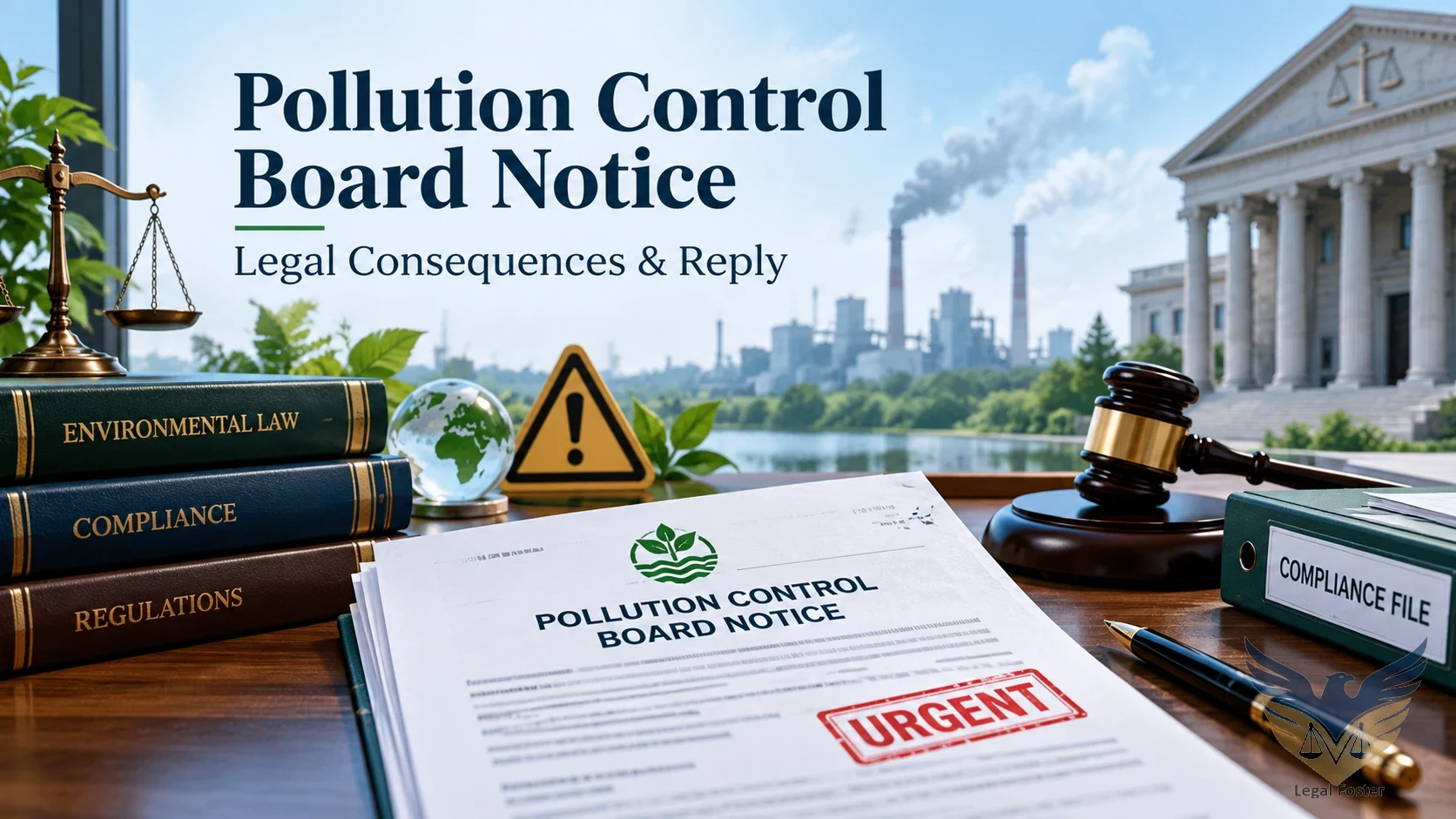
What Are the Legal Consequences of Receiving a Pollution Control Board Notice and How Should You Respond?
Getting a Pollution Control Board notice can be very unsettling for an industrial unit, developer, hotel, hospital or other establishment. One letter can raise issues relating to environmental permits, shutting down operations, fines and penalties and long-term viability.
A Pollution Control Board notice is not like any other letter. It may relate to suspected air emissions violations, effluent discharge infractions, industrial waste handling issues, missing environmental permits or alleged violations of consent conditions.
Owners and operators may simply want to know if the regulators can shut down the business. Will the electricity or water be cut off? Is environmental compensation going to be demanded? Can the allegations be disputed?
The answer depends on the notice, the statute under which it was issued and what is actually happening on-site.
In India, State Pollution Control Boards (SPCB) and Pollution Control Committees (PCC) exercise delegated regulatory authority under the environmental laws. They have powers to visit premises, conduct compliance audits, issue statutory notices and initiate enforcement action as authorised by the laws.
Businesses and individuals receiving pollution-related notices, orders to shut-down, demands for environmental compensation and other enforcement actions may speak with BK Singh Advocate of Environmental Lawyers.
Ignoring a notice will only complicate the situation. But responding to every allegation in a notice may not be advisable if the claims are unsubstantiated.
The owner of one facility may have all the required consents in order but may have received a notice after an inspection. The owner of another premise may have recently installed air pollution control equipment without prior approval from the regulators. These situations are different.
The notices should be understood, records should be preserved and legal and technical advice should be obtained quickly.
In this article we discuss Pollution Control Board notices and their legal implications in India in 20<|end_of_text|>26, the environmental laws applicable to notices, potential remedies, key documents and when to speak with a lawyer.
Why Do Pollution Control Board Notices Matter in India in 20<|end_of_text|>26?
Industrial compliance with environmental laws is becoming a greater operational priority across India. Businesses located in Delhi NCR, Noida, Greater Noida, Ghaziabad, Gurugram, Faridabad may be facing increasing regulatory attention around air pollution, industrial emissions, dust at construction sites, wastewater and solid waste management.
Industrial hubs like Kanpur, Meerut, Pune, Ahmedabad, Chennai, Bengaluru and Hyderabad have companies that need to understand sector specific environmental regulations too.
It is not just about dealing with regulatory notices.
A notice proposing closure impacts employees, vendors, production timelines, lease agreements and pending loans. Environmental allegations can harm commercial relationships as well.
For small businesses, a temporary closure notice can cause significant cash-flow stress.
BK Singh Advocate can review the notice and its potential legal implications so that businesses know what is at stake. A notice of violation is not always grounds for immediate shutting down of business operations.
Environmental compliance needs to be part of any response, but legal rights should also be protected. If there is actual pollution, remediation should begin immediately rather than waiting for a legal challenge to play out.
Quick Pollution Control Board Notice FAQs
- A Pollution Control Board notice may relate to conditions of consent, air emissions, wastewater discharge, solid or industrial waste handling or other environmental requirements.
- A show-cause notice typically requires a response before regulatory action is taken.
- Section 33A of the Water Act and Section 31A of the Air Act empower issuing certain directions.
- Regulators can powers to mandate closure, regulate operations or stop utilities from supplying power or water.
- Appeals generally lie with the National Green Tribunal (NGT).
- The time to respond will depend on the notice, the statute and the type of proceeding.
- Replying within the given timeframe will not automatically stay a closure order or mandatory directive.
A Pollution Control Board notice refers to an official letter sent by a state pollution control board or pollution control committee concerning environmental violations, deficiencies, proposed action or regulatory requirements.
Pollution control boards can issue notices after visiting a premise, receiving a complaint, conducting environmental monitoring, reviewing consent documentation or obtaining information from another agency.
Notices can have different legal meanings.
Asking questions is different from issuing a show-cause notice. Requesting that a business shuts-down is different from issuing an order of closure. A demand for environmental compensation is different from alleging that a Consent to Operate has expired.
BK Singh Advocate can help determine the meaning of a notice and its legal significance based on how it is worded.
Examples of notices that businesses receive
Businesses can receive notices related to:
- Showing cause for alleged pollution. Asking a business to explain alleged violations.
- Demanding closure or limitation of operations.
- Issuing warnings for deficiencies in Consent to Establish (CTE) or Consent to Operate (CTO).Issuing notices for polluting beyond permitted limits or discharging effluent without permission.
- Demanding environmental compensation payments. Ordering pollution remediation.
- Checking compliance with hazardous waste, plastic waste management or biomedical waste rules.
- Issuing directives to improve pollution-control equipment.
- Alleging non-compliance with previously issued orders.
Notices are not necessarily true just because they have been received. Denying violations without any technical justification can also be problematic.
What To Do After Receiving A Pollution Control Board Notice?
Upon receiving a notice, it is important to understand what the regulatory agency alleges, what (if any) action it wants the business to take and if there is an immediate requirement to comply.
A notice does not always mean that the agency wants to shut down the facility. A show-cause notice should also not always be treated as though it is a final order of closure.
Read the notice carefully.
Look at the notice itself, any attachments, the findings of inspectors, the law cited and the deadline (if any). Take note of the deadlines.
Some notices may require reviewing laboratory samples or records of treatment. Others will require obtaining consent to operate from the regulator.
Keep records safe.
Documents like consent to establish/coperate, lab reports, records of maintenance, waste transfer receipts and correspondence may become important later.
Do not destroy records. If there is an immediate pollution issue, it should be corrected without delay.
Get a lawyer and technical consultant(s).
Environmental law cases will often have legal and technical issues.
A lawyer can advise on the potential legal consequences. Technical experts can help review emissions, effluent quality, equipment issues or sampling reports.
BK Singh Advocate can provide legal advice on notices where operations are at risk of being shut down, there is a significant financial liability at stake or you are unsure of your legal options.
Will Pollution Control Board Close My Factory?
Yes. If legally justified, Pollution Control Boards can close industrial facilities or limit operations.
The powers of closure and regulation are found under Section 33A of the Water Act and Section 31A of the Air Act. Both statutes mention powers to give certain directions. These include powers to close and regulate industries.
These powers have to be exercised in a lawful manner.
In some cases, notice and an opportunity to be heard will be required. How much time is required and if the matter needs to be heard personally will vary. Just because a business was not allowed to speak on behalf before an order shutting-down operations was issued, it does not mean the order will be cancelled if challenged. Each notice will have to be reviewed on its facts.
Immediate shutting down of business operations is a different situation than the board proposing to close an operation until the matter is resolved.
Businesses should comply with any order that restricts operations until they have obtained a legal remedy stopping the order from taking effect.
BK Singh Advocate can help determine if the board can issue a closure order and what can be done about the order legally.
Documents To Preserve For Pollution Control Board Notice
Cases involving environmental notices will often turn on documents and technical records. A business may believe that there is nothing wrong, but it must have documentation to prove compliance.
Documents that may be requested or become important include:
- Consent to Establish (CTE) – This is permission issued by the regulators to set up certain facilities.
- Consent to Operate (CTO) – The operating permission applicable to the business and any conditions.
- Reports of inspections – Reports from regulatory agency inspections.
- Laboratory reports – Reports of emissions tests, effluent samples or other analyses.
- Records of ETP and STP – Records showing how effluent and sewage is treated at the facility.
- Waste handling records – Documentation showing how waste is collected, stored and disposed of by authorized agencies.
- Copies of previous notices and responses. Any correspondence with the regulatory agencies and documentation of how previous issues were addressed.
- Environmental clearance – If applicable, a copy of the clearance received under the EC notification.
- Photos and maintenance logs – Documentation showing the current condition of facilities and equipment.
Ensure that copies of these documents are available and correct. Outdated consents or missing permits will make it difficult to defend allegations.
BK Singh Advocate can review the legal context of documents along with technical input and the claims made by the board.
Can I Appeal A Pollution Control Board Order In NGT?
Yes. Appeals can be made against certain orders issued by Pollution Control Boards to the National Green Tribunal.
The NGT Act, 20<|end_of_text|>10 allows appeals to be filed against certain orders under the environmental laws.
For instance, Section 5A of the Environment (Protection) Act, 1986 provides a right to appeal against certain orders issued under Section 5.
The Water Act and Air Act also contain appeals for certain decisions.
Appeals have to be filed within 30 days of receiving the order. There is a limited provision to ask for more time, but extensions are not granted lightly. The effective date of the order and the specific appeal will need to be confirmed.
Show-cause notices will typically not be appealable until a decision has been issued.
BK Singh Advocate can review if the Pollution Control Board order is appealable and if so, help with filing an appeal in the NGT.
When To Consult An Environmental Lawyer About A Pollution Control Board Notice?
Consulting with a lawyer early can be important if the notice accuses a serious violation, has the potential to stop operations or requires the payment of a large fine.
Speaking with a lawyer can help if the reasons for an inspection are not clear based on the records kept at the facility. If there is a question about what the permit allows or the regulator wants to revoke or suspend permission, legal advice should be considered. Businesses also should talk to a lawyer before deciding not to comply with an order from a Pollution Control Board.
If a business operates in more than one state, there may be variances in the way each state applies environmental regulations. Consent conditions from one state may not be the same as another state.
Businesses can speak with BK Singh Advocate about pollution complaints, notices from regulatory agencies, demands for closure and environmental lawsuits.
The goal should always be to comply with the law and preserve your rights. Consulting a lawyer does not mean you are trying to pollute.
How Can Lawyers Help With Pollution Control Board Notices?
Environmental Lawyers offers those searching the web a source to find lawyers that can assist with pollution control board notices. Environmental lawyers can help with notices because they involve questions regarding:
- The legal authority of the regulator to issue the notice.
- Environmental standards that are alleged to have been violated.
- Requirements under permits or consents issued by the regulator.
- Any financial liability or fines and penalties that may apply.
- The process for defending allegations and accessing judicial remedies.
BK Singh Advocate is here to provide a legal review of notices, documents and potential legal remedies.
Legal advice may be required for show cause notices, orders proposing closure of an industry, consent to establish/operate issues, environmental compensation claims and matters before the National Green Tribunal.
Visit Environmental Lawyers to learn more about how lawyers can help with pollution control board notices.
There are no guarantees with legal matters. Outcomes depend on the strength of your position, the law and evidence.
Frequently Asked Questions
1. I got a notice from PCB, now what should I do?
Read the notice carefully. Understand the allegations, cited laws and the time allowed for reply. Keep copies of consent orders, monthly self-monitoring reports and any other supporting evidence. You may also want to consult a lawyer and technical expert if the notice is regarding closure order, penalty or severe pollution.
2. Can Pollution Control Board close my factory?
Yes. The powers under the Environment Act and rules may allow them to close or regulate your industry. Such action has to be within the scope of law and is challengeable in a suitable forum.
3. Do I have to answer a PCB show cause notice?
Typically you have been given a chance to explain. If you dont reply, they can take action against you based on whatever information they have. Read the show cause notice that you have received and the relevant law.
4. Can I run my factory without Consent to Operate?
If you are required to have a valid CTO number by law, then you are breaking the law by running without it. Whether you need a consent depends on what you do, under which laws and what categories you fall under. There can also be valid exemptions at times.
5. Can I appeal against a penalty issued by PCB?
Some type of penalties can be challenged before the appropriate forum provided by the law. BK Singh Advocate can review the type of penalty imposed, forum it has been issued from, the evidence and the limitation period.
6. Can they demand environmental compensation if they cant prove my factory polluted?
It depends on what law they are taking action under and the evidence they have. Compensation under environmental laws is not the same as every other type of penalty. There has to be a legal justification to impose it as well.
7. Someone went for an inspection at my factory and put wrong info in the report. What should I do?
The industry has the right to bring this incorrect information to their notice through the process provided by law. Keep technical documents, online monitoring reports, videos if any and other evidence that can support your case.
8. Can NGT stop the order to close down my factory?
The green court has the power to provide relief if it falls within their jurisdiction. It also depends on if your case is maintainable and you have a strong case. Just filing a case against the order will not stop it from being implemented.
9. How many days do I have to respond to the pollution notice?
It depends on which notice you have received. Different laws provide for different response times. Read the notice and find out the deadline ASAP.
10. How do I search for an environment lawyer for PCB notice?
Look for someone who knows environmental law, works with regulatory bodies and has knowledge of the legal forum you will have to approach. You can contact BK Singh Advocate to schedule a consultation regarding your PCB notice, its violations and the options you have.
Final Thoughts
Receipt of a PCB notice is significant but does not ipso facto mean that an establishment has to shut down forever or that every charge is justiciable.
The correct course of action depends on the facts surrounding the notice, the relevant environmental act, nature of inspection,consent provisions and ground realities.
Commercial entities must keep documents safe, rectify actual environmental hazards and seek guidance prior to the expiration of notice.
A firm specific analysis of notices issued by regulatory authorities,involvement in alleged violations and orders directing closure can be provided by BK Singh Advocate. He is part of Environmental Lawyers.
Getting legal advice quickly allows a company to know not only what it must do to comply with environmental laws, but also what options it may have.