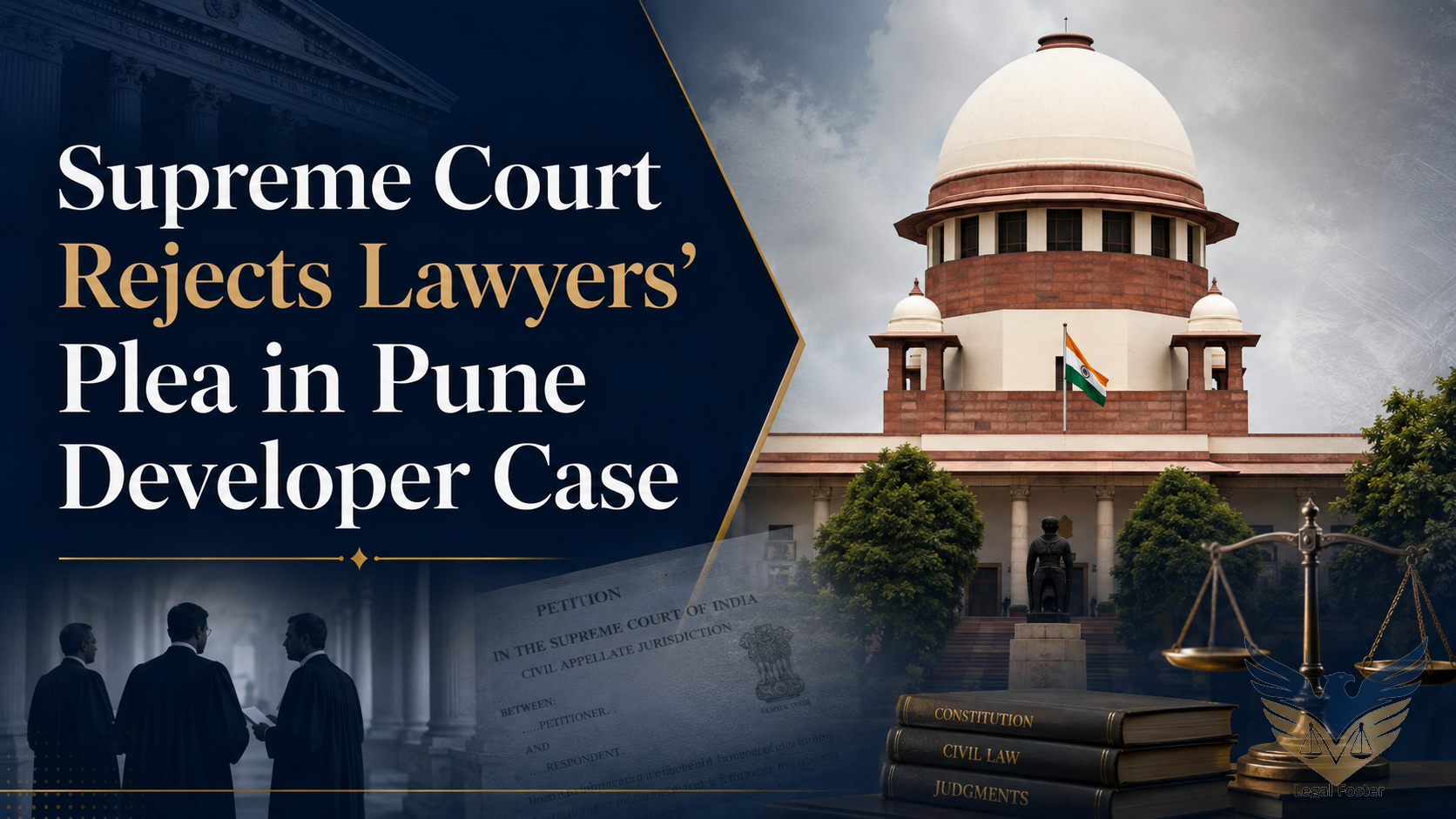
Supreme Court Rejects Plea by Lawyers Claiming Police Harassment After Pune Developer Case
The Supreme Court asked the Bombay High Court to hear the lawyers' pending plea on priority, but declined their request to transfer the investigation from Pune Police to another agency.
The Supreme Court refused to grant immediate relief to five advocates who alleged that they were being targeted through criminal proceedings after appearing against a Pune-based real estate developer in court.
Key Highlights
- Five advocates alleged police harassment after appearing against a real estate developer.
- The lawyers sought transfer of the investigation from Pune Police to another agency.
- The Supreme Court declined to transfer the investigation at this stage.
- The Bombay High Court was requested to hear the pending plea on priority.
- The Supreme Court clarified that it was not expressing any opinion on the merits of the dispute.
What Did the Supreme Court Decide?
A Bench comprising Chief Justice of India Surya Kant and Justices Joymalya Bagchi and V Mohana considered the plea filed by five advocates who alleged that they had been subjected to criminal action because of their professional involvement in litigation against a real estate developer.
The advocates sought transfer of the investigation from Pune Police to another investigating agency. The Supreme Court, however, declined to grant that request. Instead, it asked the Bombay High Court to take up the advocates' already pending petition on a priority basis.
The Bench noted that the petitioners had already approached the Bombay High Court with substantially the same grievance. It therefore considered it appropriate for the High Court to examine the matter first.
Lawyers Alleged They Were Targeted for Appearing Against Developer
Senior Advocate Devadatt Kamat, appearing for the petitioners, told the Supreme Court that all five petitioners were advocates who had appeared before a trial court in proceedings against the developer.
According to Kamat, the lawyers believed that the criminal proceedings were connected to their professional representation in those cases. He further alleged that the Pune Police Commissioner was acting in concert with the developer.
Kamat submitted that the circumstances surrounding the investigation had caused the petitioners to lose confidence in the investigating agency.
Allegation of Late-Night Arrest Without Existing FIR
During the hearing, Kamat told the Court that one of the advocates had allegedly been arrested after a large group entered his residence at around 1:50 am.
He claimed that no First Information Report had been registered against the lawyer at that point and that information was recorded later, with the FIR ultimately being registered at around 4 am.
Kamat told the Bench that the advocate remained in custody for about 40 days before receiving relief from the Bombay High Court.
Second FIR and Allegations Against Other Advocates
The Court was further informed that another FIR was registered against the same advocate on June 29, 2026, concerning an alleged assault stated to have taken place in 2025.
According to the submissions, the remaining petitioners included the advocate's sister, who is also a lawyer, and three junior advocates. Kamat said that all five lawyers had now been implicated in the criminal cases.
Developer Dispute Cited as Background to Criminal Cases
Kamat told the Supreme Court that the principal petitioner had earlier filed three civil suits against the real estate developer on behalf of a client.
The lawyers alleged that the subsequent criminal proceedings were retaliatory and connected to those civil cases.
Kamat therefore urged the Supreme Court to transfer the investigation to another agency, maintaining that the petitioners had lost confidence in the Pune Police investigation.
Why Did the Supreme Court Refuse to Transfer the Investigation?
The Supreme Court was not persuaded to bypass the proceedings already pending before the Bombay High Court. The Bench observed that the High Court should first be allowed to consider the petition seeking similar relief.
The Court also made it clear that it was not deciding whether the allegations against the police or the developer were correct.
With these observations, the Supreme Court declined the request for immediate transfer of the investigation and directed the petitioners to pursue their pending proceedings before the Bombay High Court.
What Happens Next?
The advocates' petition will now remain before the Bombay High Court, which has been requested by the Supreme Court to consider the matter on priority.
If the petitioners receive an adverse order from the High Court, the Supreme Court's observations indicate that they may approach the apex court again in accordance with law. The Supreme Court has not expressed any view on the merits of the allegations or the criminal investigation itself.