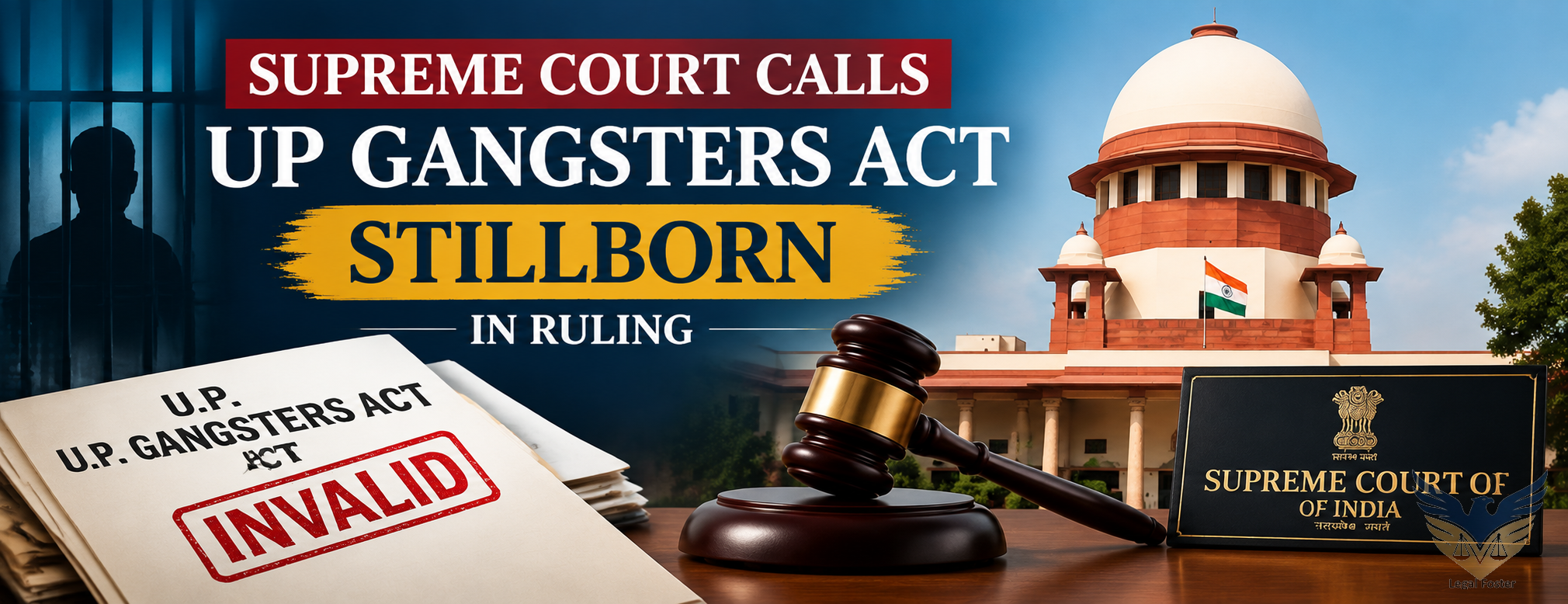
Supreme Court Declares UP Gangsters Act ‘Stillborn’, Cancels Criminal Proceedings Against Two Lawyers
The Court held that the legislation defines a “gang” and a “gangster” and prescribes punishment, but fails to create a distinct criminal offence under the Act.
The Supreme Court has held that the Uttar Pradesh Gangsters and Anti-Social Activities (Prevention) Act, 1986 is “stillborn” because it provides punishment for a gangster without creating a separate criminal offence under the statute.
A Bench comprising Justices J.B. Pardiwala and K. Vinod Chandran observed that the legislation defines the expressions “gang” and “gangster” but does not identify any independent criminal act or omission punishable under the Act. According to the Court, this fundamental omission prevents the penal legislation from operating as a valid source of criminal liability.
“The Act merely defines gang and gangster; and activities indulged in by such persons covered under the said definitions are punishable offences under the IPC or other penal laws.”
The Bench noted that acts mentioned in Section 2(b), including kidnapping, drug trafficking and human trafficking, were already punishable under the Indian Penal Code or other penal statutes. The UP legislation, however, did not create a distinct offence based on any separate prohibited conduct.
Why the Supreme Court Called the Act ‘Stillborn’
The Court explained that a penal enactment must clearly create an offence before punishment can be imposed. Merely giving a person the status of a “gangster” because of alleged involvement in activities already covered by other criminal laws cannot substitute the legislative requirement of defining an offence.
“The Legislature by the impugned Act has not prescribed punishment for committing any offence. Rather, the U.P. Act merely provides for a punishment insofar as involving in any of the activities specified under sub-clause (i) to (xxv), which is already penalised under a different penal law.”
According to the judgment, the Act defines the status of a person as a gangster but does not make that status an offence in itself. The Court concluded that the legislation does not create a crime and merely assigns a label to a person alleged to have participated in one of the offences listed in its definition clause.
Punishment cannot be imposed merely because executive authorities classify a person as a gangster. A valid penal law must first create and define an identifiable offence.
Proceedings Against Two Advocates Set Aside
While deciding the matter, the Supreme Court set aside Gangsters Act proceedings initiated against advocates Shiv Pratap Singh and Himanshu Srivastava.
Singh was allegedly identified as a member of a gang following a dispute concerning the election of the Fatehgarh Bar Association and the disciplinary and criminal proceedings arising from it.
The second petition related to proceedings against advocate Himanshu Srivastava, his brother and their father. The father had allegedly been identified as the leader of the purported gang.
The advocates approached the Supreme Court after the Allahabad High Court declined to quash the proceedings. Since both petitions raised a common question concerning the validity of action taken under the UP Gangsters Act and the Uttar Pradesh Gangsters and Anti-Social Activities (Prevention) Rules, 2021, the Supreme Court heard them together.
Court Examines the Gang Chart Mechanism
The Bench also examined the gang chart procedure created under the 2021 Rules. Under this mechanism, a gang chart prepared at the police-station level is submitted with the recommendation of the Additional Superintendent of Police and approved after consultation with senior police officials and the district administration.
The Court found that this arrangement effectively allowed executive authorities to determine whether a person had acquired the punishable status of a gangster. It held that the Rules exceeded the authority delegated by the parent legislation.
“The creation of crime, or to make an act or omission punishable as an offence, is essentially a legislative function and it cannot be thrown away and left to sprout in the thickets of subordinate legislation.”
Subordinate rules may explain or administer a statute, but they cannot independently create an offence when the legislature itself has failed to do so. The power to define criminal conduct and prescribe punishment remains an essential legislative responsibility.
Risk of Arrest and Pre-Trial Incarceration
The Court highlighted the serious consequences of including a person’s name in a gang chart. Such inclusion could lead to arrest, pre-trial detention, prosecution and eventual punishment, even though the parent Act did not create an independent offence.
The Bench found the process particularly troubling because the same executive classification could form the basis of detention as well as trial. It compared the situation to the English proverb, “Give a dog a bad name and hang him.”
The judgment observed that when executive authorities first identify a person as a gangster and that determination subsequently forms the basis of criminal prosecution, the person’s conviction may appear to become a foregone conclusion.
Article 20(1) and the Principle of No Crime Without Law
The Supreme Court relied upon Article 20(1) of the Constitution, which protects a person from being convicted for an act that was not an offence under the law in force when it was committed.
“Article 20(1) encapsulates the principle of ‘nullum crimen nulla poena sine lege’—no crime or punishment can exist without a penal law; there can be no punishment without an offence in law.”
This constitutional safeguard requires criminal laws to clearly define prohibited conduct. A person cannot be subjected to criminal punishment merely because an administrative or executive authority assigns a particular status or label to them.
Comparison With Maharashtra and Gujarat Laws
The Bench referred to organised-crime statutes operating in Maharashtra and Gujarat to highlight an important legislative distinction. Those laws expressly create specific offences, whereas the UP Gangsters Act, according to the Court, failed to do so.
The Court clarified that this comparison should not be interpreted as an endorsement of the Maharashtra or Gujarat enactments. It also stated that it had neither upheld those statutes nor approved the earlier Full Bench judgment of the Allahabad High Court concerning the UP law.
Criminal Cases Under Other Laws Can Continue
Although the Gangsters Act proceedings against the two advocates were set aside, the Supreme Court clarified that its decision would not affect charges registered under other valid penal laws.
If the alleged activities amount to offences under the Indian Penal Code or another applicable criminal statute, those proceedings may continue according to the procedure prescribed under the Code of Criminal Procedure and the relevant penal legislation.
The finding concerning the UP Gangsters Act does not automatically erase separate charges under other criminal laws. Such allegations must be examined independently under the statutes that expressly make the conduct an offence.
Key Findings From the Judgment
- The UP Gangsters Act defines “gang” and “gangster” but does not create a distinct criminal offence.
- Activities listed in the Act are already punishable under the IPC or other penal statutes.
- A person’s status as a gangster cannot itself become a substitute for a legally defined offence.
- Executive authorities cannot perform the essential legislative function of creating criminal liability.
- The gang chart mechanism under the 2021 Rules exceeded the delegated power available under the parent Act.
- Article 20(1) requires that an offence must exist in law before punishment can be imposed.
- Proceedings under other applicable criminal statutes may continue independently.
Court Invokes George Orwell
Before concluding, the Court invoked the words of George Orwell to observe that a law introduced with the stated purpose of preventing violence could itself perpetuate coercion against unsuspecting citizens when its structure did not comply with fundamental criminal-law principles.
“The enactment under scrutiny, on the pretext of adjuring violence, is in fact perpetuating it on unsuspecting citizens.”
The judgment ultimately concluded that the Act was stillborn because it did not create a crime. The decision, however, leaves unaffected valid criminal charges under other laws that expressly identify and punish the alleged conduct.