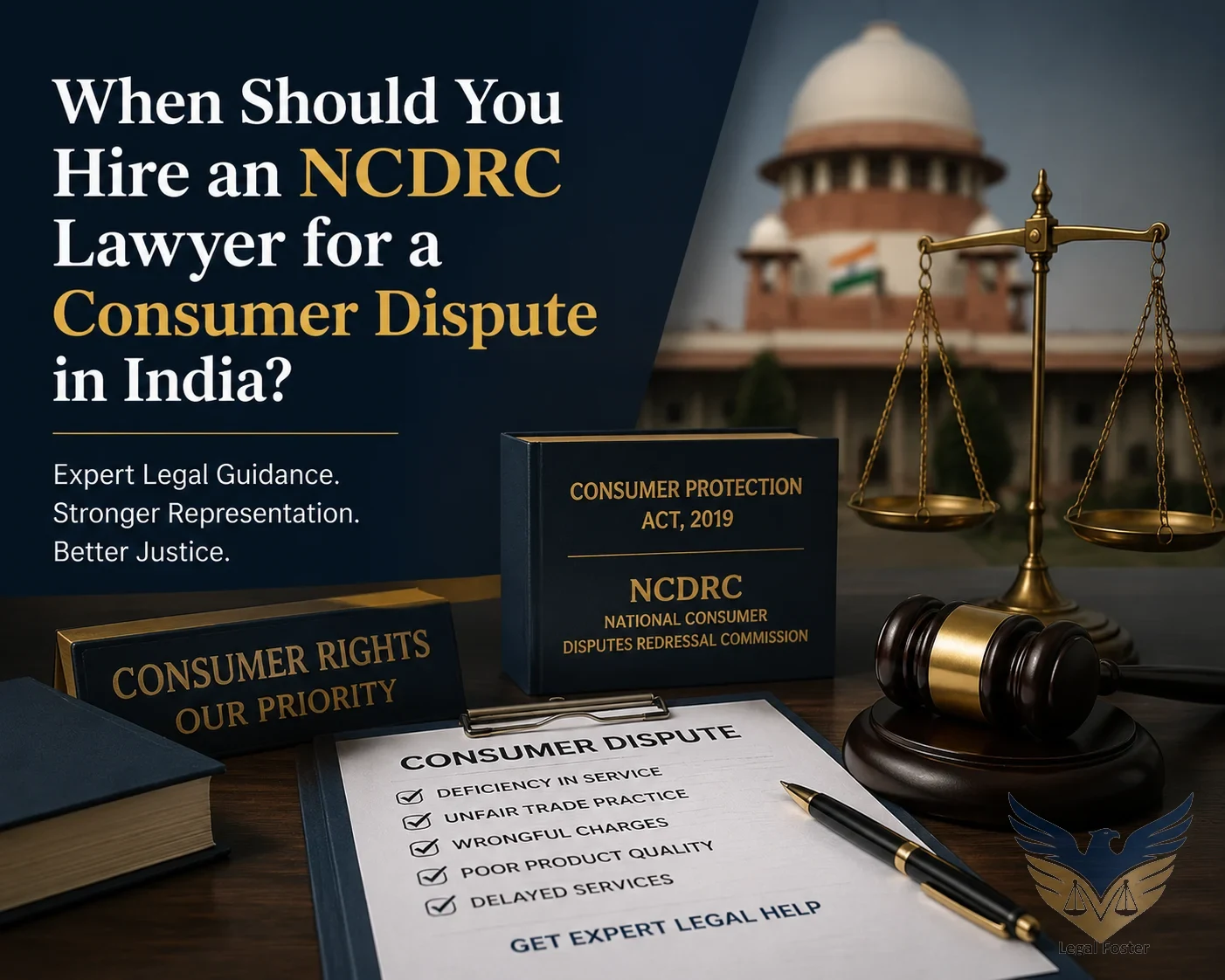
When Should You Hire an NCDRC Lawyer for a Consumer Dispute in India?
A consumer dispute may start with a denial: denying payment of a legitimate claim (insurer), denying handing over possession (builder), denying allegations of negligence (hospital) or denying liability for an unauthorized transaction (bank). While it may start off as a dispute, the stakes can quickly become significant amounts of money in legal fees and damages when limitation, jurisdiction, evidence or an adverse consumer commission order comes into play.
The National Consumer Disputes Redressal Commission, also referred to as the NCDRC hears major consumer disputes filed under the Consumer Protection Act, 2019. However, not all consumer disputes are filed at the National Commission. Some high value disputes start at the National Commission due to the monetary value of the dispute. Other disputes are appealed or revised to the NCDRC from a State Consumer Commission.
Too many people realize the magnitude of their dispute too late. They have already sent panicked emails that damage their position, lost original documents, accepted a low ball settlement offer or let a statute of limitations become contested. Businesses can also be exposed to significant risk when faced with a high-value consumer complaint alleging sale of defective goods, deficient services, false advertising or unfair trade practices.
Why High-Value Consumer Disputes Become Difficult So Quickly
Consumer law strives to be user-friendly, but easy access should not be confused with legal simplicity. Even if you are filing a claim for a few crores, or challenging a technical service or a State Commission order, the dispute might turn upon contractual interpretation, statute language, expert reports and/or a voluminous record.
The stakes can be high for consumers and companies alike. Consumers may risk life savings, their home, an insurance payout, their business assets or the money they spent on a botched service. Companies can be threatened with significant compensation awards, interest payments, legal fees and harm to their commercial reputation.
Where the transaction happened can add yet another layer of complexity. The buyer in Bengaluru could have purchased from a firm incorporated in Mumbai, paid with a cheque from a bank in Delhi and received the goods or services in Hyderabad. Determining the proper forum can raise questions about territorial jurisdiction as well as which consumer commission has pecuniary jurisdiction.
Quick Facts About NCDRC Disputes
- National Consumer Disputes Redressal Commission (NCDRC) is the apex consumer commission at national level constituted under Consumer Protection Act, 2019.
- Consumer complaints in the first instance usually fall under its pecuniary jurisdiction where value of goods or services paid as consideration is more than ₹2 crore, as per existing jurisdictional rules.
- Claimed compensation amount by itself does not generally confer pecuniary jurisdiction under existing regime.
- Appeals from certain orders passed by State Consumer Commissions are entertained by NCDRC.
- Revisional jurisdiction can be initiated by NCDRC where State Commission allegedly had no jurisdiction to entertain the dispute, or did not exercise jurisdiction or exercised it illegally or with material irregularity.
- Appeals and proceedings are subject to limitation. Statutory limit.
- Consumer cases can get rejected on grounds of maintainability or lack of evidence even if the actual grievance is legitimate.
When Does the Financial Value Signal a Serious Jurisdiction Problem?
National Consumer Disputes Redressal Commission (NCDRC) is the highest level of consumer commission at national level. It is constituted under Consumer Protection Act, 2019.
Consumer cases, at the first level, fall under its pecuniary jurisdiction, when value of goods/services paid as consideration exceed ₹2 crore. (As per existing jurisdictional amounts).
Claimed compensation amount, by itself, does not confer pecuniary jurisdiction in most cases. (Existing Regime).
Appeals from the orders of the State Consumer Commissions, in certain cases, can be made to NCDRC.
Revision against order passed by State Commission can be initiated by NCDRC, if State Commission had no jurisdiction to entertain a dispute or State Commission did not exercise jurisdiction or exercised jurisdiction illegally or with material irregularity.
Has a State Consumer Commission Already Passed an Adverse Order?
An adverse State Commission order is typically a red flag that the matter has reached a more legalistic phase. The party may be responding to an order dismissing a complaint or passing a much lower than expected award. Monetary directions for compensation may be high or the party may have received an order rejecting an application with findings that have implications on related proceedings.
Appeals are strictly limited in time. An appeal against an order made by a State Commission with which the NCDRC has jurisdiction is limited to a period of 30 days from passing of the order by the Consumer Protection Act. Failure to appeal within that period will require reasons for the delay and condonation is at the discretion of the court.
The respondent against whom money is directed to be paid is under immediate pressure by virtue of the statutory pre deposit requirement. A challenge therefore becomes not just a legal issue but a significant cash-flow requirement.
Is the Opposing Party Questioning Your Status as a Consumer?
Not all buyers/service recipients are “consumers” under the Act. Typically, purchases of goods for resale or for a commercial purpose, and services received for a commercial purpose (outside the statutory exception for self-employment for livelihood purposes) fall outside the scope of the definition.
Many investors, proprietorships, startups, companies and professionals encounter this issue. A business which buys a machine may call itself a customer. The seller may claim the buyer used the machinery for commercial purposes. Somebody buying multiple houses could be accused of doing so for investment purposes, rather than for self-use.
The names parties use in a contract don’t always prevail. Facts around nature, size and purpose of the transaction are litigated. Where objections are raised on commercial-purpose, Mr. BK Singh Advocate analyzes these as a threshold risk, as the commission may dispose of issues of maintainability before hearing out the complaints of defects and monetary loss.
Does the Case Depend on Technical or Expert Evidence?
Yes, but personal knowledge can only go so far. Cases involving medical negligence, building damage, industrial machinery, engineering projects or specialist insurance policies often rely on technical records.
When medical treatment goes wrong, there may be questions about what records and consent forms were provided, what diagnostic tests were run, what constitutes accepted medical practice and what other experts might say. Poor result is not necessarily proof of negligence. Similarly, hospital records may be incomplete or difficult for loved ones to assess.
BK Singh Advocate will treat your case with special care if crucial technical records are missing, if on-site reports conflict or if there’s no paperwork to back up reported losses. We know this information can present obstacles if you want to move forward with a claim against an insurance provider at the NCDRC.
What Records Reveal That Your Case Is at Risk?
Documents turn messy if they are lost, don’t match or exist only after a dispute became serious. Following are some examples of records that often get challenged:-
- Agreements of sale/purchase, booking receipts, policy papers, service agreements
- Bills, payment confirmations, account statements and EMIs
- Email correspondence, letters, complaint reference, scanned copy of SMSes/whatsapp messages
- Decline to do business letters, cancellation emails and compromise proposals
- Clinic notes, inspection paperwork, pictures and quotations from third parties
- Orders issued by District/State Consumer Forums
- Evidence of the date of receipt of documents/orders
- Documents supporting interest/consequential damage/compenstation claims
The plaintiff might have evidence of payment but not the terms under which the payment was made. The service provider might quote standard terms and not prove that it was sent or accepted by the consumer. Screenshots might not have date, From or conversation before/after the message. Missing information can lead to questions on credibility/integrity of the evidence. BK Singh Advocate says tampered files/partial chat exports and mismatch in payment amount are damaging as they take the matter away from dispute to reliability of evidence provided.
Is the Dispute Spread Across Several Parties or Proceedings?
Consumer cases become more complex if there are multiple parties sharing liability. The seller may be a manufacturer and/or dealer; a bank or insurance company may have financed or insured the sale; the transaction may have been conducted online involving a platform or an app developed/maintained by a third party. Each defendant will seek to blame some other party for the loss.
Joint defendants in a consumer dispute could include the developer, land owner and bank from whom a homebuyer sought financing. In online fraud, joint defendants could include a bank, wallet company and e-commerce platform. In a medical dispute, the hospital, doctor and insurer might all be named. Faulty comprehension of the roles played by various parties can lead to pleadings disputes about who is liable or if parties were properly joined.
Can You Rely on a Revision Petition to Correct Every Unfavourable Finding?
You may think that the State Commission did not properly understand a testimony or arrived at an incorrect decision. But the NCDRC’s power to interfere in revision is typically predicated on established grounds of jurisdictional error or material irregularity. A petition for mere reappreciation of all documents may be resisted.
This difference is important when an order of the District Commission has already been heard in appeal before the State Commission. By then, parallel findings may have been made. The burden of proving an error that is recognizable on revision of law can be very different from relitigating the dispute.
Advocate BK Singh points out that such misaligned expectations are a frequent cause of time spent in vain: Parties tend to think of revision as a second full re-hearing of the matter.
Warning Signs That Professional Assessment Should Not Be Delayed
You may especially require an NCDRC lawyer if :
- The consideration involved is more than ₹2 crore or its computation is in dispute.
- The State Commission has given you an adverse/ costly order
- The limitation period for filing an appeal/ revision has already begun.
- The opposite party is disputing your consumer status.
- The complaint is based on medical / engineering or other technical evidence.
- Multiple companies are denying liability for the same loss.
- Your earlier pleadings have factual inaccuracies or inconsistencies in the claim amount.
- Similar proceedings are ongoing before RERA / Civil court / any other authority.
- Cases involving substantial pre-deposit / direction of compensation / execution proceedings.
- Original documents are lost / in dispute / with the opposite party.
Please note that the above points do not imply that you will definitely win that specific point. They indicate that your dispute has legal complexities which take it beyond a simple service deficiency complaint. Please feel free to read about the firm’s experience from here and BK Singh Advocate’s experience from the lawyer’s profile.
Frequently Asked Questions
Not necessarily. Subject to certain exceptions, original jurisdiction is normally determined by the consideration paid for the goods/services. A large compensation claim does not automatically make the NCDRC the appropriate forum.
You are limited by principles of appeal/revision, limitation and the material on record. Decided findings by the State Commission can pose considerable material/legal hurdles.
Delayed filing can be condoned if sufficient cause is shown. However, condonation is not guaranteed. BK Singh Advocate warns that giving an explanation for the delay does not excuse every period of delay.
No. Revision is generally construed more narrowly. It is usually confined to jurisdictional error, failure to exercise jurisdiction or material irregularity rather than review of all aspects of fact.
It can be challenged if the goods/services were acquired for a commercial purpose. The precise nature/purpose of the transaction and the facts surrounding it can become critical issues.
They can involve intricate questions of medical standards, causation, consent forms and opinion evidence. Unsatisfactory medical treatment may not always constitute negligence. Missing hospital records can also hinder the evaluation of facts.
Missing contracts/orders, invoices/receipts, reports or correspondence can harm your evidence relating to the transaction, the alleged deficiency and loss incurred. Impact depends on the facts in dispute.
Ordinarily, the value of compensation claimed is not the relevant factor for determining present pecuniary jurisdiction. The monetary value lies in the consideration you’ve paid for the goods/services in question.
The Parties may dispute whether the cause of action was continuous or arose upon a particular date of refusal, cancellation or non-performance. Multiple representations do not automatically extend limitation.
If jurisdiction, limitation, consumer status, technical evidence, an unfavourable State Commission order or a high stakes financial claim are all matters in issue with your case, legal review becomes even more crucial. BK Singh Advocate evaluates these factors based on your unique facts.
Final Thoughts
At the NCDRC stage,a consumer dispute can be about much more than simply a defective product, denied claim or shoddy service. Issues such as pecuniary jurisdiction, limitation, consumer status, technical evidence, adverse State Commission order and maintainability can often become issues of equal importance with the original complaint itself.
Failure to recognize and address these issues in a timely manner can result in unnecessary delay, expense, loss of evidence or even dismissal without ever reaching the merits of the matter. Businesses and consumers involved in high value claims should be aware of the seriousness of their situation as soon as possible.
We can discuss your matter with Advocate BK Singh to determine how the facts, documents and procedural history of your dispute will affect your case. Although no outcome can be guaranteed, each consumer dispute will be determined based on its unique set of facts.