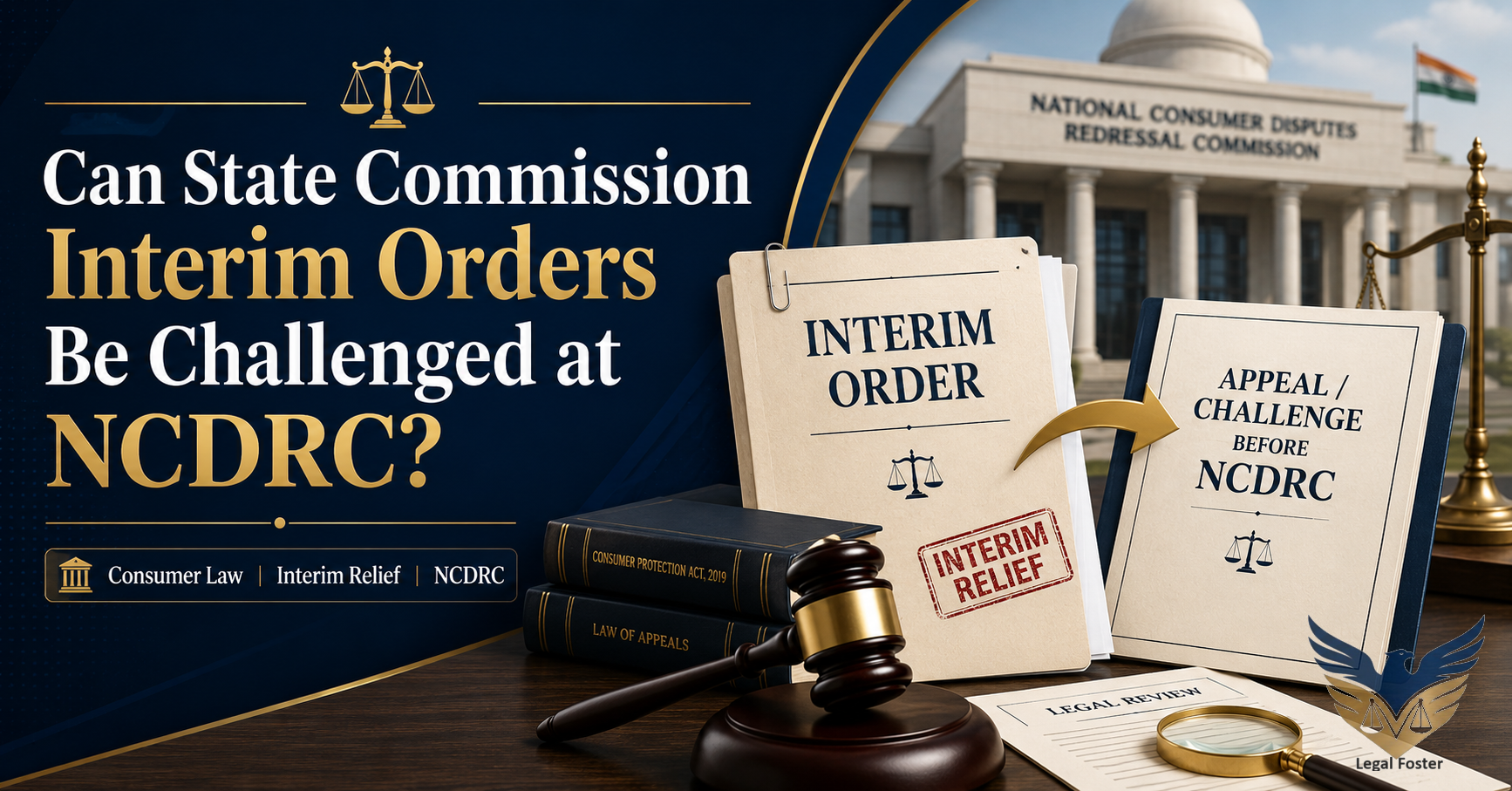
Can You Challenge an Interim Order of the State Commission Before NCDRC?
An interim order passed by the State Consumer Disputes Redressal Commission has the effect of disturbing the proceedings in a consumer dispute from start to finish. It may close a party' door to add evidence, reject an application, impose a procedural condition, permit proceedings to continue despite a jurisdictional objection or subject a trader or consumer to immediate financial liability.
The instinctive reaction is also the correct reaction. "Can we appeal this order before NCDRC?" Immediately. But the law doesn't operate very broadly. Not every adverse interim order is appealable as of right. It can be reviewed by National Consumer Disputes Redressal Commission in its limited revisional jurisdiction under Section 58(1)(b) of Consumer Protection Act, 2019, where appropriate.
This is a subtle difference. While an appeal is entertained, the power of review is much broader as statutory limits permit. A revision petition is primarily aimed to find out whether the State Commission: acted ultra vires; refused to exercise the jurisdiction conferred on it; or exercised its jurisdiction with material irregularity. One cannot present their case afresh on the entire dispute.
Many a times, clients will say to BK Singh Advocate that the interim order is "unfair". Unfairness will not by itself trigger a ground for revision as per statutory language. The words used in the order, the stage of the proceeding when the interim order is passed, the nature of power invoked by the State Commission and practical consequences on the underlying complaint are to be considered collectively.
If an order is presumed appealable, precious time will be lost as consumer proceedings progress on merit. That is why the question is not whether an interim order is challengeable. The question is whether the order is passed suffers from a jurisdictional defect revisionable by NCDRC.
Why Does an Interim State Commission Order Matter in 2026?
Consumer complaints now include building plans, insurance claims, bank deposits, medical services, ecommerce transactions, defective goods, high value commercial disputes etc. While an interim order passed during a consumer dispute may appear to be interlocutory, it can have consequences that last till the judgement is pronounced.
If you are the consumer, an adverse order can affect your right to produce evidence, request technical documents be treated as an exhibit or even challenge a point raised by the opposite party. If you are the builder, insurer or bank, that order could impact you when it comes to presenting evidence, limiting liability or dictating the course of how the complaint proceeds.
Consumer disputes will be heard before state commissions in Delhi, UP, Maharashtra, Karnataka, West Bengal and other states even while the party decides to file a revision against the interim order at NCDRC in New Delhi. We, BK Singh Advocate handle many such matters where there is uncertainty if the main proceedings need to be stayed on filing a revision.
It is not stayed merely because a revision petition has been preferred or is being heard. So the petitioner will have to fight two battles simultaneously...
They will have to keep an eye on their proceedings at the State Commission and evaluate the nature of the interim order passed. If the order requires something to be done by a short deadline, deprives you of the chance to produce information or permits the other party to take some irrevocable action, any delay can make the consequences worse.
Also, if the interim order passed is in prejudice of jurisdictional aspects (territorial/pecuniary), maintainability, denying the principles of natural justice to be followed, rejection of evidence or not accepting a material application, the situation becomes critical. Now the revision petition becomes maintainable, even if serious consequences would result from the interim order.
Quick Facts About Challenging an Interim Order
- NCDRC' s revisional powers over orders passed by the State Commission have been conferred by Section 58(1)(b) of the Consumer Protection Act, 2019.
- An interim order may not become appealable only because it injures the rights of one party adversely.
- Revisional jurisdiction is not as broad as appellate jurisdiction; it is not a retrial of facts.
- Exercising jurisdiction excessively, failure to exercise jurisdiction and material irregularity in such exercise have become the main considerations statutorily.
- Application of revision itself will not stay the proceedings of the State Commission or operation of order passed by it.
- The very nomenclature of the order passed and the real effect brought out by the order are important and may have a greater significance than what is described.
- Grant of interim protection is discretionary and is to be decided on the facts and circumstances of ea
What Is an Interim State Commission Order?
An interim order is passed before the disposal of complaint appeal/revision pending before the State Commission. It directs that some part of the proceedings shall be conducted in a particular manner without finally disposing of all the issues involved in the proceedings between the parties.
Examples of such orders include orders relating to adjournments, evidence, amendment, impleadments, restoration, expert materials, jurisdiction, maintainability or any other procedural matters. Some interim orders may simply deal with the procedure of conducting a hearing. Others can have a significant impact on a party' ability to establish its claim or defense.
Interim itself does not let us know whether NCDRC has jurisdiction to intervene or not. An inconsequential procedural order and order from where irreversible procedural effect flows are both interim orders and their legal consequences could not be differentiated more.
BK Singh Advocate explains whether the order merely shows State Commission exercising its discretionary power of case management or whether the order shows an error in exercising statutory jurisdiction. This issue becomes the main point of debate of maintainability/front NCDRC.
Can Every Interim State Commission Order Be Challenged Before NCDRC?
No. Remember that the National Commission cannot be directed to babysit the proceedings of every matter pending before the State Commissions. As a matter of routine, any interim orders passed whereby routine adjournments are passed or usual scheduling orders are made or discretionary powers are exercised would not be revisable merely on the ground that one of the parties is dissatisfied with the same.
Section 58(1)(b) states that The National Commission may call for the record and pass such orders in any consumer dispute which is pending before or has been decided by the State Commission
Where such Commission has exercised jurisdiction not vested in it by law;
Or has failed to exercise jurisdiction vested in it by law;
Or has acted in the exercise of its jurisdiction illegally or with material irregularity.
Revision is not to be used as a tool to file a devious appeal under a different name by repeating the same contentions, written statement and facts all over again. BK Singh Advocate has read draft petitions where page after page is devoted to telling the National Commission that the State Commission could have decided the matter the other way since another view of facts was also possible. No jurisdictional error is ever pointed out. These draft petitions are doomed to fail straightaway for being not maintainable.
In my view, an interim order also can be revised if the defect falls within the ambit of statutory revisional jurisdiction. But the National Commission may choose not to exercise its revisional jurisdiction if the matter is capable of being reviewed after the final order is passed, the alleged harm is speculative or if revision would lead to fragmenting of the pending proceedings.
Readers interested in understanding the two remedies can read this post on the difference between filing a revision and appeal before NCDRC.
What Legal Problems Determine Maintainability?
Absence of a jurisdictional error
"One can strongly differ with the logic of the State Commission' provided you cannot demonstrate that it failed to exercise or improperly exercised jurisdiction conferred on it by statute. A wrong conclusion is not always jurisdictional."
Limited Revision: If the complaint involves NCDRC needing to assess contested evidence, or choosing between two acceptable conclusions on the evidence then I think the petition sounds like it is appeals in nature.
Material irregularity is not every procedural mistake
"Material irregularity" means a serious irregularity in the exercise of jurisdiction. A petty inconvenience, adverse comment or a curable procedural defect may not amount to that.
Similarly, contentions of breach of natural justice also have to be seen subject to facts. Merely stating that no opportunity of hearing was granted may not be valid if records show that there were numerous opportunities, prior notice or due absence of the party complaining. BK Singh Advocate peruses through the order sheets along with the order appealed against as the complete timeline can support or negate the allegation.
Premature interruption of proceedings
The NCDRC is understandably sceptical of intervention when it is sought at the interlocutory stage by filing a revision petition. Challenges to interlocutory orders at multiple fora can fragment a single consumer dispute into several proceedings and delay final adjudication unduly.
This leaves the party with a vexing question: does the order cause a legal injury as it stands, or is the harm feared contingent on future happenings? Title of the application cannot tell you the answer.
Discretionary orders
State Commissions enjoy procedural discretion in regard to adjournments, accept/reject of documents etc. and manner of conduct of hearings. Revisional interference with such exercise of discretion, as a rule demands something more than a mere showing that a different view was possible.
Where discretion is exercised capriciously i. e. by overlooking relevant limiting provision or ignoring the record itself, then the complaint assumes a different legal character. However even then, whether the complaint is sustainable is fact dependent.
Appeal, Revision and Review Are Not the Same
Misinterpretation between Appeal, Revision and Review is probably the largest procedural mistake witnessed across consumer cases.
Appeal is a statutory remedy available against orders and only those orders mentioned in Consumer Protection Act. Section 51 enumerates appeal from certain orders of State Commission exercisable when Commission has exercised its original jurisdiction. Not all interim orders are appealable through that route.
A revision petition filed under Section 58(1)(b) looks at legality of jurisdiction. It is not a second opportunity to hear the evidence afresh. The revision petition against an order of State Commission is therefore tested with a narrower statutory requirement.
Review is yet another kettle of fish. It typically moves before the same forum to review its order as allowed under the review clause mentioned in the statute itself. One cannot file a Review petition before NCDRC merely because you have used the word "review" and hope that NCDRC will reappreciate an interim order passed/granted by a State Commission.
I have witnessed this scenario happening umpteen times with people coming to BK Singh Advocate for help. They decide upon the remedy they want to opt for rather than what is actually available depending on the nature/order passed by the forum. This attitude/opinion only leads to an objection raised by the registry, a maintainability objection and unnecessary wastage of time as the main petition goes on.
What Problems Can Arise While the Challenge Is Pending?
A second concern is absence of automatic stay. Only filing the papers at NCDRC will not automatically stay the interim order/along with stopping the next date of hearing at the State Commission on the merits.
Lastly there are procedural parallels. You may have to follow directions from the proceedings afoot even while you file a separate suit challenging those very directions as having been passed in absence of jurisdiction. Non-compliance could land you in a fresh set of unfavorable orders. Compliance could render the challenge itself futile.
Also, consider the element of delay. Although limitation would have to be looked at closely with respect to the relevant provision; rules & procedural context etc. the act of letting the underlying suit become stronger, will often defeat the purpose of justifying the timeline. BK Singh Advocate interestingly breaks down the date of pronouncement, date of receipt & next hearing dates as distinct facts instead of automatically treating them as one.
Faults in the registry can open another can of worms. Missing annexures, unreadable copies, misprinted dates, missing translations or an incomplete record can delay your petition from being filed for substantive hearing.
If there is money involved or enforcement is available then issues pertaining to pre deposit, stay and the correct statutory route will need to be considered too.
Please note that each of these qualifiers may not apply to every interim order.
Documents and Evidence That Expose the Legal Problems
These documents will usually tell you whether the petition you are planning to file addresses a
bona fide jurisdictional error or simple disagreement:
- Authenticated copy of order under challenge
- Order sheet along with dates of hearing and opportunities given
- Copy of the original complaint and affidavits filed along with it.
- Parties' written statement, response and affidavits
- Petition upon which State Commission passed the interim order.
- Response and written statement filed against the above said petition.
- Any Appeal/Revision applications before State Commission.
- Proof of date of order received.
- Any other documents which substantiate the urgency of monetary/procedural injury
- Previous connected orders from District /State Commission.
- Resolution, Powers, Board meetings and vakalatnama of the parties(if firm)
- Authenticated English translation of relevant documents if they are in local language.
If an order sheet is missing then it can alter the whole narrative of the proceedings. For example, A says that they were not given a chance to be heard and the order sheet dated 2 months back says that the matter was adjourned due to repeated no shows. Another example would be an order "being challenged" may be concise and speak nothing about points of law. However, attachments can reveal that a major point was raised but never decided upon.
Advocate BK Singh says that Documentary trail is extremely necessary because NCDRC would like to see the record and make their decision if State Commission' exceeded its jurisdiction or not. You don't want to hide the jurisdictional error you're pointing out in your revision petition by an incomplete record..
When Does the Situation Require Legal Assessment?
Lawyers like me often have to maintain that Legal assessment would become maintainable only if interim order takes away jurisdiction, closes evidence, dismisses/submits an application with serious adverse consequences, is passed ex-parte i.e. without any notice apparent to you or result in irreparable/prejudice/oppression before disposal of matter finally.
Similarly legal remedy under Section 58 would also become relevant where parties themselves are at loss to decide whether their appeal/review/revision/civilRevision application is against final order or not. Filing such application under wrong provision would certainly land you into preliminary issues even before reaching into merits of the matter.
Consult me if your next level State Commission hearing is approaching, if order passed by learned Court has compliance directive in it or if you have any proceeding connected to execution being feared. Advocate BK Singh would never agree that since you have an urgent matter the application is maintainable. Urgency is different issue than issue of legality/maintainability of application.
An objective study would often reveal that your plea/prayer is actually directed towards merits of the case and has got nothing to do with the narrow ambit of Section 58. You may not like to hear this, but it's better to know this before you waste your precious time and money on something which is procedurally defective.
How NCDRCLawyers.com Examines the Dispute
Professional review focuses on whether the order meets the criteria necessary for NCDRC to consider assuming jurisdiction, not on ensuring NCDRC will intervene. The analysis starts with the statute granting powers to the State Commission' and the record demonstrating how those powers were exercised. BK Singh Advocate analyses the challenged order, underlying application, pleadings and order- sheet chronology through NCDRC Lawyers.
The review makes a difference between challenge to the finding on questions of material facts, excess of jurisdiction, non allowance of jurisdiction and alleged material irregularity. An interim order does not have any guaranteed result. NCDRC can issue notice, refuse to allow intervention, pass an order on maintainability or consider whether the alleged misconduct can be cured at the time of passing final orders. Hence BK Singh Advocate limits the opinion based on the record available and stage of consumer proceedings.
Frequently Asked Questions
Q1. I want to challenge an order passed by State Commission (Interim) at NCDRC, Can I?
Yes. You can file a petition for revision against an order passed by State Commission (Interim) if the conditions under Section 58(1)(b) are fulfilled. BK Singh Advocate says, "An adverse order simplicitur does not confer revisional jurisdiction."
Q2. Revision petition is same as an appeal right?
No. "Revision and appeal are mutually exclusive remedies. While an appeal provides an opportunity of re-examination within the appellate jurisdiction conferred by law, revision is a narrower concept and generally relates to jurisdictional excess, failure to exercise jurisdiction or material irregularity."
Q3. Will the interim order get stayed on filing of revision against it?
No. Only by filing of a revision against the interim order passed by State Commission the direction impugned or the proceeding pending before State Commission will not get automatically stayed. So, the proceedings before State Commission will continue and it will not await for NCDRC to pass any order. Unless, there is any order passed by the competent forum which specifically affects the operation of the case.
Q4. NCDRC will re-appreciate all evidence of the case if I challenge an interim order?
Not at all. Revision is not the correct forum to re-appreciate the facts and evidence of the case. BK Singh Advocate answered that "There is a distinction to be made between a disagreement with the findings of fact arrived at by the inferior forum and a defect in the exercise of lawful jurisdiction."
Q5. Can I file revision if State Commission passed an order merely directing that evidence may now be closed?
BK Singh will decide the maintainability of such revision on the facts and circumstances of each case. These facts include the chronology, whether an opportunity was offered earlier or not, reasons recorded and prejudice caused. Only because an order says that evidence may now be closed, does not lead to the assumption of material irregularity.
Q6. State Commission has passed the order without hearing one party. What should I do?
If it is very clear that one of the parties was not heard at all, then there is a blatant refusal of a fair hearing. But the entire order sheets along with service record will be required to be seen. Even the conduct of the party who is affected would be relevant to see what was the true procedural scenario.
Q7. One of the party got an order from State Commission granting routine adjournment. Can I challenge this order?
Directions regarding case- management are not expected to lead to any strong grounds of revisional interference. BK Singh Advocate clearly says that " The key enquiry would be whether the order complained of crosses the boundary of normal exercise of such discretionary powers and causes material jurisdictional impact."
Q8. NCDRC will entertain my revision petition if I can say that other view was possible while deciding the case?
No. Generally, the fact that the opposite party could have arrived at another view would not be sufficient to cross the revisional threshold. The dispute has to be connected with one of the grounds which relate to NCDRC's jurisdiction.
Q9. Can I challenge the final order passed by State Commission at a later stage?
The remedy available to you against a final order would differ depending on whether the State Commission had exercised original, appellate or revisional jurisdiction. Also, the Consumer Protection Act under which the order was passed would have to be seen as these acts differ from each other on the provisions governing further appeal. Hence, it would depend on from where the order is coming to NCDRC.
Q10. Why do you ask the record of the underlying case?
Order passed by State Commission will not mention the particulars of every opportunity given or objected by the parties earlier. BK Singh Advocate just wants the particular relevant orders to be supplied alongwith certified copy of the record to know the real history of the case.
Final Thoughts
Setting aside an interim order of State Commission at NCDRC can be attempted only under the very narrow jurisdictional gateway available under consumer law. The gravity of consequences does not expand NCDRC' legislative intent and loudly shouting bullshit doesn't turn an order into 'revisable' order magically.
While Inter preting the order legally within the framework of procedure it was passed (rather than attempting to guess the decision just from a quick description of facts) B K Singh Advocate discusses the three largest issues he encounters with these attempts: treating revision like a second appeal, confusion over ongoing proceedings and working with an incomplete record.