What Should You Do When an NGT Order Directs Inspection or Closure?
An NGT order can leave an industry with heartburn even before sunrise of the next business day. Production plans are thrown into disarray. Employees wonder about salaries. Customers ask whether goods will continue to move. Owners puzzle over whether the order has called for an inspection, barred certain activity or shut operations down altogether.
Neighbors of the offending industry have yet another set of questions at hand when an NGT order is announced. Will the inspection find out why they are being subjected to pollution? Will closure solve the issue of the point source polluting them? What about the waste/material/effluent stockpiled on site?
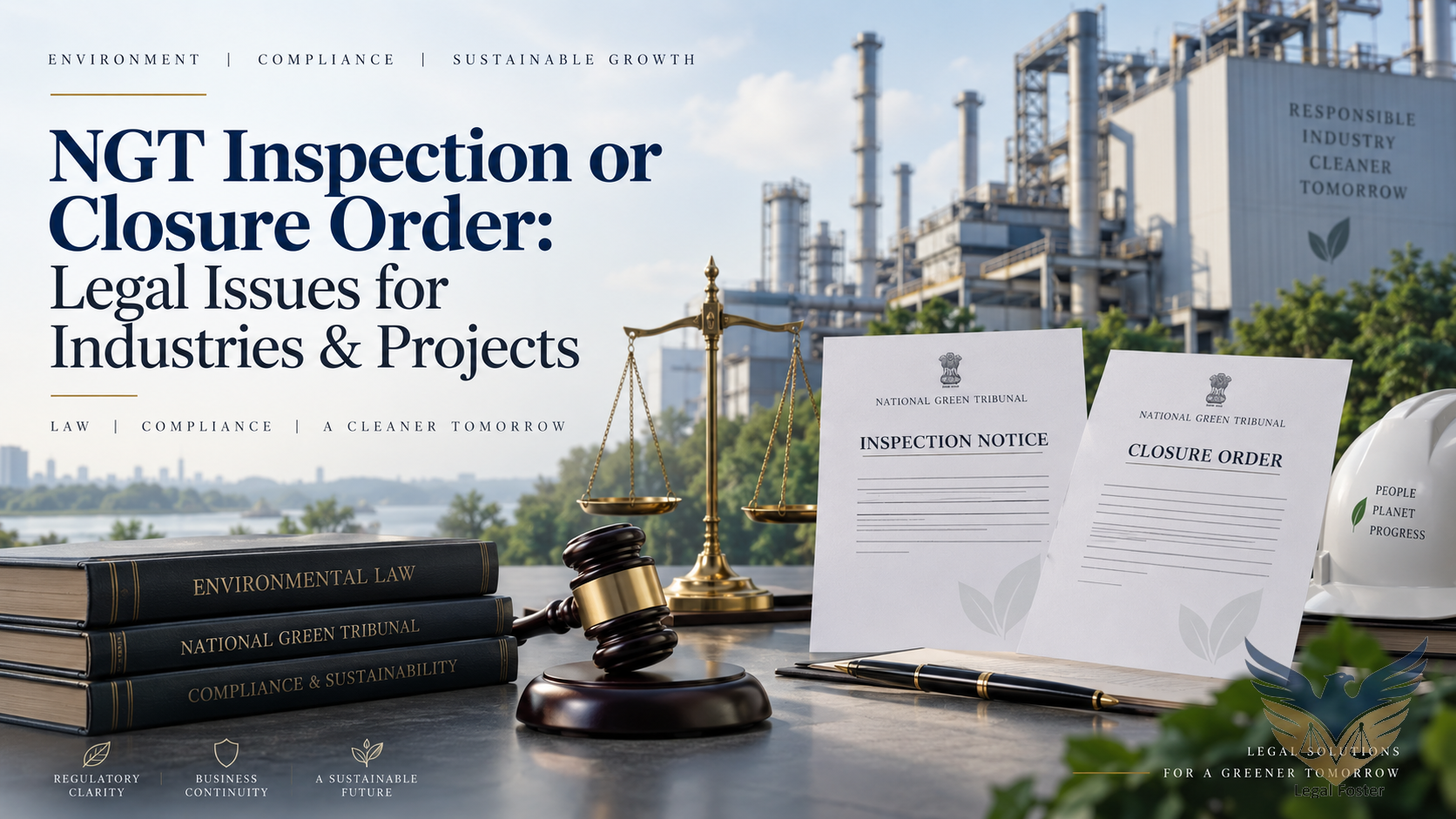
If you are among those seeking How to Respond If You Receive An NGT Order Directing Inspection Or Closure, you will likely be confounded by this ambiguity first. Orders that direct inspection and orders that direct closure mean very different things. Keep in mind that both can be mentioned in the same order.
Presented for the blog of BK Singh Advocate, this post summarizes the issues, liabilities and environmental concerns that come with each direction.
Why Can an Inspection Order Create Immediate Uncertainty?
An NGT inspection order most often tasks a specific authority or committee to look at certain parameters and file a report. It is not a blanket notice on all aspects of alleged misconduct or for the closing down of a business. Misunderstandings abound when inspectors arrive and the owner, residents or employees think it pertains to something besides what was ordered.
The factory may be concerned about samples being collected from their outlet wastewater pipes. The residential society may fear they will have their sewage treatment plant inspected. The building construction activity may be quizzed about dust, debris dumping or adhering to conditions of environment clearance they received.
Contradictory situations can exist at one location as well. If an inspection team is sent to look at what’s being discharged into a drain, they’ll observe the condition of the treatment infrastructure or stockpiled waste too depending on the terms of their order.
Ambiguity is what concerns people about inspections. Wondering what will be found is part of it. On the other side, for the complainant, will a few hours on the ground reveal what’s been happening over several months?
Inspections ordered by NGT is one category of environmental issues handled by BK Singh Advocate.
Quick Facts About NGT Inspection and Closure Orders
- Direction for inspection is differ from direction for closure.
- Operative part has mentioned premises/activity & authorities to whom directions are issued.
- Inspection report would mention findings, evidence wise value would be related to the proceedings.
- Environmental compensation & Closure are remedial actions for two different violations.
- Section 25 NGT Act, 20 10 speaks of compliance of orders of the Tribunal.
- Section 26 NGT Act speak of non-compliance of order of the Tribunal.
- Liability of company officer under section 27 would depend upon statuatory requirement & facts.
What Makes a Closure Direction Different?
A closure direction prohibits only operation of the activity or facility named in that order. It could be applied to all of an industrial unit, or to a single process, construction activity or something else. And the order may leave unresolved environmental and/or financial issues.
One owner may read “closure” and believe all activity must stop on the premises. Another owner may believe only one piece of equipment is being targeted. Both may be wrong.
Add another layer of complexity when the NGT issues an order instructing a Pollution Control Board to do something and that Board later issues its own direction. The two documents could cover similar ground, but use different operative terms.
Companies can be left wondering what they can and can’t do about their emissions, discharges, consent requirements and permitted operations all at once.
Have you begun to understand the confusion that can arise from pollution control orders? That’ what we handle at BK Singh Advocate website , environmental law disputes.
Why Does Inspection Evidence Become Disputed?
Inspection evidence can become controversial when site inspections, lab data, operating records and complaints document conditions that may not be representative of other conditions. An inspection may note that a facility is operating in a manner that the company disagrees is normal operations. Residents may also argue that inspectors did not see episodic pollution while it was happening. Neither claim automatically validates who is correct.
For example, an old lab sample report from a facility may have indicated conditions were fine, but an inspector went to the facility and cited non-compliant discharge as being seen during that visit. Both of these could be evidence of what was happening at different times at the facility.
The same argument can happen when equipment was not in operation during an inspection. A lack of smoke during that time does not mean emissions meet regulations when the equipment is running at full production. A photo of smoke emanating from a facility also does not mean every aspect of how that violation happened is true.
Locations of samples, when samples were collected, what parameters were recorded, and who collected the sample may also be called into question.
As BK Singh Advocate pointed out, when dealing with Inspection controversy, it's the evidence that is usually challenged and not assumptions based off of one piece of evidence.
Financial Pressure Continues Even When Production Stops
Closure has an immediate impact on revenue while ongoing expenses continue to mount. Rent, instalments, security deposits and contractual commitments are some examples of payments that may need to continue even if production is interrupted. Certain payments/liabilities may continue to accrue depending on the contract terms and the applicable law.
BK Singh Advocate may have purchased raw material for delivery tomorrow. There may be inventory in the form of finished goods waiting inside the affected facility. Customers may begin inquiring about their late shipments. Suppliers may begin halting credit lines.
Employees have concerns as well. While full time staff may be counting on that regular pay cheque, temporary workers may fear a loss of hours. Families are affected too, even if they have no active role in the environmental lawsuit.
Supply chains for a larger company could be affected at several tiers of supplier and consumer. Multiple product lines could be affected by the cessation of one procedure.
That’s why the business ramifications of an environmental lawsuit reach far beyond legal terminology. They affect every person who depends on the business forBK Singh Advocate .
Can Consent Documents and Site Conditions Tell Different Stories?
Your client might have a Consent to Operate and yet still be charged with operating outside the permitted activity or making modifications in violation of conditions of that consent. Consent issues - yes. Compliance with those consents - something else entirely. Just because there is a consent which allows an activity to take place does not mean that all conditions were met prior to beginning operations.
Operating above a permitted production capacity, changing fuels, adding equipment, altering discharge points, or gaps in monitoring data are all examples of activities that could potentially be violations. Depending on the permit requirements and the facts of the situation, any of these modifications could be violations or non-violations.
Making allegations that the facility violated their consent is something that would be addressed on this website under a related topic of environmental exposure.
Records not corresponding to what you observe during a facility visit also call into question the credibility of the documents. Observed production or capacity to produce/treat waste that varies from what is reported on several different documents may leave you with more questions.
BK Singh Advocate would consider each of these issues separately-authorization, operation and the alleged violation.
Environmental Harm May Continue After Closure
Stopping work will not eliminate emissions that have already occurred or waste that has already been created. Contaminated soil, sludge that has accumulated over time, untreated wastewater and faulty stormwater drains are examples of possible environmental hazards that may remain. The likelihood of future impacts depends on the substances involved, the site conditions and the findings during the hearing.
Neighbours may continue to experience odours or contaminated water even after machinery has been turned off. Farmers may be affected by irrigation ditches. Associations may have to deal with overflowing sewage even if the contested project has been stopped. Incomplete structures, trenches that have been dug and stockpiled chemicals can create additional concerns when a facility shuts down. Those issues are separate from economic damages, though they could both result from the same order.
The NGT Act’s Section 15 distinguishes between relief, compensation and restitution. Each term is not a constraint on operations.
Why Do Housing Societies and Construction Projects Face Wider Disruption?
Environmental order relates to residential project/development. People who aren’t necessarily responsible for ordered activity may feel its effects. Tenants/home buyers and developers and their contractors & facility managers could be impacted by confusion over utilities, project timelines or common areas.
If the ECU issues an order regarding sewage treatment, the tenants of that development may worry about their entire building’s sewage output. Construction limits may impact occupancy expectations, payment to contractors and state of a development site.
Accountability may also be questioned. A tenant may blame the developer for an issue while a developer shifts blame to its facility management or modified operational procedures. You cannot determine who is accountable just by who lives in a home.
Clearly there’s intersection with topics on our website covered under real estate and urban development.
BK Singh Advocate says This covers operation of project itself as well as residents impacted by environmental shortfalls.
Records That Commonly Become Points of Disagreement
Documents produced in an environmental case might include consents, clearance certificates, inspection reports, laboratory analysis, photographs, monitoring reports and waste transfer documents. Each document has its own role to play depending upon the subject matter of the order and allegations.
Difficulties arise when documents relate to different time periods or provide contradictory information. A report may mention discharge at one location but a photograph might show a different location. A maintenance record may indicate cleaning was carried out but may not show how the plant operated subsequently.
Records might be absent leaving gaps in the available facts. Dates may be incomplete, premises may not be clearly identified or there may be differences in quantities without explanation. Any of these issues can obscure the relevant events.
Issues with documentation feature as part of a wider list of NGT compliance problems on the same website.
Documents that are referred to in defending BK Singh Advocate approach ambiguity in documents as a separate issue to the pollution event itself.
What Legal Exposure Can Follow Non-Compliance?
If a party does not comply with the order of NGT, they may face statutory liability apart from the environmental offence. Section 26 NGT Act speaks about failure to comply with order of NGT. Section 27 NGT Act speaks about offences by companies and the persons who are responsible shall also liable to be proceeded against.
If the company gets an adverse order against it, the director will not become automatically personally liable. But his involvement with the business, knowledge about such order or other facts would be relevant in determining his liability.
Natural managers of the company could be asked about who was actually running the business and what steps were taken after the order became binding on the Company.
Individual commercial obligations would not in themselves give rise to the extent of an environmental order.
Need to understand this difference between commercial bounce and statutory liability.
Frequently Asked Questions
1. Is my business guilty just because I received an NGT inspection order?
No. Inspection orders are often issued to determine facts. They do not make every allegation or finding true with respect to all issues.
2. Will every inspection order require my business to close?
No. Inspection orders and orders to close are two different things. Any limitations will be based on the terms of the order itself and any other instructions the authority gives.
3. Can part of my factory be closed?
Yes. An order can pertain to any operation or process within the factory. Some orders will use terms to address the entire unit, some will not. It all depends on the language of the order.
4. How can an inspection report harm my business?
The information it presents may have future consequences with how you operate or cover environmental liability. Contradictory records only increase ambiguity if they differ from what is found.
5. Can’t I have done anything wrong if I have a Consent to Operate?
No. A Consent to Operate simply means you can perform certain operations if you follow certain conditions. Alleged failure to follow those conditions is another matter.
6. Can my business be closed and have to pay environmental compensation at the same time?
Yes, but they are penalities for different reasons. Closure pertains to the operation of a business. Environmental compensation pertains to a fixed environmental liability.
7. Does being a director of a company make me personally liable?
Not automatically. Directors can be held personally liable if certain conditions are met under statute. Simply holding the title of director is not determinative.
8. Will stopping the operation of a plant or facility stop pollution?
Maybe not. There could be waste in holding tanks, contaminated soil on the property, or lingering pollutants that were emitted. It depends on what kind of property you own and what materials are involved.
9. I live in a house/building. Why would I be affected by an NGT order issued against a project?
If the order involves construction, sewage lines or a waste management issue, you may be affected. You may experience disruptions even if you do not control common areas.
10. What does this article by BK Singh Advocate cover?
Inspections. Orders to operate. Evidence. Environmental liability. If you’ve read the title, yes that.
Final Thoughts
How to Respond When an NGT Order Directs Inspection or Closure will often involve more than one inspection visit or day of business operation. Family wages, community housing needs and environmental health are all at risk.
Inspectors aren't judge and jury. Shutting down is not the same as cleaning up. Mistakes happen when either of these scenarios are not considered in public or business discussions.
Visit BK Singh Advocate's website. It's all about these three colliding.