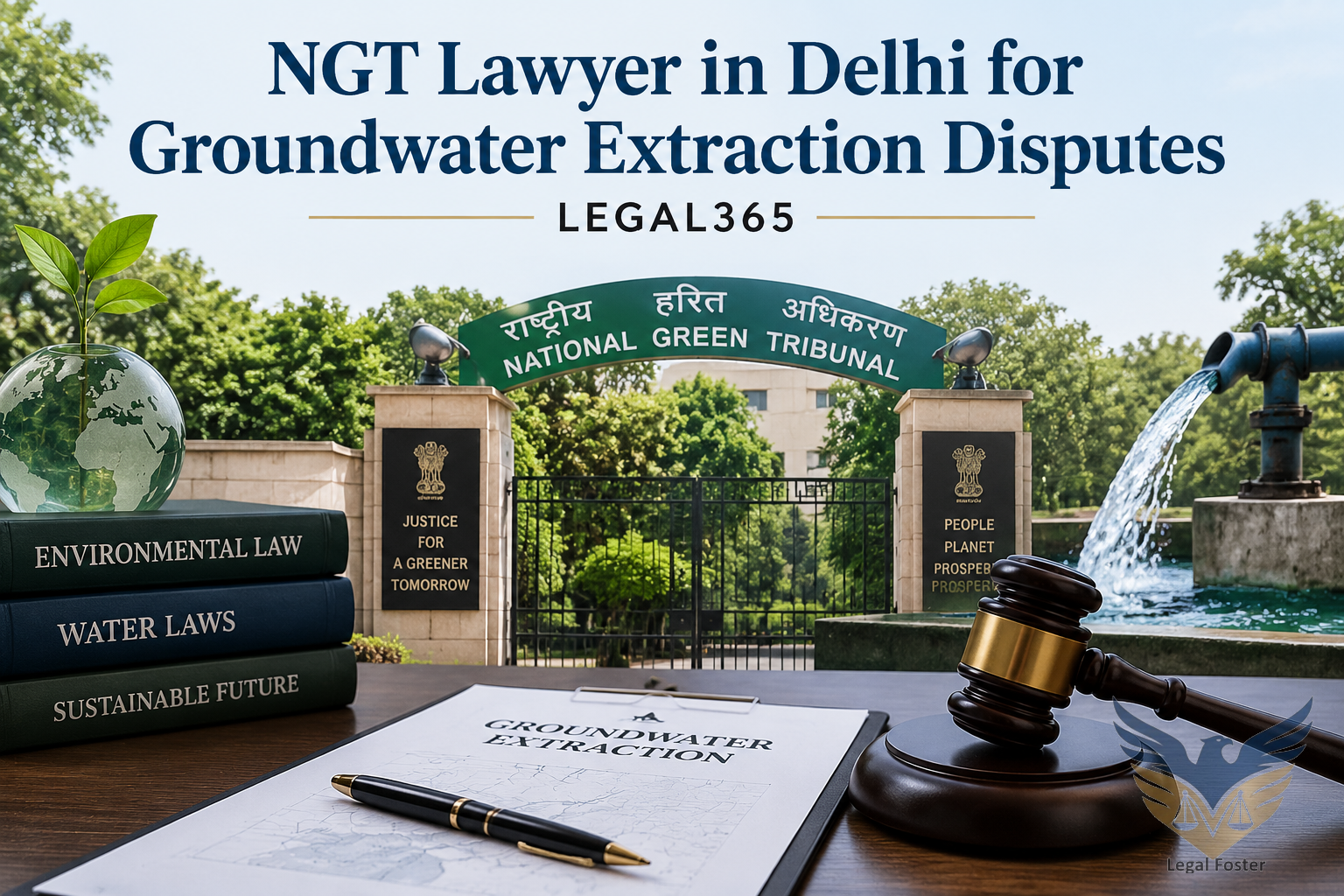
NGT Lawyer in Delhi for Groundwater Extraction Disputes and Violations
Legal guidance concerning groundwater extraction disputes, borewell permissions, environmental compensation, regulatory notices and proceedings before the National Green Tribunal.
Environmental Law • NGT Litigation • Groundwater DisputesGroundwater extraction in Delhi can seem like a straightforward operational issue until you receive an inspection notice, a complaint surfaces or the water department issues a violation letter. The borewell of a hotel, housing society, factory, hospital, construction site or commercial building could come under scrutiny if permission has not been obtained, has expired or does not match up to the volume of water pumped out.
The issue often extends beyond paperwork. Environmental compensation could be questioned along with orders to seal the borewell, disconnect electricity, direction to close and accountability for past pumping. Businesses can suffer reputational damage and loss of normal operations as well.
Owners often don’t realise the severity of the issue until officers arrive at their doorstep or a complaint is filed at the National Green Tribunal. At this stage, past electricity bills, water metre readings, photographs and inspection reports may already give clues on how long the borewell has been active.
Why Groundwater Extraction Is a Serious Issue in Delhi in 2026
Water availability in Delhi is under stress. High-density residential societies, commercial complexes, construction activities and industries put demand on groundwater which also varies across locations.
Unauthorized extraction could impact local communities, lower water levels and exacerbate summer scarcity. One functional borewell could thus lead to a dispute between a RWAsociety, municipal corporation, pollution control committee and groundwater board.
Liability increases if groundwater is tapped for commercial activities. Restaurants, event halls, water-bottling plants, nursing homes, colleges, builders and industries could consume volumes much higher than regular household needs. Parameters like the purpose stated on paper, actual usage, machinery installed and size of the premise could be analysed by officials.
Cases relating to Delhi would be heard at the Principal Bench of NGT Delhi. BK Singh Advocate evaluates how site visits, regulatory documents and petitions could impact you or your entity if named in such a lawsuit.
Quick Facts
- Ground water cannot be treated as unlimited private property even if it is below your own land.
- Permission: -Commercial/Industrial purpose may need prior approval from respective groundwater authority.
- Borewell digging and Groundwater extraction permissions are 2 different issues here.
- Permission validity which is time-bound, conditional or purpose-specific can't help you extract beyond it.
- Unauthorized extraction can invite environmental compensation cost and prohibition to extract further.
- Project proponents, Occupier, Govt. Department/NGT from time to time framed regulators, etc. can be parties in NGT.
- Liability: Depending upon facts, period of extraction, rules applicable at the time & evidence on record.
What Is the Core Legal Problem in Groundwater Extraction Cases?
The issues usually turn on whether the groundwater was abstracted by legitimate authority and for the approved purpose, quantity, location and time-frame. Owning or occupying the premises does not give automatic rights to have a borewell.
Contentions typically occur when the occupier believes that an existing borewell, municipal consent or previous agreement are adequate. Subsequently it may become apparent that there is no legitimate no-objection certificate, the approval has expired or conditions were not complied with.
Another frequent issue relates to who is liable. The land could be owned by one person, leased to another and worked by a business or franchise. All may claim that the borewell is not under their control. Electricity bills, repair invoices and internal communications may become important evidence.
BK Singh Advocate has seen many groundwater battles where the facts are harder to prove than the legal aspects. Nobody actually knows when the borewell was sunk, who funded it, how much water was taken out or if any meter ever worked.
Which Laws and Authorities May Become Relevant?
Groundwater objections typically involve environmental law intertwined with government notices, conditions of permission and directions issued by the relevant authority. The Environment (Protection) Act, 1986 provides an umbrella statutory structure under which environmental norms and standards may be specified, and regulatory directions issued.
The Central Ground Water Authority has regulatory oversight relating to extraction of groundwater within the states under central jurisdiction. State bodies and Municipal corporations in Delhi could also be engaged, depending on the property, nature of the industry, land use, nature of the complaint etc.
If the complaint involves a substantial question of law relating to the environment, the matter could be taken up by the National Green Tribunal established under the National Green Tribunal Act, 2010. The NGT has jurisdiction over claims relating to environmental damage, failure of regulation and claims related to restoration, within its statutory authority.
Advocate BK Singh would analyze whether the complaints pertain to the act of extracting groundwater, breach of condition of approval, inaction on part of the authorities or alleged damage to the environment around the groundwater table.
What Problems Arise When the Borewell Has No Valid Permission?
Lack of valid permission results in something worse than a procedural flaw. The legality of the entire period of groundwater extraction and the profits earned from its usage are brought into question.
Officials can inquire about how long the borewell has been active, how many hours it operates per day and where the water was supplied. In the absence of a flow meter or log book, the volume becomes contestable. Officials may also indirectly question electricity bills,Installed Capacity, tanker invoices and even occupancy.
Obtaining new permission does not mean previous questions about groundwater withdrawal go away. Similarly, having a pending application with the authority does not mean groundwater extraction in that period was permissible.
A buyer of the property is not exempt from a messy reality check. The buyer could argue the borewell was drilled prior to the transaction. However, the current functioning of the borewell, electricity connection and use of water can be queried independently.
Why Can Environmental Compensation Become a Major Risk?
Environmental compensation is not the same as an ordinary penalty. This may be linked to how long and how much unauthorized abstraction has taken place, what type of use and environmental damage.
The details may not be apparent from a brief inspection report. There can be challenges on the presumed number of days of operation, calculated volume of water, class of use and period allocated to the current occupier.
Businesses have an additional issue to consider. The regulator may perceive groundwater abstraction as a financial benefit they have received without adhering to the regulatory system. Many years of purported abstraction can therefore lead to significant financial liability.
Arguments over payment can continue during sealing, shutdown or compliance actions. Advocate BK Singh questions if record of calculations corresponds to site history, but the outcome ultimately rests on the evidence before the competent authority.
How Do Complaints and Inspections Complicate the Matter?
Landlord prosecutions often start with a neighbour’ complaint, society disagreement or RWAs illegal construction grievances. Personal animosity might have played a role but the authorities will still look into the matter to find if an actual offence took place.
When an inspection takes place, the condition at ground zero is fair game for evidence. Officials might note the borewell, pump set, pipes, electricity meter, water storage and connection to the functional building. Pictures clicked on spot and explanations given by the owner/party can be used later.
Issues arise when various documents conflict with each other. A supervisor might claim that the borewell isn’t operational but electricity bills suggest otherwise. The accused might protest that they aren’t using water for business purposes but plastic pipes may lead straight to the kitchens, guesthouse or workshops.
Denying officials entry, giving flimsy excuses or maintaining misleading records may impact how the actions are judged. Advocate BK Singh places a lot of weightage on the record of inspection since subsequent verbal rejections do not erase what officials wrote on the spot.
Which Documents Commonly Expose Evidentiary Gaps?
Groundwater complaints collapse with lack of documents or inconsistent documents rather than just one admission. Key documents are:
- Groundwater NOC/Conditions of renewal of NOC
- Borewell fitment bills & contractor details
- Title deeds/lease deed/occupation certificate
- Plan indicating borewell, overhead tanks and connecting pipes
- Flow- meter analysis register and daily consumption register
- Power bills of the pump set used
- Water tanker bills and municipal water bills
- COE/CO or Consent to Operate documents
- Inspection memo, photographs and sampling memo
- Direction issued, response and demand for environment compensation
- Declaration specifying liability of owner and occupier
- Production/Occupation/Consumption data clarifying requirement of water
Merely holding some documents does not prove that you are compliant. Check the dates, address, borewell number and purpose are as per the activity undertaken.
BK Singh Advocate regularly sees that old Approval is being furnished for some other occupier/plot/noise purpose of extraction.Ready to become the crux of the allegation.
Who May Be Named in an NGT Groundwater Case?
The operator of the borewell may not necessarily be the sole respondent either. The petition may list the owner, tenant, company, director, promoter of project, society of residents, contractor or even a government department.
The owner may claim that it was the tenant who was involved with the day-to-day activities. The tenant might argue that he had rented the property along with the borewell. An officer of a company may say that he was not personally involved. All such defenses will depend upon the contract, internal division of work and who actually had control over the activities.
Government departments can themselves be asked about negligent supervision, not acting in time or ineffective oversight. As such, the case turns into an environmental litigation involving multiple defendants with each one having a different story to tell.
An advocate practicing at NGT Delhi for borewell operations and ground water extraction will have to be aware of these shifting blame games. BK Singh Advocate analyses who has been accused of what role rather than jumping to conclusions based on who owns the title of the property.
What Operational and Commercial Consequences Can Follow?
Groundwater dispute can cause disruption to business operations even before final liability is determined. Suspension of borewell operations by way of sealing may impact sanitation, cooling towers, construction activities, manufacturing processes or customer service.
Arrangements to source alternative potable water can cause steep expenditures. Apartment complexes can deal with discord within society members, hospitals may have to make do with providing basic healthcare, schools may face difficulty in administering regular classes.
Timelines for construction projects can be impacted if the commercial project’s source of water is challenged. Claims against lenders, investors, contractors, or customers can arise from closure-related allegations. A business may even be required to disclose any pending environmental litigation during sale transactions or while undergoing due diligence by a third party. The matter spirals out of just being a dispute over a borewell.
If the business operates from a rented property, the dispute can give rise to another set of breach of contract claims. BK Singh Advocate analyzes the environmental dispute separately from any landlord-tenant or commercial dispute stemming from the same set of facts.
When Does Specialist Legal Review Become Necessary?
Specialist advice may become important when the matter has graduated from being a routine correspondence to a file on the desk of a regulator or a Judge.Telltale signs are Inspection, show cause notice, sealing action, demand for environment compensation or notice from NGT.
Review becomes necessary if the permission has lapsed, land has recently changed hands or history of extraction cannot be easily pieced together. Divergent responses from officials, contractors and landowners only increases liability.
Care must be exercised where a complaint references multiple affiliated parties since one party's response could undermine another's defense. BK Singh Advocate reviews whatever record exists and points out these weaknesses and their legal implications.
No lawyer can guarantee that mineral extraction will be permitted, that compensation will be withdrawn or that the proceedings will be concluded in any predetermined way. Each outcome depends on the relevant notification, the site, the reason for extraction, the paperwork and the observations of the authority or Tribunal.
Why Groundwater Disputes Require Careful Legal Assessment
Groundwater proceedings involve issues of property usage, environmental law, business operations and public-resource management. Viewing the matter as only a small licensing defect may lead parties to ignore the period of purported extraction and alleged environmental damage.
The matter may also contain scientific data that typical real property records cannot address. Pump capacity, meter readings, aquifer sustainability and demand for water can affect issues of fact.
Clients can utilize Legals365 to request a reviewed opinion from BK Singh Advocate on the allegations, paperwork, accused and forum. This review alone will not ensure immunity, prevent shutdown or reduce environmental damages.
For environmental disputes, regulatory notices, NGT proceedings and other legal concerns, Legals365 provides access to legal professionals and consultation services across Delhi NCR and other locations.
Frequently Asked Questions
No. A private landowner does not automatically have an unfettered right to extract groundwater. Permission regulations, purpose, location criteria and conditions would still apply.
An existing old borewell does not establish that current extraction is permissible. BK Singh Advocate looks at the date of approval, whether it was renewed and any continuing conditions in the existing document.
Yes. A tenant can be accused in a case where it exercises control over the well or benefits from extraction. Ownership details, operational control, lease rights and actual usage should be considered collectively.
Yes. A landlord can be included if ownership, installation permission, knowledge, control etc. is alleged. Simply including a person does not by itself determine final liability.
The lack of reliable measurements leaves an evidentiary gap. Authorities can review other documents or material when determining the timeframe or potential extent of extraction.
No. Environmental compensation typically relates to environmental harm, restoration or illegal profits gained. Separate legal action could also be initiated depending on the offence and relevant laws.
Any person who believes that there has been a violation may report the matter to the authorities. The claim would still need to be substantiated through investigation and evidence.
Filing an application does not inherently legalise or forgive a prior period of extraction where no approval was obtained. BK Singh Advocate would assess both time periods separately.
The Tribunal has powers to issue environmental orders for matters within its purview, but any sealing would likely be implemented by the concerned regulatory authority or local Government body. It would depend on the specific facts and the applicable laws.
Groundwater extraction cases can involve analysis of technical evidence, relevant environmental laws, conditions of any prior NOC’s, compensation amounts and multiple responsible parties. BK Singh Advocate can help you understand how these aspects apply to your specific dispute.
Final Thoughts
Issues surrounding groundwater extraction in Delhi can leave individuals, tenants, societies and traders exposed to regulatory action, claims for compensation and disruption to operations.
Often the absence of an NOC is just the tip of the iceberg. How long have you been extracting? How much have you been extracting? Who has control? What about environmental impact?
BK Singh Advocate offers professional evaluation of groundwater extraction issues and NGT hearings. It may be possible to identify your exposure with an early review though nothing is certain.