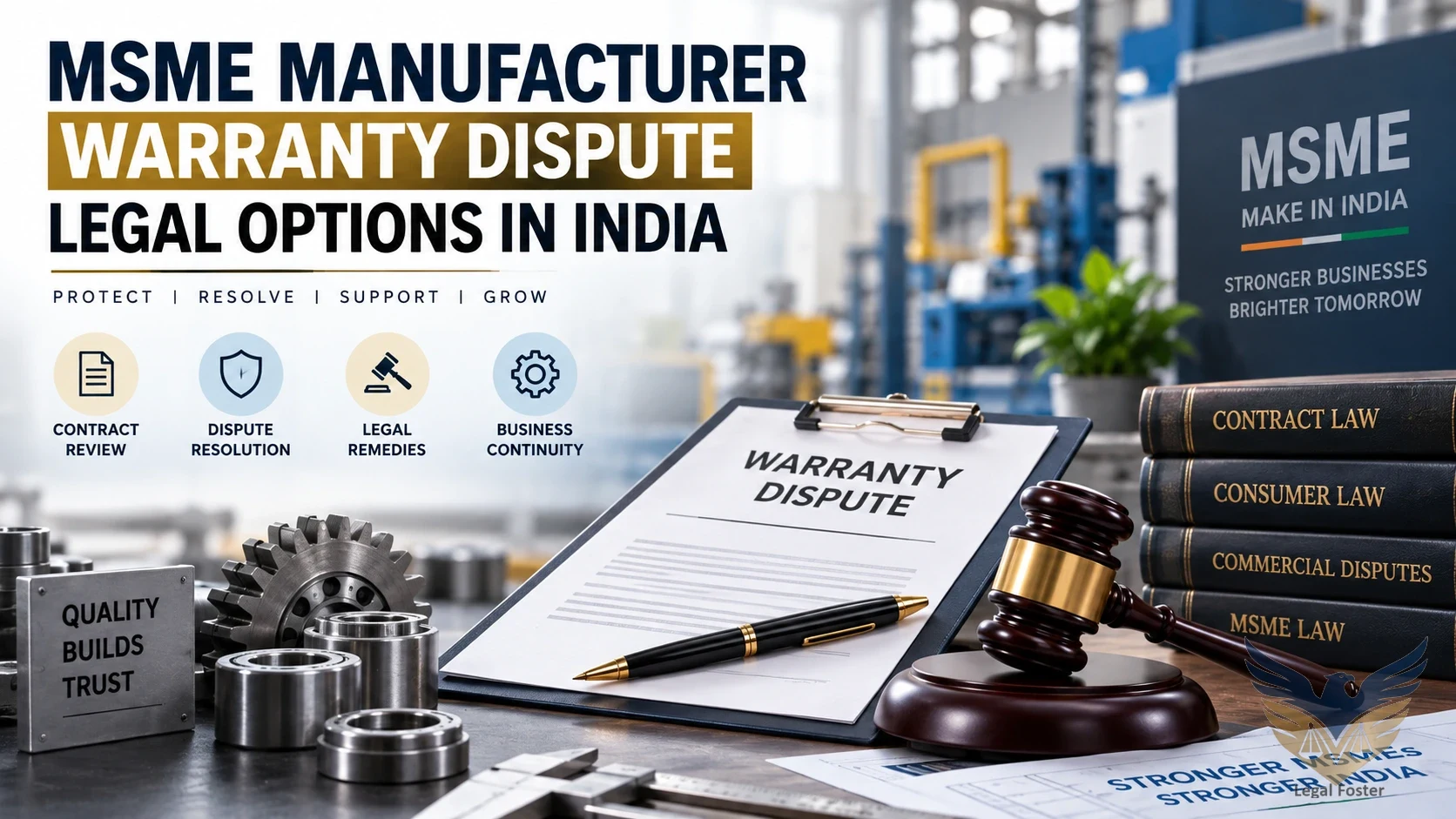
It all starts with a routine warranty claim . The buyer says your machine is not working as warranted. The product you delivered is faulty. Parts were not changed timely enough or the Product broke down early. He just stops paying the bill.
This can turn into a commercial dispute for the MSME Manufacturer.
The Manufacturer thinks his product met all specifications and was well within warranty conditions. Maybe the buyer is right and the product is indeed faulty as per warranty terms. Technical departments start sending emails.Left and right. The Account department stops authorising invoice payments. And suddenly someone is talking about lawsuits.
Its no longer a warranty case. It can span into Conditions of contract. Specifications of product and non performance. Breach of Contract and Claim for Damages.
As an MSME Manufacturer these are the questions you should be asking yourself if you want to handle a warranty dispute.
Did I actually breach the express OR implied warranty of my product? If so what do I stand to loose?
The term Warranty may not always help you narrow down to a solution.
Under the Sale of Goods Act 19◦30 there are Conditions and Warranty. This act mentions about Sale by Description. Quality and Fitness and Sale by Sample. It even has a section 59 which mentions Remedies for breach of warranty.
If your buyer is refusing to pay your invoice because of some alleged Warranty defect. You can fall back on the MSMED act. As it has various sections from 15-24 which mention about Payment to qualified Micro and small enterprises.
Over at BK Singh Advocate we like to review the purchase order. Clearly defining the technical specs and warranty terms. Was there any inspection before delivery? What about the payment history?
These will be crucial questions if you are an MSME Manufacturer located in Delhi NCR. Noida, Gurgaon, Faridabad, Ghaziabad. Mumbai, Pune Bangalore, Hyderabad, Chennai, Ahmedabad or any major manufacturing city for that matter.
Why Do Warranty Disputes Matter for MSME Manufacturers in 2026?
Buyers always want Manufacturer to follow their PO's , Vendor portal, quality specifications and contract. There can be a clause asking for a certain dimension of the product you sold to them, production rate, tolerance you have provided, material you have used, performance of the product, installation criteria and after sales services.
But there can be consequences other than just paying for the replacement of that product.
The Buyer can withhold payment of outstanding invoices. He can stop placing future orders. He can blacklist your company from his approved vendor list. Some other customer can hear about this incident. If that equipment was critical for his process he can even claim compensation for the loss he has faced because of that.
Running an MSME as a Manufacturer your cash flow is everything.
One invoice unpaid because of a few lakhs can make it difficult for you to pay your salaries, buy raw material, pay GSTn working capital loans. It's best not to let a disputed warranty claim drag on for too long. Facts become blurry when you try and recall what happened months ago.
At BK Singh Advocate we treat warranty claims as pieces of evidence to build a commercial argument. We don't look at people being right or wrong.
Lets look at the sale first.
If your contract states that you are selling a machine which will provide you X amount of product per day when run at Y speed. Then its perfectly reasonable to ask the customer if they have operated the machine at that speed.
But remember, manufacturers shouldnt hide behind their warranty clause to not take responsibility for anything. There are implied terms under the sale of goods act which can be included depending on your situation.
You need to consider all these.
Quick Facts
- Warranty claims may arise under express terms, such as written warranty, purchase order, supply contract, technical specifications, quote or implied obligation.
- Under Sale of goods Act There is a difference between condition and warranty and it would carry different consequences.
- There are certain implied conditions in Section 16 which may imply as to merchantable quality or fitness for purpose subject to certain statutory exceptions.
- Section 59 provides the remedy if its fit for purpose then the buyer can treat such breach as breach of warranty and seek reduction/extinction of price or damages.
- The plaintiff would have to fall under the ambit of consumer law if its applicable to a product liability action.
- Under MSMED Act, Small and Micro Supplier may be protected from delayed payments if goods supplied are unpaid.
- Technical inputs would assist whether its a manufacturing defect/incorrect usage/poor installation/maintenance or simply a contract mismatch.
What Is a Warranty Dispute in Manufacturing?
When delivered products do not conform to a stated or implied standard and are therefore subject to remedy, a manufacturer warranty claim is made by the buyer.
Often the warranty party disputes the validity, cause or severity of the problem.
Here’s an example of a straightforward manufacturing warranty issue:
A MSME sells 20 control panels to a buyer. Six months later the buyer says they have failed repeatedly. The controls were purchased with a manufacturers warranty which stated defects in material and workmanship were covered for twelve months. Damage due to voltage spikes orUnauthorized repair were NOT covered.
- When the equipment failed during warranty” does not automatically assign liability.
- Was it a defect in manufacturing?
- Was the panel altered by the buyer?
- Did the voltage exceed specified limits?
- Was preventative maintenance performed per recommended schedule?
- What does the service report say?
- You can see these fact based questions are relevant.
BK Singh Advocate will help you determine if the situation falls within the language of your warranty or was caused by something outside of the manufacturers control.
What Is the Difference Between a Condition and a Warranty?
The distinction can have very real consequences on what remedies are available.
Section 12 Sale of Goods Act . Section 12 Sale of Goods Act deals with express and implied terms which may amount to conditions or warranties. Simplifying greatly; A condition relates to the primary purpose of the contract, and a warranty is secondary to the primary purpose.
It should not be thought that if a clause is labeled a “warranty”, that it will be treated as such in all situations.
Section 59 is focused on remedies available when a warranty is breached. It states that where a warranty is broken, or a breach of condition is allowed to be treated as a breach of warranty, the buyer may, at his option, in some cases plead the breach, against the seller, either in abatement or extinction of the price, or may claim damages for the breach of warranty.
Manufacturers should not rely solely on the title of a clause as a catch all analysis. The exact language used, the nature of the promise made, the actual defect encountered and the entire contract itself all come into play.
What Usually Causes Warranty Disputes?
Rarely is the warranty certificate itself the problem when a warranty dispute arises.
Most problems are caused much earlier than that.
Here are 5 typical reasons why…
Ambiguous specifications
Occasionally a PO may define a machine in general terms. Details are clarified by email. But come disagreement time, each party “chooses” which document best supports their argument.
Specifications, tolerances, drawings, approved samples & even “conditions” of performance should all be explicitly stated. Preferably by the manufacturer.
Buyer misuse
Products can fail for reasons unrelated to how they were made. Mis-use/mishandling by the buyer could include improper storage, over-use, incorrect installation, unsuitable feedstock, unauthorized repair, or lack of maintenance.
If you believe this is the case, evidence will help your case more than accusations. BK Singh Advocate generally advises manufacturers to save inspection material, instead of simply saying “the problem was caused by the buyer.”
Actual manufacturing defect
Sometimes the customer is correct. The process may be out-of-spec. Incorrect parts may have been assembled. Raw material variation may be the root cause.
When things are self-evidently true, a commercially sensitive legal strategy shouldn’t always be based on denial.
If possible, investigate early. You may be able to remedy the situation by repair/replacement before grievances escalate into claims for loss-of-production, storage fees and legal expenses.
Incorrect exclusion
Ambiguous wording is also a common source of dispute over warranty exclusions.
Warranties often exclude liability for wear & tear, consumables, improper maintenance, external electrical faults or third-party modifications.
When investigating the root cause of failure, manufacturers should consider if any exclusions apply. But question if these are also clearly written, and factually valid.
What Documents and Evidence Should MSME Manufacturers Preserve?
Contract attorneys have discovered that warranty claims are frequently decided on documents created well before any litigation was expected.
So hold on to your entire sales records.
Sales documents ( invoices )
SAVE
- orders;
- contracts;
- quotes;
- warranty documents;
- specifications sheets for products;
- drawings;
- samples; and
- any modifications or email confirmations. Don’t bank on your final sales invoice by itself.
Inspection/Test Documents
Pre-shipment inspection (PSI) certificates can serve as important exhibits.
Inspection reports from Factory Acceptance Tests (FAT), quality-control paperwork, calibration records, batch records, photographic test evidence, and independent inspection certificates can assist to demonstrate the condition of the goods when they were shipped.
Delivery/Acceptance Records
Keep delivery challans, e-way bills, goods- receipt notes, certificates of installation, commissioning reports and certificates of acceptance, if applicable.
Strict acceptance might not rule out every warranty claim filed afterwards. They might still assist with the chain of events.
Customer Notices
Preserve any first notice letter from the customer.
Date and language are crucial. Emails,Whatsapp conversations, service tickets, photographs, videos and engineering analysis should all be saved as well.
BK Singh Attorney will look at this timeline to determine whether the claim was changed at a later date.
Repair / Maintenance Records
Ideally, every service call should include:
- what problem was discovered;
- what tests were conducted;
- what parameters it was operating under;
- what modifications were discovered;
- parts that were replaced; and
- customer comments and signatures or confirmation, whenever feasible.
It’s usually preferable to have a record produced when an event occurred than to remember it later.
Payments
Keep all invoices, ledger advices, credit/debit notes and bank statements.
If payment is being withheld by the buyer due to a warranty claim, be sure to specify which invoice is being withheld and why (according to them).
What Should an MSME Manufacturer Avoid Doing?
- Behaviours that can aggravate warranty claims issues. …
- \
- Don’t alter service history documents retrospectively.
- Don’t create retrospective inspection certificates.
- Don’t provide multiple conflicting accounts from sales, technical and legal teams.
- Don’t admit blanket liability before understanding the cause of failure.
- Similarly, don’t dismiss obvious manufacture errors because the customer is yet to settle their account.
- But most importantly, don’t let months of informal Whats App conversation replace official correspondence when large sums of money are involved.
- One off contradictory conversation can be used as ammunition against the manufacturer in the future.
When Should an MSME Manufacturer Consult a Lawyer?
NOT every warranty claim requires a lawyer.
Many routine replacement claims can remain commercial disputes.
Warranty disputes can benefit more from legal review when they begin to affect finances, reputation or future liability.
Consider consulting a lawyer if:
- a substantial payment is being withheld by the buyer;
- the buyer alleges substantial loss of production;
- the goods are alleged to have caused property damage or personal injury;
- you are being blacklisted or terminated;
- the contract contains arbitration/jurisdiction clauses;
- the value of the debit note is disproportionate to the value of goods being withheld;
- more than one batch is being withheld;
- MSEFC referral is being considered; or
- you receive a legal notice.
- your failure analysts are uncertain about cause of failure.
BK Singh Advocate can provide a commercial perspective before the manufacturer has officially taken a legal position.
It is often cheaper to prevent a problem than to fix it. Often a small investment in legal advice early can prevent the cost of an expensive admission later.
How Can MSME Lawyers Help Manufacturers?
MSME Attorneys can assist manufacturers in evaluating warranty claims brought under commercial purchase orders, non-payment of invoices due to alleged technical issues and MSME claims for payments.
Not every claim needs to end up in court.
Usually a manufacturer will want to 1) preserve the customer relationship if commercially viable; 2) protect itself from unjust liability; and 3) recover any amounts it is rightfully owed. In striving to achieve these results.
There is a strategy to handle each situation. BK Singh Advocate will look at purchase orders, warranty clauses, inspection documentation and the correspondence to understand what the real issue is at hand.
If the dispute revolves around technical information, then the legal standing must come from the analysis of that information. It should not be used in place of the analysis. Additionally, if payment is being withheld, we may have to figure out if the supplier falls under the delayed-payment regime for micro and small enterprises.
If so, the MSME statutes apply and will control. If the matter is a contractual dispute, then the clause governing how disputes are resolved will control. If negotiation, mediation, arbitration, commercial litigation or the MSME statute is the appropriate forum, no decision should be made until reviewing the contract and understanding enterprise status. From there BK Singh Advocate can advise on how to respond to a legal notice or major debit without accidentally making admissions.
Remember to keep things simple: understand what the defect is, who may be liable and preserve evidence by choosing the correct forum.
Frequently Asked Questions
1. What is a warranty dispute for an MSME manufacturer?
Sometimes after goods are manufactured and sold, the buyer may claim that they are defective or do not meet an agreed warranty, specification or applicable quality obligation. This can relate to repair, replacement, rejection, damages or payment. BK Singh Advocate will review the contractual terms (usually in writing) and technical evidence to help understand what the real issue is.
2. Can a customer withhold payment because a product is defective?
The buyer may have legal or contractual rights to remedy if there is a valid defect. However, not every complaint allows the buyer to withhold all amounts owing under the contract. The warranty wording, seriousness of breach, value of goods at issue and the applicable law will also play a role. BK Singh Advocate will help you review if the amount withheld is justified given the alleged breach.
3. Does the MSMED Act apply to warranty disputes?
The MSMED Act provides certain micro and small suppliers the benefit of a special mechanism to claim overdue payments. A warranty or quality claim could be brought up as part of a dispute over whether an amount is payable. Simply because you are registered as an MSME does not mean the buyer’s underlying claim of defects will not be decided.
4. Can an MSME manufacturer file with MSEFC if the buyer claims defects?
Filing an MSEFC application could be an appropriate step if you are a eligible micro or small supplier and the amount payable for goods or services provided is still outstanding. If the buyer has issued a quality defense, the paperwork and contract become even more important. BK Singh Advocate can first review the specific facts to determine if referring to MSEFC is the right step.
5. What documents help prove a warranty claim?
Purchase orders, warranty terms, drawings/specifications, inspection reports, delivery notes, commissioning logs, service history, photographs, email discussions and payment history can all be useful pieces of evidence. Technical documents that help prove the real cause of failure can also be very important.
6. Do warranty disputes involve consumer law?
No. The Consumer Protection Act only applies to certain buyers and types of transactions. Business to business transactions require careful analysis. The CPA does have special sections on product liability which do cover manufacturing defects, design defects and non-conformity to warranties.
7. Can a manufacturer say there is no warranty?
Whether any exclusion clause is effective will depend on how it’s worded, the nature of the transaction, and what law applies. Manufacturers should not assume that stating "no warranty" on the invoice will prevent any future disputes. BK Singh Advocate will review your contract to see if any exclusions are valid and would hold up under scrutiny.
8. What if the buyer has abused the product?
If the goods were abused this may become important to demonstrate that the warranty was excluded due to improper use, modifications by the buyer or not following operating instructions. Make sure you preserve any evidence you have of the operating conditions and what was found during inspection. Simply telling someone the buyer abused the goods may not be enough.
9. Can warranty disputes be referred to arbitration?
Yes. If the parties have a valid arbitration clause that covers the dispute then arbitration could be utilized. How this interacts with any special statutory remedy should be reviewed beforehand. BK Singh Advocate would also review the dispute resolution clause before any legal action is initiated.
10. When should a manufacturer talk to BK Singh Advocate?
You should consider speaking to BK Singh Advocate where the buyer has stopped payment, raised a large debit note, threatened damages for lost production, rejected multiple batches, sent you a legal notice, mentioned MSEFC proceedings or seems likely to file a lawsuit.
Final Thoughts
Exactly what was promised? Which specification? Why did it fail? Was it misused? What remedy does the contract allow? Did the buyer wrongfully withhold more than the amount in dispute?
Warranty Questions Often Also Impact Cash Flow for MSME Manufacturers
Valid warranty claims should be paid. Inflated claims should be negotiated down based on the agreement and supporting evidence. And unrelated invoices past due should not disappear just because the word “warranty” is mentioned.
India has several remedies available. These include the Sale of Goods Act, contract remedies, the Consumer Protection Act (for eligible complaints), arbitration/commercial court cases and MSMED late-payment rules (for eligible micro/small sellers). Approaches must be tailored to the specific facts of each case.
Manufacturers need lawyers who understand warranty issues, contracts, buyer claims, payment problems, legal notice responses and most effective dispute resolution. MSME Lawyers and client BK Singh Advocate can help.