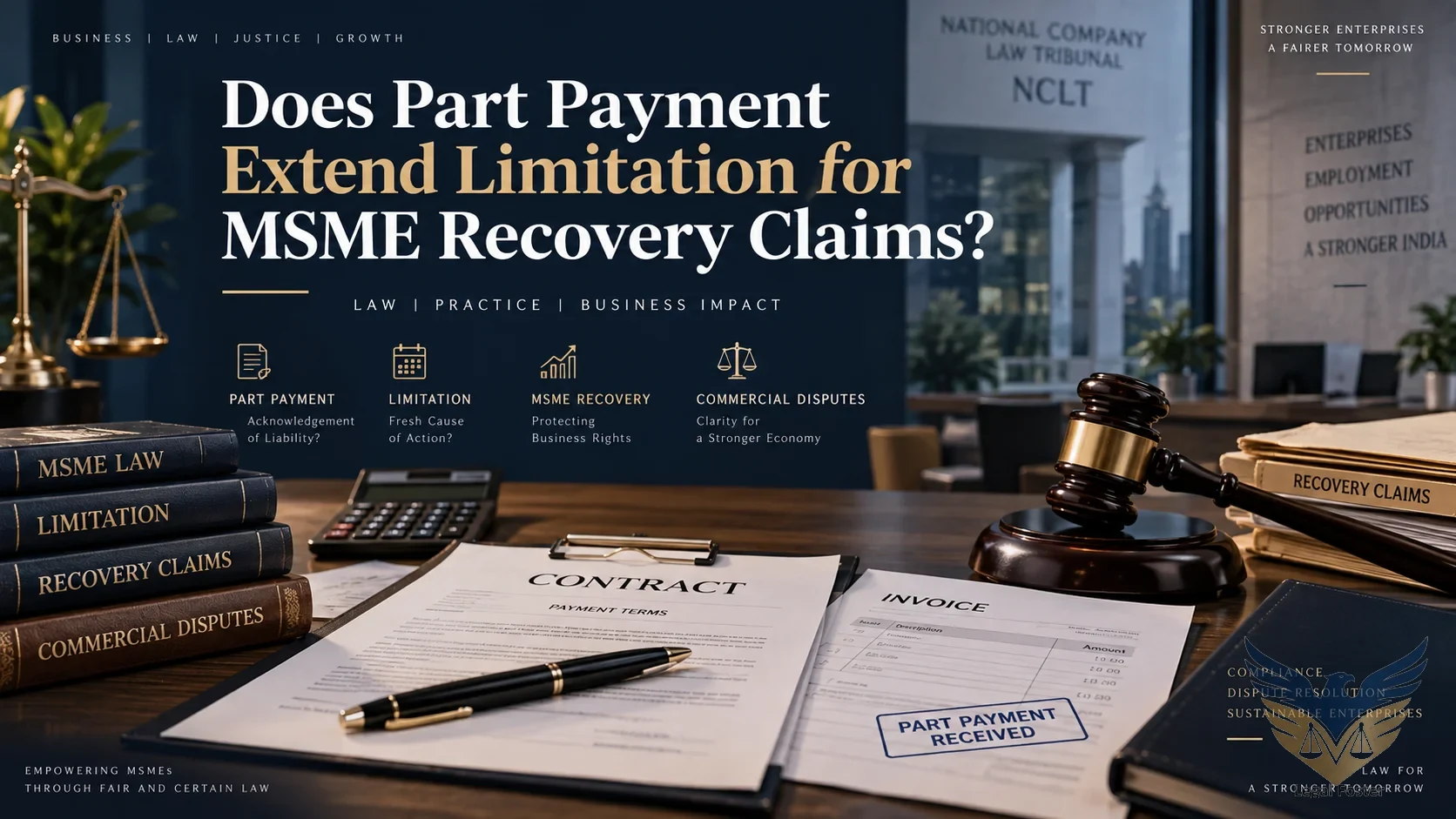
Does Part Payment Give MSMEs More Time to File a Recovery Claim?
Seller receives payment on account towards an outstanding debt. Months or years later. “Better late than never.” Sellers may think to themselves. At least I’ll recover that token amount. But then 12 months pass. No account of statements. And then a worrying thought occurs. Did that token payment I received actually reset the limitation period for my MSME overdue invoice?
The short answer is no … not always. For a token payment to affect limitation, there are a number of legal principles which need to be established. When was payment made; who made the payment; what evidence of payment is there; was there a written acknowledgement; what were the terms on the invoice; have there been any accounts of statement issued; is there a purchase order in place; even the stage of the dispute can all become critical. An unpromissory bank transfer; an inflationary adjusted payment with no comments; or a payment made after limitation has expired can all be very different facts.
Across MSME businesses in Delhi NCR (indeed across India), this can be a matter of real commercial significance. Fighting off piles of unpaid invoices, cash is already under pressure to fulfil wages; raw-material procurement; GST liability; rent; operating capital. Thinking that a token amount has extinguished all limitation risk could leave a supplier exposed.
Accounts receivables consultant BK Singh suggests sellers review aged-payment portfolios to protect against assumptions becoming a limitation trap.
Why Does Part Payment Matter for MSME Recovery Claims in 2026?
Confusion surrounding hope and limitation is why part payment becomes applicable to an MSME recovery demand. A buyer can make token payments against outstanding invoices.
This can provide false hope to the supplier that the buyer has accepted the full overdue balance and that limitation has restarted. But this isn’t necessarily the legal case. Account statements, date of payment, narration of payment, reference of invoice, buyer’s power and much more can all factor in. MSMEs today are dealing with overdue receivables, high operating costs, supplier difficulties, GST payments and employee wages in 2026.
The last thing they want is for receivables they can collect on to become time-barred because of a limitation misunderstanding. Have Advocate BK Singh analyze the part payment and any related documents to see if it benefits the MSME claim or hurts it through a limitation argument.
Quick Facts about Part Payment & Limitation…
- Section 19 of Limitation Act, 1963 deals with part payment on account of debt specifically.
- Limitation will start afresh from date of qualifying payment.
- Payment should be made by person liable to pay or his duly authorised agent.
- There should be written acknowledgment of payment by the person making payment in his own handwriting or signed by him.
- Time barred claim does not get revived automatically by making a payment after expiry of limitation under Section 19.
- Bank Statements are not the gospel truth from which you can conclusively infer everything about ack/nature/purpose/authority/payment/invoice/etc.
- Advocate BK Singh will analyze if your records actually support the claim or not when limitation is involved in the matter.
Very language of section 19 itself makes it crystal clear that the qualifying payment should be done before the expiry of prescribed period. It further says that there should be a written acknowledgement by the person who makes the payment.
Section 19, Limitation Act 1963 .
Why Can a Small Part Payment Become a Bigger Problem?
Contentious issues occur when there has been a part payment which has been interpreted one way by the buyer & supplier. Although one party may consider it an acceptance of the balance outstanding, the counter party may subsequently claim that it was for one invoice only, that it was an advance/payment against later supplies or simply an act of goodwill or that such payment was made under protest i.e. without liability for the remaining balance.
Such disputes typically arise out of running- account type transactions where multiple purchase orders, invoices, delivery challans, credit notes and part payments/transfers have occurred.
If nothing else has been recorded along with the payment to show what dues it was paid against, ambiguity arises instead of clarity.
BK Singh can review payment narration, ledger, emails/messages by buyer and invoice records to see if the part payment clearly settles the MSME’s claim or if there is any room for doubt.
Why Is Limitation a Serious Risk for MSME Businesses?
Limitation can pose a very real danger because although a debit may be commercially recoverable within your books receivable, it can become time-barred legally. Buyers will string along MSME suppliers with “I’ll pay you next week/month/once funding is received” excuses. Sometimes not even paying a part amount can cause suppliers to delay. By then, however, the paperwork can get misplaced, employees transferred/retired, account officers changed, and buyers may even begin denying liability for the debt.
This cash-flow problem can result in your inability to pay salaries, purchase raw-materials, cover rent, pay GST, or service your loans. Advocate BK Singh can analyse payment history, invoice dates, acknowledgements and communication with buyers to assess whether limitation could affect your MSME debt recovery.
What Happens When a Buyer Disputes the Purpose of Part Payment?
One defense to purpose of part payment could be raised by buyer that it was against some other invoice or was made after quality deduction as advance adjustment or payment without any admission of balance. Such defense would lead to scope for complicated account- reconciliation disputes especially when parties have been dealing for months or years.
Though supplier could say payment implies admission of liability; buyer's correspondence/ communication, account ledger entries and narration on payment can speak different languages. A lot of ambiguities in records can also impact limitation stance apart from claim amount. BK Singh can analyse whether all documents are strictly only projecting supplier's stand on non-payment of amount and reason for part payment.
What Documents are Crucial in an MSME Limitation Defence?
Tell one commercial story through your documents
Most commonly requested documents are work order, purchase order, GST invoice, delivery challan/ e-way bill, goods- receipt confirmation, service completion record, ledger/ account confirmation, bank statement/payment advice, emails, correspondence from buyer.
If your business availed MSME status and wants protection against delayed-payment then business registration details and date of supply would matter too. A messy/confused bundle of documents can spoil a good commercial argument. BK Singh walks his customers through what paperwork proves their payment history and what paperwork can be held against them.
When Should You Consult Advocate BK Singh?
Don't let the buyer stall you…
If you have a buyer who has made a partial payment leaving a substantial balance outstanding, if you have received inexplicable payment narration, if you have aged receivables, if a buyer disputes the amount owing or if you have received a “No Liability” letter from a buyer’s lawyer, call Advocate BK Singh.
Before writing off a receivable, taking a partial payment, granting a credit note or otherwise accepting payment as “final”, consult with Advocate BK Singh. We will review your documentation and advise you as to whether your documentation supports your belief that the debt is time-barred.
Why Hire MSME Lawyers for Part-Payment Dispute?
Need to view your invoice dispute Commercially & Legally.
Part-payment Limitation issues can look very straight forward in your account apps. When you get into the invoice dates, packs received, PO’s & corresponding buyer excuses; questions come up that require legal review.
Once you review commercially and legally, you will see if it's a limitation issue. If its a contract terms issue, late-payment interest issue, Invoice reconciliation issue or all three combined.
With MSME Lawyers you or your company can have your unpaid invoices, MSEFC claims, commercial recovery disputes & part-payment history reviewed (Privately) by Advocate BK Singh. No wins can be guaranteed. Every claim is judged on its own paperwork and merits.
How Can Advocate BK Singh Help With a Part Payment Dispute?
Advocate BK Singh will review the invoices, work orders, delivery notes, accounts statements, bank entry slips, payment advice, email and whatsapp conversation and correspondence received from buyers. The purpose is to assess whether the part payment strengthens the MSME’s position for recovery or leaves questions unanswered.
Such document based consultation would also help the business understand if the dispute concerns limitation, outstanding invoices, late-payment interest, buyer deductions or an MSME recovery claim before the MSEFC. Every case is different based on its facts and no result can be guaranteed.
FAQs About Limitation on Debt Recovery
Q1. Does part payment automatically restart limitation?
Ans. No. There are conditions to part payment restarting limitation under Section 19. These conditions include that payment was made before the prescribed period expires AND was acknowledged in writing by the payer.
Q2. Will a bank statement suffice to prove part payment?
Ans. A bank statement can prove payment. However, it may not prove purpose, authority or statutory acknowledgement to determine all questions related to limitation.
Q3. Can a debtor make part payment after limitation period expires to revive the claim?
Ans. No, not necessarily. See question 1. Also, timing of the payment is key. Get a legal opinion if a claim seems time-barred based on all of the records.
Q4. Is limitation period different for the MSMED Act?
Ans. The MSMED Act gives delayed-payment rights and MSEFC route for qualifying complaints. The Limitation would still need to be assessed based on facts and documents.
Q5. Can a buyer selectively pay some invoices and not others?
Ans. Yes. This is why invoice references, payment narration, account statements, emails and correspondence between parties matters in a recovery dispute.
Q6. If the buyer emails acknowledgment of outstanding amount, does it help?
Ans. Yes. Email or any written acknowledgment can be helpful. The language used, date of email, authority of sender and whether it refers to the alleged debt is key.
Q7. Does a GST invoice only suffice to support an MSME claim?
Ans. GST invoice helps, but a claim is typically stronger if supported by a work order, proof of delivery, payment history, ledger statements and correspondence with buyer.
Q8. Why hire Advocate BK Singh to review my Limitation questions?
Ans. Advocate BK Singh can review dates of payments, acknowledgments, invoice aging, contract terms and delayed-payment exposure before your business acts on part payment. Beware of false limitation defenses.
Q9. Can the accountant of the buyer make an acknowledgment on behalf of the buyer?
Ans. That would depend on the authority of the person making the statement and the facts. Factors to consider would be their role at the company, any records that support their claim and under what circumstances it was made.
Q10. What documents should I bring for MSME recovery consultation?
Ans. Bring invoices, work orders, proof of delivery, ledger statements, bank records, email and Whats App conversations, MSME registration details and any communication on the matter of payment or settlement.
Conclusion
Part payment can sometimes take a limitation clock right back to start. But don’t ever think that it does. Question the payment. When was it made? Who made it - were they authorised to do so? Was it in writing? What was the intention? Does it specifically relate to the debt in question? Sending through an aged invoice does not make that debt safe from limitation just because some funds appear in your account.
BK Singh can look at any MSME overdue-payment or limitation issue. Get ahead of the problem sooner, so your business doesn’t have to deal with risky decisions, uncertain expectations or any more cash-flow pain.