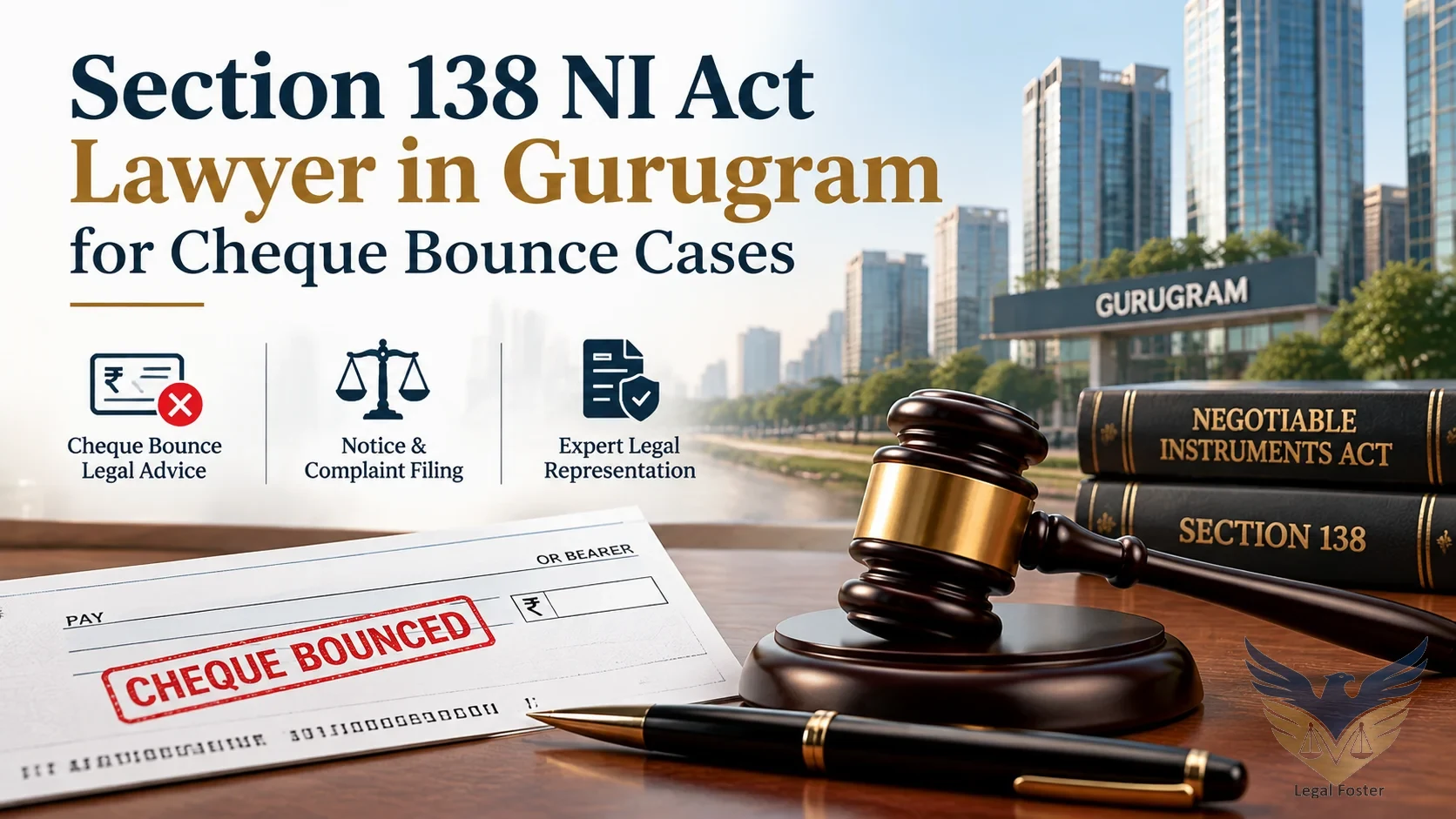
Section 138 NI Act Lawyer in Gurugram For Quick Legal Notice & Filing
It takes little effort for a cheque to feel benign. Until it doesn’t get cleared by the bank. Now there’s pressure. Maybe a businessman is relying on that cheque to receive his payment next. Maybe a family member loaned money to someone else in the family. Maybe an accountant, plumber or contractor finished their work knowing they would get paid by cheque. Something changed when that cheque was bounced and now the question is about timing. What do I do now? How much time do I have?
Deadlines start coming into play. Sending a legal notice must be done correctly but there’s no need to rush until you know what you should be doing. Have a Section 138 NI Act Lawyer in Gurugram review your cheque, bank memo, the liability behind the payment and all documents before sending a legal notice. This could save you time overall. Advocate BK Singh will go over your cheque bounce issue(s) by computing the statutory requirements are actually met vs. presuming every cheque that bounces is an instant cause of action.
Section 138 covers cheque dishonour when made for a legally enforceable debt or other liability and certain other conditions under the NI Act are met. The NI Act allows for the filing of a criminal complaint. But most transactions behind these disputes are commercial or financial disagreements. Offences under the Act are also compoundable (See Section 147) which means settlement is always an option too.
Most cheque holders in Gurugram spend little time reading the actual law when their cheque gets bounced. Strict timelines, appropriate court, language in the notice, proof of debt and fearing they will make one wrong move consume their attention.
Knowledge of the law is where taking a step back can really help.
Why Does My Cheque Bounce Case Matter in Gurugram in 20/26?
Because Gurugram isn’t made up of the same type of businesses, startups, contractors, consultants, traders, professionals and borrowers. One cheque could be the result of an unpaid business invoice. Another could be a personal loan between friends/family members. Property deals. Service agreements. Down payments. You get the idea.
Financial relationships come in all shapes and sizes. Just because your cheque bounced doesn’t mean all elements of a Section 138 complaint are met. Cheques presented past the validity date or unrelated to a debt/permissible liability will not qualify. Same goes for the notice period and opportunity to pay under the NI Act. Section 138 actually requires the bank where the cheque was issued to send a written demand notice within 30 days of the issuer being informed of the cheque dishonour. The drawer then has 15 days from receipt of the notice to make good on the cheque pursuant to Section 138.
Cheque holders wanting to hire a Section 138 NI Act Lawyer in Gurugram should worry less about moving forward with speed and more about trying to identify important dates upfront, preserving evidence and getting the notice & subsequent complaint workflow analyzed before running up against a statutory limitation.
Advocate BK Singh has worked with clients from Gurugram and Delhi NCR (and elsewhere in India) who needed a second opinion on their cheque bounce matter.
Quick Facts :
Cheque is made towards a legally enforceable debt or other liability.
Cheque is presented to bank within validity period (typically 3 months).
Cheques deposited after 3 months will not be processed by banks as per RBI rules.
Cheque holder must issue notice to drawer demanding payment within 30 days of knowing about cheque dishonour.
Drawer has 15 days from receipt of notice to pay the cheque amount as per Section 138 NI Act.
Failure to make payment within the notice period results in cause of action arising for filing of complaint within one month (unless an application to condone delay for sufficient reason is filed).
Summary trial under Section 143 applies to these offences. The courts must attempt to dispose of every Section 138 complaint within one month from the date of filing. But this isn’t always realistic as cases go on.
What Does Section 138 Mean?
Section 138 lays down an offence if a cheque is made for payment, in whole or in part, of any debt or other liability. And it is dishonoured for the reasons mentioned in the NI Act. Also, the other requirements under this section are satisfied.
Cheque dishonour is not automatically assume to be offence under Section 138 NI Act just because the bank gave it back to you. Analyze whether the liability is valid, cheque was presented in time, the notice and payment requirements match up with the Sections provisions.
Section 139 of the NI Act provides a presumption in favour of the holder. That means something for legal purposes but it doesn’t end all arguments related to cheques.
The facts and evidence of each case matter. Plus whatever defence is raised by the other side during prosecution.
That’s why Advocate BK Singh asks his clients to preserve all details about the transaction. Based on the facts, any combination of a cheque, invoice, agreement, bank statement, text message conversation, acknowledgement or delivery note could become important evidence.
What Law Applies to Cheque Bounce in Gurugram?
Majority of the law applies to the Negotiable Instruments Act, 1881.
Section 138 : Defines offence relating to cheque dishonour.
Section 139 : Presumption in favour of holder.
Section 141 : Offence by companies and others associated.
Section 142 & 142(2) : Cognizance of offences & place of trial.
Section 143: Trial of offences & Section 143A : Ad interim compensation.
Section 147 : Compoundable offences.
Don’t forget about Section 142(2). This Section has special rules relating to jurisdiction. If the cheque is presented to the bank through an account specifically opened by the payee or holder for the purpose of collection of cheques then a complaint can be filed in specific courts which are mentioned in that section. Jurisdiction will be based on where the transaction took place and where the bank accounts are located. It doesn’t automatically mean you file where the person who wrote the cheque lives or works.
When meeting with a Section 138 NI Act Lawyer in Gurugram double check that they go over the account info (from where the cheque was issued) and understand where your transaction took place. They should explain to you where they would file your case. We want to ensure you utilize the correct location when sending a legal notice and filing the complaint.
Who Would Need a Section 138 Lawyer in Gurugram?
Typically the lawyer is contacted by the lender. But more situations exist where someone can receive a cheque from another party and it bounces.
Vendor providing a cheque against unpaid invoices.
Consultant getting paid upon job completion.
Advance given against a promise in writing which then gets converted to a cheque.
Companies aren’t excluded from cheque bounce disputes either. When the person who issued the cheque is a company Section 141 NI Act comes into play. Not only can the company be liable but other individuals that were “in charge of and responsible for the conduct of the business of the company” can be liable as well.
Many facts can exist for each of these transactions above. That is why BK Singh tries to focus on the exact transaction you have been part of as opposed to offering a checklist that applies to every client.
What Happens Next After I Receive A Bounced Cheque?
Step 1: Preserve Bank Return Information.
Read the bank memo carefully. Verify the cheque or look up the bank statement. Gather any documents that can support the transactions happened.
Step 2: Understand the statutory timeline.
You have 30 days to send the notice from the date you became aware of the cheque bounce as explained by Section 138. The drawer has 15 days from receipt of the notice to pay the cheque amount again under Section 138. Failure to pay within the 15 days results in the cause of action for filing of complaint arising provided the statutory requirements discussed above are met.
Remember to have the legal notice detail the transaction, cheque issued, cheque dishonour, and payment amount specifically. Don’t over draft and include facts that your documents do not support.
Step 3: Send your complaint to Court.
After the payment deadline passes you can have your lawyer draft and send the complaint to court. The court case will then proceed through its stages such as appearances, pleas, evidence etc. based on the facts of the dispute.
Settling is always an option during certain stages of a lawsuit. Offences under Chapter X are specifically mentioned to be compoundable (compoundable = able to settle) under Section 147.
Keep organized at this point. Dates, documents, notices, court filing requirements, communication with your lawyer and yourself should all be synchronized.
Documents To Prepare For Cheque Bounce Lawyer
Advocate BK Singh cannot analyze your cheque bounce case if he doesn’t know when, where and how the transaction occurred. Gather as much information as you can before meeting with a lawyer.
Here are some documents that will help with your consultation:
Original cheque or information about the cheque ( bank branch where issued from, account number etc.)
Bank return memo / Note about the cheque bounce
Copy of the bounced cheque
Bank account statement showing cheque presentation, if available.
Loan agreement / invoice /purchase order / Service Agreement
Challans / Proof of supply / Goods delivery notes
Payment receipts / Evidence of payments made
Email conversations, WhatsApp chats or any other correspondence that discuss the amount owed to you.
Ledger / Statement of account (if this is for business transactions)
Any correspondence discussing settlement or prior repayments
Identity of the drawer / company (if applicable)-
Copy of and Proof of service for the legal notice you’ve already sent (if any).
Don’t throw away evidence. Delete chat histories. Try to hide information because you feel it may not support your side of the story. Your lawyer will need to review anything and everything you have.
When Should I Contact a Lawyer?
Consult a lawyer as soon as you:
Got a cheque that was dishonoured recently.
The 30 day notice period has begun.
The cheque amount is large.
The transaction underlying the debt is being disputed by the other side.
The cheque was provided as a “security cheque”. They’re tricky.
The person who issued the cheque is a company or partnership firm.
There is more than 1 invoice / transaction you would like to enforce.
You and the issuer live in different cities.
You received a legal notice from the issuer.
You and the issuer are talking but the cheque bounce proceedings have been threatened.
Meeting with a lawyer for a document review can be very helpful if you are looking for a Section 138 NI Act Lawyer in Gurugram. Advocate BK Singh will go over whatever information you have and explain your legal options, what questions are unanswered and what deadlines you should be aware of.
How Can A Cheque Bounce Lawyer Help Me?
Cheque Bounce Lawyer is a website dedicated to providing information and legal-service navigation for individuals and businesses facing cheque dishonour and debt recovery matters. Helpful information and services related to cheque bounce legal issues can be found here Cheque Bounce Lawyer .
One article on the page explains the differences between cheque bounce lawsuits versus civil recovery when the actual transaction involves invoices, acknowledgements or is an overall payment dispute. Visit Cheque bounce vs. civil recovery to read more.
Advocate BK Singh can assist you with a preliminary document review, legal notice preparation, explanation of the statutory timeline and overall filing process. Remember to look at what actually happened and focus on the documentation before allowing any lawyer to guarantee you a certain result.
Clients located in Gurugram, Delhi NCR, Noida, Faridabad, Ghaziabad or anywhere else can contact our office to schedule a consultation to see if your matter would qualify for a legal review.
FAQ’s
Q1. How quickly do I need to send a cheque bounce legal notice?
Ans. Within 30 days from the date you received information from the bank about the cheque bounce. Look at the bank memo to see when you were notified. Advocate BK Singh will assist you with computing the timing based on the documents you provide.
Q2. How long does the person who issued the cheque have upon receiving the notice?
Ans. 15 days to make the payment to you. If the drawer does not pay the cheque amount within the notice period then other remedies become available to you under the Act subject to statutory conditions.
Q3. Where should I file cheque bounce case in Gurugram?
Ans. It depends on the jurisdiction as explained in Section 142(2) NI Act and how did you receive the cheque? Don’t assume the case needs to be filed in Gurugram just because you live/work here or the other side does. See Question 1 for more info.
Q4. The cheque I received was post dated. Now it got bounced. Help!
Ans. Post dated doesn’t matter much for Section 138 purposes. See Question 4 . Mere labels such as security cheque may not answer all your Section 138 questions. Evaluate the true liability, purpose for issuing the cheque and circumstances under which you presented it.
Q5. Can legal proceedings under Section 138 be initiated against my company too?
Ans. Yes of course. Section 141 NI Act specifically talks about offences committed by companies. Whether your company and/or the officers of your company will be liable is dependent on the statute and the facts.
Q6. Can the parties settle after filing the cheque bounce lawsuit?
Ans. Yes of course. Section 147 NI Act talks about the complaint being compoundable. Offences can be settled based on the parties involved and the facts. Timing and terms of a settlement would depend on when the parties decide to settle and other specifics regarding the case. For example, a settlement is not possible after the court has finalized judgement in your case.
Q7. Can the court order the drawer to pay me interim compensation?
Ans. Yes. Subject to fulfilling the statutory conditions in Section 143A the Court hearing the offence under Section 138 may order interim compensation to the payee. The amount cannot exceed 20% of the cheque amount demanded by the payee.
Q8. Does cheque bounce guarantee my victory in court?
Ans. No. When you receive a bounced cheque it neither instantiates nor concludes your legal case against the issuer of the cheque. Whether he fulfilled the statutory requirements to bounce your cheque, his liability for the cheque when it was issued to you, certain presumptions under the law, the evidence you have and the defence he presents at trial are all factors to be considered during the lawsuit.
Q9. What should I do if I receive a legal notice under Section 138?
Ans. Don’t panic and don’t ignore the notice. Preserve the notice, bounced cheque & bank memo and any documents that prove the transaction happened. Speak with a lawyer immediately. Advocate BK Singh can review the notice and documents for you to better advise you before you take any action or respond to the issuer of the bounced cheque.
Q10. Why should I meet Advocate BK Singh for advice on cheque bounce?
Ans. Advocate BK Singh will go over the cheque you received, bank memo provided by the bank, any supporting documents that show the transaction took place and explain the applicable statutory timelines. Once we review your paperwork, you will have a better understanding of the process and won’t think that every cheque related dispute has the same solution.
Conclusion
Receiving a cheque return memo can be frustrating but panicking won’t improve your legal standing. Be smart about it. Preserve the documents, mark your Statute barred dates and evaluate if the cheque was given for a legally enforceable debt or liability.
Need a Section 138 NI Act Lawyer in Gurugram? Getting legal advice could save you time if the notice period is nearing, the cheque amount is high or the transaction underlying the payment is in dispute.
Advocate BK Singh will walk you through the notice, documents and filing process according to the facts of your unique situation. No lawyer will ethically guarantee you’ll get your money back, secure a settlement or foretell any court outcome. But we can responsibly handle your legal matter according to law and make sure all the evidence is in order.