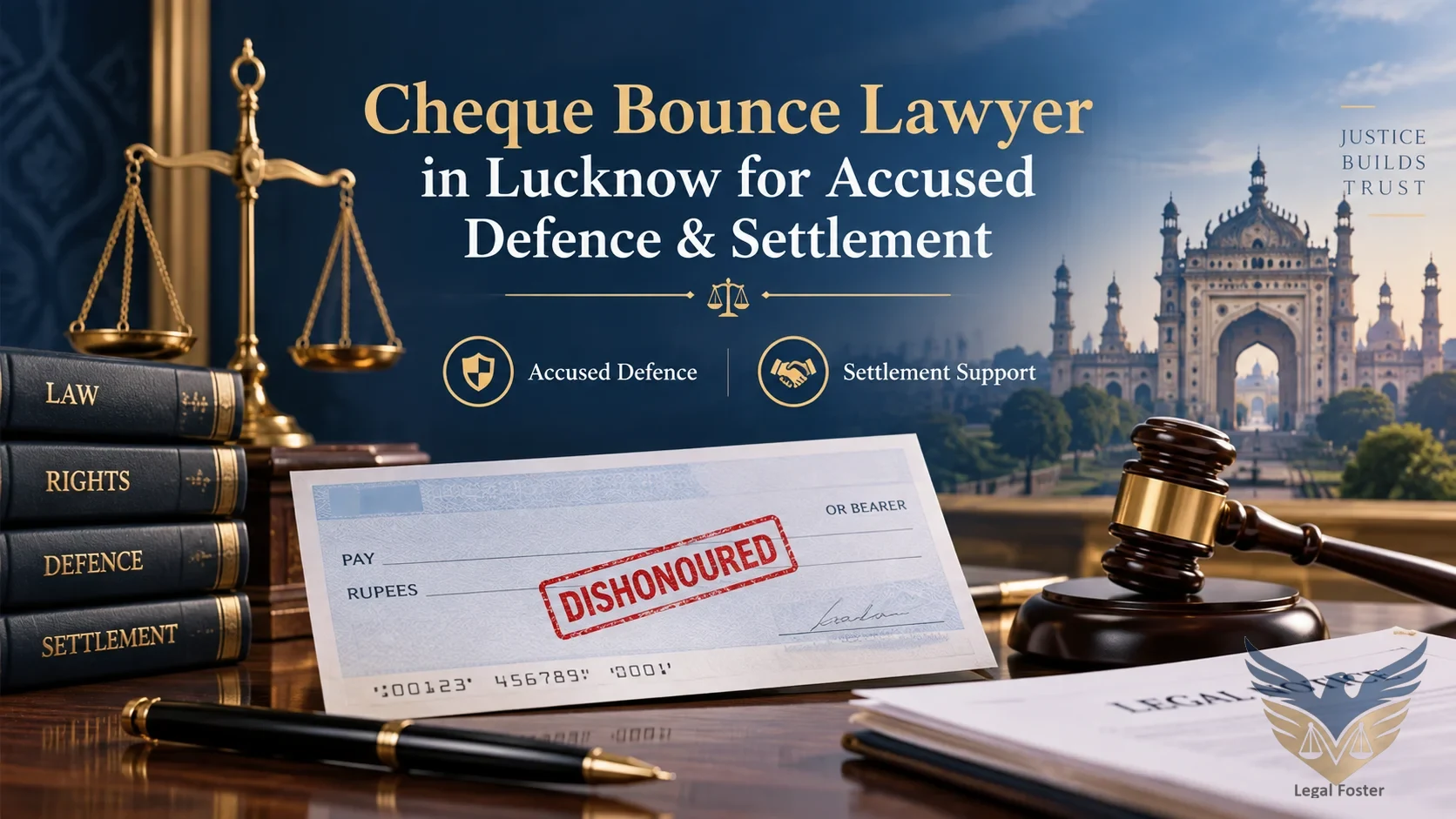
Cheque Bounce Lawyer in Lucknow for Accused Defence and Legal Settlement
Dishonour of cheque. Legal notice. Calls from the other party. Then, possibly, summons from court. The accused might understandably treat all this as just noise pollution – especially when the cheque that triggered it was issued because of a genuine commercial dispute; say, a loan agreement turning sour or a family transaction/settlement that never fructified.
While getting proceedings against for cheque bounce under Section 138 of the NI Act, 18 81 should not strike fear in an accused’s mind, treating it as something that can be ignored is also not wise. Conversely, just because a person gets served a notice or summoned by a court, it is not automatically implied that the complainant’ case and all his allegations are established.
Criminal Lawyer Advocate BK Singh stresses that each case is assessed by him after looking at the cheque itself, the transaction for which it was issued, bank record, statutory notice served on the accused and documents that support the complainant’s alleged cause of action. Keep in mind that’s an important point. Any defence has to be built around evidence and have a clear focus on the facts that surround a transaction. Simply relying on the accused’s statement that he does not owe money is no defence.
What may be some basic questions that someone looking for legal representation on a cheque bounce matter in Lucknow will have: what should I do after receiving a notice? Can I settle? What if I don’t have the entire amount mentioned in the cheque to pay? Will handing over a security cheque help me get out of the woods? Does complainant need to prove that there was underlying debt? What after I get served with summons, etc. These questions and concerns can’t be addressed by examining the cheque and responding with an arrogant ‘no, you can’t sue me’ legally printed on paper.
There can be scope to defend a case based on the underlying liability, the circumstances under which the cheque was issued, the statutory notice sent, jurisdiction, limitation, evidence available with the parties and more. Also, whether it is commercially viable to enter into a compromise with the complainant.
Remember that while Section 138 of the NI Act makes cheque dishonour a criminal offence that the courts will punish, it also has a provision that allows the complainant and the accused to compound the offence under Section 147. This means that settlement is always an option, even after the case is initiated.
Why a Cheque Bounce Case in Lucknow Needs Prompt Attention in 2026?
There is barely any neighborhood in Lucknow where you will not find a cheque bounce issue. Friends lending money privately, paying a supplier, a property deal related transaction, an advance given to a business or repayment schedule.
Where the culprit lives is just one consideration for determining where a section 138 complaint can be filed. Section 142(2) of the NI Act has elaborate territorial-jurisdiction clauses. If a cheque is deposited into a bank branch for collection through the account, typically the State + District where the payee/holder maintains an account with that branch will have jurisdiction. The SC has also been interpreting this statutory provision consistently.
That’s why it’s advisable to see bank statements and transaction records before panicking and thinking a case filed in ‘x’ court is wrongly filed.
Availability to attend Court is usually the actual concern that plagues a person from Lucknow. Businessmen don’t want their work life disrupted every other day. A salaryman doesn’t want his colleagues to mock him at work. Families worry a cheque issue will spiral out of control into a bigger money or relationship dispute.
BK Singh can review the case documents at the beginning and explain what can be done urgently, what timelines need to be considered and what matters are actually pending.
Quick Facts
- Section 138 is attracted only in cases of cheque dishonour for the payment of a ‘legally enforceable debt or other liability’. Additionally, the Section contains other requirements which must also be fulfilled.
- The cheque should have been presented to the bank within the period of its validity. And; The statutory demand notice must be complied with.
- Drawer has 15 days from the date of receipt of notice of the statutory demand to make payment of the amount demanded.
- Section 139 creates a statutory presumption in favour of the holder. This presumption is rebuttable.
- Section 142 lays down requirements relating to Cognizance, Limitation and jurisdiction to initiate prosecution.
- Section 143A empowers the court to order interim compensation by drawer.
- Section 147 allows compounding of offences under NI Act.
What Cheque Bounce Case Can Be Made Out Against an Accused?
Simply stated, a cheque bounce case under Section 138 is a case where there has been dishonour of a cheque for discharge of a debt or other liability, legally enforceable; followed by presentment, notice and failure to pay.
Plainly speaking: dishonour is only part (a) of offence under Section 138. Conditions prescribed by statute with respect to presentation, notice and failure to pay have also to be fulfilled.
However, from the standpoint of the accused, many a times the real question is whether the transaction as claimed by the complainant in the cheque can be legally and factually upheld.
The defence can spring from the very nature of liability itself (whether it existed? How much was it for? ), the circumstances of issue, the consideration/transaction, payment made, accounts being disputed, allegations of fraud/misrepresentation, authority to issue cheque, etc. or any other relevant evidence which will overcome the presumption.
Time and again, the Supreme Court has recognised that the presumption under Section 139 is rebuttable. Some recent judgments have also clarified as to why this defence cannot be seen in a hit and trial manner but has to be judged on the facts.
What Legal Framework Applies to the Accused?
The principal Act is Negotiable Instruments Act, 18 81. Sections which would become applicable to the Settlement are Sections 138, 139, 141, 142, 143, 143A, 145, 146, 147 and 148, as applicable in the particular case.
Section 138. This section deals with the substantive offence and the statutory requirements. The punishment prescribed is imprisonment for a term which may extend to two years or with fine which may extend to twice the amount of the cheque or with both.
Section 139. Presumption in favour of holder. This section raises a presumption in favour of the holder that the cheque was received for discharge of any debt or other liability. This is not the end of the road for hands of the accused are not completely dry. Holder’’s presumption can be rebutted because it is a rebuttable one which can be fought with a probable defence subject to the matrix of facts and evidence available. Once disproved the scope for settlement becomes viable.
Section 142. Procedure for compoundable offences. This section deals with cognizance as well as lays down important procedural requirements including time limitation in clear statutory language. Section 143.Powers to try summarily. Section 143A.Interim compensation in certain cases.
Section 147 Decaring offences under NI Act compoundable. This section is very important in context of settlement as it declares offences under NI Act compoundable. Recent Supreme Court has held that both voluntary settlement and compounding are always available at any stage subject to facts and circumstances of case and order of Court.
Who Usually Needs Accused-Side Cheque Bounce Guidance?
This article will be of help to that individual who has received a Section 138 Notice, against whom summons have been served, who has already appeared before the Magistrate or wants to compromise after a cheque dispute. Directors and Business representatives may even find this article useful to read.
As there is a separate provision which deals with offences committed by companies i. viz Section 141, one cannot extend the liability of the person beyond/Kesleyarawen to the mandate and requirements of that section and his role in the acts of the company. For example if anybody issued a cheque towards his business receivable or say loan advanced or for security given or instalments or even towards a disputed amount, he must have retained a copy of all the documents which were part of the said transaction.
Advocate BK Singh tries to document the original documents rather than listen to the heat of Section 138 Notice in the first meeting.
What Should an Accused Do After Receiving a Cheque Bounce Notice?
POINTERS WHILE REPLYING TO STATUTORY NOTICE UNDER NEGOTIABLE INSTRUMENT ACT
Keep the notice & envelope containing the notice (Or) delivery slip safely. Do not destroy the bank statement, cheque counterfoil, return memo, agreement, invoices, receipts or any messages regarding the said transaction.
SEQUENCE OF TRANSACTION:
Recreate the transaction by timeline. When was the cheque issued? Upon what consideration? How much was legitimately payable on the date of presentation? Was the remainder paid afterwards? Was there a prior settlement? Was the cheque allegedly provided as an advance against goods provided as security? Did the parties exchange any written communication?
Your reply to statutory notice should match with the facts. Only to avoid the uncomfortable cross examination of an accused, he should not make a statement which seems to be conveniently true. Similarly, the reply should not contain allegations which you cannot prove subsequently.
You may ask Advocate BK Singh to go through the notice, documents related to the transaction and the defence material available with you before you prepare your reply.
If a complaint has been filed already, the analysis would be little different. Summons, Complaint, Affidavit Evidence and Court Record have to be read in conjunction.
For detailed information about cheque bounce legal notice services, visitors can review the relevant service information.
Can a Cheque Bounce Case be settled?
Yes.yes you can settle and compound, because offences under NI Act are compoundable offences Section 147 provides for compounding.
The settlement can be for the cheque amount or lesser amount as agreed to by parties (can be paid in lumpsum/instalments) or withdrawal/complainant(friendly) disposal of terms favourable to you or any other condition which ever the parties agree to. Will vary from case to case whats agreed to by parties.
Best if the settlement is in writing.If not agreed upon, the promise to pay can be denied later on. The compromise shall clearly mention the amount to be paid,timings of payment,what shall happen on default,pending complaint(payement received what to do with the complaint?) and what each party has to do at termination of terms.
Supreme court has recently been dealing with cases regarding compromise agreements in cheque bounce cases. Highlighting the need for voluntary compromise and compliance with terms.
BK Singh can advise you on evaluating any settlement offer and guide you on the legal effect of what is being agreed to so that you are not cheated. Just because parties have settled, does not mean you will get an automatic acquittal.Order has to be passed by the court which is dealing with the matter according to procedure provided depending on what stage the case has reached.
For more information, see the cheque bounce case settlement service.
Documents to be preserved by Accused Person?
Cheque should not be the only document you retain.File/ preserve every piece of information.
If your saved mail/messages have got deleted, edit it and preserve it as evidence.
- File/ Copy of passbook/ utility bill with account balance
- Copy of cheque,Bank return memo.
- Bank statement as on the date of transactions
- Copy of statutory/legal notice issued.
- Envelope, track sheet or any proof of delivery/service
- Loan documents/agreement, bill, purchase order or contract note
- Receipts and proof of part-payment (if any)
- Whatsapp/chat/e-mail/SMS conversations leading to transaction
- Books of accounts/ ledger/ account statement of cashing etc., if any.
- If any compromise was offered/admitted in the past.
- Documents which prove why cheque was issued
- Any document related to security cheque, if issued.
- Court summon/complaint copy and subsequent papers.
When Should You Consult a Cheque Bounce Lawyer?
If you are served with a statutory notice, receiving a complaint filed against you, served with summons, the amount involved is high, if there are multiple transactions or settlement negotiations are underway. These are the times when legal advice is crucial.
Early stage legal advice may also be beneficial if the person accused of cheating thinks that the cheque was mishandled; the amount demanded is not correct; it has already been paid against that cheque; that cheque was issued for a disputed transaction; or he thinks that the complaint is filed in a jurisdiction where it does not belong or is time-barred.
The above are only a few of the circumstances in which Advocate BK Singh can review the record available with you and assist you in pinpointing the genuine legal issues from speculation or posturing.
Click here if you are a visitor to this website in need of assistance. Please visit our Cheque Bounce Lawyer website containing detailed information about our services.
How Can a Cheque Bounce Lawyer Help in Lucknow?
Swapping Documents vs Making Promises: Your First Step to a Useful Legal Consultation
For clients looking for legal help in Lucknow with respect to cheque bounce cases, this work could include reviewing the Section 138 notice, assessment of the underlying transaction, drafting or reviewing response to notice, complaint review, advising on appearances /procedural requirements, settlement analysis and appearances on behalf of the accused, as required.
The firm has even authored companion articles on how to decide between cheque litigation and civil recovery. Once you read why the underlying transaction matters when analyzing a dispute here: Cheque Bounce vs Civil Recovery , you will have a better appreciation of the information needed for your legal consultation.
Advocate BK Singh can help you figure out what paperwork you need to organize before meeting. Just that exercise will pay for your first legal consultation as you will leave with recommendations based on facts rather than an oral summary.
(Note: These are broad generalizations about typical issues that arise in cheque bounce cases. Please consult Advocate BK Singh for advice on your specific case.)
Frequently Asked Questions
Q1. Can an accused compromise cheque bounce case in Lucknow?
Ans. Yes. Offences are compoundable under section 147 of NI Act. Procedure varies on basis of the stage of the proceedings and the court where matter is pending.
Q2. I received a legal notice. Doesn’t that mean I am already convicted?
Ans. No. Statutory notice is merely a part of the Section 138 procedure. Conviction is separate judicial order which cannot be inferred from receipt of notice.
Q3. What is default defense to cheque bounce lawsuit?
Ans. There is no catch all defense to cheque lawsuit. The issues in any case will vary on facts. Some possible issues include whether there was a legally enforceable liability; what amount was payable; what were the circumstances under which the cheque was issued; what payments were made before or at the time of issuing the cheque; what documents were passed along with the cheque to support the underlying transaction; whether the complainant complied with statutory requirements; or whether the statutory presumption of Section 139 can be rebutted.
Q4. If I mark my cheque as “security cheque” does that remove it from scope of section 138?
Ans. No. Merely labeling a cheque as a “security cheque” does not in itself establish liability or lack thereof. The transaction would have to be analyzed to determine whether there was a legally enforceable liability outstanding when the cheque was presented.
Q5. I cannot afford to pay the cheque amount. What should I do?
Ans. Accused must see if he can come to settlement or agree to pay by instalments with complainant. Settlement must be well documented and preserved through court process.
Q6. The cheque was for ₹ 20,000 but the complainant is demanding more. Can he do that?
Ans. Complaint’s total claim may include multiple causes of action in addition to cheque amount. This depends upon underlying transaction and legal theory for claim. Defendant must review complaint and supporting documents and not simply assume that complainant is entitled to recover everything demanded.
Q7. What about Section 139? Doesn’ t that mean the complainant is guaranteed to win?
Ans. No. Section 139 merely raises a presumption in favor of the complainant. Accused should litigate complaint if there is a potential defense and evidence to support it. Exact situation will depend on facts and procedural stage of case.
Q8. Which court has jurisdiction over cheque bounce cases?
Ans. Section 142(2) lays out statutory framework for jurisdiction. Jurisdiction usually attaches to bank branch where payee/depositor had account if cheque deposited to account. Facts should be verified before filing complaint or seeking to challenge jurisdiction.
Q9. Can’t I compromise even if convicted in cheque bounce case during appeal?
Ans. At later stages compounding may still be available depending on facts and appellate court. Supreme Court has approved of settlements done at appellate stages in appropriate cases.
Q10. Why should the accused talk to Advocate BK Singh as soon as possible?
Ans. Notice, cheque, transaction documents, evidence of payments, jurisdiction and compromise position should be reviewed at earliest. Avoid procedural errors and learn whether matter should be contested, compromised or handled differently are reasons to contact Advocate BK Singh early.
Conclusion
Looks can be deceiving with cheque bounce cases. While it may look intimidating to the accused the logical first step is not panic or a hastily written denial. First review of the cheque, underlying liability, statutory notice, bank records, court documents and any other evidence you have is recommended.
While the statute does give holder benefit of statutory presumptions such as under Section 139 those can be overcome. Furthermore compromise and compounding are always possibilities under Section 147.
Don’t let a cheque bounce notice or complaint catch you in Lucknow unaware. BK Singh can help explain paperwork, procedural posture, possible defenses and settlement options before you make your next move.