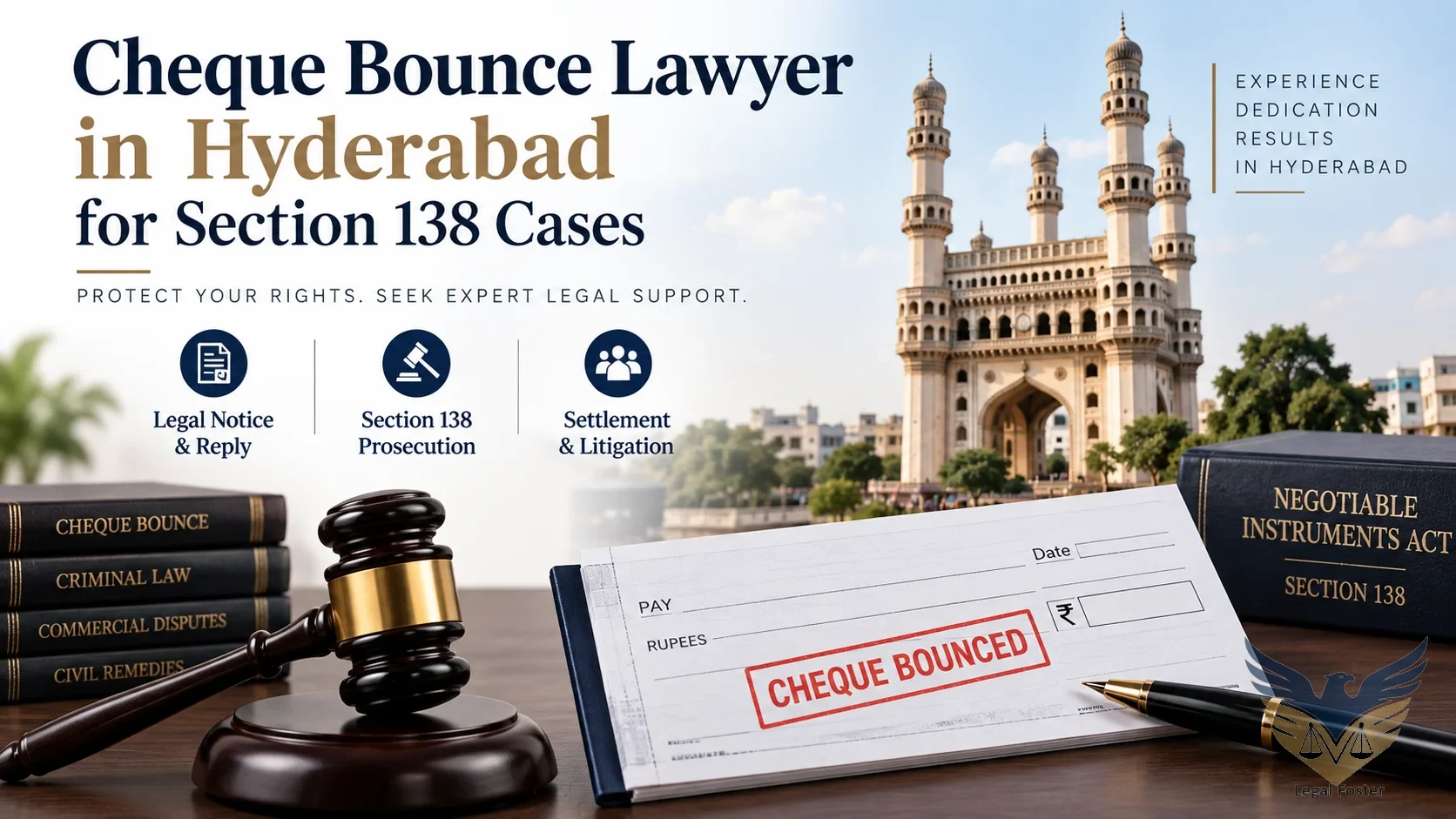
Cheque Bounce Lawyer in Hyderabad for Section 138 Notice and Trial
Issuing one bounced cheque can turn a routine payment dispute into a criminal court matter overnight. It can clog up your business’ accounts if you’re a merchant. It can put your hard-earned money at stake if you’re an individual or a family.
Expectations of that much money being in your account on a particular date can be devastating.
Procrastinating is the error that most people make.
The offence of cheque bounce is covered under Section 138 of the Negotiable Instruments Act, 1881. The statutory requirements are met, the offence of cheque dishonour is invited. It carries criminal liability. The statute also requires compliance with certain prescribed procedure relating to presentation of cheque, issuance of demand notice and time frame allowed for repayment on receipt of notice.
If you are searching for Best Cheque Bounce Lawyer in Hyderabad, inquiring who can send a notice is barely scratching the tip of the iceberg. You also need to know if the cheque was issued for a legally enforceable debt or liability, if the statutory period is over, where to file the case and what evidence will be presented at trial.
Cheque Bounce Lawyer handles these matters for our clients through Advocate BK Singh. Instead of mindlessly proceeding with every cheque bounce as if they are identical, we analyze these practical issues initially. Sometimes a notice is required, but what about the transaction itself? Was there any security-cheque given against? Is the liability even disputed? What about jurisdiction?
Our firm is located in Hyderabad also requires looking at local angles as well. Just because the payee and drawer both reside in Hyderabad, India. The transaction may have occurred between parties located in different cities, or a multi-state company, an e-commerce transaction, invoice raised from out-of-state, cheque deposited into a particular branch and so on. Hyderabad will not have jurisdiction just because the debtor lives there for example.
We touch on the Section 138 procedure, the need for a notice, evidence, timelines to keep in mind for trial and possibilities of settlement. We will also guide you on where it makes sense to have a lawyer represent you.
Cheque bounce is Important Hyderabad Well Written Article in 2026
Business invoices, personal loan, property loans, professional fees, all advances received/paid, for inventory, payment to creditors, lawyers and others are potential areas of conflict that can lead to cheque disputes in Hyderabad.
That transaction which resulted in the one dishonoured cheque you issued/pay thereby becomes a piece of a bigger puzzle.
Recovery of funds may be your buyers concern while yours could be handling the legal notice you received, reading through the allegations in the notice and deciding whether you want to pay, settle or dispute the notice through legal proceedings.
A Cheque Bounce Lawyer in Hyderabad therefore has to analyze the transaction that resulted in the dishonoured cheque and cannot confine his research to the cheque that was presented by the complainant.
One important aspect that needs to be looked at closely is the issue of territorial jurisdiction. Section 142(2)(a) of the NI Act raises a special jurisdictional bar with respect to a cheque which is delivered for collection through an account.
The Apex Court has repeatedly held that the court empowered to entertain a complaint is the branch in which the account of the payee in whose favour the cheque was issued for collection is maintained.
Bank statements and the mode of presentment thus become important factors in determining the forum where a complaint has to be filed.
Quick Facts
- Section 138 is attracted on the dishonour of cheque by reason of insufficiency of funds in the account or it amounting to more than what was arranged to be paid by drawer –
- The cheque must be presented to the bank within the period of its validity i.e. normally 3 months from the date of cheque. This is however not a requirement of section 138 statutorily.
- The holder or payee of cheque must issue notice demanding payment within 30 days of his knowledge of the fact of its dishonour as received from bank.
- Drawer has 15 days of receiving the notice, to compensate the amount demanded by notice.
- Section 142 lays down time limit for filing complaint under section 138.
- Section 139 provides for presumption in favour of holder which can rebutted off under the provisions of law.
- OFFENCES punishable under NI Act are compoundable under Section 147.
Understanding – What is Section 138 Cheque Bounce Case?
A 138 cheque case means dishonour of cheque for the discharge of any debt or other liability which is legally enforceable WHEN SUCH STATUTORY CONDITIONS ARE COMPLIED WITH. Simple.
138 Cheque case does not become a case because of cheque bounce on its own.
Transaction, liability, presentation, bank return etc., Statutory notice & failure to pay within stipulated time-ALL THESE FACTORS become relevant.
If proven beyond reasonable doubt then Sec 138 prescribes Imprisonment which may extend to TWO YEARS OR WITH FINANCIALITY WHICH MAY EXTEND TO TWICE THE AMOUNT OF THE CHEQUE OR WITH BOTH.
Sec 139 ALSO IMPORTS PRESUMPTION that cheque was received for discharge of any debt or liability unless contrary is proved. Which simply means not every cheque bounce complaint filed will be able to get proved. Facts /documents/evidence will still be relevant.
What Is the Legal Framework for Cheque Bounce Cases?
The principal Act is Negotiable Instruments Act, 18 81 . It contains Sections 138 to 148.
- Section 138. Dishonor of cheque for insufficiency etc, of funds in account – offence and conditions threshold.
- Section 139. Presumption in favour of holder.
- Section 141. Offences by Companies.
- Section 142. Cognizance and Limitation.
- Section 143. Powers to try Summary Trial in certain cases.
- Section 143A. Interim compensation.
- Sections 145 and 146. contain important provisions relating to evidence.
- Section 147. Offences under the Act compoundable.
Section 148 becomes relevant on appeal also. If there is an appeal against a conviction under Section 138, the appellate Court can order appellant to deposit not less than 20% of fine or compensation awarded by trial Court towards realized fine/ compensation, subject to certain conditions as laid down in statute.
The procedure to be adopted is not the same as an ordinary civil suit for recovery of money. Note that a cheque dishonour Complaint under Section 138 is a statutory Complaint. So, the same is to be proceeded with in manner as prescribed.
Who Generally Needs A Cheque Bounce Lawyer In Hyderabad?
Legal assistance can also help the payee (individual or business) who has received a bounced check and wishes to understand if he wants to issue a statutory notice.
Legal remedy can also come into play if you are a drawer who has received a notice and wants to review the transaction, payment history, paperwork, and decide how you can legally answer back.
Running a small business comes with its own set of issues. You may have issued a bill months ago, there may have been reminders via the form of received partial payments or WhatsApp conversations, and the cheque may have been provided to you much later down the line. Having someone review that history before you serve a legal notice can save you from serving a notice with avoidable mistakes.
At Advocate BK Singh and team, we can assist you in going over these documents to help you decide if you want to take the matter forward legally.
What Is the Section 138 Process?
Step 1: Retain Copy of Original Transaction
Retain the original cheque, bank return memo copy, invoice(s) supporting the transaction, agreement/order, account statement showing payment, payment advice and all other communication regarding the said transaction.
Screenshots of transactions or information based on hearsay will not do justice to your case where originals are available.
Step 2: Confirm Dishonour and Presentation
Bank return memo speaks for itself. Section 146 – Bank slip/memo indicating dishonour, as it bears official mark, is the prima facie evidence of dishonour until proven otherwise.
Reasons for dishonour are to be noted along with date when information from bank was received.
Step 3: Issue the Statutory Demand Notice
After complying with the conditions precedent under Section 138, the payee/ beneficiary is required to make demand for payment by serving notice in writing within a period of 30 days from the date of receiving knowledge of the dishonour.
The demand notice should be drafted by professionals. Cheque should be clearly identified along with the transaction amount involved, the amount claimed and a clear statutory demand. Do not add unnecessary allegations.
Step 4: Allow Statutory Time for Payment to Elapse
Drawer has 15 days from the date of receiving the notice to make good on the cheque amount.
At this stage, discussions for settlement can take place. But ensure that any settlement arrived at is reduced into writing.
Step 5: File the Complaint
After fulfilling statutory pre-req’s and if no payment is received within statutory time, file a compliant keeping Section 142 and Limitation requirements in mind.
Jurisdiction, who all can file the complaint, supporting documents and identification of complainant become important at this stage.
Step 6: Prepare for Trial
Trial of cheque dishonour case does not end with filing of complaint. Evidence, affidavit, recording of evidence via cross examination (if needed), supporting documents, checking/relying upon relevant statutory presumptions, checking contentions raised by defence and always looking out for settlement are all crucial.
Cheque Bounce Lawyers in Hyderabad at LawRato guide you through each step.
What Documents To Keep Ready?
Ideally speaking your cheque bounce file would consist of :
- Original dishonoured cheque.
- Bank return memo.
- Copy of statutory legal notice sent.
- Postal/Courier details and slip
- Loan agreement/invoice/purchase order/ any document on which transaction has been entered into
- Bank statements showing relevant payments
- Ledger/account statement, if any.
- Any written acknowledgements of liability
- Relevant e- mails/messages/correspondence
- Power of Attorney/Authority from parent company supporting documents in respect of companies/firms
- Details identifying proper jurisdiction.
Also remember if applicable to retain GST invoices, delivery notes and account ledgers. Companies should also retain GST invoices, delivery notes and account ledgers. Do not throw away any document that you think may be relevant to your claim even if you’re not sure you need it. You never know what may be important when it comes to cross examination :) Start your file from day one.
When Should You Consult a Lawyer?
Seek Legal Counsel When The Value Of The Transaction Is High; It's a Contested Deal; Numerous checks have been issued; When you're holding a security check and plan to use it; If the issuer is a corporation; If the parties reside in various locations; When you've already received a notification. Also consider having someone evaluate your situation as soon as possible if your check bounced and you have 30 days before you must send a notice.
If you are in search of Cheque Bounce Lawyer in Hyderabad Then Instead of sending him/her a photocopy of your cheque, provide him the entire file. Your lawyer requires context to determine whether every statutory condition has been fulfilled.
How Cheque Bounce Lawyer Can Help in Hyderabad?
Cheque Bounce Lawyer services can include all legal and documentation tasks related to cheque dishonour disputes. These services may include reviewing the transaction, verifying statutory timelines, drafting/responding to a Section 138 notice, researching jurisdiction, drafting complaint pleadings and representing clients in Court.
Business Cheque Bounce Lawyers will often also review invoices, ledgers, payment paperwork, and company authorizations.
Handling a cheque bounce dispute on an individual level may be more cut and dry: proving the transaction existed, preserving evidence, understanding the notice and deciding if settlement or Court is a possibility.
Lawyer Advocate BK Singh starts every cheque bounce dispute by reviewing the paperwork. Since it is against Lawyer ethics to promise a certain outcome from Court, Advocate BK Singh feels that clients should know where they stand legally before making decisions on how to move forward.
If you are in the middle of an active dispute/recovery situation that involves more than just a cheque bounce, you can read Cheque Bounce And Civil Recovery Options for more information on these issues.
Please visit Cheque Bounce Lawyer for direct information on these services.
Frequently Asked Questions
Q1. Can I send Section 138 notice for cheque bounce?
Yes. Upon satisfaction of statutory preconditions, the payee can issue the demand notice as prescribed under Section 138. The notice should be sent typically within 30 days of receiving bank’s dishonour notice.
Q2. How many days does drawer have after receiving cheque bounce notice?
Drawer will have 15 days time from the date of receiving statutory notice to make good on the cheque amount (refer to Section 138(c)).
Q3. Can security cheque bounce case be filed under Section 138?
Cheque issued as security does not automatically come out of the ambit of Section 138. The Court will have to look into the question as to whether there was a legally enforceable liability when the cheque was presented for encashment and became due for payment.
Q4. Where should I file cheque bounce complaint in Hyderabad?
This would depend upon the provisions of law read with the facts as to where the cheque was presented for payment and collection. Section 142(2)(a) creates a jurisdictional connection to the branch of the bank through which the cheque was sent for collection if it was drawn on an account maintained with the bank by the payee.
Q5. Can a company write a cheque and file cheque bounce case?
Yes. Section 141 specifically talks about offences committed by companies. It would include persons who, at the time of the offence, were in charge of and responsible to the company for the conduct of the business of the company, subject to any conditions or defences available in statute.
Q6. Is bank return memo required in cheque bounce case?
Yes. Section 146 of NI Act says that “when a bank slip or memo is returned by the bank with the official mark of dishonour thereon, such bank slip or memo shall be deemed to be, unless the contrary is proved, prima facie evidence of the fact of dishonour”.
Q7. Is cheque bounce case can be settled?
Yes. Offences punishable under Chapter XI of NI Act are compoundable under Section 147. However, the practicalities of how and at what stage a settlement can be worked out would depend upon facts and proceedings in each case.
Q8. Does sending cheque bounce notice mean that drawer is already convicted?
No. Sending of legal notice is just a requirement of statute. Non-payment within statutory period and subsequent complaint instituting will lead to legal process unfolding. Conviction is not guaranteed.
Q9. What if cheque amount was partially paid by drawer?
Part payment is a material fact which changes the table game completely. Proof of payment, balance amount due, cheque amount, dates etc. will need to be reassessed before deciding to take any action.
Q10. Why should you hire Advocate BK Singh for cheque bounce case?
Advocate BK Singh and Our Cheque Bounce Lawyers from Hyderabad know that every cheque transaction is unique. Instead of approaching every bounced cheque as just another lawsuit, we advise our clients by carefully reviewing the transaction, statutes of limitations, documentary evidence, jurisdictional issues and procedures required to move forward.
Where the drawer has already received Section 138 summons, the procedural stage of the matter becomes relevant to further representation.
Where non-appearance has resulted in court coercive process, Bail and NBW in Cheque Bounce Cases may require separate legal assessment.
Matters involving parties based outside India may require review as NRI Cheque Bounce Cases depending on residence, representation and court proceedings.
A drawer who disputes the underlying liability may also require Cheque Bounce Defence based on the transaction documents, payment history and statutory record.
Conclusion
Though a cheque bounce is commonly thought to be mere paperwork, the limitation period clock starts ticking very quickly. A notice or procedural mistake can take your easy cheque bounce case outside the ambit of section 138.
If you are an individual or company located in Hyderabad and have received a legal notice for cheque bounce or have a cheque that has bounced, a good first step is to keep the cheque and bank statements safe, figure out what the cheque was given for and calculate how much time you have before consulting a lawyer. Your next step should be to call and speak to a lawyer about your specific situation before jumping to conclusions or taking any irreversible steps.
Advocate BK Singh will guide you through the Section 138 Notice and Litigation process in Hyderabad. Best Cheque Bounce Lawyer in Hyderabad will always be decided based on facts of your case, evidence available, forum which the case falls under and laws applicable to that case – and not based on some billboard claiming to win all cases.