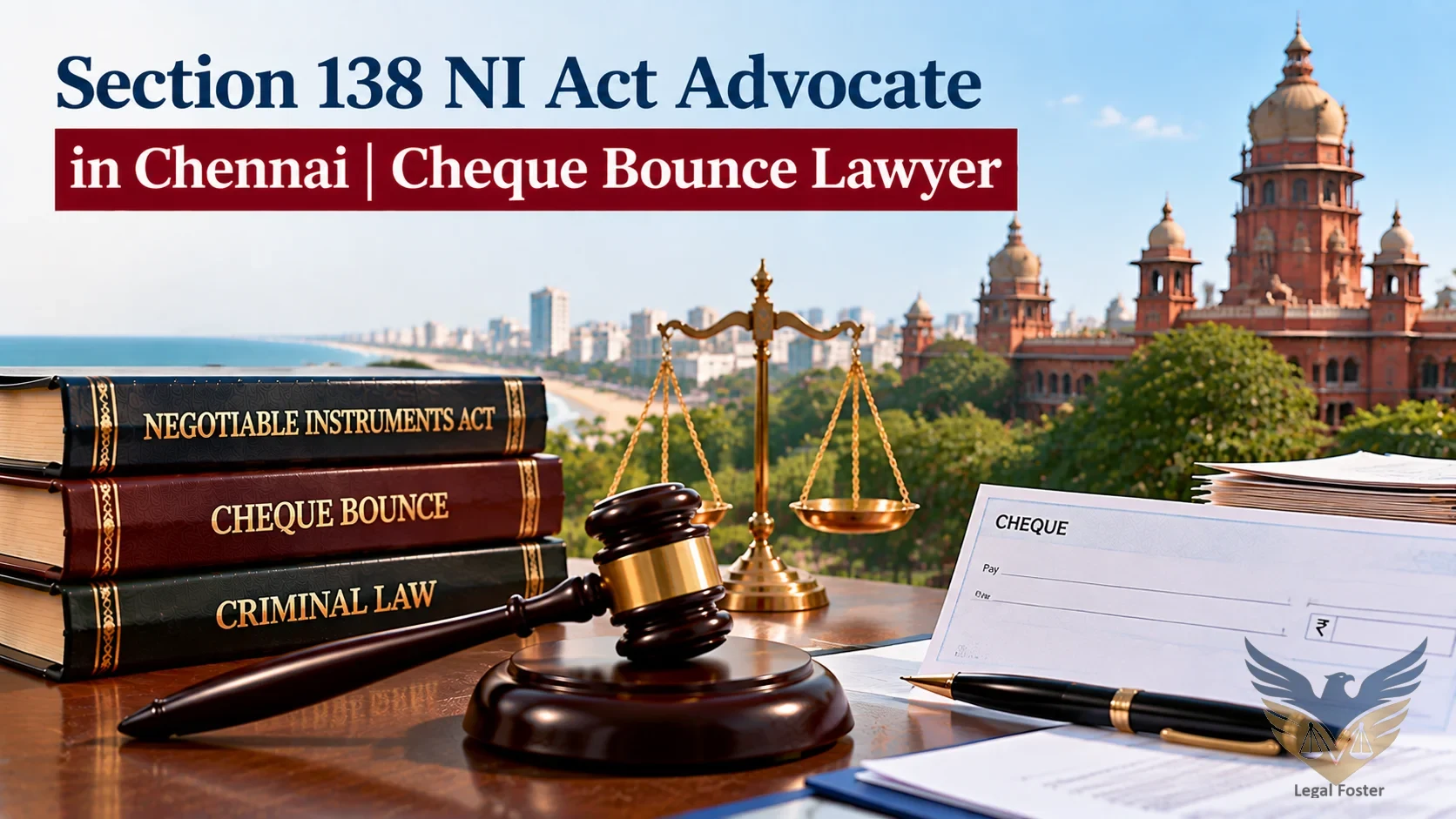
Section 138 NI Act Advocate in Chennai For Legal Notice & Filing Solutions
Give issuing a cheque takes seconds. Months of legal harassment can follow if that cheque bounces. Read on if you live or run a business in Chennai and find yourself waiting for that cheque to clear or worse, hearing that it did not.
When it comes to cheque bounce legal advice in Chennai the first question clients ask is often a simple one. What should I do after my cheque bounce in Chennai? The answer depends on the cheque, transaction, bank memo, statutory notice and several relevant dates.
Hire an Advocate for Section 138 NI Act in Chennai and he can walk a payee through these facts before sending a legal notice. If the elements to file are met, he can also assist with filing the complaint. The same advice can extend to a drawer who has been given a cheque bounce notice and wants to know his rights before sending a reply.
Section 138 only applies to dishonour of cheques drawn for the discharge of a legally enforceable debt or liability. Because of this, Section 138 places specific demands on how that cheque is presented, when a written notice is sent and how long the drawer is given to honour that cheque.
Delay can become detrimental to Chennai resident’s and businesses because the laws are strict on these limitation periods. Acting fast should not be mistaken with poorly written legal documents. Instead, it means knowing which dates matter, preserving essential documents and taking legal action within those dates.
For these reasons consulting a Section 138 NI Act Advocate in Chennai when you receive a cheque bounce notice may be preferable to waiting until you need to file a complaint.
Why Should I Care About a Cheque Bounce in Chennai in 20|26?
Used for business and personal transactions throughout Chennai. Whether paying for supplies, rent, fees or a loan payment. More cheques write than most realise. When a cheque dispute happens, the face value of the cheque is not the only thing on the line.
A company could be waiting on that cheque to cover payroll. The vendor may be a small contractor who already delivered materials. A freelancer could have finished his project but hasn’t been paid. An individual may be dealing with an unexpected dispute with his loan shark.
Since Section 138 requires that the cheque was issued in respect to a legally enforceable debt or liability having your cheque bounce is only part of the initial investigation. Prosecuting the offence requires several elements to be true.
The parties involved will also play a factor when figuring out your legal position. Because of this, the transaction and history should be reviewed as soon as possible.
Another reason seeking legal advice early can help is Chennai locals will understand Court procedures and interpretation of key documents.
For example, since the case is filed in a Magistrate court under Section 138. Both the Magistrate with local jurisdiction and limitation period will apply. And because Section 142 goes over the complaint, where to file and limitations. Not understanding local rules can complicate what is normally a straightforward process.
Instead of trying to figure this out yourself, the first step to find an Advocate for Section 138 NI Act In Chennai should be consulting a lawyer who can clearly explain what happened, what your documents indicate, what deadline applies and what legal options are available to you now.
Quick Facts
- Section 138 is a provision under The Negotiable Instruments Act, 18 81 .
- The provision applies to the dishonour of certain cheques.
- Drawn by any person for the discharge, in whole or in part, of any legally enforceable debt or other liability.
- The cheque should ordinarily be presented within its period of validity.
- The written notice should ordinarily be issued within 30 days of receiving knowledge of the fact of the cheque’s dishonour.
- Drawer should make payment within 15 days of receipt of statutory notice.
- The complaint should be filed ordinarily within one month of the date on which cause of action arises.
- Delay can be condoned under certain circumstances by the Courts.
- Offence under Section 138 is triable by the court of the competent Magistrate.
What is a Section 138 Cheque Bounce Case?
Section 138 represents a statutory criminal complaint filed due to a particular kind of cheque dishonour. In accordance with The Negotiable Instruments Act.
It is not enough for the bank to bounce your cheque. The cheque must have been drawn for the payment of money to satisfy a legally enforceable debt or liability. Furthermore, the statutory requirements of presentation, demand notice and failure to make good on that payment must also be met.
Section 139 also creates a statutory presumption in favour of the cheque recipient. Based on the cheque being supplied for the discharge of a specific debt and account.
This presumption does not mean that factual disputes cannot be raised. There are legal defenses the drawer can raise. But the court will listen to evidence and review the facts surrounding the dishonoured cheque case.
The distinction is important for Chennai residents because lawyers have to look at the entire transaction allegedly creating liability.
What Law Governs Cheque Bounce in India?
Primarily, The Negotiable Instruments Act, 1881. More specifically Chapter XVII.
- Section 138. Punishment for dishonour of certain cheques for insufficiency, etc., of funds in account.-
- Section 139. Presumption in favour of holder.
- Section 141. offence by company. Persons responsible for the business of company.
- Section 142. No cognizance of offence after complaint.-
- Section 143. Trial of offences. Procedure.
Section 143 empowers Magistrates to try cheque bounce offences in accordance with the Act. Also, mandates that said trial be conducted in a summary fashion. The sooner the better.
Section 143 A provides for the Court to order interim compensation of a portion of the cheque amount. On the application by the complainant under specific conditions. This is not automatic upon filing a complaint. Rather, it is discretion afforded to judges to allow.
Indian Courts have even clarified that complying with the statutory demand notice and waiting period is crucial before filing a complaint. Just because your cheque bounced does not mean you can instantly file a complaint.
Who Needs a Advocate for Section 138 NI Act In Chennai?
Assuming one plans on handling legal matters without an attorney (not recommended). Clients on either side of a cheque dispute will need to understand how Section 138 applies to their situation.
The first side would be any cheque recipient. Whether a customer, borrower, tenant, business associate or some other type of debtor issues you a cheque that bounces, clients will want to know what legal options are available to recover the amount due. Concerns regarding recovery, statutory rights and timelines are common.
Conversely, the drawer of a bounced cheque will want to understand his rights after receiving a legal notice. Instead of reacting out of anger or disbelief (cheques were provided as “security” only). Taking a step back to review the original transaction, payment history and documents is recommended.
Businesses will sometimes have more complex issues if multiple cheques were provided for one single commercial transaction. Authorized signatories, companies and Directors can also raise separate legal issues depending on the facts.
Contact Section 138 NI Act Advocates In Chennai to help both sides of cheque dishonour disputes.
How Do I Handle a Cheque Bounce in Chennai?
Outlined below is the general procedure for a cheque dishonour situation. Please contact a lawyer regarding your specific circumstances.
Step 1. Review Cheque & Bank Memo
All information about the cheque and bank should be reviewed before sending a notice or reacting. You should know which cheque was deposited, when it was deposited and why the bank refused payment. Cheque bounce lawyers in Chennai will know this information is important because the bank memo explains the reason for the return.
Step 2. Analyze The Transaction
Second, it would be advisable to figure out where things went wrong. Was payment originally intended? Does the party who issued the cheque have a history of not paying? Supporting documentation such as invoices, agreements, account statements, records of payments, emails and correspondence will help piece together what happened.
Step 3. Send Statutory Notice
If conditions under Section 138 are met, the payee has a right to send the drawer a written notice demanding payment. As stated above, this demand notice must be sent within a specific time limit.
Step 4. Allow 15 Days to Respond
Upon receiving the notice, the drawer will have 15 days to pay the amount demanded. Keep in mind this period only starts when the drawer receives the notice. If they fail to respond with payment, the cause of action arises for the payee to initiate a lawsuit.
Step 5. File Cheque Dishonour Complaint
You would need to hire a lawyer to prepare a complaint and all supporting documents. Lawyers in Chennai will help draft, file your cheque bounce complaint with the appropriate Magistrate court.
Clients that need assistance drafting a legal notice can utilise our cheque bounce notice service available through this website.
Keep Important Documents Related to Cheque Transaction
This point cannot be stressed enough. Documentation is critical during cheque transactions and when disputes arise.
Documents to Preserve Include:
- Original cheque or best copy available (cancelled cheque). Bank return memo / cheque dishonour memo received from bank.
- Bank statement showing cheque was deposited (if presented).
- Original invoice / loan agreement / rent agreement / any document which created the liability.
- Account Statement or account payables ledger.
- Record of payments made and history of transactions between parties.
- Emails / messages / any other relevant correspondence discussing said transaction.
- Copy of the legal notice you send.
- Proof of dispatch and service. Postal receipt, courier track record etc.
- Any response received from the drawer.
Obviously, not all documents will apply to every transaction mentioned above. A dispute over an invoice for supplies will require different documents than a personal loan agreement. Obtaining these documents in a chronological order will also help your Section 138 NI Act lawyer assess the case without relying on memory.
When to Contact a Lawyer?
As a general rule of thumb, you may want to speak with a lawyer right away if the cheque was for a substantial amount; if the transaction itself is in dispute; or if you have multiple cheques from the same person due/dated around the statutory deadlines.
You should also speak with a lawyer if the person who bounced your cheque is now disputing the liability; claims you used the cheque fraudulently; already paid you or issued you a “security cheque”. Any of the above could change your legal rights and obligations when sending a legal notice.
Another instance would be if the cheque is issued by a business or Company. Rules are different when pursuing a Company, LLP or partnership under section 141.
Received a Section 138 Notice in Chennai? What Should I Do?
Do Not Ignore the Notice. Print out the cheque, bank statement and notice. Review the documents before consulting a lawyer about your legal rights.
How Can Lawyers help you with Section 138 Notice?
Cheque Bounce Lawyer handles legal matters involving cheque dishonour. From the legal notice, Section 138 complaint, defending against such claims and settling the dispute thereafter. As mentioned above, we can assist with drafting the notice and filing a cheque bounce complaint.
If you have a matter in Chennai, we will review the cheque, bank memo and all transaction related documents; confirm the dates, notice period and where such a case can be filed in Court. Explaining your legal options is how we can help you. Unlike some lawyers in Chennai, we do not guarantee you a specific outcome.
Advocate BK Singh can help you out with respect to sending a Section 138 NI Act Notice. Upon examining the facts and documents specific to the matter at hand. We can draft the notice, send it to the Drawer and proceed with the subsequent cheque bounce dispute.
Sometimes it makes business sense to settle a dispute. If you decide to accept a promise to pay in full as “compensation”. We can ensure you understand the legal terms of the settlement before you throw away that original cheque.
FAQ’s
Q1.What is Section 138 of NI Act.
Ans. Section 138 of NI Act pertains to the cheque being dishonoured by the bank for insufficiency of funds etc. where the cheque is issued for discharge of any legally enforceable debt or liability in whole or in part and if certain conditions are fulfilled.
Q2.When should I send legal notice for cheque bounce?
Ans. Within 30 days of receiving the bank memo stating the cheque has been dishonoured by the bank.
Q3.How many days the drawer has to pay after receiving the notice?
Ans. The drawer has 15 days to pay from the date of receipt of notice.
Q4.Issue notice immediately when my cheque bounce?
Ans. No, you need to send statutory notice. Allow the 15 days to expire. These are crucial elements of Section 138.
The Supreme Court has specifically stated that a complaint filed even 1 day before the expiry of the statutory period would not as a general rule be maintainable as a Section 138 complaint.
Q5.In which court the cheque bounce case can be filed?
Ans. As per Section 143, the offence shall be tried by a Judicial Magistrate of the First Class or Metropolitan Magistrate, as the case may be. Jurisdiction of the Court will be decide as per the NI Act.
Q6. Can a cheque bounce be settled?
Ans. Yes. As per Section 147 offences under Chapter XVII are compoundable. If parties wish they can settle the matter. Whether its a good idea to settle and on what terms would require specific analysis.
Q7. My friend gave me a security cheque, does it defeat the purpose of Section 138 proceedings?
Ans. Do not jump to conclusions just because someone mentions the word security cheque. Look at whether the cheque was presented for payment towards the discharge of a legally enforceable debt or liability. Facts and evidence shall have to be carefully scrutinised.
Q8.My drawer has already paid me part of the amount, what should I do?
Ans. That could be very important from a factual and legal standpoint. You would have to review bank accounts, transactions, receipts and correspondence before deciding on a course of action.
Q9.Can take legal action against a company under Section 138?
Ans. Yes indecent. Section 141 specifically talks about offences committed by companies. As well as the officers of the companies who were actually responsible for the conduct of the business of the company at the time of the offence.
Q10. Why Should I hire a Lawyer for Section 138 NI Act Cases in Chennai?
Ans. To ensure your legal notice is sent within set time limits and for help understanding the underlying liability. Lawyers will help you draft / respond to the statutory notice and explain the procedural steps you should take. Contact Advocate BK Singh for skillful legal services.
Conclusion
When your cheque gets dishonoured it should not be taken lightly. Section 138 has created a distinct process. Understand the importance of timely cheque presentment, bank return, sending the notice, allowing opportunity to make good on the payment and filing a complaint.
If you are the payee. Make sure you preserve evidence and know the statute of limitations. If you receive a Section 138 notice. Take a moment and review what transpired before throwing it away.
Need legal assistance with a cheque bounce in Chennai? Contact us to find out how we can help you with sending a Section 138 NI Act Notice, drafting a cheque bounce complaint and many other legal services depending on your needs.