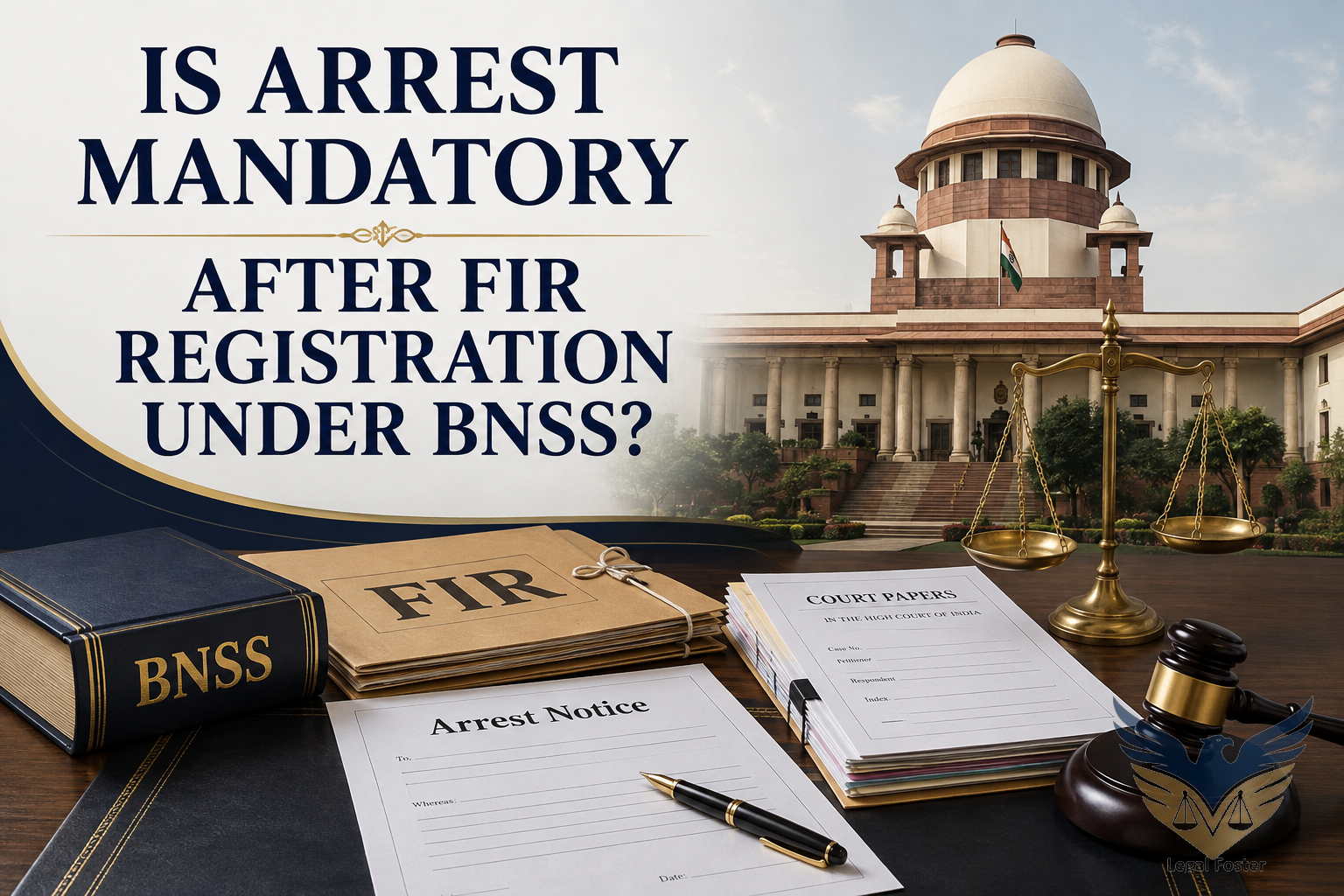
Is Immediate Arrest Compulsory After FIR Registration Under BNSS?
Right after an FIR gets registered a family may panic. They may receive a call from the police station, learn that an FIR has been registered against them, or find out that someone has complained about them. One of the first things nearly everyone wants to know is the same: “Will the police arrest me now?”
Nope. But registering an FIR won’t automatically require an arrest. Whether an arrest is legal and required will be decided on the basis of the offence alleged, the punishment it attracts, material on record, the conduct of the individual against whom an allegation is made, and the protections they have under applicable law. (For the purposes of this blog, we’re talking about protections under the Bharya Nagarik Suraksha Sanhita, 2023 (BNSS).)
This distinction is extremely important to understand. Rather than arresting someone, police may ask them to join an investigation, issue a notice to appear/receive/respond to questioning by police. Of course, ignoring a legal notice, intimidating witnesses, deleting chats/emails and absconding can become grounds for arrest.
In Delhi, Noida, Ghaziabad, Gurugram, Faridabad and other cities too many families lose valuable time reacting to Whatsapps, half-heard information, or trusting policemen who they encounter outside the station and who give them verbal assurance. It’s always best to take a deep breath, and figure out your FIR number, PS name, what sections have been invoked against you, whether the offence is bailable/ nbailable, and whether a notice has already been served.
After all, as Advocate BK Singh has explained to me time and again, an FIR is just the beginning of an investigation. It neither confirms that someone is guilty, nor does it compel the police to make an arrest. Thinking before you act can go a long way in protecting an individual’s rights, and following the protocols of the agency conducting the investigation.
Why FIR Arrest Matters Concern Everyone in India In 2026
An arrest will appear on employment background checks, education admissions, business associates, family reputation and mental stability until a judge considers evidence and testimony regarding the validity of the accusations. Business litigation, family complaints, neighborhood feuds, social media bickering can all result in multiple defendants when personal responsibility may differ.
Police action can vary from Delhi NCR to Mumbai, Bengaluru, Hyderabad, Chennai, Kolkata, Ahmedabad, Lucknow, Jaipur or your small hometown. The legal rights under BNSS however remain the same. Lawyer BK Singh advises clients to remember that a police call is not an arrest warrant though, and neither should a notice be brushed off as just a phone call.
Quick Facts: FIR and Arrest Under BNSS
➢Registration of FIR means entering the information about cognizable offence. It does not mean that person is guilty of that offence.
➢ FIR doest not necessarily have to be followed by arrest.
➢ Section 35 BNSS – Arrest without warrant and recording reasons in particular cases.
➢ Section 35(3) says that in cases where arrest is not necessary, police officer may issue notice to appear to such person against whom such proceedings are instituted.
➢ If such person receives the notice and comply with such notice, they will not be arrested in respect of that offence unless reasons are recorded.
➢Person arrested shall be produce before the competent Magistrate within 24 hours, exclude the time necessary for the journey.
What Does “Arrest Is Not Mandatory” Actually Mean?
It is not necessary that a person for whom FIR has been registered by the police on ground of alleged commission of cognizable offence has to be arrested. What is required is for police officers to analyze the statutory yardstick for arrest against facts and circumstances of each case. FIR equals arrest cannot be the mantra of the police.
Section 35 contemplates arrest in case of offences punishable with imprisonment up to 7 years. Here, the officer arresting has to be satisfied that he has reason to believe as well as he is satisfied about necessity of arrest for purpose of any condition which the law recognizes.
Conditions include prevention of commission of further offence, investigation of offence, prevention of destruction of evidence or means of proof of offence or intimidation of witnesses or securing the presence of such person.
Advocate BK Singh quotes, “If a person is cooperating with the investigations, that is one factor to be taken into consideration. But cooperating with the investigations does not mean giving up your rights or signing blank papers.”
Which BNSS Provision Talks About Arrest After FIR?
Section 35 of BNSS relates to arrest without warrant and we will focus on this section first. For qualifying offences punishable below or with seven years of imprisonment, reason to arrest is to be recorded by the police officer. If there is no need to arrest the person, then reasons for not arresting are also be recorded.
Section 35 (3) goes ahead to empower police officer to issue notice to appear by the person concerned. If a person appears and obeys such direction, they cannot be arrested later for the same matter unless the reasons are recorded by the officer as to why the arrest became necessary later on.
For non-cognizable offences, arrest cannot be made except by warrant or with order of Magistrate which is again subject to general provisions of BNSS as discussed above. Section 35 grants further protection for arrest of an infirm person or above age of sixty years where the offence alleged is punishable with imprisonment below three years. In such cases, prior permission is required from police officer not below the rank of Deputy Superintendent Police.
Sections concerning procedure of arrest, to be informed of arrest to relatives or friends, ground of arrest and production of arrested person before Magistrate all seem equally applicable. Advocate BK Singh can guide you through if the action was justified and proportionate to the sections mentioned in FIR & stage of investigation.
When Should You Consult FIR and Arrest Anticipation guide early?
Whether you are the person against whom FIR is likely to be filed, your relative is receiving a call from Police station, you are a businessman against whom complaint is likely to be filed against your Company, you are a student and some other student has involved in some group crime and you are being harassed or you are a professional and someone is threatening to file a complaint against you due to some personal enmity.
Guide will help you if a complaint has been filed at a police station of some other city. You stay in Noida and wants to appear in Delhi to defend an FIR. Someone from Gurugram is implicated in a case which pertains to some other State. BK Singh analyses the location of jurisdiction, nature of offence and urgency to suggest the appropriate legal course of action.
From FIR Received to Safe Legal Course of Action
Cross check 1st. Get the FIR copy if already registered. Else keep the copy of police notice/complaint on call/message & name of the investigating officer who came. Never believe on a screenshot sent to you.
Judge 2nd whether the notice served under Sec 35 (asking to join for enquiry only) has been served to the person and whether arrest is really expected. If the notice received is genuine then best would be to refrain from doing any silly thing. Panic, running away or speaking to witnesses tactlessly would only compound your problems.
Should there be a genuine threat of arrest for a non-bailable offence, then you may have to consult him for filing of anticipatory bail application u/s 482 BNSS. If already arrested, then the issues of concern would be regular bail, remand and protections from custody. BK Singh helps his clients understand these stages discretely rather than panicking and trying the wrong remedy.
Documents That Matter at the FIR Stage
Documents handy to have before going to the police station/court.
FIR copy/complaint, police notice & any notices served to you.
❖ Identity & address proof.
❖ Job offer letter/company slip/ student ID
❖ Any agreements, bills/invoices, evidence of payment or property papers related to the issue
❖ Original chats/ messages, emails, call details, photographs and electronic documents
❖ Medical/tourist boards/gps reports if it absolutely applies to your case
❖ Any older complaints, previous orders or correspondence showing you have been cooperative
Don't delete conversations or “wipe” your phone. It can actually be more useful to hand over the actual electronic device. The origin, date and full context can be verified. Edited or partial screenshots can be useless.
If this is an emergency and you need help with FIRs/arrests please see our authenticated Helpful Notes on FIRs and arrests page with what documents/custody information families should have.
When to Approach a Bail Lawyer?
If notice has been served to you by the police, they have visited your home/office, asked you to assist in the investigation, filed an FIR against you, questioned your relative or informed you that you are likely to be arrested then seek legal advice at the earliest.
You should also consider consulting a lawyer at the earliest if the FIR has been filed under a non-bailable offence, invokes an allegation under special law, if there are multiple accused, complainant is from another city/state, you already have a pending criminal case, your computers/mobile were seized or if police are asking for custodial interrogation. Lawyer BK Singh will read the FIR and guide you whether the immediate need is to respond to the notice, apply for anticipatory bail or regular bail or some other requirement.
Services provided by BestBailLawyer
BestBailLawyer Clients with FIR related queries or arrested/bailed out cases all over Delhi NCR and India can get assistance. Rather than making generic statements we endeavour to understand the particular accusation, stage of process, custody situation and paperwork of each case.
Advocate BK Singh can help you analyze FIR, notice served by police, category of offence, chances of arrest and jurisdiction of courts. If someone has already been jailed/arrested then our curated bail advice will help you know the difference between post arrest bail & anticipatory bail.
No lawyer can assure you that you will not be arrested or that you will receive bail. Every situation has it’s own facts, statutory limitation, evidence with police and judge’s predisposition.
FAQ's
Q1. FIR can lead to automatic arrest?
Ans. Advocate BK Singh clarifies that just because an FIR has been registered that does not result in automatic arrest. Police will have to proceed in accordance with relevant BNSS Sections, consider the nature of offence alleged, evidence available, whether custody is necessary for the investigation and behaviour of the individual.
Q2. Police will just ask me to join instead of arrest?
Ans. Yes. Police can summon a person to join investigation/ enquiry. Further police can also issue a notice to appear under Section 35(3) BNSS in respect of which arrest will not be necessary.
Q3. If I comply with Section 35 notice of police can they arrest me later?
Ans. If the person appears in response to Section 35 notice and continues to comply with the terms of notice, they cannot be arrested in respect of the said offence. The police officer will have to record reasons for causing the arrest.
Q4. Can I file for anticipatory bail after filing of FIR?
Ans. Yes. In appropriate non-bailable offences, anticipatory bail can be filed under Section 482 BNSS subject to facts and statutory limitations. Advocate BK Singh can assist you if there’s an immediate and genuine danger of arrest.
Q5. If police just gives me a info that I am to be arrested does it amount to notice of arrest?
Ans. No. But it is best to verify from whom, from which police station, FIR number, what sections you are being inquired for and when you are needed to join. In case you get a written notice, it should not be ignored.
Q6. Police can arrest if offense is punishable with 7 years imprisonment
Ans. Police can arrest a person only if conditions as laid down in Section 35 are satisfied and reasons are documented for the arrest. It is not a consequential effect of FIR registration.
Q7. What should my family do if I am arrested?
Ans. Record the following: - Police Station where arrest was made, Time of arrest, Sections you’re alleged for, Name of Investigating Officer, Whether police took you into custody and what Court you’re likely to appear for purposes of grant of remand. You should prepare identity cards and gather documents related to the case.
Q8. Do I need to join investigation if police ask me to join?
Ans. No one should outright deny to obey a legal notice. If you have any legal concern, consult it at the earliest and represent your side legally.
Q9. Can someone be arrested for false allegations?
Ans. False allegations can be contested but the issue here is how police is viewing the FIR, material on record and statutory requirements for arrest or further investigation.
Q10. Can FIR from different city cause arrest at my house?
Ans. Yes. False allegations can land you in trouble. An FIR from a different city can create a potential danger of arrest depending upon the offences alleged & investigation conducted. Advocate BK Singh can evaluate from where FIR was initiated, whether the locality falls under the jurisdiction of that police station and if pre-cautionary step should be taken.
Conclusion
In some cases FIR’s can be serious however it does not mean that you will be arrested in every case. Section 35 BNSS brings in conditionalities to arrest and provides for noticeability appearance in place of custody where ever possible. The appropriate response is to be calm, quick and cooperative instead of panicked or careless.
If you/your family member have received a call from police or have been served notice/information on an FIR you can get the current status assessed by Advocate BK Singh and understand how to lawfully respond.
SEO Details
- SEO Title: Is Arrest Mandatory After an FIR Under BNSS?
- Meta Title: Is Arrest Mandatory After FIR Under BNSS?
- Meta Description: Learn when police may arrest after an FIR under BNSS, the Section 35 notice rule, key safeguards and when to seek bail guidance.
- Meta Keywords: arrest after FIR under BNSS, is arrest mandatory after FIR, Section 35 BNSS notice, FIR arrest lawyer, anticipatory bail lawyer, police notice after FIR, bail lawyer in Delhi