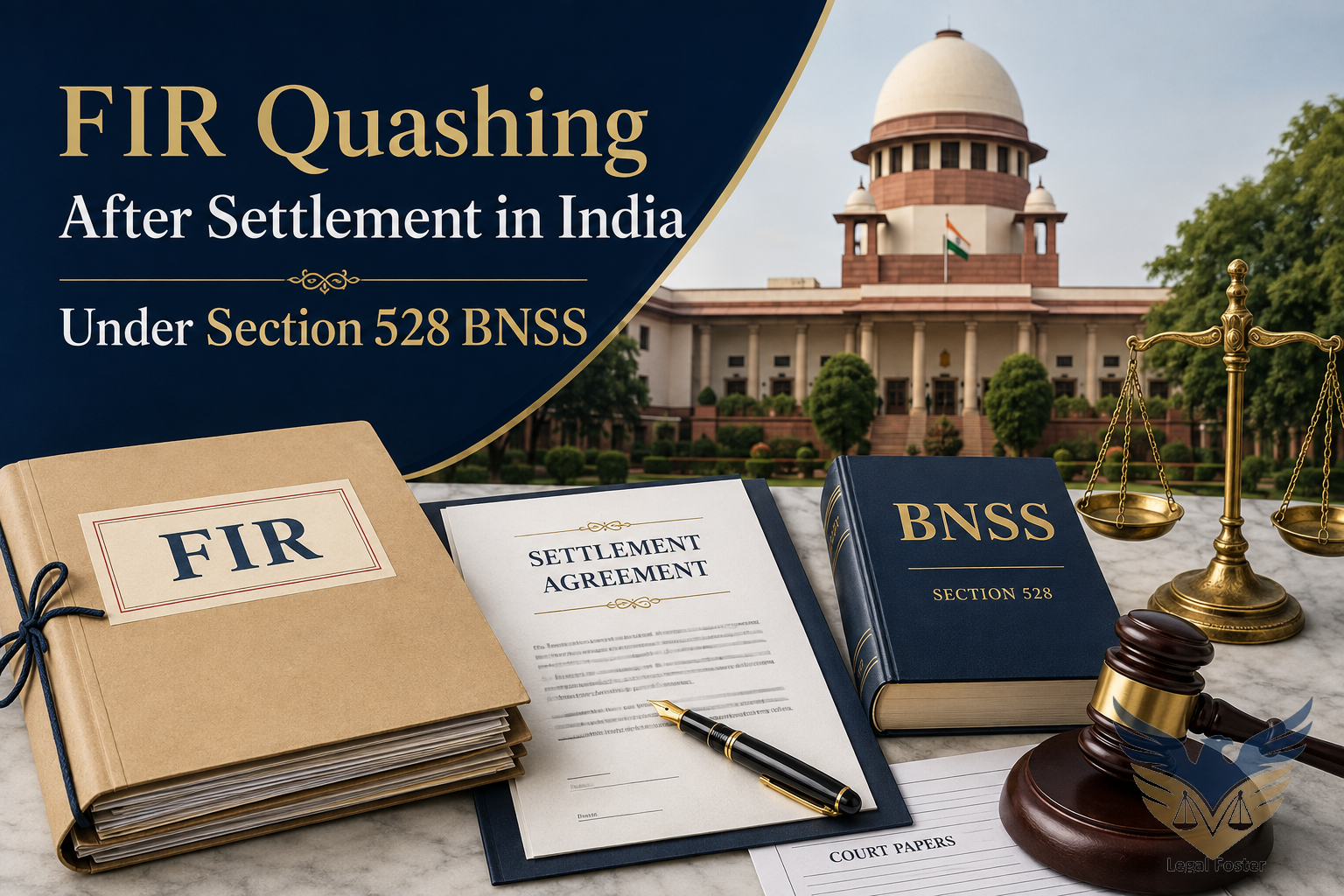
Can an FIR Be Quashed After Settlement in India in 2026?
Settlements offer quick justice to two disputing parties. There however, arises a question after most compromises are done and dusted – what about the FIR? Can that be put to rest as well?
Suppose there’s a matrimonial dispute filed at the police station in Delhi. An FIR is registered. A couple of months down the line, the parties sit for mediation and file a written settlement. Similarly, a business dispute in Noida where one party makes criminal allegations against the other in the middle of a dispute involving payments of money. Let’s assume the parties settle – the money is paid, goods are returned or allegations are accepted mutually. The criminal case will remain active on the court’s records until the件ions are pursued to completion or some provision allows it to be disposed of definitively.
QUASHING OF FIR AFTER SETTLEMENT
For FIRs to be quashed after settlement, the High Court with jurisdiction would have to analyze whether permitting the criminal complaint to proceed would give the proceedings a lawful purpose. Or whether they represent an inappropriate use of the Court’s resources. The High Court’s inherent powers have not been repealed by the Bharatiya Nagarik Suraksha Sanhita, 2023. Instead, they are preserved by way of Section 528 thereof.
But one factor in such an inquiry would be compromise or settlement.
The Courts have looked into factors such as the nature of the offence, impact on society at large, whether the compromise was entered into honestly, conduct of the accused, stage of the proceedings and whether the matter pertains to a dispute between individuals. Guided by these principles set out by the Apex Court, the courts have held that if the dispute is private in nature or substantially personal between the parties, then the matter can be quashed even if the offence is non-compoundable. However, if the offence is serious in nature and affects the society at large, then the same matter is treated in a different light.
Only after consulting Advocate BK Singh, those accused in such matters can review their documents and facts and not believe that the criminal matter against them terminates when both parties ink a compromise deed.
Why FIR Quashing After Settlement Matters in India in 2026?
We have settled the matter with complainant. File a statement in Court that we have settled our issue. Can’t we get the criminal case dropped?
It is common to hear that a settlement has been done and to believe that the criminal proceeding should end. This is not how our criminal justice system works. A compromise does not terminate a criminal proceeding. It is possible for the complainant and accused to privately resolve their issues while keeping the criminal proceeding alive.
This legal technicality can create real-life consequences. Investigations can continue. A chargesheet may be filed. Parties may be required to defend themselves in Court. Bail conditions can become relevant. Ongoing criminal proceedings can affect professional licenses, travel plans, reputation and personal goals.
Jurisdiction is everything in Delhi NCR. An FIR first information report filed in Delhi will generally be under the territorial jurisdiction of the Delhi High Court. FIRs filed in Noida, Ghaziabad, Meerut or any other district in Uttar Pradesh will be under the jurisdiction of the Allahabad High Court and its many benches. Gurugram and Faridabad criminal cases would typically fall under the Punjab and Haryana High Court.
The rule applies all over India. The appropriate High Court will have jurisdiction over the criminal proceedings based on territorial boundaries, not where the accused lives or where the attorney maintains an office.
Because the facts change the recommended solution, please allow Advocate BK Singh to review the FIR, settlement terms and current status of the case before deciding to file for quashing.
Quick Facts
- FIR is not withdrawable by a private compromise.
- Section 528 BNSS preserves the inherent powers of the High Court to prevent abuse of the process of the Court or otherwise for the ends of justice.
- Section 359 BNSS has mentioned offences that can be compoundable as per law.
- Compoundable and quashing by HC are two different concept of law.
- Offence can be quashed by HC even if it is non compoundable if it pertains to some private dispute.
- Offence which is serious in nature and affects the societal interests cannot be quashed just because it was settled privately between two parties.
- Quashing is considered on every case basis. Every petition for quashing is decided on its facts, averments and legality.
Meaning of FIR Quashing After Settlement?
Quashing of FIR after settlement means asking the High Court having jurisdiction to quash an FIR or the criminal proceedings arising therefrom on the ground that the cause of action has been settled bona fide and that there is no scope to proceed with the prosecution for reasons of justice.
Needless to mention, this is different from compounding.
Comparison between IssueCompounding FIR Quashing Legal provision Section 359 BNSS or otherstatutory provision reading High Court’ s inherent powers
including Section 528 BNSS Offence Only compoundable offences. Offence can be both compoundable as well as certain non-compoundable disputes(non-compoundableoffences with the leave of the Court) .
Authority
Depends on offence & stage of proceedings. High Court
Can mere settlement quash the FIR? Dependent on statutory provision No. High Court will look into merits of the case
Whats about grave offences affecting public interest? The offended is statutorily barred to compound. Court’s will take lots of caution in exercise of their discretion and pun
ishment
FIR Quashing is sought after the dispute is settled amongst the parties.
Since quashing of FIR after settlement is quite different from compounding the offences complained of in the FIR, we cannot treat terms like ‘matter settled’ to mean compounding or dropping of the criminal case.
The Adv Bacqui Singh can help you analyze if your case can be compounded, or needs High Court quashing or cannot be ended by settlement.
Under what law can an FIR be quashed?
The Bharaya Nagarik Suraksha Sanhita (“BNSS”) came into force on 1 July 20 24. Section 528 BNSS. Provides that “Nothing in this Sanhita shall be taken to derogate from the inherent powers of the High Court to make such orders as may be necessary to give effect to any order made by it or to prevent abuse of the process of any Court or otherwise to secure the ends of justice.”
TIP: Senior Lawyers who practise at the High Court will be familiar with criminal trials and older judgments will often cite Section 482 Cr.P.C (“CrPC”). That proviso contained a similar provision granting inherent powers to the High Court under the previous criminal procedural law.
Section 482 CrPC still matters because it refers to BNSS in Section 531 BNSS. This Section on repeal and savings matters. It essentially says that investigations, applications, trials, inquiries and appeals already pending immediately before the BNSS commenced, may continue under the previous CrPC regime. Read the savings clause.
CrPC will not bind the High Court
Matrimonial offences and offences affecting socio-economic rights can be quashed if there is a bona fide compromise. However this ONLY depends on the facts. Just because parties agree to settle, doesn’t mean serious offences affecting society at large can become private matters.
Courts will look at the FIR, compromise and other material to see if:
(a) the accused has good antecedents;
(b) he has behaved properly during the trial; and
(c) the overall circumstances of the case are consistent with a bona fide compromise.
In 2025, the Apex Court themselves recalled these very principles while denying permission to quash a criminal case because of a compromise.
BK Singh will need to look at the merits of the allegations.
Who Needs To Read This Information?
Examples where parties have compromised:-
Matrimonial and related matters;
Business or partnership disputes;
Private civil matters (property);
Financial transactions/commercial matters along with criminal complaints
Against the parties;
Personal or neighborhood disputes;
Set-off claims arising out of same private dispute.
The compromise quash petition are not only from Delhi court but are also filed from High Courts for Mumbai,Pune,Bengaluru, Hyderabad,Chennai,kolkata, Ahmedabad,Jaipur,Chandigarh cases.
Stayed abroad: There are numerous clients who have compromised their family/commercial matters in India but have an FIR pending against them. They will need assistance as well.
Speak to Advocate BK Singh before you compromise anything. He will ensure that all complainants, defendants and related proceedings have been compromised.
Documents / Evidence Checklist
Documents that would normally be attached to a settlement- based quashing petition are :-
- copy of FIR;
- complaint upon which FIR was lodged;
- copy of settlement agreement/mediation settlement;
- identity documents/address proof of parties;
- proof of payment if money was exchanged as part of compromise;
- receipts/acknowledgement for articles returned;
- bail orders (if any);
- charge sheet/final report(if already filed);
- any order passed by trial court yet to be acted upon on relevance;
- details/complaint number of any linked complaint/cross-FIR if exists;
- order/ decree of matrimonial court/order of settlement (if any)
- evidentiary letters/support showing that settlement was not done under any sort of pressure.
Advocate BK Singh can advise whether the documents/evidence fit the facts that parties want to produce before Court.
At what stage should you speak to a lawyer about FIR Quashing?
When to Seek Legal Assistance:-
- Settlement done and agreement executed but FIR still not withdrawn;
- Police investigation is ongoing;
- Charge sheet has been submitted;
- Summon has been issued;
- There are multiple accused/complainants;
- FIR discloses private- dispute along with serious offences;
- Compromise deal includes settling of matrimonial disputes & withdrawal of multiple proceedings.
- Money paid by instalments;
- Accused/complainant is residing outside India;
- Complainant has withdrawn/reopened his complaint after compromise.
A consultation with Advocate BK Singh would cover analysis of whether the facts/findings on record, compromise terms and stage of the proceedings make a favorable case for seeking an effective remedy in the High Court.
How BK Singh Advocate Can Help
Many of our clients come to BK Singh Advocate, when legal opinion is required after the settlement process has been completed only to find that the FIR / bail matter or trial is still underway.
Please get your FIR, settlement deed and related documents, checks on jurisdiction and current status reviewed by BK Singh Advocate. .
You will be advised about the difference between compounding and quashing, based on whether the matter in the true sense is private, if any documents are missing and what relief can be expected from the High Court.
Look for someone who can suggest a legal plan to close your case on merits i.e., on legal grounds rather than someone who promises you a predetermined result.
BK Singh Advocate guides clients all over Delhi NCR and for cases from other states in India where criminal proceedings are still pending despite a genuine settlement being reached.
Answers to Your Common Questions
1. Can we file an FIR after complaintant and accused has reached a settlement?
Ans. Yes. The High Court has quashed FIRs which deal with a dispute which is essentially private in nature and the parties entered into a voluntary compromise. However, There can be quashing after compromise as Settlement of disputes does not entitle the parties to quashing per se.
2. Can we file a non compoundable offence after settlement?
Ans. Yes provided it is an appropriate case to do so. The exercise of inherent jurisdiction by the High Court is entirely separate from (and not in addition to) the statutory power to compound offences. However, the nature and gravity of the offence will still be relevant factors for consideration.
3. If my complaintant agree and give his consent can he cancel his FIR?
Ans. No. It is entirely up to the High Court to exercise its discretion or not irrespective of whether any of the parties wants their matter quashed. Mr Advocate BK Singh will be able to advise you whether on the facts the substance of the allegations against the accused are capable of being quashed on the basis of a compromise being reached.
4. Under what section FIR will quashed under BNSS?
Ans. Section 528 BNSS preserves the inherent powers of the High Court. Any proceedings pending or saved by that section will still have Section 482 CrPC invoked in conjuction with Section 531 BNSS.
5. What is the difference between compound and quash?
Ans. Compound is a remedy specifically provided by law for specific offences. Quash is a inherent remedy available only to the High Court. Quashing can be allowed in situations where the offence is non compoundable.
6. After mutual divorce by consent can we compromise a matrimonial FIR?
Ans. Matrimonial disputes are perhaps the 1st category of cases where compromise is most applicable. But the Court will have to be satisfied that such compromise was entered into voluntarily and that there are no other facets of the case which require the Court not to permit quashing.
7. Can we quash serious offences against victim's wishes?
Ans. No,atleast not normally. The Supreme Court has on many occasions stressed that while exercising such powers, courts need to see the nature of the offence and its impact on society and can’t view every offence as being purely a matter between the victim and the accused.
8. Can we file an FIR after charge sheet against the accused has been filed?
Ans. Yes. Whether a particular court will allow a compromise depends on the nature of the offence, the stage of the proceedings, the facts of the case and the applicable legal principles. The fact that a charge sheet was filed would not by itself give the answer.
9. Can one of the accused apply for quashing when there are multiple accused in an FIR?
Ans. Yes.........No. It depends on the facts. You have to look at the nature of the allegations against the various accused and the terms of the settlement. The role of the accused as alleged in the FIR, the wording of the compromise and what is being said by the complainant are some factors that would need to be considered.
10. If both parties has reached a compromise and signed an affidavit for the same, is quashing of FIR guaranteed?
Ans. No. No reputable advocate would make such claims. Advocate BK Singh will be able to review the facts of your case and tell you what your chances are of obtaining quashing on a settlement being reached. But he can’t guarantee the court will grant such relief.
Conclusion
Civil settlement is often the biggest event in a private criminal dispute. But settlement is not synonymous to Judicial resolution.
Courts have inherent powers under Indian law to ensure that the criminal justice process is not abused and also to do justice. In exercising this power courts also make sure that societal interest is not damaged by letting down serious offences by merely accepting that parties in direct dispute have settled.
If someone has got an FIR after a matrimonial settlement/ commercial agreement/property settlement/personal settlement they need to look into the FIR charges, settlement agreement,stage of proceedings and jurisdiction of High Courts before assuming that their matter is concluded.
Advocate BK Singh can look into these aspects and let you know the possibility of getting FIR quashed on the basis of settlement on case to case basis.
SEO Details
SEO Title: Can an FIR Be Quashed After Settlement in India?
Meta Title: FIR Quashing After Settlement in India | 2026 Guide
Meta Description: Can an FIR be quashed after settlement? Understand Section 528 BNSS, compromise-based quashing, High Court powers, documents and legal risks in India.
Meta Keywords: FIR quashing after settlement, FIR quashing lawyer, quashing FIR after compromise, Section 528 BNSS, Section 482 CrPC, FIR settlement India, High Court FIR quashing, non compoundable offence quashing, matrimonial FIR quashing, criminal case settlement, FIR quashing Delhi, criminal lawyer Delhi NCR