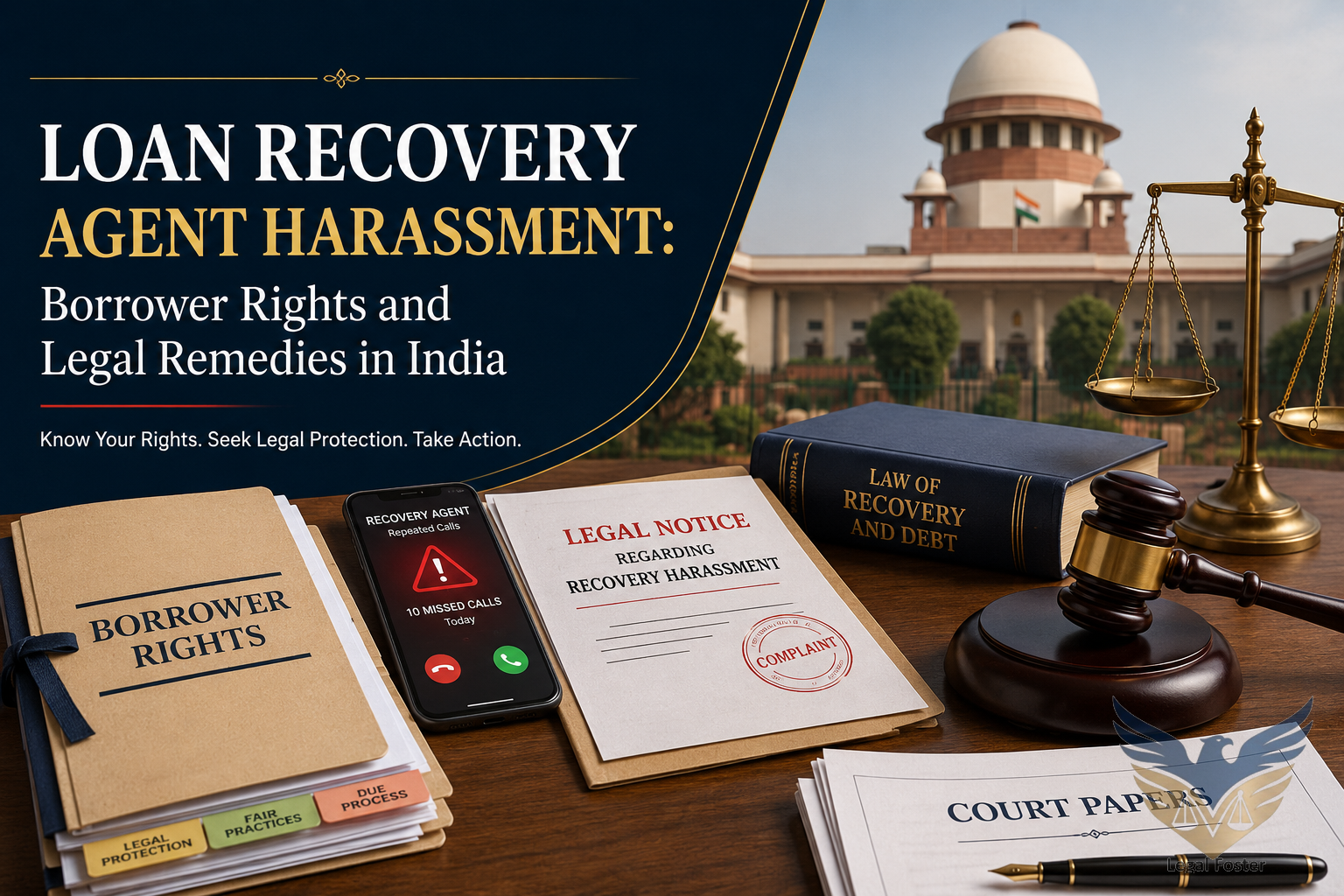
Are Loan Recovery Agents Harassing You? Know Your Legal Remedies
Having an EMI go overdue can happen suddenly. You’re juggling salary, rent, school fees, medical expenses or a slack business season for one week. Then suddenly unknown numbers call you all day, WhatsApp forwards reach family members, someone visits your home for recovery or someone threatens to inform your employer. Yes, you may have debt. But shame isn’t an acceptable form of repayment.
Loan recovery agent harassment includes threatening, abusive, invasive, deceptive or privacy-invading behaviour that pressures a borrower or someone else to repay a loan. Legitimate lenders will request repayment and utilize legal collection options if a borrower doesn’t pay. However, that right doesn’t allow a bank, NBFC, fintech lender, card company or third-party agent to run roughshod over a borrower’s residence, workplace, family members or reputation.
One of the simplest distinctions for borrowers in India is this: default and harassment are two separate problems. You have the right to resist harassment even if your payment is late. However, ending harassment will not erase your loan, erase interest or fix your credit history automatically, or stop legal collection action.
Borrowers are recommended by advocates BK Singh & Advocate Sadhna Singh to start by listing the facts: Who is calling? Who do they say they represent? What did they say? Which loan account? What proof do they have? How can you reasonably pay this back? A well-kept log will always beat yelling.
Our guide will walk you through the important rights, dangers, and practical options.
When Collection Pressure Crosses the Line
Things cross a legal line when a reasonable request for payment escalates into harassment, threats, shame, relentless pestering, fraud or abuse of private data. RBI guidelines mandate regulated parties and agents from engaging in threatening or abusive conduct, public humiliation, intrusive contact referencing family members, referees or friends, threatening or anonymous calls and repeatedly calling. Calls outside of 8: 00 a.m. to 7:00 p.m. aren’t allowed for overdue loans under RBI’ s 2022 collection-agent guideline.
Harassment takes many shapes across the country. In Noida, a borrower may be getting daily WhatsApp calls. In Gurugram, a professional might worry about an HR escalation. In Ghaziabad, an entire family may experience an aggressive visit at their doorstep. In Bengaluru, Mumbai or Hyderabad, an individual might find that referees they uploaded on an app have been tapped.
A creditor can continue calling you about payments you owe them, send notices, appoint a legitimate recovery agent, negotiate a repayment plan and pursue legal options. Just because a creditor contacts you and you feel uncomfortable doesn’t mean it’s harassment. The legal issue is how, when and how often the conduct occurred and whether it was deceptive or caused harm.
Lawyers Advocate BK Singh & Advocate Sadhna Singh have encountered the worst force usually where borrowers have multiple unsecured loans, credit cards and/or digital loans following an unexpected loss of income. The best outcome is often to cease illegal pressure tactics without allowing borrowers to think the debt will go away.
Quick Facts: What Recovery Agents Can and Cannot Do
- Agents working on behalf of a regulated lender are still answerable to that lender.
- Legitimate recovery can’t involve coercion, foul language, violence, or defamation.
- Repeated calls are forbidden by RBI guidelines, and within the overall delinquent loan scheme they are calling before 8:00am and after 7:00pm.
- Agents may be asked by borrowers what company they work for and why they have been contacted.
- The banks must inform customers if their loan recovery has been transferred to a third party agency, per RBI regulations which agent has picked up the assignment, and that agent must ask to see suitable ID/documentation and approval.
- The borrower’s legitimate debt is not forgiven when they file a harassment claim, nor are they immune to any legal collection efforts.
- Effective July 1, 2026, eligible complaints will be handled by the Reserve Bank–Integrated Ombudsman Scheme, 20 26, following the mandatory first level of grievance redressal.
How Loan Recovery Agent Harassment Differs from Lawful Recovery
Just because a recovery call is stressful doesn’t make it illegal. If your EMI is late, a lender can call you, request payment, outline lawful consequences and factor your options into their recovery efforts. Borrowers are protected by how lenders conduct that communication.
It matters how and what is said.
An agent who identifies themselves, mentions the overdue amount and requests a date to pay is not engaging in harassment. Someone calling twenty times in an effort to bully a borrower into paying, threatening arrest when they have no lawful authority to do so, calling neighbours or the borrower’s employer, discussing debt specifics with coworkers or saying they’ll visit your home to embarrass you is.
References given at the time of borrowing may include relatives or friends. Contacting those people does not give a lender permission to discuss account specifics, pressure them for payment or shame you through them. RBI instructions explicitly consider privacy for family members, referees and friends.
Pressure at work can take a serious toll. Especially if your HR, manager or colleagues learn of your personal debt through repeated calls, the collector could inadvertently cause issues with your employer unrelated to the collection of your debt. If a specific contact crosses the line will depend on what is said, why and how often.
Visiting your home is another area where context matters. Visiting your home isn’t per se wrongful. Doing so and threatening violence, refusing to leave when asked, yelling in front of neighbours, threatening your parents or elderly family members, refusing to identify who they work for or attempting to seize your possessions without lawful authority are wrong.
BK Singh & Associates . As BK Singh & Associates the lawyers we advice you not to engage with an aggressive caller. Note down what happened during the call precisely and ask for identification. Shift to a recorded form of communication for any serious matter.
Rules Banks, NBFCs and Their Agents Must Respect
Borrower protection in India is provided by a patchwork of regulations, not by a single anti-harassment law. RBI guidelines, lender fair practice obligations, consumer protection statutes, criminal laws and contract law can all apply.
Reserve Bank guidelines on recovery conduct
One of the sections in RBI’s Aug. 12, 20 22 guideline states: “No regulated entity shall allow its agents or persons at whose direction the activities are conducted to resort to coercion, harassment, publication of defaulters’ names/shaming, trespassing into the borrower’s property, unsolicited messages through mobile phones or social media, threatening phone calls or anonymous phone calls, frequent calls to disturb the borrower’s peace and quiet, or tele-calling beyond the time window specified for recovering delayed loans”. It adds that “Responsibility for activities undertaken by third parties/service providers will rest with the regulated entity.”
So far as collections are outsourced, the guidelines also speak to identification. Banks were instructed to provide borrowers with a notice when cases are referred to collection agencies. Collections agents should have identification on them along with a copy of the notice and authorization letter. These guidelines are significant because borrowers regularly receive demands that include phone numbers that do not reveal the lender or agency.
Credit card collections are subject to similar expectations regarding confidentiality and professionalism. Issuers are expected to share recovery agent details when the account is outsourced and must ensure collections don’t cross the line into harassment.
Digital lending regulations outline transparency requirements as well. Regulated lenders are expected to share loan details, recovery processes and grievance officers. There is no exemption for technology lenders whose collections occur via apps.
RBI Ombudsman route from July 2026
The Reserve Bank–Integrated Ombudsman Scheme, 2026 (Ombudsman Scheme) commenced on 1 July 20 26, replacing the 20 21 Scheme for purposes of new covered complaints. The Scheme provides a free alternative dispute resolution process for eligible complaints relating to deficient services by regulated entities.
Borrowers will typically be required to raise the issue with the regulated entity and meet the Scheme’s complaint criteria before escalating to the Ombudsman.
The Ombudsman should not be viewed as a debt forgiveness scheme. The Ombudsman is likely to have more application in cases where the complaint relates to the conduct of recovery, failure of the complaints process, unfair service recovery conduct or other covered complaint.
Consumer and criminal-law safeguards
The Consumer Protection Act, 2019 may also apply where the conduct in connection with banking or financial services amounts to a deficiency in service or an unfair practice and the complainant is a consumer. This would depend on the facts of the transaction.
Threats may take the matter outside of regulatory misconduct. Criminal intimidation under Section 351 of the Bharatiya Nyaya Sanhita, 2023 addresses making any threat of injury to person, reputation or property intending to cause alarm, knowing that such alarm is likely to cause the person threatened to do any act that they are legally bound. Physical force, trespass, false representation of identity, forged documents or similar acts may invoke other offences.
Being owed money doesn't allow you to threaten others.
Which Borrowers Are Most Exposed to Recovery Pressure?
A common thread in harassment is that it typically begins after debt and cash flow abruptly become mismatched. Professionals on salary might fall behind if they lose a job, experience a delayed paycheck, or have a family crisis. Small businessmen can default if receivables come to a halt or if working capital runs dry.
App-based credit is a new area where students and young professionals are susceptible because multiple small loans result in multiple due dates. Multiple collection agents may start calling you all at once once you miss one account.
Minimum payments on credit cards keep the account active while doing little to reduce the balance. When you become seriously delinquent, you may receive more collection calls.
Seniors and family members are occasionally harassed even if they aren’t borrowers themselves. A parent, spouse, sibling, friend, coworker, or landlord who provides a number as a reference isn’t necessarily obligated to repay unless they sign up as a co-applicant, guarantor, or are otherwise legally obligated to repay.
Delhi, New Delhi, Noida, Greater Noida, Ghaziabad, Gurugram, Faridabad, Meerut and Hapur are familiar with salaried, MSME and digital lending disputes. Lucknow, Kanpur, Prayagraj, Varanasi, Agra, Jaipur, Chandigarh, Mumbai, Pune, Bengaluru, Hyderabad, Chennai, Kolkata and Ahmedabad follow the same trend.
Each situation is different, and the appropriate course of action will be determined by the lender, loan amount, stage of default, evidence you have, and the borrower’s actual ability to settle the account, as Advocate BK Singh & Advocate Sadhna Singh would like to stress.
From Threatening Calls to a Safer Position
First don’t try to win an argument with the caller. Take back control of info. Write down number, date, time, caller’ name, lender claimed, agency claimed and verbatim demand/threat. Save screenshots/messages before blocking.
Confirm loan & collector details. Cross-check sanction letter, account statement/credit-card statement, app docs, KFS where relevant and official sites of the lender itself. If the caller balks at giving lender/aginst identity, write that down too.
Shift dialogue to writing. Inform lender you will accept legitimate account correspondence but not abusive calls, third-party sharing, workplace harassment or forced visits. Keep language objective. Hyperbole diminishes a legitimate complaint.
Tackle inability to repay separately. Depending on the loan account, the borrower may discuss regularisation, a new payment plan, restructuring (if applicable) or a lump-sum settlement offer. None of these are guaranteed in all situations. Settlement is a business decision and should never be agreed to except on documented, written terms.
Never transfer money to a personal UPI ID because you were promised quick closure. Confirm payment method, amount, due date, which account is affected and verbiage on closure. Loose language can trap a borrower into making a payment without settlement terms.
If harassment persists report at the lender’ official complaints process. Contact the provided grievance cell, nodal officer or DLO (“digital lending officer”) if mentioned. If the eligible complaint is not resolved via RBI channels, the Ombudsman scheme may open for consideration. Threats of violence, actual violence, trespassing, impersonation or cybersecurity violations may also need police/cyber filing depending on facts.
BK Singh & Associates – Advocate Sadhna Singh & Advocate BK Singh handle many such calls and can help borrowers quickly identify the issue needing fastest remedy: safety, privacy, workplace-harassment, contested-due, settlement or formal-recovery.
Readers may educate themselves through Legals365 – a complete RESOURCE GUIDE ON DEBT/TRAP here.
If you live in Noida, you can visit LEGALS365’s LEGAL SERVICES FOR Noida Page.
Evidence That Can Change a Harassment Complaint
Good complaints tend to be built on basic records. Retain the loan agreement or sanction letter, the current statement, the repayment history and any settlement or restructuring correspondence. Save emails sent about your grievance and reference numbers for your complaints.
Save call logs (evidence of how often and when they called) for harassment. Keep WhatsApp messages, SMS conversations, emails, voice notes, screenshots, payment requests and any messages they sent to family members or coworkers. If they visit your home, document the date, time, agent’s name, agency they work for, any identification they provided and the interaction.
Request that family members or co-workers who received calls save their records as well. Maintain original documents when possible. Don’t crop out the time stamps or sender information.
If someone calls and says they’re from the collection agency, request lender identification. If someone shows up at your door, you can ask for ID too, but don’t get yourself into an argument. If they won’t identify themselves and are threatening immediate payment, that’s a material fact.
Documentation of your hardship may also be helpful if you’re attempting to work out a realistic repayment plan. Evidence of delayed salary payments, termination letters, doctor’s notes, bank statements or business account cash-flow documents can help you build a narrative for why your account went south. They don’t absolve you of responsibility, however.
BK Singh Advocate & Sadhna Singh Advocate suggest creating a short dated chronology. 10 neatly labelled incidents will be much easier for your reviewer to understand than hundreds of miscellaneous screenshots.
Why Timing Matters More Than Most Borrowers Realise?
Start recording harassment from day one. Email trails and electronic recordings will be difficult to produce after a while. Phones are upgraded, apps erase conversations and families unblock numbers. It will be much easier for them to explain their position if they filed a complaint after evidence was collected contemporaneously.
The stage of lender grievance redressal is important too. As per the RBI Ombudsman scheme, a borrower would typically file the complaint with the regulated entity first. Further escalation is subject to meeting the requirements of the relevant scheme.
Legal demand documents introduce a time sensitivity. Do not dismiss a demand notice, arbitration letter, cheque notice or secured loan notice as yet another harassment call. Evidence of harassment may still be useful, but defaulting on the document creates its own issues.
Foreclosure can happen on secured loans with notice under the SARFAESI Act, if the requisite conditions are met. Section 13(2) demands and actions under Section 13(4) are available only after following due process. Filing an anti harassment complaint will not in itself stay that action.
Also, settlement offers are only good for as long as the lender decides to give. An oral settlement offer can be retracted or denied tomorrow. Double check the amount to be paid, the account to receive payment, the timeline given, methods of payment accepted and terms of closure with an official channel before you make a payment.
Respond appropriately to the level of threat, not the volume of calls. Advocates BK Singh & Sadhna Singh add, “Keep in mind that collection agents urgency is not legally urgent. Ask them what notice, deadline or clause in your agreement actually applies. Take steps to protect yourself from immediate threats first, then focus on negotiating a payment plan.”
Ten Reactions That Usually Make the Situation Worse
- Get another expensive payday loan to pay off the collection agency. You might stave off one default but you’re opening up another one.
- Pay off an unidentified personal account. Confirm who you’re paying and how much you’ll need to pay to settle.
- Yelling at the caller id back. Angry conversations generate commotion and pollute your good standing.
- Deleting conversation threads upon blocking contacts. Keep records first.
- Ignoring every legal notice you receive. Debt harassment and legitimate collection notices are two different conversations.
- Making promises on dates you know you can’t afford. False hopes erode trust if you let someone blow them too many times.
- Thinking because someone gave you a reference they can be pursued. You must have legal standing to collect; a saved contact number does not qualify.
- Thinking every threat you receive from police/courts is real. Request to see the official paper, then validate it.
- Settling for a payout via a random WhatsApp number. Get official written agreements.
- Letting harassment slide is debt forgiveness. Unethical behavior may open you up to remedies, but it doesn’t void a legitimate debt you owe.
What Happens If Harassment Is Left Unchallenged?
Harassment can hurt more than sleep. The borrower may stop answering all calls, even legitimate lenders. Family stress increases, employers may get involved and small business owners may fear reputational damage.
Financial injury can compound as well. A panicked borrower might make random payments, take out more loans on other apps, liquidate household necessities or agree to an impossible payoff timeline. Each of these choices can exacerbate the debt cycle.
Privacy harm can’t be untold after coworkers, family members or neighbors receive account notifications. Submitting a written dispute early and preserving evidence can reduce misconceptions and establish responsibility.
Failing to respond to the default notice can be harmful, too. Contractual payments, fees and credit reporting can continue as permitted by law. Secured creditors can begin lawful foreclosure; unsecured creditors can exercise available contractual remedies.
Consumer Lawyers Advocate BK Singh & Advocate Sadhna Singh recommend consumers respond to both avenues: dispute illegal activity, and make an informed decision about the debt.
When Professional Legal Advice Becomes Necessary
Recovery promises to cease if you complain. You should get legal advice if your repayments are not yet habitual, if the debt is disputed or if court action or wage garnishment is pending.
Promises to visit your home or office, profane language, calls to relatives, references to HR departments, anonymously threatened consequences or false claims of law enforcement authority should be reviewed with care.
Additionally, when multiple lenders are being used and you are unable to track which debt collection agency is calling about which account, assistance can help you sort out legitimate debt recovery efforts from harassment. Official paperwork means it's time to call. A demand letter for an auto loan, debt arbitration notice, court summons, attorney demand or repossession letter warrants attention regardless of how many times you've complained about being harassed.
Special care should be taken when discussing settlement of a debt. Make sure you know who at the debt collection company is allowed to make that offer. Understand what account the payment is intended for and how the paid-in-full status will be documented.
How Legals365 Supports Borrowers Facing Recovery Harassment
Legals365 address the borrower’ s pressing concern: stopping illegal harassment, understanding the account and identifying a feasible path to resolution. Assistance may involve analysing recovery communications, verifying apparent authority, evaluating lender responses, outlining grievance rights and clarifying settlement or restructuring offers.
If relatives, references or employers have been harassed, the account can be compiled based on the most egregious events.
If there is a formal demand notice, that document can be reviewed separately from the harassment issue.
Advocate BK Singh & Advocate Sadhna Singh specialize in recovery disputes with banks, NBFCs, credit cards and online lenders. No advocate can promise debt waiver, a specific settlement figure or immunity from legitimate recovery efforts. Results depend on lender policies, payment history, collateral, stage of default and financial situation.
The best result for many borrowers is a manageable situation: stopping illegal calls, a consolidated record, an informed understanding of the debt and a decision about what to do with their debt.
Frequently Asked Questions
1. Will a recovery agent keep calling me?
Yes, lenders can contact you regarding pending dues. No, RBI directions say no harassment or repetitive calling. Context matters – number of calls, time of day, tone and intent.
2. When can recovery agents call?
As per RBI’s general direction on overdue lending accounts in 20 22, calls shouldn’t occur before 8:00 a. m. or after 7:00 p.m.
3. Can a recovery agent knock on my door?
Not every visit by an agent will be illegal. Threats of force, using force, humiliating you, entering your home or seizing property without legal right are separate violations.
4. Can recovery agents call my relatives?
Merely because you provided a reference number does not give unlimited consent to discuss your debts with family, harass relatives or use your contacts to embarrass you.
5. Can a lender HR or manager harass me at my job?
Contacting your employer also has potential for abuse if done repeatedly, with unnecessary disclosure of details or to embarrass you. Context matters.
6. Can an agent say the police will arrest me if I don’t pay?
Failing to repay a loan on time does not subject you to arrest, unless a police officer lawfully issues an order. If there are genuine fraud allegations, perhaps. But not merely overdue loans.
7. Should I just hang up and block after abusive recovery calls?
Hang up if they’re abusive. Collect evidence of harassment, write down what happened, and complain to the lender via their official process. Immediate threats may also merit a police complaint.
8. If I file a harassment complaint, do I still need to pay EMI?
No, filing a complaint will not erase your dues if the loan is otherwise valid. It will only prevent unlawful collection practices against you.
9. Can I file an RBI Ombudsman complaint in 2026?
Successful complaints can be handled under the Reserve Bank–Integrated Ombudsman Scheme, 2026 if you raise the issue with the lender first.
10. What evidence should I collect?
Keep call detail records, messages, emails received, screenshots of conversations, recordings (if legally obtained), visitor information, details of the recovery agency and any communications from third parties.
A Borrower Can Owe Money and Still Have Rights
Loan recovery turns hazardous when fear clouds judgment. It is possible for a borrower to legitimately owe money and also be owed dignity, privacy, truthful communication and fair recovery practices within the bounds of the law. Both statements can be true.
If you suspect harassment:
When threats, calls to family members or employer, office visits or continuous calls are increasing, getting advice early can avert decisions made in panic. Borrowers can benefit from learning, with the assistance of Advocate BK Singh & Advocate Sadhna Singh, whether the underlying issue is harassment, bona fide dispute over debt, desire to settle, risk of formal recovery actions or a mix of these issues.
A calm approach won’t magic away all financial issues overnight. But regaining a sense of control is often the first step towards a legal and long-term solution.