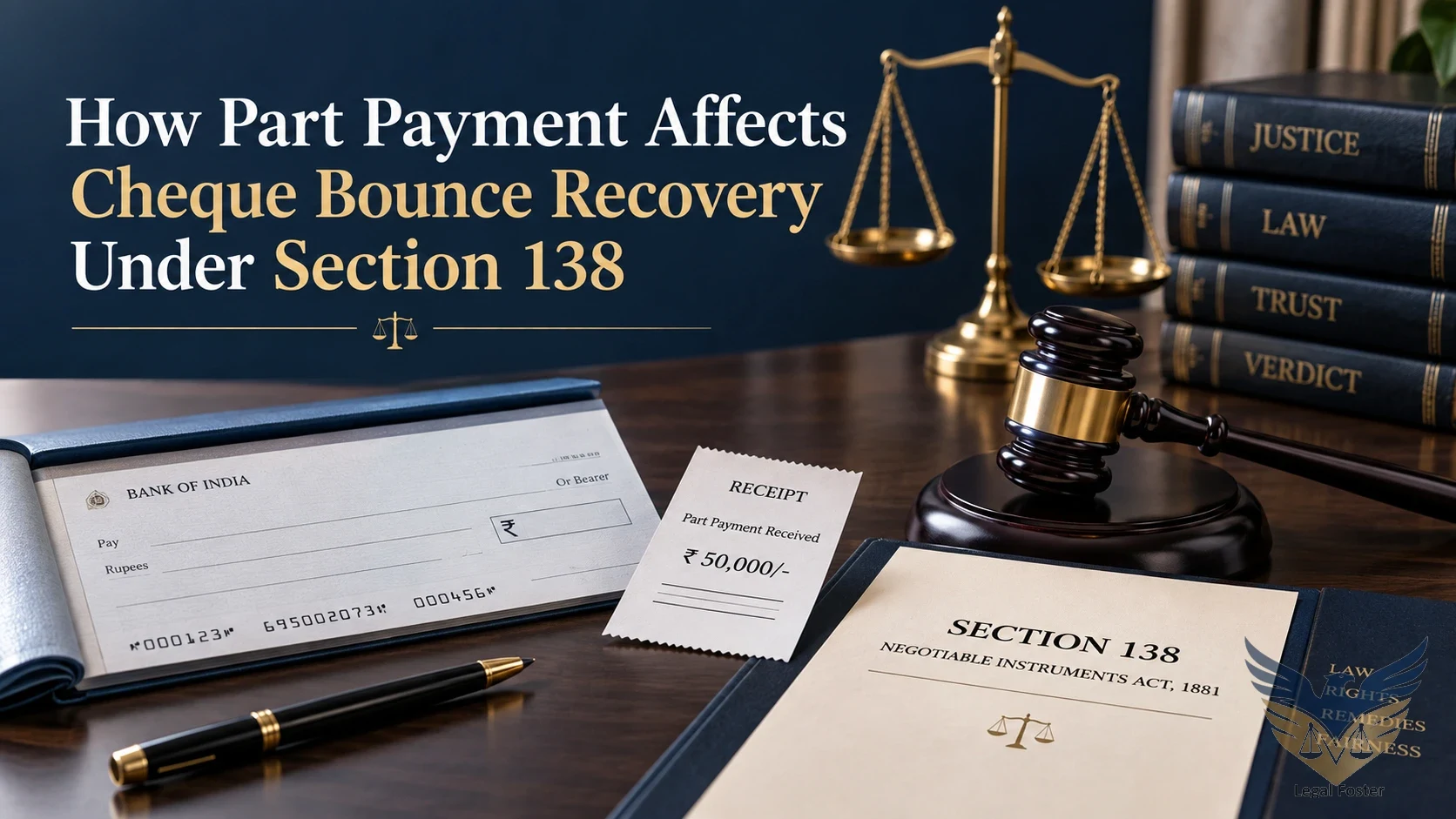
How Does Part Payment by the Accused Affect Cheque Bounce Recovery?
“I’ll lodge an RTI against you” cheque bounced ₹5 lakh. Drawer calls you up saying, “Let me pay ₹25,000 today. I will pay you the remaining amount later. Please cancel your complaint.”
When lakhs are at stake and you have waited for months, even ₹25,000 promise can sound tempting.
Promises can also confuse you. Should you accept it? Will accepting part-amount affect your cheque bounce case? Will the drawer get a ‘get out of jail free’ card because he paid some money? Do you need to give him a receipt? Can you prosecute him for the remainder of the amount under Section 138 NI Act?
You can’t find answers to these questions by reading some commercial law sop which says, “Part-payment allowed”. These depend on timing.
Payment promised or offered before cheque is presented will have completely different implications than a promise made after the cheque has been dishonoured. If a payment is made after the statutory notice is sent, it is treated very differently than a compromise reached when a Section 138 proceeding is pending.
As the cheque given under Section 138 NI Act, 18 81 should be for the discharge any “legally enforceable debt or liability”, Hon’ble Supreime Court has specifically looked into whether a subsequent payment (i.e. after the cheque was issued but before it was presented) negates that requirement.
If you are a complainant wanting to recover your dues, the simplest approach to any settlement offer would be to accept the bona fide amount that has been repaid without accidentally acknowledging a larger amount as not due.
BK Singh Advocate & Cheque Bounce Lawyer will always look at the cheque, Bank return memo, Documents which prove debt, chronology of payments made, Legal notice sent and any compromise being offered along together before telling you how a token amount affects your options.
A ₹10,000 transaction in a ₹10 lakh dispute can be insignificant as money. But legally, it can make a huge difference to your dues depending on WHEN it was made.
Why Does Small Part-Payment Matter in Cheque Bounce Cases?
Section 138 talks about the cheque amount needing to represent a legally enforceable liability “at the time of presentation”.
Here’ what I mean -
Let’ assume that a accused owes X ₹4 lakh and issues them a cheque for ₹4 lakh.
But before they deposit that cheque he pays them ₹50,000 through a bank transfer.
That payment was made as part- payment.
Now the liability outstanding against him becomes ₹3.5 lakh.
They still go and deposit the cheque for ₹4 lakh ( which makes no mention of the ₹50,000 payment)
Then the legal question becomes –-
Does that cheque (for ₹4 lakh ) represent the LEGALLY ENFORCEABLE LIABILITY WHICH EXISTED AT THE TIME OF PRESENTATION (which is now ₹3.5 lakh only)
The SC answered this question (in Dashrathbhai Trikambhai Patel v. Hitesh Mahendrabhai Patel) YES
Yes, IT DID.
The court said that where post-dated part-payment has been made after cheque was drawn but before its presentation then the lesser liability would HAVE TO be accounted for. (pursuant to Section 56 of the NI Act). If an unendorsed cheque is presented for a greater amount, the requirement of Section 138 of the NI Act that the cheque amount represent a legally enforceable debt at the time of presentation may not be satisfied.
Numerous courts have gone back to this question UNTIL VERY RECENTLY (20 26). Recent judgments have confirmed the law that a cheque presented for the entire face value despite admission of part-payment (before presentation) will cause a “death-knell” for prosecution.
Which is why BK Singh Advocate recommends documenting your payment timeline.
Ask FOR THE RECORDS “ WHEN EXACTLY ” was money paid.
"some" money doesn’t help you. "Exact amount" paid at "exact date" helps.
Quick Facts
- 138 would only apply where the cheque is issued in respect of a legally enforceable debt or liability and it is dishonoured subject to the statutory conditions being satisfied.
- Normally, the payee has 30 days from receiving knowledge of dishonour to serve statutory demand notice.
- Drawer has 15 days from receipt of notice to make payment of cheque amount.
- Payment to drawer before presentation may alter the legally enforceable amount represented by the cheque.
- Section 56 appears to permit part-payment to be noted on the instrument and the instrument to be negotiated for the balance.
- Payment of a trivial amount after dishonour does not automatically extinguish cause of action under Section 138.
- Under Section 147 offences under the NI Act are compoundable.
What Does "Part-Payment" Mean in a Cheque Bounce Recovery Case?
By definition Part-payment means payment of part of the outstanding liability.
It can be through bank account, UPI, cash, NEFT, RTGS, cheque or even structured settlement.
The issue is not with the amount being offered as part-payment.
Offenses relating to cheque bounce and part-payment can arise at different stages -
- between the issue of the cheque and its presentation;
- between cheque presentation and the complainant receiving information about the dishonour;
- between the complainant receiving the dishonour information and serving of the statutory notice;
- during the statutory 15 day notice (payment period);
- after cause of action arises;
- after filing of the complaint;
- or at any time during trial, appeal or compromise.
As you can see each situation is different from a legal point of view.
Tell your friend not to paint all part-payment situations with the same brush if he wants to recover funds on bounced cheques. BK Singh Advocate can help you identify which situation you are dealing with before you accept any offer of settlement from the cheque issuer or admit anything to your client about the liability.
Does a Small Payment After the Cheque Bounces Cancel the Case?
Ordinarily an advance after dishonour but only token at best – Does not extinguish offence at time of presentation.
138 offence turns on whether cheque when presented was legally enforceable debt/liability & other statutory requirements are there.
Cheque for Part payment after presentation of cheque & dishonour are two different transactions.
It can reduce what is ultimately payable.
It can be evidence of compromise.
It can have evidential value as to amount of damages.
But does not per se mean that complainant has to let accused off prosecution. Facts matter.
If a cheque is issued for ₹6 lakhs and after dishonour accused says / pays ₹20,000:-" I am paying you now. Don't send notice."
Such a statement is not openended. Complainant can consider it. He is not bound to forego rest of balance straightaway. He can consider the statutory period & balance due.
BK Singh Advocate Will advise if it makes any difference to your demand / compromise position / procedure.
Can an Accused Use a Token Payment to Delay the Complainant?
Sometimes ₹5K or ₹10K IS the first instalment of payment towards settlement.
Sometimes it is an oral promise to allow time.
Courts will NOT assume that because there has been a transfer of ₹5,000/- or ₹10,000/- that the settlement deal is concluded.
The Courts have to ask if the parties agreed to settle terms.
Is it proven the parties settled their dispute?
- Did the parties reduce their "Settlement" to writing ?
- How much TOTAL LIABILITY was admitted ?
- Was the ₹5K or ₹10K referred to as an instalment of that liability ?
- Were future dates for payments agreed ?
- Was withdrawal of complaint strictly SUBJECT to full payment ?
- Did the complainant say he will "compound tomorrow" ?
Does the settlement document specify what happens on default ?
"I will pay slowly. Love. ", in a Whats App message, does not amount to the same thing as executing a recorded and bona fide settlement.
BK Singh Advocate suggests we make it VERY CLEAR that taking money and a full- and- final settlement are TWO VERY DIFFERENT things.
Can the Complainant Accept Part-Payment Without Withdrawing the Case?
You can demand payment on account. (But insure that the legal consequence is documented.)
Receipt of money does not imply acceptance of accused’ s condition that he wants “matter settled”.
Complainant can deposit part of what is admitted as due and prosecute for balance sum still due.
Cheque’s cover letter may become critical evidence.
E.g. Accused issues cheque for ₹50,000 against demand of ₹5 lakh and accompanies it with a note saying
“Consider this amount as paid towards full and final settlement.”
If you are not agreeing to this condition, then silence at this stage can cause factual disputes later that can easily be avoided.
Sending a reply in writing that said amount is being accepted as part satisfaction towards outstanding demand will remove any doubts.
Sound pleasantly. Don’t have to be brutal.
Just be clear.
BK Singh Advocate will prepare such receipt notes which enable you to take the money without conveying any unintended meanings about demand or compromise.
Should the Complainant Give a Receipt for Part-Payment?
Yes partial payment needs to be acknowledged..
- However, be careful with your wordings while acknowledging.
- You can send a receipt stating :
- "Received ₹25,000 towards outstanding dues." .
- which is completely different than stating,
- "Received ₹25,000 as a complete/full and final settlement." .
- Don't use the latter if that was not the case.
- Your ledger posting should also match Bank statements and settlement notes..
- Sending unclear accounting will weaken your stance.
If the other party later contests that ₹25,000 was accepted as complete settlement , your written documents will come handy. BK Singh Advocate Might want to proof read settlement wording if a large cheque bounce case is being settled by receiving payments in instalments.
Can a Small Payment Be Used as Evidence of Liability?
Voluntary part-payment. Voluntary part-payment may be applicable depending on the facts. Voluntary part payment is not conclusive evidence. It can be used to prove you admit that you owe some amount.
- Except that it's not conclusive evidence of every allegation by the complainant.
- The defense can argue that they were paying for something else.
- You could have multiple invoices with a company.
- Friends and family can have numerous financial dealings.
That's why Part-payment references are valuable. Bank narration, text messages, settlement emails, and bank statements can all link a payment to the purported debt. The judge will not infer. Prove it.
Which Documents Become Important After Part-Payment?
Please do not destroy the record of all payments made. Keep all proof including bounced cheque.
Keep the following: (Proof related)
- cheque or an e-cheque which satisfies legal requirements;
- return memo by the bank;
- loan agreement/statements of account/invoices or any evidence of consideration;
- pass book extract/bank statement where first consideration was credited/debited;
- statutory demand if sent;
- posting/presentation/courier/email (as the case may be) evidence;
- reply from the offender;
- proof of UPI/NEFT/RTGS/bank-transfer of part-payment (if any);
- WhatsApp/email chats;
- compromise settlements received;
- account sales;
- receipts issued for instalments paid; and
- worksheet showing balance amount calculation.
In case a Firm is filing complaint, power- of authority docs and company documents are required as well.
Important to keep the clean documents especially if you receive payment by instalments.
What Should the Complainant Avoid Doing?
You should NOT refuse to accept payment when it is credited to your bank account.
You should NOT persist with a suit for specific performance/payments upon original demand and not account for payments received by adjusting them as required by law.
You should NOT encash an old cheque, mechanically just because you received a large amount before presentation. (Read Sec 56 and Judgement of SC)
"Don'ts" agree to "full and final settlement" when you are not willing to settle fully and finally.
"Don'ts" agree orally that you will withdraw your case just because you have received one instalment.
"Don'ts" allow the claim to become time barred while discussing an out-of-court settlement.
DON'T COMPROMISE YOURSELF DOWN BY MISINTERPRETING YOUR COMPROMISE NEGOTIATIONS AS A RELINQUISHMENT OF YOUR RIGHTS.
Being professional in your settlement negotiations, there is no "don't" in being polite and courteous.
When Should You Consult a Cheque Bounce Lawyer?
Professional review can be beneficial where:
- prior payment has been made by the accused;
- the cheque has previously bounced and token payment is being made;
- the statutory period is almost expired;
- there are several part payments;
- payment is made for numerous invoices;
- the accused wants an immediate discontinuance for a small instalment;
- a deed of settlement is proposed;
- the accused is disputing the application of payment;
- the client is a company or partnership;
- more than one cheque is at issue;
- the drawer is claiming that the cheque was delivered as security; or
- consideration of civil recovery is required.
Allow BK Singh Advocate to review the whole transaction prior to you having to make a decision on recovery based on incomplete information.
How Can Cheque Bounce Lawyer Help?
Dealing with cheque bounce for individuals/firms. Cheque Bounce Lawyer handles you or your client for all matters relating to cheque bounces. From the statutory notices, reviewing documents, queries regarding settlement and 138 proceedings.
Why is advising on part-payments complicated?
The timing of part payments can change the legal stance drastically.
BK Singh Advocate will firstly classify if the payment was made-
Prior to presentation.
Post dishonour.
During the proceedings.
We then assess the underlying liability.
Invoices, Loan agreements, bank statements, messages, acknowledgements and correspondence around any settlement will now become extremely important.
Cheque Bounce Lawyer will explain the difference between cheque bounce legalities and civil recovery if more than one cheque has been issued.
Civil recovery is a matter that needs to be reviewed independently. Work out what documentation you have and also the limitation stance.
Declining payments as you have a cause of action is not the goal.
Accepting payments & budgeting wisely. Collecting what is owed to you.
Not the destroying a valid claim with bad evidence.
Frequently Asked Questions
Frequently Asked Questions About Cheque Bounce Cases
1. Can I accept part-payment from the accused?
Yes. The timing of the payment is critical. Where payment is received from the accused prior to presentation of the cheque to the bank for payment, this is dealt with differently under Section 56 and Section 138, than if payment is received after the cheque is dishonoured. BK Singh Advocate can assist you in reviewing when money was received from the accused and how best to word how much balance is owed.
2. Does accepting ₹10,000 from the accused extinguish the Section 138 Case?
No. Just because the accused has paid you ₹10,000 does not mean that the liability is extinguished or compounded. Whether proceedings continue against the accused will depend on how much money is left outstanding, the stage which the statutory process has reached and any agreement entered into by the parties.
3. What if I received part-payment from the accused but the cheque wasn’t deposited yet?
You will need to be cautious in this situation. If part of the overall liability was discharged by the accused prior to presentation of the cheque to the bank, but the cheque provided by the accused for the remainder was not given for a legally enforceable debt when it was presented to the bank, then Section 56 will override Section 138. Refer to this decision of the Supreme Court.
4. The accused sends me a cheque for ₹10,000, after I’ve already sent the statutory demand for ₹2 lakh. Now what?
Because the accused has paid you only a small amount of the total statutory demand, it will not be assumed that the whole statutory demand was paid. Accept that payment was made towards the demand and adjust the balance of the money claimed to reflect the remainder of the original cheque amount. BK Singh Advocate will be able to review the evidence provided by the parties and give you advice on the effect that part-payment will have on your claim based on when the payment was made and what was stated in the statutory notice.
5. Do I have to provide a receipt if I accept part-payment of the cheque amount?
If you receive money, it is always good practice to provide a receipt in exchange. However if you write on the receipt that the payment is made in “payment in full and final settlement”, this could cause you issues if you try to recover the balance later on. Instead, ensure that the receipt issued accurately explains what has occurred. If only a part- payment was made by the accused towards the total amount owed, simply state this on the receipt.
6. The accused has paid me the first instalment. Can he/ she now ask me to drop the case against him/her?
Yes, the accused can ask you to let him off this wrongful act. However you cannot be forced to drop the complaint against the accused just because he has paid the first instalment. Deciding whether to allow a withdrawal or compounding of an offence should be linked to the facts of what occurred and how far the proceedings have progressed.
7. Can I compound the proceedings under Section 138?
Yes. Section 147 of NI Act states that offences which are punishable by the NI Act are compoundable. If the parties have reached a settlement, it is vital that the terms are recorded correctly so that there is no misunderstanding about whether anything remains to be paid.
8. Will accepting part-payment help me prove that the accused has acknowledged his liability?
Acceptance of part-payment could be used as evidence against the accused. However part-payment of the cheque will not alone be enough to prove your case. You will need to prove that the payment received was linked to the account or liability you refer to in your notice. Messages, emails or account book entries can help you prove this link.
9. Can I file a civil recovery suit for the balance amount?
Whether you can file a civil recovery suit depends on several factors including the facts surrounding the transaction, limitation period, your documents and what remedy you intend to recover. Civil recovery suits and Section 138 proceedings can operate side-by-side. You should consider sending a civil demand or filing a civil recovery suit in court based on your individual facts. They are separate legal processes and should not be viewed as alternatives to one another.
10. When should I speak to BK Singh Advocate?
If any of the above situations apply to your case, you should speak to BK Singh Advocate. We can help you review your documents and provide specific advice based on when money was paid and what was stated in your statutory demand.
Final Thoughts
Don’t lose heart because the accused is making you a plaintive waiting for money with promises of a token first instalment. But what the complainant ought to know is what legal effect acceptance of that money would have. Sometimes the critical question is not how much has been paid, but when.
Did a payment made before presentation change the nature of the legal liability which the cheque acknowledges? Did a pre- presentation payment change the jurisdiction of the court? Dashrathbhai, which the Supreme Court decided last week, makes this issue dicey indeed. Did a payment made after dishonour change the legal position? Clearly. Did a payment made during the statutory notice period change anything? Again clearly. Did a compromise effected during the pendency of the case change anything? For this reason I like to place transactions on a neat timeline: