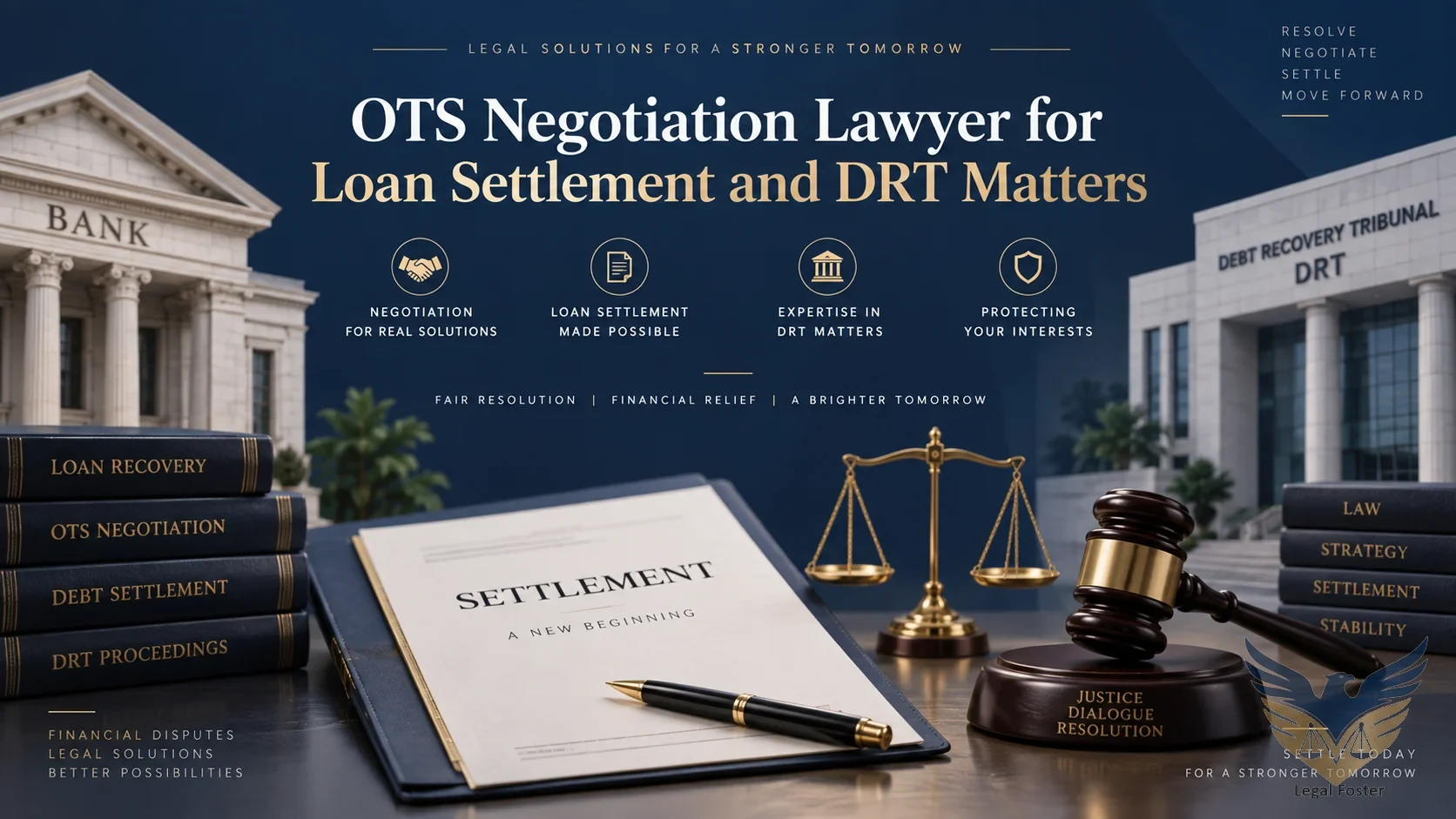
How Courts Approach OTS Negotiations in Loan Settlement Cases
One Time Settlement (OTS) works if you have been asked by your bank or financial institution to repay a big loan. The goal is to settle a stressed account. But an OTS is NOT a legal right. You cannot justifiably assume that if you wave some lower amount in front of the lender, they will happily agree.
Being a borrower in Delhi NCR, Delhi, Noida, Greater Noida, Ghaziabad, Gurugram, Faridabad or anywhere else in India the question becomes slightly different: How do you legally analyse, document & negotiate an OTS where recovery has already started or is about to start?
BK Singh and his team of experienced DRT Advocates work with borrowers to help you understand your legal standing before entering into important settlement negotiations. The focus is not just on negotiating with the bank for a discount. Rather, we look at the loan documents, stage of recovery, securities provided, any pending proceedings etc. and negotiate the terms on the table.
OTS could potentially be considered by the lender as part of a compromise settlement. RBI has put out the 20.23 framework on compromise settlements defining it as “a negotiated agreement for the resolution of a regulated entity’s claim against a borrower by acceptance of payment in cash towards full and final settlement subject to the lender having a board approved policy for the same and in compliance with applicable laws.”
BIG if indeed.
While you might be facing stress due to money problems, family pressure, business losses or any liquidity crisis. The lender is going to look at your settlement offer from the perspective of its internal policies as well as the merits of your account. A legal counsellor can help you understand the terms you are agreeing to before you sign on the dotted line or handover money on an OTS.
Why Should You Take OTS Negotiation Seriously in 2026?
OTS discussion can get further complicated if the loan account has already gone into heavy default or become an NPA or has entered into the adjudication process for recovery. You as a borrower are likely to be already receiving notices/demands/communications regarding the outstanding dues.
In case of secured lending, proceedings under SARFAESI Act, 2002 may also have become initiated against the borrower/ guarantor. In cases where debt recovery proceedings are already pending in a judicial forum any compromise would first need the approval of that forum. RBI’ s compromise- settlement guidelines specifically deal with such cases.
If you are a borrower located in Delhi NCR or anywhere else in India, there are few more questions that run through your mind at this stage:-
OTS Discussion
1. What does a lender's loan compromise offer mean in practical terms and what are the checks that need to be done before accepting the same?
How DRT Advocates can help you at this stage as well so that you know EXACTLY what you are agreeing to when you sign on the dotted line and not make decisions because you are pressured to clear the dues.
What Are the Quick Facts About OTS Negotiation?
- OTS stands for One-Time Settlement.
- It is a settlement agreed upon usually after negotiation between borrower and lender.
- OTS cannot be asked for by every borrower as if it is his/her right.
- The lender has to approve the OTS.
- Generally the internal policy on settlement may differ from case to case.
- On June 08, 20,RBI released its Framework for Compromise Settlements and Technical Write- offs.
- This Framework would apply to all regulated entities mentioned in the framework.
- One of the characteristics of a compromise settlement is that in a compromise settlement , lender has to give up something of its claim.
- Terms and conditions of the settlement have to be put down on paper in proper format.
- OTS is different from the normal closure of loan.
What Does OTS Negotiation Actually Mean?
OTS negotiation means negotiating with the lender to settle all outstanding dues of the loan on a one-time payment basis, where terms are mutually agreed upon and subject to lender’settlement approval, policy and law.
Sounds simple enough. What happens next isn’t.
OTS is a legal-financial document that will encompass topics including but not limited to principal, interest, charges, security, guarantees, pending proceedings against the borrower and even the manner and timelines of payment. For this reason, when a borrower enters into an OTS negotiation, he needs to look beyond the quoted X amount.
For e.g. An OTS offer might say that you can settle an account by paying X amount. But look closer. There may be fine print on when that amount must be paid, what penalties will be incurred if you default on terms of the offer, what happens with release of security or other key details.
Professional eyes can see these things.
We, and Advocate BK Singh can guide our clients through the intricacies of OTS negotiations. At DRT Advocates, we can help you see if the document you are thinking of signing is really what you want to sign.
What Legal Framework Applies to OTS Settlement in India?
Depends on the lender, loan type, type of security and the stage of recovery process.
Since you have mentioned SARFAESI Act, please note that RBI Framework for Compromise Settlements and Technical Write-offs released on June 08, 2023 mandates regulated entities (which fall under its scope) to have board approved policies on compromises settlements. It mentions details on approval authority, valuation of security etc.
A compromise settlement as mentioned in that framework would be distinct from a technical write off. And a technical write off itself wouldn't mean that the borrower's liability is written off.
If there are secured assets, SARFAESI Act, 2002 would come into the picture. If there are recovery proceedings already initiated before Debt Recovery Tribunal (DRT), status quo of those proceedings would also need to be examined.
Debt Recovery Tribunals act refers to the recovery of debts due to banks and financial institutions. It was enacted by The Recovery of Debts and Bankruptcy Act, 1993.
Hence the OTS discussion should be done in light of the underlying recovery issue.
Who Should Consider Professional OTS Assistance?
Are you a Personal borrower with high ticket loans pending against you?
Are you a small business owner who can’t keep up with your working- capital / business loan payments?
Has your account been classified stressed or NPA already?
Have you begun to receive recovery/SARFAESI notices?
Does your bank want to settle and you aren’t sure what paperwork is needed?
Have you already consulted/ heard about DRT concerning your matter?
Do you have a secured loan against property/ mortgage or some asset at risk?
Advocate BK Singh and his team at Legals365 can assist borrowers who wish to get a second opinion before taking any crucial decision about settlement. We, DRT Advocates have managed cases from the start until the Appellate tribunal.
What Does the OTS Legal Assistance Process Look Like?
“What Happens During The First Legal Review?” Well you guessed it. Reviewing what’s really going on in the account. Loan documents, statements, notices, correspondence, securities documents and prior settlement discussion all can be reviewed. The goal is not to overwhelm the borrower with legal speak. It’s the opposite. We want to figure out what’s really going on. Attorney BK Singh will review those documents that will actually matter when it comes to settling this debt.
Once we review the relevant documents what’s next?
Now we need to figure out where this debt stands in the recovery process. Debt that’s in the early stages of discussion will require a different approach than one where a demand for payment/recovery has been sent or securities enforcement proceedings have already been initiated. Once we figure this out we can review the proposed OTS with this newly understood piece of the puzzle. “How can legal counsel help when negotiating an OTS?”
If your attorney does nothing more than allow the borrower to understand the legal implications of the proposal, spot those conditions that matter most and negotiate with the lender at the appropriate time, legal counsel can add substantial value. The objective is to reach an agreement that is transparent. Not litigated. not full of promises. And definitely not some “xxx” dollar amount we can “guarantee” you.
What Documents Should You Keep Ready for an OTS Consultation?
A borrower must have ready access to typically following documents:
- Loan sanction letter & loan agreement
- Most recent loan statement
- Past history of repayment
- Letters of default/demand notices
- NPA notices, if any.
- Letters/S Notices issued u/s SARFAESI, if any.
- DRT proceedings, if any.
- Current OTS or settlement offer.
- Security/Mortgage deeds.
- Guarantee/GUARD deed.
- Correspondence with the lender, which might be useful.
- Bank statements or other documents that establish your ability to repay.
- Evidence of payments made till date.
- Any past settlement letter, if any.
Documents to be focused upon can be suggested by DRT Lawyers after going through the documents.
Why Should You Hire DRT Advocates and Advocate BK Singh?
Engaging Professionals doesn’t mean that you outsource someone to write a letter to the bank.
At DRT Advocates (the Legal services of Legals365 and Advocate BK Singh), we understand that loan recovery and settlements have a legal side to it. This side starts with understanding your facts on the ground, instead of making false promises of settlement.
Why engage Professionals for OTS
Documents review: Loan and settlement related documents can be reviewed prior to you making any heavy decisions.
Recovery stage analysis: Legal position can be assessed when you start getting notices, SARFAESI action or DRT proceedings (if any).
OTS Communication with bank: We will handle talking to the bank the right way.
Terms explained to clients: Clients understand what matters to them and we don’t overload them with meaningless legal jargon.
Security review: If there is property or any other security provided by you, we can review those documents as well.
OTS Planning: Loan settlement documents, payoff terms and post payoff requirements can be planned out in a realistic manner.
No false promises: We don’t advertise OTS as some magical percentage discount or guarantee quick settlement.
OTR Consultation with Advocate BK Singh will start with knowing about your account and discussing your alternatives. Based in India and serving clients in Delhi NCR (Noida, Greater Noida, Ghaziabad, Delhi, Gurugram, Faridabad), we know the ins and outs of bank offices here.
As mentioned on our What We Do page, DRT Advocates offers DRT Advocacy for loan recovery, NPA/SARFAESI actions, and loan settlements.
Frequently Asked Questions About OTS Negotiation
Is OTS a right of the borrower?
No. OTS is not an automatic right of a borrower and is typically a matter for negotiation with the lender. The lender will consider such proposal having regard to its policy as applicable to the account, the circumstances and any applicable regulatory guidelines. DRT Advocates can assist a borrower in determining whether the proposed settlement is commercially and legally acceptable to them prior to agreeing.
Can a bank refuse an OTS?
Yes. Just as a borrower can request or negotiate a settlement with the lender, the lender is under no obligation to accept it. A lender may consider all relevant factors including the account, the security, the prospects of recovery and its own internal policy on settlements. Under the RBI framework on compromise settlements published from time to time, regulated entities to whom it applies are required to have a board approved policy for dealing with settlements. Advocate BK Singh can review the circumstances prior to a borrower committing to any course of action.
Is OTS closure of loan?
OTS is not commonly referred to as loan closure. Settling an account may result in closure of the account but loan closure more commonly refers to the repayment of the contractual obligations under the loan. An OTS results in the account being settled on agreed terms. The borrower should ensure that they are comfortable with how the lender will report the account and what documentation the lender will provide on fulfilment of the settlement terms. DRT Advocates can review the proposed terms of the settlement and any associated documents prior to settlement being accepted.
Can we negotiate OTS after receiving SARFAESI notice?
A borrower can always discuss a settlement with the lender even after recovery action has commenced. However, a borrower should not expect that simply by entering into negotiations that the statutory process will be postponed or halted. That will depend on the specific facts and how far the process has progressed. Advocate BK Singh can review the notice and loan documents as well as any proposed OTS to explain the legal options.
Can we think of OTS after DRT case is filed by bank?
Where proceedings have been filed by a lender before the Debt Recovery Tribunal (“DRT”) in respect of recovery of debt, it may still be possible to settle the account. However, there are legal and procedural requirements that must be complied with. As mentioned in the RBI Guidance on Compromise Settlements, in respect of cases where recovery/ prosecution proceedings are pending before any judicial or quasi judicial forum, the settlement would be subject to obtaining the consent decree or such equivalent judicial action, if required.
Is there any fixed percentage for OTS?
No. Just as every borrower is unique and every loan is different, there is no standard settlement percentage that lenders will accept across all types of loans. They have their own policies and will consider all of the facts relevant to the account including value of security, prospects of recovery, regulatory directives (if any) etc when considering a settlement proposal. Any website or individual telling you they can get your lender to accept a fixed percentage without reviewing the details of your account should be treated with caution. Advocate BK Singh can advise you on all of the factors that may apply to your particular situation.
What are the documents required for OTS consulting?
There is no set list of documents required for consulting on a potential OTS. Useful documents to begin reviewing include: the loan agreement, account statement and/or loan history, any demand notices received, terms of the proposed settlement, any documents related to security/guarantees provided, receipts of any payments made and any letters or correspondence from either the lender or borrower related to the account. There may be other documents that we would require depending on the specific facts. DRT advocates can help you identify key documents after performing an initial review of what you have available.
Will OTS affect the credit history of the borrower?
OTS results in settlement with the lender. How the lender reports the settled account to various credit reporting agencies/aggregators may impact your future credit history and ability to borrow. Borrowers should understand this implication before agreeing to an OTS. Advocate BK Singh can advise you on both the legal and documentation issues surrounding an OTS proposal. How the lender or bank reports the matter to credit agencies is at their discretion and would be subject to applicable regulations on credit reporting.
Can an advocate guarantee that a bank will accept OTS?
No reliable advocate will guarantee this. Whether a settlement can be agreed upon will depend on a number of factors including the decision of the lender. DRT Advocates can provide professional advice on reviewing relevant loan documents, preparing an OTS offer and negotiating with the lender on behalf of our clients if required. Ultimately, the decision to accept or reject a settlement offer will remain with the lender.
Why DRT Advocates/ BK Singh?
DRT advocates and Advocate BK Singh focus on providing borrowers with information on their options when it comes to loan-recovery or settlement. We strive to provide borrowers with a clear understanding of their legal position before making any decisions. This can include reviewing loan documents, analysing any actions taken by the lender to recover the loan, reviewing potential settlement documents and professionally communicating with the lender on behalf of the borrower if required. We don’t make promises we can’t keep. We aim to provide you with an understanding of your legal position.
Why Choose Legals365 For OTS Legal Assistance?
When most people engage a lawyer or advocate it is never at a good time. Either they are constantly being harangued for repayment, their business is undergoing a cash- flow crisis, their property is being attached or a notice has been received / they don’t know what the bank can do next.
Legals365 understand that and that is why we have partnered with DRT Advocates and Advocate BK Singh to provide professional assistance with these types of loan related legal issues. Its simple advice that aims to protect your legal rights.
Final Thoughts
OTS negotiation is not limited to discussions on slashing of loan amounts.
OTS can encompass bank policy, settlement documentation, security / recovery suit issues, DRT matters, SARFAESI proceedings,timing of payment and post settlement consequences.
It is important that a borrower understands these issues prior to agreeing to material terms.
OTS experts such as DRT Advocates and Advocate BK Singh can guide your clients through OTS issues with proper legal insight rather than conjecture or false hope.
Received an OTS letter from your bank?Filed against in a recovery suit?Not sure who to turn to next?
Seek legal counsel before you affix your signature on that dotted line or send in a hefty payment.
Contact Legals365 and Advocate BK Singh for OTS Negotiation and DRT legal assistance.