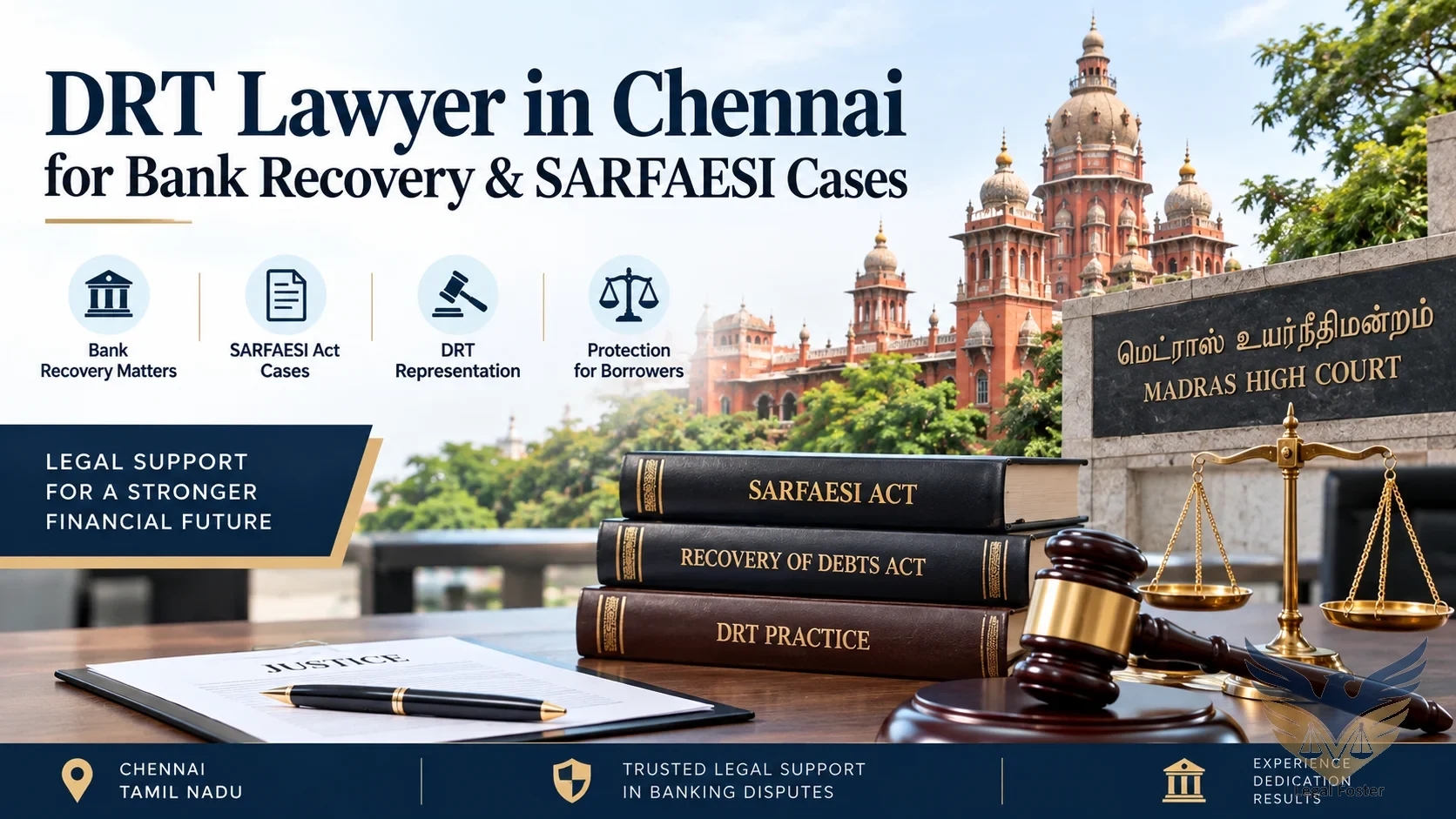
DRT Lawyer in Chennai: Legal Remedies in Bank Recovery Cases
You go to bed as a borrower with defaulted installments and wake up to a notice from the bank for recovery of dues. Overnight, a bank recovery notice can change sides. One day your borrower has defaulted on a few EMIs due to lower business profits, delayed receivables from his customers, higher medical expenses or some other temporary liquidity crisis. Suddenly, the next day you find yourself facing a demand notice, possession notice, recovery proceeding or auction notice being sent to you.
If you are searching for a DRT Lawyer in Chennai right now, your first question will probably be simple – what can be done to stop before the recovery turns into high financial or asset losses that cannot be recovered?
Under The Recovery of Debts Due to Banks and Financial Institutions Act, 1993 (famously called RDDBFI Act or recently renamed as Recovery of Debts and Bankruptcy Act), Debt Recovery Tribunals have jurisdiction to entertain applications by banks and financial institutions for recovery of debts covered under its scope. In addition, The Securitisation and Reconstruction of Financial Assets and Enforcement of Security Interest Act, 2002 (SARFAESI ACT) enables enforcement of security interest by secured creditors and provides a recourse before DRT for certain proceedings initiated under that Act.
Acting at the right time is crucial if you are a borrower, guarantor, property owner or a business operating in and around Chennai. You might have very few practical options by the time the auction date is looming over you. But taking the help of a lawyer when that first notice for recovery of huge amounts lands in your mailbox may help you. BK Singh Advocate has handled clients ranging from borrowers, guarantors, MSMEs to companies and individuals from across India for DRT, DRAT, SARFAESI and bank recovery matters.
Our strategy always begins with analysis of the documents and facts of the situation at the stage of recovery instead of speculating what the bank can or cannot do.
Why DRT and Bank Recovery Issues Matter in Chennai in 2026
With one of the largest pool of salaried borrowers, property owners, manufacturers, traders, professionals, startups and MSME’s in India, Chennai witnesses recovery cases concerning both residential and commercial properties, factory premises, plant and machinery, business accounts, guarantees and outstanding working capital loans.
Moreover, the facts and history of a recovery dispute are often complicated further by claims such as the borrower disputing the amount claimed to be outstanding, non-updates of payments made, defects in documents providing security, notices being overlooked or the lender initiating recovery at a later stage than allowed.
With these facets in mind, a well informed DRT Lawyer in Chennai will be able to review the original documents quickly and understand whether the matter concerns a DRT recovery suit, SARFAESI type proceeding, appeal against a DRT order, auction matter, liability of guarantor, or if there is a possibility of discussing an amicable settlement.
Additionally, borrowers should be aware that merely filing a suit will not stop the recovery process in Chennai. Interim relief is not available as of right on the mere filing of a suit. The borrower has to pray for the relief he deserves and his prayer is examined in light of statute and facts.
BK Singh Advocate can review your recovery timeline and highlight where a particular legal forum and remedy can be sought. This is crucial in cases where loss of possession/auction is nearby.
Quick Facts About DRT Bank Recovery
- Proceedings before the Statutory DRTs are covered under Recovery of Debts and Bankruptcy Act, 1993.
- Section 17 of the RDB Act speaks about jurisdiction , powers and authority of the DRT on covered debts recovery applications.
- Appeal before DRT is statutorily provided for certain actions initiated under Section 13(4) SARFAESI Act.
- Issuance of SARFAESI demand notice under Section 13(2) and subsequent enforcement action have different legal consequences.
- Accounts related to possession/auction disputes shall be considered only on merits of the notices issued, dates, the security document and recovery action initiated. Initiating a proceeding does not in itself confer any right to stay of possession/auction/recovery.
- OTS or Settlement is largely a commercial decision which is arrived at by the lender on the basis of the facts of the account.
- Appeal before DRAT is distinguishable from proceeding before DRT and has to be examined with reference to the statute under which it is provided.
What Does a DRT Lawyer in Chennai Actually Handle
DRT Lawyer – Lawyers practicing law in Debt Recovery Tribunal which means a lawyer who handles cases arising out of bank/recovery from a financial institution before the Debt Recovery Tribunal established under the statute conferring jurisdiction upon the DRT. Simply
A DRT lawyer handles DRT defence, SARFAESI cases, possession disputes, auction disputes, guarantor liability, recovery suits, interim relief from attachments or any other remedy including settlement negotiations and appeals if necessary.
The bank can file recovery suit against the borrower under SARFAESI act. SARFAESI refers to action taken by secured creditor against secured asset. Recovery can also be initiated against the guarantor. Guarantor can be proceeded against separately from the borrower/customer who took the facility.
Lawyer will have to analyze whether money is payable and go through the loan documents, understand the nature of security, account notes, payments made, correspondence and what is the current procedural position.
Analyzes loan documents and advises client on appropriate remedy under relevant statute. See this website’s DRT Loan Recovery Service page for more information on how BK Singh Advocate can help with DRT lawsuits, SARFAESI actions, Asset Disputes, Guarantor Liability, Possession and Auction Disputes.
Visit this website’s DRT Lawyer page to learn about legal options from a DRT lawyer.
Can Loan Settlement or OTS Still Be Considered
A DRT lawyer is concerned with any matter which arises out of bank/recovery from a financial institution and which is subject to statute that confers jurisdiction upon the Debt Recovery Tribunal ("DRT").
Meaning a DRT lawyer handles DRT defence, SARFAESI disputes, Possession Disputes, Auction Disputes, Guarantor Liability, Recovery Suits, Interim Relief or other remedy, settlement, negotiation and Appeals based on the circumstances surrounding the matter.
The bank can initiate a recovery suit against the borrower. SARFAESI involves an action taken by a secured creditor against a secured asset. A Guarantor can even be tackled separately from the borrower, who took the loan.
The lawyer must assess whether any money is owed, but must also analyze the loan documents, understand what security was provided, read the account notes, know what payments were made, sift through correspondence and know what procedural posture the matter is currently in.
Advocate BK Singh will review what documents are available and pinpoint the remedy available under the relevant statute. This website covers the services a lawyer can provide under our DRT Loan Recovery Service page. Here you will learn the lawyer can assist in any matter that involves DRT litigation, SARFAESI, Asset disputes, Guarantor Liability, Possession disputes and Auction Disputes.
Visit BK Singh – Debt Recovery Tribunal Lawyer page to learn general information about legal representation from a DRT Lawyer.
What Documents Should You Give a DRT Lawyer
Good advice starts with good records. Borrowers have typically only brought the most recent notice with them. Older documents get left behind at home. That can hide what really happened.
Here provides a non-exclusive list of what can be helpful:
- Loan sanction letter and loan agreement
- Statement of loan account
- EMI or repayment records
- Bank correspondence
- SARFAESI demand notice, if any
- Notice of possession
- Notice of auction/ sale
- Mortgage/ securities documents
- Guarantee document
- Hypothecation document
- Copies of any replies / representations sent to bank
- Settlement/OTS proposal sent
- DRT pleadings/orders, if a case has already been filed
- DRAT order, if appeal has been filed
- Property title documents
- Proof of payments / disputed credits
Nothing herein should be considered exhaustive. The documents you need vary with the facts. For example, if the borrower is running a business, you might want their books of accounts, records of how the recovery action is affecting the business, and so on.
BK Singh Advocate recommends doing a document based rather than narrative based assessment. i.e. listen to the borrowers version less. The lawyers’ page on Bank Loan Recovery Consultation recommends notices, loan agreements, account statements, guarantees/mortgages and possession/auction papers.
When Should You Consult a DRT Lawyer
Seek legal advice if notice states a date of compliance with Act (Statute) or law under which notice has been issued to you or notice specifies recovery of secured property
Seek advice if :
- Notice has been received from DRT OR a recovery application has been filed against you.
- You have received Notice under SARFAESI Act demand.
- Notice of possession
- Notice of auction/ Sale
- Bank’ calculation of outstanding appears inaccurate.
- Payments are missing in your account statement.
- Guarantor has received a recovery application .
- Mortgaged property has more than one owner/legal heir or ownership is disputed.
- DRT has passed an order against you.
- DRAT Appeal is imminent.
- Working out a Settlement along with the pending process.
Getting advice at a very early stage doesn’t necessarily mean quick withdrawal from the situation. However it does mean all the papers and deadlines can be looked over before the situation escalates.
BK Singh Advocate can review what paper you received and determine whether it appears your issue is with DRT process, SARFAESI notice, appeal, settlement or completely different issue. If you are a borrower from Chennai please reach out.
How DRT Lawyer Can Help
Services listed on the homepage of DRT Lawyer include DRT case defence , SARFAESI Section 17 cases , DRT auction & sale objection and DRT stay/interim relief .
The site reads that the service is not limited to borrowers only. Depending on the nature of the transaction, guarantors, mortgagors, owners of property, companies and MSME’s can also be impacted by a recovery action.
As a general example a consultation would include finding who the lender is, what type of facility was given, what security was created (if any), what is the claim outstanding, what notice was served and we would get to know what stage of proceedings we are currently at.
Clarification on what document was served would be made. Different legal options would be explained as would timelines. Figuring out whether a settlement or defence via litigation needs to be considered.
BK Singh Advocate helps with cases from outside of Delhi NCR when possible depending on the jurisdiction and facts. One of their resource pages notes that DRT and SARFAESI work is handled on cases from all over India, even highlighting Chennai.
They explain DRT proceedings and how they can help borrowers facing an Original Application via their OA proceedings DRT legal service.
Frequently Asked Questions
Got Questions about Debt Recovery Tribunal (DRT)? Ask BK Singh Advocate
Debt Recovery Tribunal: FAQs about filing cases, lawyers & legal options in Chennai
1. Who is a DRT Lawyer in Chennai?
A DRT lawyer is specialised lawyer who appears for cases before Debt Recovery Tribunal and related banking, debt recovery and SARFAESI disputes. Correct forum and remedy would depend upon facts and nature of the case.
2. Should I contact a DRT lawyer after receiving bank recovery notice?
Yes. Your lawyer can look at the notice, loan documents, account statement and past recovery efforts to see what legal remedies might be available. BK Singh Advocate can help you understand bank recovery and Debt Recovery Tribunal issues based upon your documents and applicable law.
3. Can borrower approach DRT against SARFAESI?
Yes. Section 17 provides for remedy against certain actions taken u/s 13(4) of SARFAESI ACT before Debt Recovery Tribunal. However, the nature of remedy would depend upon facts and action taken.
4. Will DRT prevent bank auction?
Tribunal can provide interim relief if facts and law entitle you to the same. Mere filing of case will not stop auction. Stay, if granted would depend on terms of order passed by Tribunal.
5. Can a possession notice be challenged?
Notice of possession can be reviewed along with SARFAESI action taken, security documents, procedural/statutory requirements and nature of subsequent proceedings. It might be possible to see if there is any statutory remedy after examining the notice.
You can consult a DRT Lawyer in Chennai to understand rights after receiving a possession notice better.
6. What should I do after receiving SARFAESI demand notice?
You can’t ignore a SARFAESI Demand Notice issued u/s 13(2). Creditor sends statutory demand notice during recovery process. You can understand the demanded amount, refer to account records and see if notice tallies.
7. Can bank forcefully occupy mortgaged property?
Yes. Secured creditor can enforce its security interest if it is proceeding in terms with SARFAESI Act. Procedure and legal standing would vary based on type of security, notices and action initiated.
8. Can guarantor consult DRT lawyer?
Guarantor can consult a lawyer when action is being taken against him in relation to guarantee or the property mortgaged to secure the facility. Notably, the guarantee and loan agreement would have to be reviewed.
9. Can MSME Business consult a DRT Lawyer?
Yes. MSME businesses can consult a DRT lawyer to understand their legal options in case of disputes involving business loans, secured lending, guarantees, SARFAESI notices, possession, auctions and Debt Recovery Tribunal. BK Singh Advocate has helped many businesses and MSMEs understand DRT and SARFAESI cases.
10. Can I do OTS after receiving bank recovery notice?
OTS can still be an option depending on bank, account status, security and commercial factors. If you choose to settle there is no guarantee that the bank will agree to OTS merely on you making an application. Ensure that final settlement is documented.
Conclusion
Bank recovery notices rarely hinge on a single notice. Often there’ lender, a home or small business asset or plant & machinery or working capital facility or matrimonial asset or guarantee or decades of financials behind that notice.
For that reason it pays to avoid two extremes. Do nothing and ignore the bank at your peril. Don’t believe either that every action the bank initiates can be stopped in its tracks automatically just because a lawyer has been consulted.
A seasoned DRT Lawyer in Chennai can help you sort out what statute applies, what’s the right forum, procedural stage you are at, what documents would be needed and what legal options are available. Legal options could range from fighting a DRT Recovery proceeding, opposing SARFAESI action, filing for interim relief, filing an appeal or exploring a settlement.
BK Singh Advocate specializes in handling cases which require special procedures like DRT and SARFAESI. With focus on documentation based defense, he helps clients understand exactly what went wrong and explores legal options which may be available, if any.