How Can an Ex Parte NCDRC Order Be Recalled or Challenged?
Understand the procedural issues surrounding an ex parte NCDRC order, including recall, review, limitation, execution risks, documents and further challenge before the appropriate forum.
You get an email late at night or very early in the morning. NCDRC has disposed of your case. You never got a chance to be heard. The notice may have gone to an old address. Your lawyer could have missed out on the date. The builder may have changed its authorised signatory. You may have had a medical emergency on the day of the hearing.
At stake could be a money order directing refund by a builder, grant of an insurance claim, compensation for medical negligence or a hefty sum against your business.
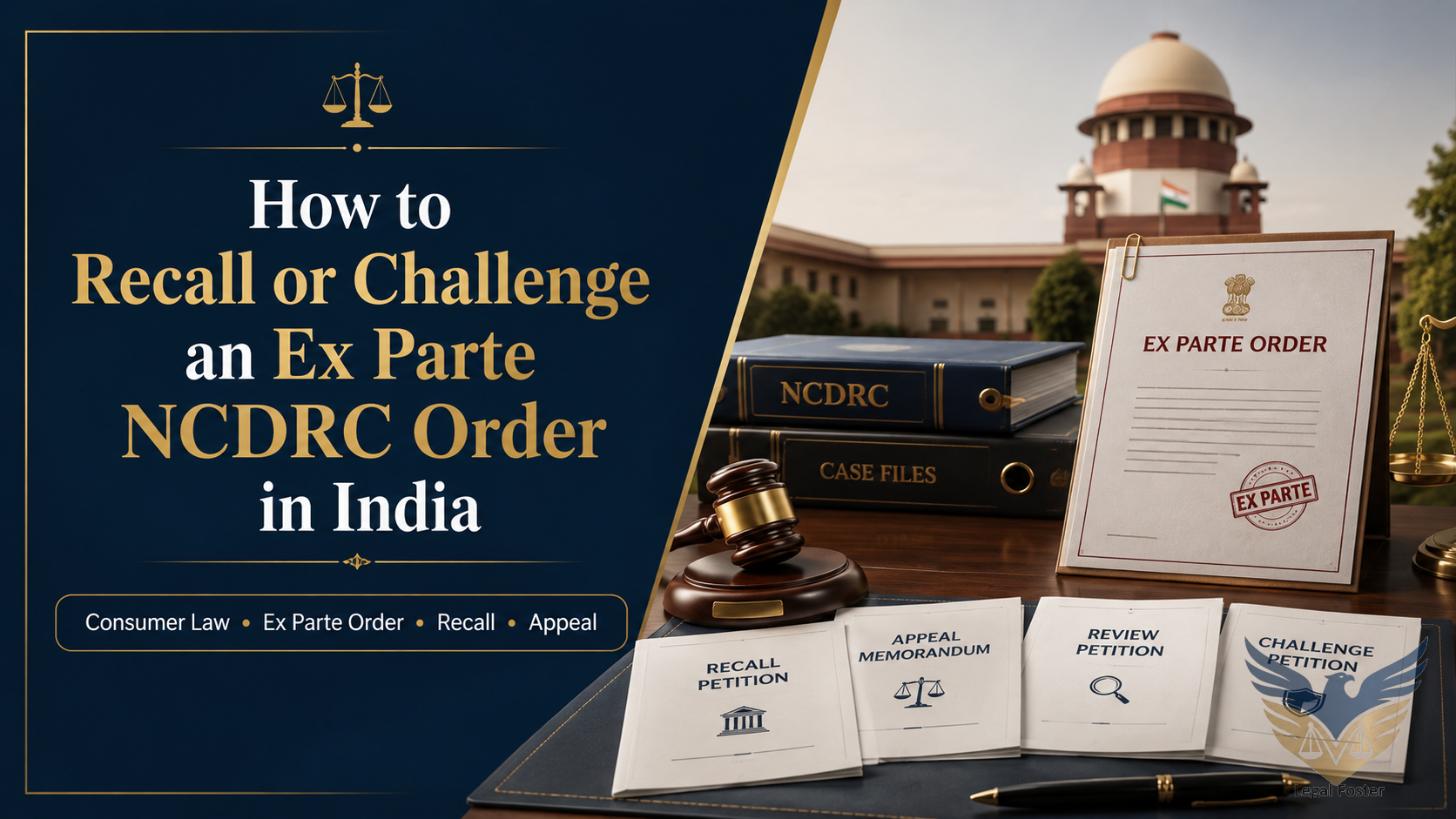
You can file against an ex parte NCDRC order but need to pick the correct remedy depending on the nature of order passed and jurisdiction exercised by NCDRC.
Under Section 61 of CPA 2019, the aggrieved party can file an application before NCDRC for setting aside its ex parte order. Review under Section 60 is of a different nature: such application is entertained only to correct an apparent error on the face of the record.
Your recourse against the order further before the Supreme Court also depends on whether the order was passed by NCDRC in exercise of original, appellate or revisional jurisdiction.
This is where most files get messed up. One lawyer may spend days drafting an appeal when an application was required to point out non-service and non-appearance. Meanwhile, execution may continue because merely filing an application does not itself operate as a stay.
Here is a guide to help you understand the mode of proceeding depending on the order passed, facts of your case and documents you have establishing service or the contrary.
Why This Issue Matters in Delhi NCR and Across India in 2026
NCDRC has its seat primarily at National Capital Region ("NCR"), however, orders passed by it are binding on parties situated across India. Tracking orders has become much easier with digitalisation.
However, occasional non-tracking can happen because of old email IDs, change in counsel not getting updated, service issues or internal communication problems.
Ultimately, one of the important questions is when the client actually first came into possession of concrete notice of the order and what the official record states regarding service.
Timing of the order matters because the order continues to remain operative unless NCDRC or a higher court of competent jurisdiction grants appropriate relief. Depending on the stage of execution, recovery or compliance, interim relief may also become relevant.
Quick Facts
Section 60 review concerns an apparent error on the face of the record. Review, recall, appeal and special leave proceedings are separate remedies.
Filing a plea under Section 61 itself does not automatically stay execution of the operative order.
Appeal to the Supreme Court under Section 67 depends upon the nature of the order and jurisdiction exercised by NCDRC.
Grant of relief remains discretionary and depends upon facts, service record, promptness, reason for absence and the interests of justice.
Who Needs This Guidance?
This guidance may be relevant to a complainant against whom an order has been passed in absence, an opposite party against whom ex parte relief has been granted and individuals or businesses that become aware of the order only at the stage of execution.
It may arise in matters involving homebuyers, policyholders, patients, banks, hospitals, sellers, manufacturers, small industries and other parties involved in consumer disputes.
Which Documents and Evidence Should Be Collected?
- Certified copy or downloaded copy of the ex parte order and consequential daily orders.
- Original complaint, appeal, revision, reply, evidence and written statements already filed, if any.
- NCDRC notices, envelopes, tracking reports, email headers, delivery slips and returned postal articles.
- Vakalatnama, advocate correspondence, hearing diary and proof relating to substitution or change of counsel.
- Medical evidence, travel-related documents, hearing records, death in family evidence or other material relied upon to explain absence.
- Identity and address documents. For a company, firm or partnership, appropriate resolution or power of attorney.
- Proposed reply or brief defence showing that reopening could involve substantive issues requiring consideration.
- Execution notice, recovery notice, compliance demand or communication indicating possible prejudice.
Document consistency matters. The explanation contained in the application and affidavit should correspond with the available service record, correspondence and other documentary material.
What Happens If the Ex Parte Order Is Ignored?
An order which is not appropriately challenged can proceed to execution , recovery, accrual of interest or compulsory satisfaction.
A company may face accounting and recovery pressure while an individual may face enforcement of the order despite not having placed a defence before the Commission.
Delay may create separate limitation and execution complications. Negotiations between parties do not by themselves eliminate procedural deadlines or the need to examine interim protection.
When Should You Consult an NCDRC Lawyer?
Legal consultation may become particularly important soon after discovering that an ex parte order has been issued, especially where service is disputed, execution has started, compliance dates are approaching or the order involves a substantial refund, compensation or payment amount.
It may also require urgent review where previous counsel is unavailable or where an order appears on the NCDRC record despite the party claiming that it did not receive information about the hearing.
Four issues generally require examination during the initial consultation:
Advocate BK Singh can examine whether a review petition against an NCDRC order or proceedings relating to Section 61 require consideration on the facts of the matter.
How Can NCDRC Lawyers Help?
NCDRC Case Review and Representation
Order analysis, procedural chronology, applications under Section 61, review petitions, affidavits, stay applications, registry-related procedural work and representation of consumers and opposite parties before the National Commission may form part of an NCDRC matter.
Advocate BK Singh can analyse matters involving Delhi NCR as well as parties situated in other cities of India in builder-buyer disputes, insurance claims, banking disputes, medical negligence and product or service-related consumer matters.
If your case involves dismissal for non-prosecution instead of an ex parte order, read: Can an NCDRC Appeal Dismissed for Non-Prosecution Be Restored?
Frequently Asked Questions
1. Can orders passed ex parte by NCDRC be recalled?
Yes. Section 61 allows NCDRC to set aside an order passed ex parte by it. Grant of relief is discretionary. The reason for absence, service record, promptness and supporting evidence should be appropriately addressed in the application.
2. What is the limitation to file an application under Section 61?
The applicable limitation should be examined with reference to the relevant regulations, date of order and date on which the order was received or became known. Where the stated period has already expired, the reasons for delay and procedural maintainability require separate consideration.
3. Can filing of a review petition under Section 60 recall an ex parte order?
Review under Section 60 and setting aside an ex parte order under Section 61 are treated as different procedural remedies. The nature of the order and the grievance raised should therefore be examined before selecting a provision.
4. Does filing an application for recall automatically stay execution?
No. Filing the application itself does not automatically stay the operative portion of the order. Where execution or compliance is already approaching, interim relief may require separate consideration.
5. If we did not receive any notice, can that be a reason to set aside the order?
Non-service or lack of proper notice can be a relevant factor. NCDRC may examine the service record, including postal tracking, email delivery information, address history, returned notices and daily orders.
6. Is it possible to appeal against an ex parte NCDRC order in the Supreme Court?
Section 67 may apply to certain orders passed by NCDRC in its original jurisdiction. The route against appellate or revisional orders requires separate analysis based on the nature and jurisdiction of the impugned order.
7. Do I have to present my entire consumer dispute argument in the Section 61 application?
The application primarily concerns the ex parte proceeding, reason for absence, service, promptness and the basis on which reopening is requested. Relevant aspects of the underlying defence may also be referred to where required.
8. What if my counsel failed to attend the hearing?
Available records concerning engagement, hearing dates, correspondence and the circumstances surrounding non-appearance may become relevant. The Commission may examine the overall conduct of the party along with the stated reason for absence.
9. Can a company apply to set aside an ex parte order?
Yes. A company aggrieved by an ex parte order may seek appropriate relief through an authorised person. The authorisation, corporate documents and explanation for non-appearance or service may require supporting documentation.
10. Can Advocate BK Singh handle an NCDRC matter for a client outside Delhi?
Advocate BK Singh can represent consumers and businesses in NCDRC-related matters involving parties from different parts of India, subject to the requirements of the individual case, Commission procedure and professional engagement.
Final Thoughts
An ex parte NCDRC order requires the remedy to be matched with the nature of the order and jurisdiction exercised by the Commission.
Section 61, Section 60 review and proceedings before the Supreme Court involve different procedural considerations. Limitation, interim protection, service records and the proposed defence should therefore be examined separately.