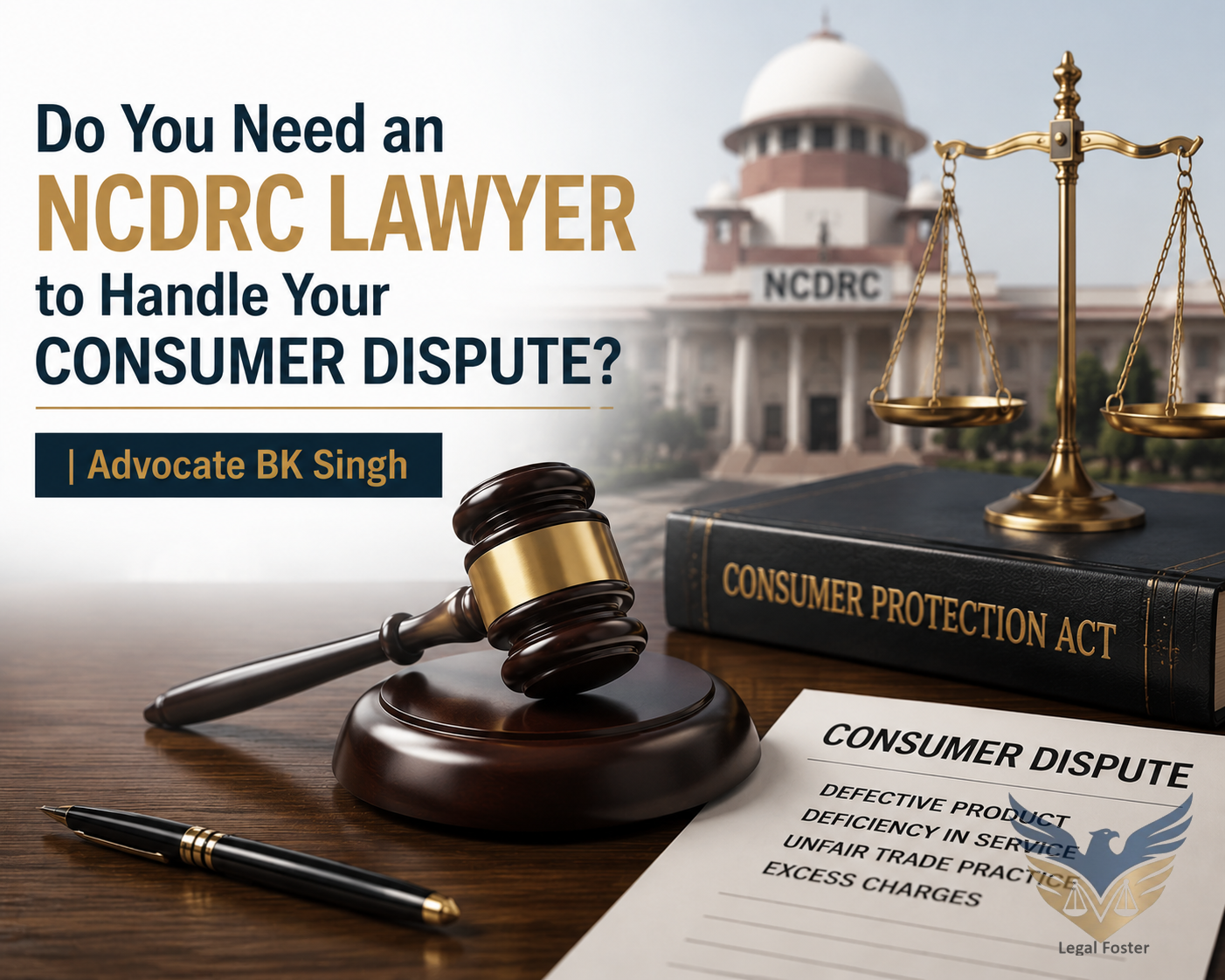
Do You Need an NCDRC Lawyer to Handle Your Consumer Dispute Effectively?
Every NCDRC matter begins with a consumer facing a significant financial or personal hardship. A homebuyer’s dream of having a house in his name could have been laid waste for years. A genuine claim to insurance could have been rejected. Your bank, hospital, e-platform or services provider may have reneged on its promise. By the time you reach National Commission, you may have piles of documents and complex legal issues in your case.
While you are not mandated to hire an NCDRC lawyer for your matter, the law does allow the consumer to appear before the forum personally. But is it realistic to represent yourself when legal issues like jurisdiction, limitation, admissibility of evidence, grounds of appeal or admissions of compensation worth lakhs and crores of rupees are involved?
Paperwork powers the NCDRC process. A genuine complaint can encounter needless obstacles if filed against the wrong defendant, remedy or with incomplete documents. Appeal and revision petitions demand greater precision as they give the Commission a chance to review your dispute rather than rewrite it de novo.
Advocate BK Singh assists consumers, businesses, homebuyers, policy holders and service providers in drafting and managing their complaints, appeals, revision petitions, set aside replies and execution proceedings before the National Consumer Disputes Redressal Commission. Efficient legal advocacy requires doing the groundwork, so when your matter is up for hearing, the facts, evidence and relief demanded before the Commission are your client’s versions.
Why Does an NCDRC Case Matter Across India in 2026?
Situated in New Delhi, NCDRC hears the consumer disputes which are of national applicability/consumers from Delhi NCR. But our consumers have filed cases from Noida, Ghaziabad, Gurugram, Faridabad, Lucknow, Jaipur, Mumbai, Pune, Bengaluru, Hyderabad, Chennai, Kolkata, Ahmedabad and all over India.
An adverse order may affect claims for compensation/ refund, business liabilities, insurance claims or possession. Let Advocate BK Singh determine if your case is eligible to NCDRC and if the matter can be filed as an original complaint/appellate/revision/review petition or some other remedy.
What Quick Facts Should You Know?
- Need not appoint counsels in all consumer cases.
- Incorrect. NCDRC has original jurisdiction as well as appellate and revisional jurisdiction.
- This statement is incorrect. Original pecuniary jurisdiction is determined on the basis of the consideration paid and not on the basis of compensation claimed.
- Appeals have to be preferred within a period of thirty days before the State Commission.
- It's correct that Appellant has to deposit 50% of the ordered amount in some cases by some appellants.
- Wrong. Limitation period for filing consumer complaint is two years from the date on which the cause of action arises.
- Both appeals and revisional petitions have separate roles.
What Is the Core Legal Issue in an NCDRC Matter?
An NCDRC case means Consumer dispute filed against order passed by Indian National Consumer Disputes Redressal Commission(NCDRC). It can be Original(high value complaint) dispute, appeal against state commission order or revision petition(during jurisdictional mistake) or review/ transfer /executions/ restoration etc.
Remedy chosen should be according to the order sought to be challenged. As for example, appeal has extensive scope of review as compared to revision petition, review petition is entertained only for apparent error. Advocate BK Singh understands this difference before filing your NCDRC case because choosing wrong remedy may land your case into further delays or rejection.
Which Law and Jurisdiction Apply?
It should be noted that the Consumer Protection Act, 2019 covers all proceedings before the NCDRC. Section 58 explains that the Commission shall have original, appellate and revisional jurisdiction. Currently, Rs. 2 crore is the original pecuniary jurisdiction if you wish to file a complaint. From information directly issued by the NCDRC, their jurisdiction is exercised in its original, appellate and revisional jurisdiction. Consumer Protection Act, 2019
Orders from State Commission(s) ( Section 51 | Appeals from the order of the State Commission ). Note that, technically, the first Appeal has to be filed within a period of 30 days as a general principle. If the Appellant is required to deposit a certain percentage, there will be a statutory pre-deposit requirement.
Section 58(1)(b) Revision by the Commission) is narrower in scope. It concerns where the State Commission either assumed a jurisdiction that was not conferred on it, failed to exercise jurisdiction that was conferred on it, acted illegally or with material irregularity. Revision is not a matter of right and is not a full retrial on the facts.
Section 60 covers Review of an order by the NCDRC on the grounds of an error apparent on the face of the record. This also typically must be filed within 30 days. Section 61 pertains to orders from NCDRC that were passed on an ex parte basis being challenged. You have 2 years to bring a consumer complaint under Section 69 Consumer Protection Act, 2019 although the delay may be condoned if there is a legally sufficient reason for not filing within the prescribed time limit. BK Singh & Associates will analyze which provision(s) apply to your facts before determining whether you can be represented.
Who Usually Needs NCDRC Legal Guidance?
You need legal assistance when you are a:
- Buyer with delayed possession or problems with cancellation/refunds
- Policy holder needing reassessment of denial of high value insurance claim
- Patient or kin wronged by inadequacy of medical service
- Banking/financial services user wronged by deficiency of service
- Tradesman facing an accusation of causing severe consumer distress
- Consumer or businessman dissatisfied with an order passed by State Commission
- Consumer wanting to enforce an existing consumer decree
What Does an NCDRC Lawyer Handle Step by Step?
Lawyer starts with knowing the sequence, deal, payment receipt and communication history. Identifying the right forum and remedy sought is next. Then legal drafting connects each claim to evidence and relief provided by consumer law.
Case admitted, you may then need to tackle registry objections to get the case removed. You may then have to deal with notices, replies, rejoinders, affidavits, written submissions and interim applications. He keeps an eye on dates and fights the case without unnecessarily changing your stand on facts.
Advocate BK Singh considers settlement offers if necessary. All settlements shall specifically state payment terms, timeline, clause to withdraw claims and consequences of default.
Which Documents Should You Share With Your Lawyer?
Files normally contain :-
- Orders of State/ District Commission
- Complaint,date filed,reply,rejoinder and affidavits if any already filed.
- Invoices,Receipts,Bank statements
- Copy of Agreement/deposit allotment letter/ Insurance policy.
- Emails,letters and important messages.
- Any reports from experts. If Medical claims then medical reports.
- Legal notice sent/ received and replies.
- Proof of delivery,payment made or deficiencies of services.
- Identity and authorization documents.
- Date wise timeline.
Advocate BK Singh also collects other past records if he feels something is missing in the file. Give him all the documents as related to your case as he would like to exactly asses the aspects of limitation, jurisdiction and evidence if he has the entire file in his hand and its arranged properly.
What Can Happen If You Ignore the Matter?
The Order becomes the Final Order if no appeal is filed. An appeal if filed late will require an application for condonation which may still be dismissed. An ex parte application can be filed if the respondent fails to show.
Execution can be filed against you if it is a final consumer order and you have not complied. Interest may be awarded as well as costs of litigation or loss of refund due to delay. There may also be reputational damage to your business name. BK Singh can guide you on how the order will impact you immediately but cannot promise any specific outcome.
When Should You Consult an NCDRC Lawyer?
Consult Advocate BK Singh at the beginning stage i.e. :-
- If State Commission has passed an order against you.
- If the compensation/amount demanded by you exceeds the monetary limit.
- If you intend to file Revision Petition.
- If the other side has raised the defense of limitation/maintainability.
- If you claim high amount of compensation/refund.
- If notice has been received from NCDRC in any proceeding against you.
- If there is non compliance of any order.
- If you want any Settlement document to be reviewed.
Mr. B. K. Singh will have enough time to go through the entire record and advise you fairly.
How Can NCDRC Lawyers Help?
Case Analysis, Jurisdiction verification, Help in structuring & drafting of pleadings, getting them filed & presented at hearings and counseling after order is filed under NCDRC Lawyers. Consumer as well as businesses can take advantage of this service if you want properly drafted reply.
Advocate BK Singh focuses on only those things that can the pleadings actually establish from the record. Clients are informed about the likely objections, important deadlines and remedies before any critical procedural steps are taken.
Click here to read about Advocate BK Singh or Learn more about us – Consumer-court Representation in Delhi
Frequently Asked Questions
1. Do I have to hire an advocate for my NCDRC matter?
No. Consumers and their advocates are not compulsory under consumer law in all proceedings before the NCDRC and parties have the right to conduct their own case. Voluntary appearance may still be unadvisable if the proceeding is a appeal, revision petition, jurisdiction application, or involves substantial evidence/claim over a certain value. Advocate BK Singh will be able to assess if you need to be represented by a professional based on the value and facts of your matter. Clients are also able to utilize a consultation to get clarity on whether their claim should even be filed before the NCDRC.
2. Do I have to file all high-value compensation claims directly before the NCDRC?
No. The pecuniary jurisdiction of the NCDRC is not determined by stating a high/ extravagant compensation amount in your complaint. Based on the existing laws, it is the value paid/ promised to be paid for goods or services received that determine the proper consumer commission to approach. Interest, compensation and other reliefs awarded by the commission cannot be inflated in order to bring a matter under the NCDRC. Have an advocate go over your bills, contracts and bank statements prior to filing because approaching an incorrect forum will lead to avoidable delays.
3. What is the difference between filing an appeal vs revision petition before the NCDRC?
Appeals and Revision petitions are entertained for different reasons under the law. Appeals before the NCDRC allow certain errors in the State Commission’s order to be re-litigated. Revisional jurisdiction in the NCDRC is much narrower and generally pertains to lack of jurisdiction, jurisdiction exercised illegally or material irregularity. The facts in dispute are usually not re-heard on a revision petition. The order being challenged, facts of the case and the nature of error will determine what course of action is appropriate.
4. Can I file an appeal even if I’m late?
Delayed appeals are normally filed along with an application mentioning the reasons for delay. The party filing will have to convince the NCDRC that there was sufficient cause for missing the stipulated time limit. NCDRC does not guarantee condonation and reviews each application on its merits. Advocate BK Singh can tell you whether your time from receipt of the certified order, stated reasons for not filing on time and documents you have to support your reason for delay are reasonable. Reasons such as “too busy with work” or “didn’t know about procedural laws” is not considered sufficient cause and will have to be backed up with facts.
5. What documents will the NCDRC attorney review during our consultation?
During the first consultation, lawyers will normally review the order challenged, pleadings before the state commission, evidence, transaction receipts, relevant dates and relief claimed. Based on these documents, the lawyer will be able to determine if there is a jurisdictional, limitation or maintainability defect with your intended appeal or revision petition. Clients should also inform the lawyer of facts adverse to their claim. An attorney can provide you with the best legal opinion when they have all the information. You should also use the consultation to discuss fees, timelines, required documentation and what you hope to achieve.
6. Can a company also hire an NCDRC lawyer?
Yes. Consumer lawyers can represent business interest if you are a Builder, insurance company, Hospital, bank, manufacturer or provide any service facing consumer complaints. Lawyers will help you draft your response to the NCDRC notice. Your defence would primarily be based on denying the consumers standing, Commission’s jurisdiction, limitation, cause of damage, alleged deficiency or challenge the compensation sought by the complainant. Support all your statements with proper documentation. Simply denying the allegations made by the consumer will not be enough.
7. Will the NCDRC lawyer guarantee me compensation or case dismissal?
No reliable lawyer will guarantee compensation, refund, dismissal, compensation or a sure win. Previous commission orders, evidence and the applicable law will dictate outcome of your legal matter. An experienced lawyer can only improve your chances by properly preparing and representing you. Avoid lawyers who guarantee results on a fixed fee. Clients should look for honest lawyers who will advise you on your legal rights, weak areas, costs and chances of success so you can decide if you want to proceed.
8. Can I settle my case after I file in NCDRC?
Yes. Parties can normally settle a dispute even after filing a case if they reach a lawful agreement. There is also a mediation scheme under consumer law to settle disputes. The settlement agreement should contain details of amount payable, payment terms, whether complaints/proceedings should be withdrawn, confidentiality (if legal) and what happens in case of default. Agreements should be gotten in writing especially for high value disputes. Your offer should also be evaluated in context of the allegations in the complaint and if the opposite party has complied with any previous orders.
9. If I win my NCDRC case, will I get the money/salary automatically?
No. The passing of an order and actual receipt of relief are 2 separate matters. If the party against whom the order is made refuses to comply, legal steps can be taken to enforce the order. Section 71 of the Consumer Protection Act, 1986 mandates that all orders from consumer commissions shall be executed in the same manner as a civil decree, except in such manner as may be provided by this Act. Refusing to comply with orders of a consumer forum is punishable under section 72. Advise will help you understand if the order is final, if there are any appeals pending and how to go about the execution process.
10. Can NCDRC orders be appealed before the Supreme Court?
Yes. Parties can appeal to the Supreme Court against certain orders passed by the NCDRC in it’s original jurisdiction. Section 67 appeals have their own limitation of 30 days from order and have additional requirements under the law. You cannot challenge every order passed by the NCDRC in the Supreme Court. Applications rejected by the NCDRC also follow separate procedures for challenge. Parties wishing to challenge NCDRC orders should consult a lawyer immediately because limitation, pre-deposit and the type of order will effect your ability to appeal.
Conclusion
An NCDRC case should be reviewed sufficiently ahead of deadlines becoming due or irreversible filing mistakes being made. Kindly put together a file with the order, pleadings, transaction documents, correspondence and a short chronology.
Advocate BK Singh will then be able to advise you as to whether the case concerns filing of an original complaint/appeal/revision/review or filing of defence or an execution proceeding. Recommendation and outcome will vary depending on the facts and documents.