Delhi NCR Legal Assistance: Selecting the Right Court, Forum and Advocate
Legal issues rarely become complicated because the law is complicated. Nine times out of ten, things start going wrong much before that. You file your matter in the wrong forum. You approach the wrong kind of advocate. You bring up a matter at the last minute before a deadline expires.
A homeowner facing a legal issue in Noida will have to access a completely different forum than what a trader in Gurugram would access to fight a contractual dispute against his business partner. Somebody needing to challenge an administrative order passed by the Delhi government needs to speak to a lawyer who knows how to navigate High Court proceedings. Somebody upon whom SARFAESI action has been initiated by a bank might want to explore options under Debt Recovery Tribunal (“DRT”).
Family disputes have courts of their own. Criminal matters go to the crime branch and lawyers experienced therein. Employment and labour-related matters are fought in Labour Courts. Consumer disputes go to the Consumer Forums.
That's why hiring the right lawyers in Delhi NCR need not begin with a base question like “Who is the best lawyer?” Instead, begin with this question: Which court/tribunal/authority/statutory forum has the jurisdiction to decide my legal issue and what kind of lawyers does that forum require?”
BK Singh Advocate then asks this question keeping facts, documents, jurisdictional limitations and relief demanded in view. It is neither our intention nor our policy to refer every matter to the same court. We intend to understand the facts exactly what happened and then decide which legal forums can be approached.
Moreover, for residents of Delhi, Noida, Greater Noida, Ghaziabad, Gurugram, Faridabad, Meerut or anywhere else in the NCR, proximity will be another factor. One must remember that Delhi NCR is not one jurisdiction with only one court where all legal disputes must be filed. The courts and forums under which disputes must be filed will differ on the basis of territorial jurisdiction, pecuniary jurisdiction, subject matter jurisdiction and statutory jurisdiction.
Choosing the right forum not only saves the clients from filing a matter in the wrong forum, tackles procedural objections raised by the other party and also understand the realistic possibilities of the case. Quality legal representation starts even before the first petition is filed.
Why Does Forum Selection Become Important Topic to Discuss for Delhi NCR ?
The same factual dispute can generate multiple legal disputes. Property disputes can give rise to civil, municipal or RERA litigation. Business disputes can involve contract law, arbitration, insolvency and/or recovery laws. A criminal complaint can further give rise to bail, trial, revision and appellate proceedings.
Forum Selection Criteria is not merely geography for Delhi NCR lawyers. The nature of dispute, forum (court/tribunal) that passed the order, where property is situated, where parties reside, what is the statutory remedy and relief sought etc. will matter.
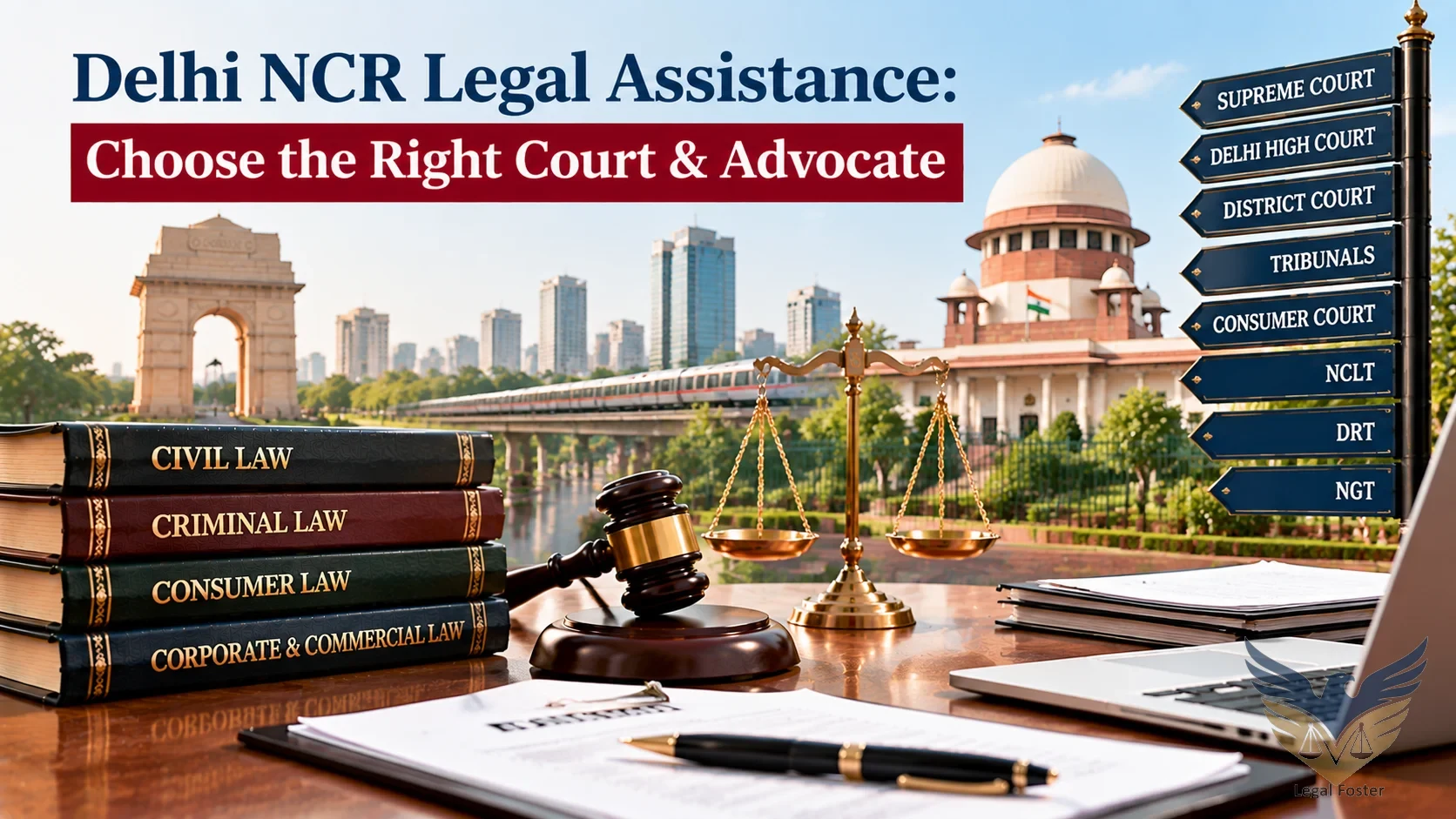
Advocate BK Singh’s website describes his practice to include matters pending in “higher forums” which refers to Supreme Court, High Courts and specialized forums such as DRT/RERA/NCLT/NCDRC/CAT/NGT cases.
Clients located in Ghaziabad should not file a lawsuit in Delhi just because the advocate has an office or claims to practice in Delhi. Correspondingly, a business operating out of Gurugram should not think that all business disputes would fall under the jurisdiction of Delhi Courts.
Quick Facts
Delhi NCR is not a single court jurisdiction.
Civil suits have a general jurisdictional rule under Code of Civil Procedure, 1908 which overrides special laws and subject to forum specific laws.
There may be a precondition of filing a statutory appeal before the higher court as per law governing the suit.
Filing a writ before High Court is not a replacement for every civil suit or statutory appeal.
Technical disputes may fall under forums like DRT,NCLT,NGT,NCDRC or CAT as per the governing statute.
Proceedings in Supreme Court have different filing and Attorney general rules, namely Advocates-on-Record.
Issues of Limitation, maintainability and territorial jurisdiction should be considered at the drafting stage itself and not after a challenge is brought against them.
What does Choosing the Right Forum Actually Mean?
Choosing a forum means selecting the court, tribunal, commission, authority or other statutorily or legally established entity which has the jurisdiction to entertain the particular dispute and to grant the relief sought.
Well, it depends. On what happened who did what; where the events took place; what law applies; and what remedy is available
So, for instance, the Code of Civil Procedure, 19 08, recognizes jurisdiction of the civil courts subject to certain statutory exceptions and has chapters dealing with the place of suing (in which Section 16 specifically mentions suits relating to immovable property, and suits which are to be instituted where defendants, plaintiffs or cause of action are resident).
Forum Selection is not simply a question of “Which court is closest?”
Rather, it is a question of “Which forum has jurisdiction over the matter at hand and can give me the relief I actually seek?”
Advocate BK Singh takes the position excerpted from the firm's higher- court service page that forum-selection falls into the same bucket as maintainability, limitation, jurisdiction, documents and nature of relief sought.
What Court Or Forum May Apply To Your Matter?
It can be important to file your matter in the correct forum. Certain disputes require different lawyers depending on the needs of the case.
District And Civil Courts
Civil suits include but are not limited to property, possession, partition, injunctions, recovery, contracts, landlord & tenant or other civil rights disputes. One would first look at territorial & pecuniary jurisdiction for the applicable Civil Court along with any special law related to the dispute.
Property Disputes
For properties in Noida, Greater Noida, Ghaziabad, Delhi, Faridabad or Gurugram, an understanding of the property documents and history of transactions would be necessary to understand where proceedings should be initiated.
The firm’s lawyers assist with property and real estate disputes as part of our property dispute resolution legal service. This includes litigation related to title disputes, possession suits and litigation against builders and related disputes.
High Court
The High Court deals with appeals, revisions, cases filed under its special supervisory jurisdiction, constitutional matters and any other proceedings that are provided for by law. Keep in mind that writ petitions are not a remedy for everything. One can file a writ against public authorities or to enforce legal rights. Factual scenarios determine whether a writ petition would be maintainable, whether there is an alternative remedy available and what nature of action is being challenged.
Only because a matter has something to do with the High Court does not mean the High Court is the first court you’ll approach. Appellate jurisdiction is the ability for courts to hear appeals. Any appeals from courts will fall under the High Court’s appellate jurisdiction. You should consider filing a proceeding in the High Court for appeals or if there is no alternative remedy available.
Our High Court, Supreme Court and Tribunals Legal Guide gives an overview to consider when choosing the correct forum. This includes what order was challenged, law, jurisdiction, limitation and relief demanded.
Criminal Courts
Crime and offenses are tried under Criminal law where each Court hears matters with jurisdiction based on the offense. Criminal law has been updated under Bharatiya Nagarik Suraksha Sanhita, 2023 (“CrPC”). Offences are triable by a Court of law has been specified in CrPC and additionally power of High Court and Court of Session are also specified for matters like bail and other proceedings.
Someone who has been given an FIR, may be arrested or face investigation, have been accused of committing a crime or are facing trial or a criminal appeal will require counsel based on the facts of their case and what stage their matter is currently at.
The firm provides civil, criminal and family lawyers. If you are looking for criminal defense lawyers, our criminal law legal service includes criminal trials, defending your rights if you’ve been accused of a crime and bail applications. Family law matters are covered under our family law legal service.
Tribunals
India has implemented multiple adjudication schemes to allow for industry specific disputes to be resolved. These statutes provide exclusive jurisdiction to the forums mentioned.
Bank recovery related matters would also fall under SARFAESI which falls under DRT regime and appeals from DRT decisions. Insolvency and Company law is determined by NCLT. Environmental laws fall under NGT’s jurisdiction. Consumers can approach the consumer commissions at District, State or National level as laid out in the Consumer Protection Act, 2019. Service matters will depend on which CAT applies to the services of the individual or if they can approach any forum for justice.
Just because you can approach the court for a matter does not mean you can. If a statute provides exclusive jurisdiction for a matter to another forum, you cannot go to court.
The legal service would include advising the client to approach the statute defined forum.
Arbitration
An agreement could provide for arbitration instead. The dispute may be resolved by an Arbitrator or arbitral tribunal. Courts could be involved in parallel to the arbitration depending on the facts. If you need court proceedings to seek an interim injunction from the arbitration, apply for the arbitrator, enforce an award or challenge an award; the arbitration itself does not negate court proceedings for those applications.
We cover arbitration under our Arbitration law guide. We mention other types of Alternative dispute resolution (“ADR”) such as mediation and conciliation.
Who Requires Forum Selection and Advocate Advice?
Forum selection is important to more individuals than those who currently have a court notice in their hands.
Before filing a matrimonial case, a family may require advice. Before signing or suing, a property purchaser may require document review. A business owner may require assistance to understand if a contractual conflict must go to arbitration, civil courts or a different statutory forum.
Employees and employers have different forums for labour and industrial conflicts. Bank notices and recovery actions can be reviewed by borrowers at an early stage. Instead of filing every complaint in a regular civil court, consumers may need assistance determining the proper consumer forum.
Businesses with multiple locations or larger transactions face a related issue because one business dispute can lead to multiple proceedings. Documents related to a company such as corporate documents, agreements, notices, arbitration clauses and even correspondence with regulatory agencies should be reviewed together.
Advocate BK Singh can review the facts involved in the dispute and determine whether the matter appears to require representation from a civil lawyer, criminal lawyer, family lawyer, property lawyer, corporate lawyer, labour lawyer, tribunal advocate or an arbitrator.
How Should You Choose the Right Advocate?
Know about their experience in that particular subject matter relevant to the forum and the problem in actual.
If a lawyer has experience only in drafting civil matters routinely, he may not be suitable advocate for a matter in front of a specialized tribunal. On the other hand, a lawyer who specializes in appellate litigation may not be the only lawyer you require if your transaction involves a lot of documents but has not turned into a dispute yet.
Ask simple questions.
Did the lawyer know the complete chronology? Did he see all the relevant documents? Did he check limitation? Is there any statutory appeal? Has any other forum already seized of the matter? What specific relief are you asking for?
If he can answer all these confidently without seeing the documents, be careful!
From Advocate BK Singh's website: Our work starts with thorough review of documents, checking limitation, maintainability, evidence and available remedies before we begin to draft and file.
Which Documents Should You Organize?
Have all the documents ready will enable your lawyer to get you the most out of your first legal consultation. Here is a list of documents you should have.
Unless specified otherwise, keep the following documents together for any matter:
- The notice, order, judgment or letter which gave rise to the issue.
- Any previous pleadings, responses, petitions and applications.
- Any agreement, contract, title documents or loan agreements.
- Bank statements, bills, receipts and records of payment if applicable.
- Email chains, letters, WhatsApp conversations or any other legal documents.
- Any prior orders from courts or tribunals.
- Case number, hearing date and filing details.
- Proof of identity and authorization if someone else will be representing you.
- A simple timeline with key dates.
Depending on the matter, certain documents may be more important than others. In a commercial dispute, board meetings, bills, contracts and bank records might be crucial. In a property dispute, title documents, sale deed, possession details and correspondence from the municipal corporation or DDMA may be more relevant.
It is very important that you don’t exclude a document from the file just because you don’t think it will help your case. Your lawyer needs to see the entire file to analyze the matter.
When to meet a lawyer?
Meet a lawyer at the earliest if –
- You have been served a notice by court/tribunal/authority
- Order against you has already been passed
- You have to file an appeal/statutory reply within a deadline
- There is a threat of possession/ demolition/ sealing/ other coercive action on your property.
- Your bank has initiated recovery/SARFAESI action against you.
- You have received a notice related to FIR/arrest.
- You have a commercial contract dispute.
- You have received a legal notice for alleged breach/ fraud/ non-payment etc.
- There is an arbitration clause involved.
- Any government /statutory body has taken an action depriving you of your rights.
Meeting a lawyer at the earliest stage doesn’t mean that you have to file a litigation straight away. Sometimes all you need is a documentation, a reply, negotiation, mediation or any other legal remedy.
How Can BK Singh Advocate Assist With Delhi NCR Legal Services?
BK Singh Advocate has handled disputes and litigations across several areas. Whether the matter is in Supreme Court or High Court, Civil-Criminal-Family-Property-Labour/Industrial-Corporate/Commercial-Arbitration- Environment-Banking Recovery related, we have worked across.
Instead of asking for “the best lawyer”, it helps to start from the nuisance i.e. the actual problem at hand. Starting with the notice/order, chronology, documents, jurisdictional issue and urgency can help determine the suitable consultation.
Taking the above example further, if the matter is with respect to a bank recovery, you might need a forum analysis to be done to see if you can challenge the municipal action as a property owner. If you are a business owner with a contractual dispute, you might need a contract and arbitration analysis. If you are an employee, you would specifically need labour-law advice.
Our practice areas separate out specific issues such as Banking recovery loan settlement where SARFAESI/DRT matters are involved.
Corporate, Commercial and Taxation laws service would be useful for business related disputes, contractual issues or corporate matters.
Our Labour & Industrial Disputes service covers the employment context and industrial dispute scenarios.
Environmental and pollution-related issues may require consideration of the specialised forum and governing environmental framework. The firm's Environmental & NGT Matters service addresses such forum-specific matters.
Where the dispute concerns a particular commercial sector or industry, the Sector-Specific Legal Solutions service can also be considered in relation to the nature of the issue.
For matters that have reached or may require proceedings before the Supreme Court, the Supreme Court legal representation service provides a relevant forum-specific reference.
Similarly, where the dispute concerns proceedings before the High Court, the High Court legal representation service provides information relevant to High Court proceedings.
Frequently Asked Questions
Q1. How do I choose the right lawyer for my dispute in Delhi NCR?
Ans. Start by looking at the subject- matter of the dispute and the likely forum (court or tribunal) which will have jurisdiction hear your dispute. From there consider, experience with that subject matter or industry, experience with that court or tribunal, ability to review documents and provide clarity on proposed legal strategy and the route ahead.
Q2. Does Delhi NCR mean there is a specific place to file lawsuits?
Ans. No. Delhi NCR covers many jurisdictions. Some jurisdictions are within one administrative division or judicial circuit while some others fall outside it. Subject to rules on jurisdiction, proper court will depend on many factors. These factors include where cause of action arose, where property is situated (if any), where parties reside or carry out business etc.
You should also consider whether a Special Statute applies which mandates a specific forum.
Q3. If my dispute arises out of Noida or Gurugram, can I still get a lawyer from Delhi to fight my case?
Ans. Lawyer can represent you before any court or forum subject to rules of professional conduct for lawyers and the procedural law applicable to that court or forum. But the primary question to ask yourself is whether the court or tribunal you have chosen can hear your dispute. Only that court will have jurisdiction.
Q4. When should I approach Advocate BK Singh?
Ans. You can approach Advocate BK Singh at any time when you need assistance or help understanding a legal notice/order received; or need help during court proceedings, appeals; property disputes; criminal cases filed against you or you need to file; matrimonial or family related legal matters; business disputes or special tribunals like IT, income tax, civil courts, etc.
Q5. Can I directly approach Delhi High Court?
Ans. No. First understand what order you have received or what dispute you have. High Courts are not required with respect to all types of orders. Additionally, some statutes provide remedies and require appeals to be filed at a different forum. Also, jurisdiction, limitation status and relief demanded will decide where to file your suit or appeal.
Q6. Can two forums (court or tribunal) simultaneously deal with same dispute?
Ans. Yes. Oftentimes disputes give rise to proceedings in courts, tribunals, statute specific authorities, arbitrator or appellate forums. These proceedings may impact each other. Therefore, it’s best to have your legal position across all those proceedings reviewed jointly.
Q7. What documents shall I bring at my first consultation?
Ans. Bring original and a copy of the notice/order you received or the document from where you have received a screenshot. Also bring along all documents previously filed by you or any party, signed agreements if any, email or postal correspondence regarding notice (if any), record of payments made/received (if any dispute is regarding refund), previous orders, if any were issued, and a chronological timeline which you can prepare date-wise. Screenshots or photocopied selected pages will not be useful.
Q8. How quickly can I expect relief from court against notice?
Ans. It depends on how quickly the matter can be taken up for hearing by the court. Lists availability, record available, grounds and procedure that need to be complied with and the damage that will occur if interim relief is not granted. The application for interim relief can be decided the same day it is filed in some cases.
Q9. Can lawyer guarantee that court will rule in my favour?
Ans. No lawyer can make such promises. Advocate BK Singh can review facts and highlight potential remedies. Advocate BK Singh will ensure matter is professionally prepared but decides the disputes in its absolute discretion.
Q10. Can I seek legal advice before the dispute actually arises?
Ans. Yes. In fact it’s recommended to take legal advice at the beginning of any matter. This way you ensure you talk to right forum, check for limitation status, gather available documents and see what remedies are available to you. Oftentimes pursuing a claim is not required and there are alternate lawful courses of action like negotiating, mediating or other processes available.
Conclusion
Don’t hire Delhi NCR lawyers just because of their name or because they practice where you live. Start with the issue, forum & remedy.
A resident of Delhi, Noida, Ghaziabad, Greater Noida, Gurugram or Faridabad may have to approach Civil courts, High Courts, criminal c