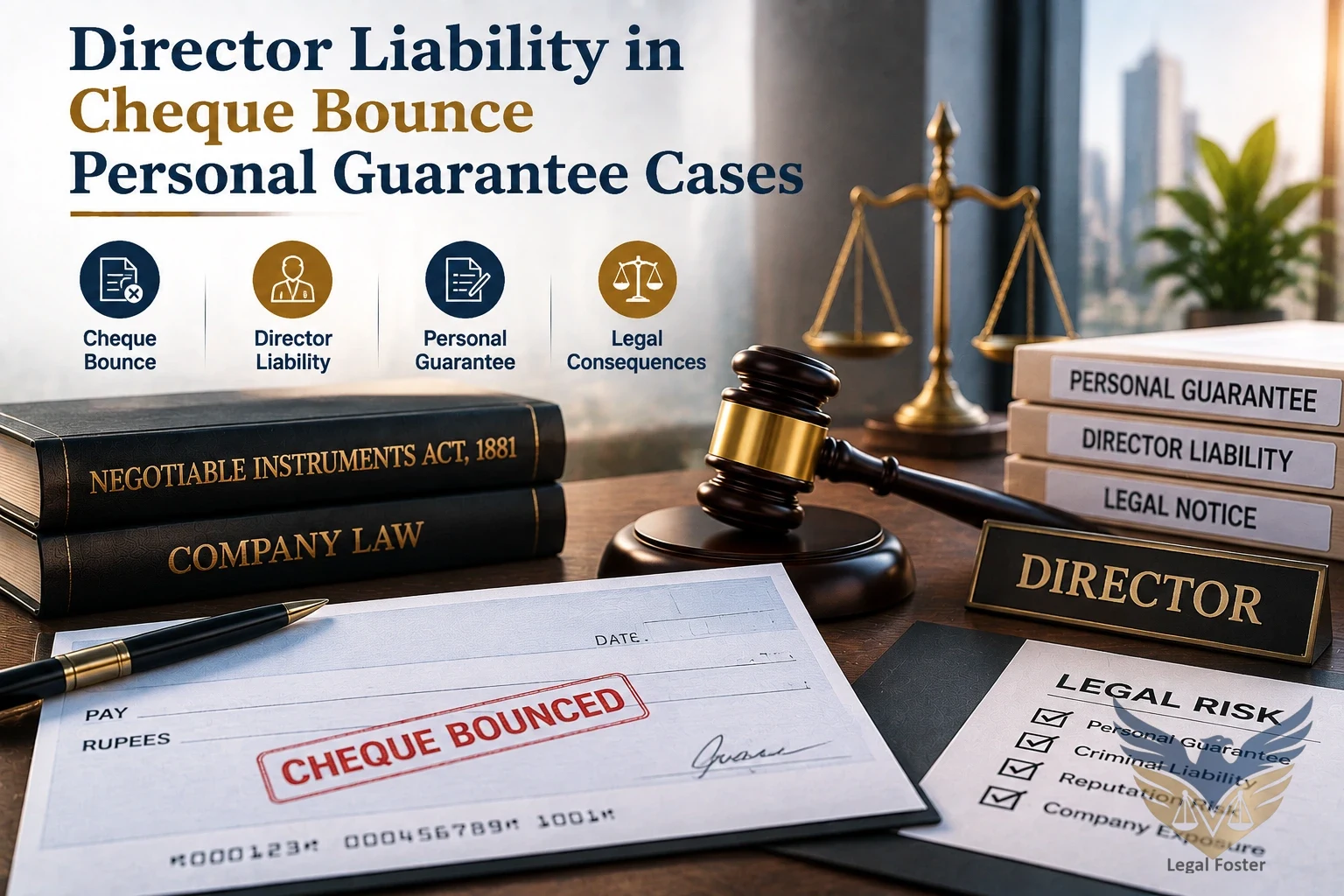
Director Liability in Cheque Bounce Cases Related to Personal Guarantee Settlements
Defaults can lead to very awkward situations. Sometimes a company finds a ray of hope when a settlement is negotiated. The defaulting company may enter into a negotiation with the creditor, arrive at a settlement amount and issue cheques under the promise to pay umbrella. Directors and promoters also go ahead and provide their personal guarantee to further convince the creditor that they will honour the promise.
But what happens when the cheque gets dishonoured in such situations?
“What did I do wrong?” Every directors’ worst fear was when his company took out a loan and he had the audacity to provide his personal guarantee. “I borrowed the money in the name of the company. So why are they harassing me personally?” This question has many legal implications and is faced by businessmen throughout India who have unknowingly provided personal guarantees while borrowing money, restructuring debt, negotiating settlements or undertaking commercial transactions.
If a cheque issued towards settlement of a personal guarantee bounces, there could be alarm bells ringing because the promoter now has civil liability on the commercial deal itself as well as criminal liability under NI Act, 1881. Every case is different and depends on the facts. It would depend on who has signed the cheque, why was the cheque issued, what are the terms of the settlement agreement, what type of guarantee was provided and what documents are available etc.
A director is not personally liable for the acts of the company, however one must be cautious when you personally sign guarantee documents or issue cheques from your personal account as you are now opening up a separate cause of action which will be analysed independently.
Cheque bounce cases get tricky when parties start fighting only on the cheque. Advocate BK Singh wants to spread awareness that the judge will look beyond the cheque if a dispute arises. The court will analyze the entire transaction including the underlying liability, terms of the settlement, who had the authority to issue the cheque and whether the cheque was issued for a legally enforceable debt.
If a cheque is issued towards settlement of a personal guarantee, that cheque is more than just a vehicle to make a payment. The cheque also ties the guarantor to the creditor and the underlying liability of the company.
Read between the lines directors. If you are anywhere in Delhi NCR, Noida, Gurugram, Mumbai, Chennai, Bengaluru, Hyderabad or even outside India and about to sign that dotted line on a settlement agreement, know the risks involved and stay away from unnecessary legal troubles.
Why Are Personal Guarantee Settlement Cheque Bounce Cases Increasing Among Directors?
In India when a company takes a loan there can be many persons associated with the business. Company might have raised credit, vendor support, money or taken a commercial loan. A creditor may ask for personal guarantee from a director or promoter of the company to secure further loan.
A company may default on its payments and enter into a settlement talk with the creditor. A creditor may also accept instalments, settlement cheques or new terms of payment during this conversation.
Problems arise when –
- The company is unable to pay the settlement amount.
- A director issues his personal cheque against the settlement.
- The amount agreed upon during settlement wasn’t paid after cheque got dishonoured.
- Creditor files a case under bounce laws.
Some directors assume that if they sign on a settlement agreement it would be only a business liability. But if you have given your personal cheque against that settlement, then you can be held liable to pay.
BK Singh Advocate explains that every personal guarantee dispute has to differentiate between
- Company’s Liability vs Personal liability.
- Loan Liability vs. Settlement Liability.
- Board versus Personal assurances.
If a director has put himself at risk depends on the documents he signed & role he played throughout the transaction.
Quick Facts About Cheque Bounce in Personal Guarantee Settlement
- Proceeding under section 138 of NI Act can be initiated only against the drawer in case the cheque is dishonoured provided the legal conditions to initiate such proceedings are satisfied.
- If there is a debt due by a company ,not all the directors are personally liable to pay the debt.
- If a guarantor gives his personal cheque,that is another issue.
- A Settlement deed and a Guarantee are both evidance documents.
- Liability of a director would depend upon facts & documents & the position of the director in the company.
- Cheque bounce cases are cases relating to payments as well as satisfying technicalities.
- Get your lawyers to examine the same before deciding that a Settlement cheque would be looked upon similarly in every dispute.
What Does Cheque Bounce in a Personal Guarantee Settlement Mean?
Guys “Cheque bounce” on personal guarantee settlement refers to when you give a cheque as part of the settlement to a lender and the cheque gets dishonoured by the bank.
- the company,
- a director,
- a Guarantor or
- someone else who was liable under the settlement.
Did the cheque bounce is NOT the question which you should be concerned with.
The questions to be asked is why a cheque was issued in the first place and was there any enforceable liability.
For example: If a Company enters into a settlement with a lender. The Company agrees to pay a sum of money in settlement of certain dues.
The Director issues his personal Guarantee and also issues a cheque to “sweeten” the lender to accept the deal.
If that cheque bounces, the lender can proceed against the Director for issuing a bounced cheque and can also sue the company for the amount stated under the settlement. He can also look at what remedies are available to him under the law depending on the facts.
BK Singh Advocate says
On “PERSONAL GUARANTEE SETTLEMENT “ :
NEVER take any settlement agreement lying down. Always remember JOB is how you draft the language clearly in the settlement agreement.mention it in the guarantee itself. clearly mention the repayment schedule in the settlement agreement and keep a record of cheque issuance.
If a lender files a dishonor of cheque case against you, the entire relationship isn’t judged there and then, in one go. The Court may take into consideration the facts and surrounding circumstances. Whether there was any liability & whether you have fulfilled the legal requirements.
How Is Director Liability Different From Company Liability?
A company is a separate legal entity from its directors. In the majority of circumstances, you as a director will not become personally liable simply because your company has defaulted on a payment.
Personal Liability may become a problem if a director:
- Provides a personal guarantee.
- Issues a cheque from his personal bank account.
- Signs an agreement that includes him taking personal liability.
- Becomes personally liable by operation of law.
Simply because a personal guarantee has been given does not mean that every default becomes a criminal issue against a director. The circumstance of why the cheque was issued, the transaction entered into and the contractually obligation can all be taken into account.
Many business owners fall into this misconception that if a company settles they as a person can not be held accountable. When you settle your debt you will sign paperwork. You also sign paperwork when you borrow money. Read the documents.
BK Singh Advocate can assist you in working out if the dispute is with the company, you as a natural person or both.
Can a Director Face Cheque Bounce Proceedings for a Company Settlement?
The Liability of a director for cheque bounce is determined by facts of each case.
When a cheque is issued by a company, can we question the liability of related persons? What if that director issued a cheque from his personal account? The analysis is slightly different when the signer of that instrument is a director.
Court will consider these factors:
- Name on cheque
- Cheque account number
- Purpose of cheque issued
- Liability
- Documents to show that there was settlement.
Just because you are a director of a company, you are not automatically liable for every transaction that company conducts through the medium of cheques. But, when that same person signs a cheque from his personal account or gives a personal guarantee, he has voluntarily distinguished himself from the said company. Voluntarily changing your position from the company.
There are numerous directors who are not aware of this distinction. They think (incorrectly) that if the company was given the benefit, then the company will have to face the consequence. This type of logic will only get you into hot water when your creditors start challenging the liability of natural guarantors.
BK Singh Advocate can guide you to understand the difference between corporate liability and personal liability in cheque bounce cases.
For matters involving the filing or defence of a cheque bounce proceeding, you can also review the Cheque Bounce Case Filing & Defence service.
What Documents Matter in a Personal Guarantee Settlement Cheque Bounce Case?
Documents become very important in how your cheque bounce situation proceeds. The documents you have available allow you to figure out the history of the transaction and who is liable.
Some of the important documents mentioned below.
- Any Settlement between parties.
- Personal Guarantee .
- Loan/Credit document.
- Copy of cheque and bank return memo.
- Schedule of payments.
- Emails/messages and written correspondence.
- Notices sent by parties.
- Resolutions/Authorisations of company if any.
- Account statements/payments.
Very often a dispute arises because of a missing document or ambiguity in terms because agreements in business transactions are very rarely contained in just 1 document. Often they are a collection of conversations.
BK Singh Advocate says If you are careful to maintain records from the beginning of the transaction you can avoid this ambiguity.
Where a formal notice is involved, the Cheque Bounce Legal Notice service is also relevant to understanding the notice-related aspect of the dispute.
When Should a Director Consult a Cheque Bounce Lawyer?
If you receive a dishonoured cheque notice, settlement default notice or legal threat letter consult a lawyer.
Some examples of situations you might encounter:
- Your customer's settlement cheque was signed under duress and has bounced.
- You have received a legal demand letter from your creditor.
- Your personal guarantee has been called.
- Your company debt dispute is affecting personal liability of directors.
- You are unsure of the extent to which your personal assets are exposed.
An early review by a lawyer can help you understand the nature of the claim, the documents involved and the potential legal processes.
BK Singh Advocate helps individuals and businesses involved in cheque bounce disputes review evidence of transactions, settlement agreements and applicable laws.
If a statutory complaint is being considered, the Section 138 Complaint service provides a relevant service page for the complaint side of cheque dishonour matters.
How Can Cheque Bounce Lawyers Help Directors in Personal Guarantee Settlement Disputes?
Every cheque bounce case on the basis of personal guarantee cannot be evaluated by merely finding out that the cheque was dishonoured. The settlement terms, underlying transaction, documents creating liability & involvement of director etc. all need to be considered together.
A skilled cheque bounce attorney can go through the documents that you have and brief the director about his legal position and consequences of such bounced cheque.
Such legal analysis would include:
- Terms of settlement and guarantee.
- Nature of cheque whether it was for existing liability.
- Statutory notice and compliance.
- Position of company and personal guarantor.
- Framing an appropriate legal reply based on facts.
BK Singh Advocate guides directors and business owners about their position in situations where personal guarantees and company liabilities are questioned.
We analyze the substance of complaint and documents which the complaint is filed upon rather than merely concentrating on preparing a reply to complaint.
Directors facing an accused-side dispute can also review the Cheque Bounce Defence Cases service for the defence-related aspect of cheque dishonour proceedings.
How Does Settlement Affect a Cheque Bounce Case?
If there is a compromise, the character of transaction gets changed as parties may enter into a new agreement regarding liability to pay.
Cheque was issued as a Compromise cheque and gets dishonoured. Some of the points which can be considered are:
- Was there a new liability created by the compromise?
- Did the old debt continue to exist?
- Was cheque issued voluntarily?
- Was there any legal liability to pay?
Facts and circumstances of every compromise would be different. Terms of compromise, conduct of parties and other supporting documents would be important.
It cannot be laid down as a rule that a compromise would extinguish the previous liabilities, or that it would give rise to liability against all persons liable on a firm.
Click here to read FAQs on cheque bounce disputes
Toplawsays " Analysing entire transaction, is the key when dealing with cases related to cheque bounce", Says BK Singh Advocate
For disputes specifically involving settlement cheques, the Settlement Cheque Bounce Cases service is directly related to this aspect of the transaction.
How Can Cheque Bounce Lawyer Help With Personal Guarantee Settlement Matters?
Individual or companies facing legal issue regarding settlement cheques, personal guarantee and commercial obligations bounced, can take help from Cheque Bounce Lawyer.
Law advice included.
- Nature of cheque transaction (trade or loan or recovery)
- Documents signed between parties
- Claim of liability by complainant against you.
- Legal remedy available to complainant and
- Response available on facts.
BK Singh Advocate guides Directors, businessmen and individuals who want to understand their stand with respect to cheque bounce situation arising out of business settlements.
Documentation review and facts analysis help us understand your legal stand before taking any further action.
For matters involving the statutory filing and defence process, you can also explore Filing & Defence under Section 138 NI Act.
Frequently Asked Questions
1. Can a director be held liable if a company's settlement cheque bounces?
No. A director will not become liable simply because a company has defaulted in payment. It depends on the facts. Factors such as whether a personal guarantee was given, who signed the cheque, whether any other documents were signed etc will be relevant in determining whether a director will become personally liable.
2. Does a director become liable for debt of a company if he gives personal guarantee?
Yes. By giving personal guarantee, a director can become personally liable to pay the debt. However, it depends on the terms of the guarantee document and facts of each case.
3. Can a director be added/ sued under cheque bounce proceedings in respect of a settlement cheque?
Yes. Proceedings can be initiated against a director for cheque bounce if the statutory requirements are fulfilled and the cheque was issued for the discharge of any legally enforceable debt or liability.
4. What is the immediate course of action that should be taken by a director if he gets a cheque bounce notice?
Take advice upon reviewing the Notice received, the Cheque (amount, date, on whom drawn, etc. ), the terms of Settlement, any supporting documents and correspondence.
5. Is the company's debt automatically the director's responsibility/liability?
No. A company is treated as a separate legal person from its directors. There are exceptional circumstances in which a director can become personally liable.
6. Will a settlement extinguish original liability?
Not always. It depends on the intention of parties and the terms of the settlement. Each case needs to be judged on its own facts.
7. As a director if I issue a personal cheque, will that result in separate risk?
Yes. Because you become personally connected to that cheque you issued.
8. What are the important documents to be analyzed if there is dispute on a cheque bounce settlement?
Settlement Agreement, Guarantee ( if any), Copy of Cheque( s), Bank's return memo, Record of payment, Correspondence, Notice( s) received. Would vary from facts.
9. Should one obtain a legal opinion before signing a settlement cheque?
Yes. It is always advisable to understand the risk and obligations, if any one would be getting into before signing a settlement document.
10. How can BK Singh Advocate assist you if your cheque gets bounced?
BK Singh Advocate can help you by reviewing the documents, advising upon the background of the transaction and making you understand your legal position under the law.
Final Thoughts
Settled cheques on personal guarantee
Whilst I don’t want to scaremonger I do want to highlight issues that directors,promoters and businessmen come across.
The issue of a dishonoured cheque being provided during a settlement can be quite worrying.
Whilst it may have been deemed a commercial dispute and resolved. Don’t forget there can be flood gates opened up depending on the contracts involved, liability and capacity the cheque was issued.
Even if the payment was agreed with a company or on behalf of the company doesn’t always mean the Directors are correct in thinking that both personal and company obligation can be dealt with in the same manner.