Cheque Bounce in Franchise Payment Dispute: Notice and Complaint Guide
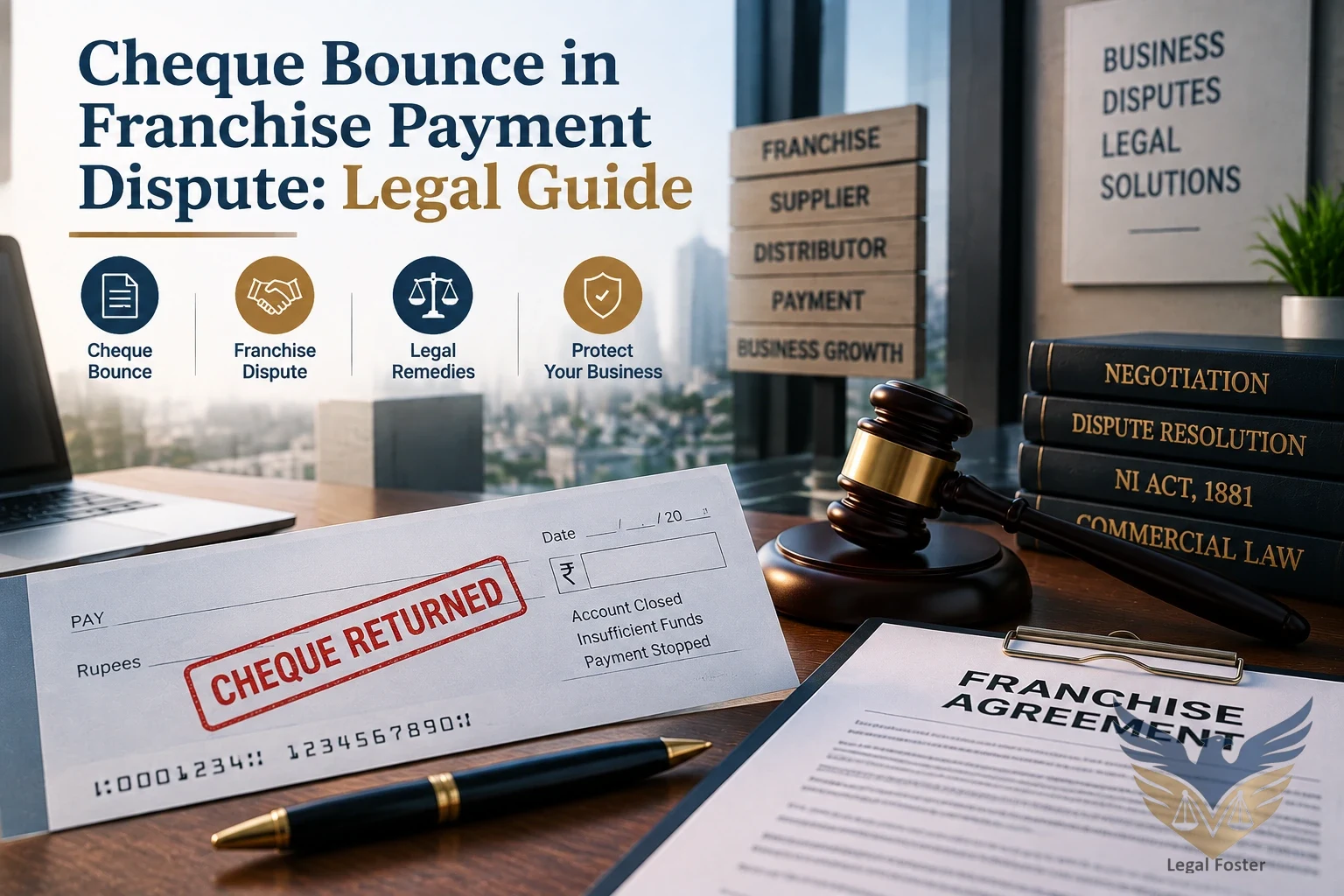
Law becomes contentious when your franchise partner doesn’t pay up and bounce a cheque issued against that amount. Any business dispute relating to franchise fees, inventory purchase, royalties, deposits or other agreed upon payments can quickly become a cheque- bounce matter under Indian law.
“What are my recovery options?” is the first question that comes to mind of a franchisor that has received a dishonoured cheque from a franchisee. Can I send a Section 138 notice? Did the cheque represent a legally enforceable liability? What proof will I need to support the complaint?
A franchisee may have equally pressing questions: “Did I issue the cheque against an actual liability? Did we terminate the agreement? Were promised services withheld? Were the underlying rights never actually licensed to the franchisee? Did I provide the cheque ”as security only“? Was the amount in dispute before I presented the cheque?”
The facts matter.
If a cheque presented against a franchise obligation is dishonoured, not every factual dispute translates into a winnable Section 138 claim. The underlying Liability, cheque, bank return memo, statutory notice requirement and limitation period should be evaluated together.
Clients are routinely counseled to revisit the franchise agreement and payment history before hastily converting a dishonoured cheque into a standard recovery demand. An easily understandable record can mean the difference between a compliant complaint and a case riddled with avoidable deficiencies.
In this article, we will discuss the general legal process for cheque bounces as it applies to franchise payment disputes. Topics include:
- Notice requirement;
- Preparing key documents;
- Complaint considerations;
- Common mistakes to avoid; and
- When to seek legal assistance.
If you’re going through a franchise cheque bounce dispute in India in 2026
Your franchise agreement is likely to be some type of written commercial agreement. Payments could have been made for an initial franchise fee, refundable deposit, royalty or marketing contribution, purchase of stock or equipment, monthly/quarterly/yearly instalments, or any other contractual obligation.
If a cheque issued against any of the foregoing obligations is dishonoured , the resulting dispute will have both contractual and statutory consequences.
“The statutory aspect would deal with Section 138 of the NI Act.”
Section 138 will come into play if the prerequisites (usually relating to cheque dishonour in respect of amount payable towards a legally enforceable debt or liability) are satisfied. There are also provisions governing presumption, company liability, cognizance of offences and the special procedure in which such cases are to be tried.
“If you are operating in Delhi you come to Delhi . Our Clients are from Delhi , New Delhi , Noida , Greater Noida , Ghaziabad , Gurugram, Faridabad and various parts of India.”
Parties in franchise disputes often reside in different cities. Assessing the contract documents and jurisdiction would be very important. If the cheque was issued from Delhi to Noida , which Court would have jurisdiction to try the offence under Section 138? Which facts would determine jurisdiction?
A franchisor should carefully mention the basis on which the cheque was issued. Merely sending a standard Demand Notice mentioning that cheque was returned dishonoured won’t cut it. Cheque was issued for “payment of dues” ? Mention the underlying transaction.
A franchisee should not think that by simply mentioning the words “security cheque” on the cheque or in the defence he can automatically defeat any Section 138 claim. Will a “security cheque” be immune from Section 138 liability? It depends on the facts. If a legally enforceable liability existed at the time the cheque was presented for payment, then Section 138 can be triggered. The law has been laid down by the Supreme Court that in proper circumstances a security cheque can attract the liability under Section 138 if the underlying liability had matured.
Quick Facts
| Issue | Practical problem arises |
|---|---|
| Main statute | Negotiable Instruments Act, 18 81 |
| Principal provision | Section 138 |
| Statutory notice | Generally required on receipt of information of cheque dishonour. |
| Notice period | Issue notice within 30 days of receipt of information from bank about cheque dishonour. |
| Payment window | Drawer has 15 days from receipt of notice to make payment. |
| Time to file Complaint | Complaint can be filed generally after the statutory cause of action arises (See Section 142 and applicable Limitation.) |
| Key Evidence | Cheque , return memo, franchise agreement, invoices/ accounts, record of payment; notice & notice delivery documents. |
| Amount / cheque can be settled | Yes, Cheque- bounce offences are compoundable under Section 147, but subject to legal process already started & the circumstances of the Court. |
Indian Law includes various provisions under the Negotiable Instruments Act, 1881. The statutory scheme is contained principally in Sections 138 and 142.
What exactly is a cheque bounce within a franchise payment disagreement?
First things first, what is a “franchise cheque- bounce dispute”? A “franchise cheque- bounce dispute” exists where:
- (a) A cheque is issued in connection with a franchise transaction; and
- (b) The cheque was dishonoured; and
- (c) The amount of the cheque was payable as payment or represented a legally enforceable debt or liability.
“What legally enforceable liability did that cheque represent at the time it was presented?”
Did not automatically mean a Section 138 offence occurred.
If a franchisee receives consideration for the bargain ( franchise rights/licenses, products or services) and issues a cheque towards an outstanding contractual amount, said cheque could fall under Section 138 upon dishonour if the statutory requirements are met.
However, it’s not always cut and dry if the parties validly terminated the agreement, disputed the underlying consideration, the promised services were never rendered, the liability had already been paid or adjusted against other payments or if the cheque was tendered for a purpose where an enforceable liability did not yet exist.
With that in mind, it is advisable to look at the entire transaction before sending a statutory notice.
What legal framework governs bounced cheques within franchise disputes?
The primary law that regulates cheque bouncing cases in India is The Negotiable Instruments Act, 1881.
Section 138 – Offence Relating to Dishonour of Cheque
This section contains the offence and details the statutory requirements to pursue a cheque- dishonour complaint in court. Conviction is contingent on meeting certain prescribed conditions. These include (a) dishonour for the requisite reasons; (b) existence of a legally enforceable debt/ liability; and (c) serving a statutory notice, followed by failure to cure the default by paying the amount within the prescribed time.
Section 139 – Presumption as to favour of holder
This section creates a statutory presumption in favour of the holder of the cheque where the facts surrounding the transaction are sufficient to give rise to the presumption. This does not mean that all other factual defences are overcame. Both the transaction itself, and the supporting documents will be important.
Section 141 – Offences by Companies
If the cheque is issued by a company or some other business entity during the course of a franchise transaction, liability will need to be established. Who can be named as sued and what is their personal involvement with the matter based on the cheque? Section 141 directly deals with offences involving companies.
Section 142 – Cognizance of offences and Complaints
This section lays out special requirements in regard to cognizance being taken of offences under section 138 and how a complaint must be made in respect thereof. Territorial jurisdiction also depends on the facts and this statue.
Section 147 – Compounding of offences
This section says offences under the NI Act are compoundable. This means the parties can settle the matter if they want to instead of prosecuting the matter in Court. It has to be commercially viable for both sides.
Sections 143A and 148
The Act also contains specific provisions relating to interim compensation and interim deposit on appeal against conviction. We will cover these sections later on if you need to send a legal notice.
Who should consult a lawyer when a franchise cheque bounces?
The franchisor might need a lawyer if the franchisee refuses to pay or bounces a cheque according to the agreed payment terms.
The franchisee might need a lawyer if the cheque was provided for a disputed payment, an incomplete sale, contract termination, refund, non-delivery or any other contractual obligation.
Senior management, directors or other officers may also require legal advice if the person that issued the cheque (Drawer) is a company.
One problem facing small franchise business is that the disputed amount may be the exact amount necessary for running your business. You need those funds for daily operations, paying suppliers and even payroll. Waiting until you send the third or fourth reminder notice can turn a simple commercial dispute into a complicated matter.
The advantages of consulting with Advocate BK Singh is he will be able to guide you as to whether the facts and documentation allow you to send a statutory notice, file a complaint, enter into settlement negotiations or pursue another remedy.
What happens when a franchise cheque bounces
Viewing the process from start to finish can help you see how everything fits together rather than viewing each step in isolation.
Not all notes of dishonor are created equally. Make sure to note and preserve the date you received notification of dishonor.
Your agreement, invoices, payment terms, correspondence, bank statements, and evidence of performance can be reviewed to help figure out what the cheque was intended to pay for.
If the requirements are met, issue a Section 138 demand notice within 30 days of receiving knowledge that your cheque was dishonored. Clearly identify which transaction is being referenced and demand payment of the cheque amount. Avoid the urge to overexplain yourself and include facts that aren’t necessary. Irrelevant facts just provide more room for factual disputes.
The person who wrote the cheque (Drawer) will usually have 15 days from the time they receive your notice to make payment.
A Court complaint can be filed before the Judicial Magistrate competent to try the offence under Section 142 and as per the territorial jurisdiction specifications once the statutory cause of action has arisen. (ie. No receipt of payment.)
The way in which you file your complaint and what Court you file in will vary on the facts and your preferred forum. Advocate BK Singh can help you review all of your evidence and help you choose what legal course to pursue.
What Documents To Preserve For Cheque Bounce?
Preserve any information related to the franchise cheque- bounce dispute. Don’t throw anything away!
Finance Related Documents
- Copy of the original cheque or reliable copy of cheque ,
- Bank return memo ,
- Bank statement showing the cheque was presented,
- Record of payments or account statement,
- Calculation of unpaid amount,
- Invoice or receipt,
- Cheque was issued against,
- Schedule of payments (if applicable).
Franchise Specific Documents:
- Original Franchise Agreement,
- Any addendum/amendment documents,
- Copy of any renewals,
- Details of security- deposit (if any),
- Royalty/commission details,
- Invoice for purchase of inventory/material/equipment.
Any Correspondence (Emails,Whatsapp messages, letters, receipts, acknowledgements etc.) will be able to help establish the business intent of the parties. Don’t pick and choose only those messages that support your position. Ideally let your lawyer review all of the relevant correspondence.
When Should You Consult a Cheque Bounce Lawyer?
If:
- You face a cheque issue in regard to your franchise;
- A cheque issued by you has bounced;
- Cheque was issued by your company;
- You have already received a Legal Notice under Section 138;
- You received a default notice from the bank;
- The cheque was provided for” security purposes”;
- The payment terms are written in your franchise agreement;
- The payment amounts are in dispute;
- There was a prior agreement to adjust the payment amount;
- The franchise was terminated before the cheque was presented;
- Payment was made by way of part-payment or adjustment; or
- The opposing party has cheated you or multiple cheques have bounced.
Hiring a lawyer doesn’t have to mean the start of a lengthy legal battle. If you consult a lawyer at the onset, you can avoid having a simple commercial dispute turn into a paperwork nightmare down the road.
Will a lawyer be of assistance when a franchise cheque bounces?
Lets say a cheque bounce issue arises out of a franchise business. You will have to analyze two things; The negotiable instrument itself and the business transaction that prompted the cheque to be issued in the first place.
At Cheque Bounce Lawyer we have assisted clients with problems ranging from the dishonour of cheques to concerns about the correct format for a statutory notice, best practices for filing of cheque bounce complaints, issues regarding drafting a defence, and questions regarding settlement.
When dealing with cheque bounce cases, Advocate BK Singh will first try to understand the nature of the transaction for which the cheque was issued. We go through all the transaction documents, understand the statutes that apply, if any limitation issues exist and explain all the options available to our clients before they decide which option they would like to proceed with.
Cheque Bounce consultations are available to Clients in Delhi NCR ( Delhi , Noida , Greater Noida , Ghaziabad , Gurugram, Faridabad). Meerut and other states in India. Even if your business or the other party is located in a different city, please do consider consulting with us.
Legal notices don’t have to be bulky and 10 pages long. They need to be legally tenable and factually comprehensible.
FAQ’s
Q1.Can i issue Section 138 against a cheque given as franchise fees?
Ans. Yes. If the cheque was provided for the discharge of a legally enforceable debt or liability and the requirements under Section 138 are met, the\_section\_ may apply. Review the franchise agreement and underlying payment obligation before deciding on a course of action.
Q2.Is cheque bounce by franchisee a criminal offence?
Ans. Upon presentment of a cheque, if the cheque is dishonoured section 138 NI Act creates a statutory offence. This is if the prerequisites of that section are met. The issue becomes whether there was a legally enforceable liability. Compliance with the notice and complaint provisions have to be reviewed as well.
Q3.How much time does the drawer has to pay after he gets the notice?
Ans. 15 days from receipt of the notice. This is subject to proof of receipt.
Q4. What’s the timeline to issue a cheque bounce notice?
Ans. The notice should be issued within 30 days of receiving notice from the bank that your cheque has been dishonoured. Refer to your documents and dates in your specific scenario.
Q5. If the cheque was marked as ” given as security only“, can Section 138 be invoked
Ans. If a cheque was provided as security, it can still fall under Section 138 liability depending on the facts. Simply writing “security” on a cheque won’t automatically mean it doesn’t apply to your situation. Facts have to be looked at, such as if there was a legally enforceable debt or liability due on the date of presentment.
Q6.My franchisee says he did not owe me the amount stated on the cheque. Now What?
Ans. All the facts have to be reviewed. If the franchisee can prove there was a bona fide dispute regarding the underlying contract or transaction, that will become a key issue for legal analysis. Both parties should have their agreements, invoices, terms under the franchise agreement, payment records, any set- offs if applicable and correspondence reviewed before deciding on a course of action.
Q7.Can a franchise cheque- bounce case be settled?
Ans. Yes it can. Offences punishable under the NI Act are compoundable. Reference Section 147 for details.
Q8.The cheque was issued by a limited liability franchise company. Who can I proceed against?
Ans. This would depend on the company and whether any person can be attributed liability along with the company. For example, if the cheque was signed by a company director. Section 141 of the NI Act specifically talks about offences committed by companies.
Q9.My franchisee wants to fight this cheque- bounce complaint. Can he?
Ans. If he has a sufficient defence he can. Just because you received a cheque bounce notice, doesn’t automatically mean your franchisee doesn’t have options. There are numerous defenses available to parties who have been sent a cheque bounce notice. Some include: Whether there was an existent legally enforceable debt or liability, what were the terms of the underlying transaction, did you make payment, was the obligation discharged or breached and if so by whom, when was the cheque presented, are just some of the recognized defenses.
Q10. Should I meet your lawyer immediately after receiving the cheque- bounce notice?
Ans. Yes. There are strict statutory time limits that have to be complied with. Additionally, your response may very well depend on a review of the underlying franchise agreement and payment records. Advocate BK Singh can go over the notice with you and discuss the transaction that gave rise to the notice before you decide how you would like to respond.
Conclusion
Rarely is Cheque bounce in franchise payment dispute purely a banking issue. Cheques, bank notices, franchise agreements and basic contract law all play a role in these cases. As the holder of a bounced cheque, your goal is to keep accurate records and preserve your rights under the NI Act. As the drawer of that cheque, your goals should be to understand why the underlying liability wasn’t paid and take action within the applicable limitation period. Advocate BK Singh can help both sides review the matter from the perspective of sending a notice, filing a complaint, assisting in drafting a potential defense and working towards a settlement if necessary. Contact us before the limitation period becomes the next issue you have to worry about.