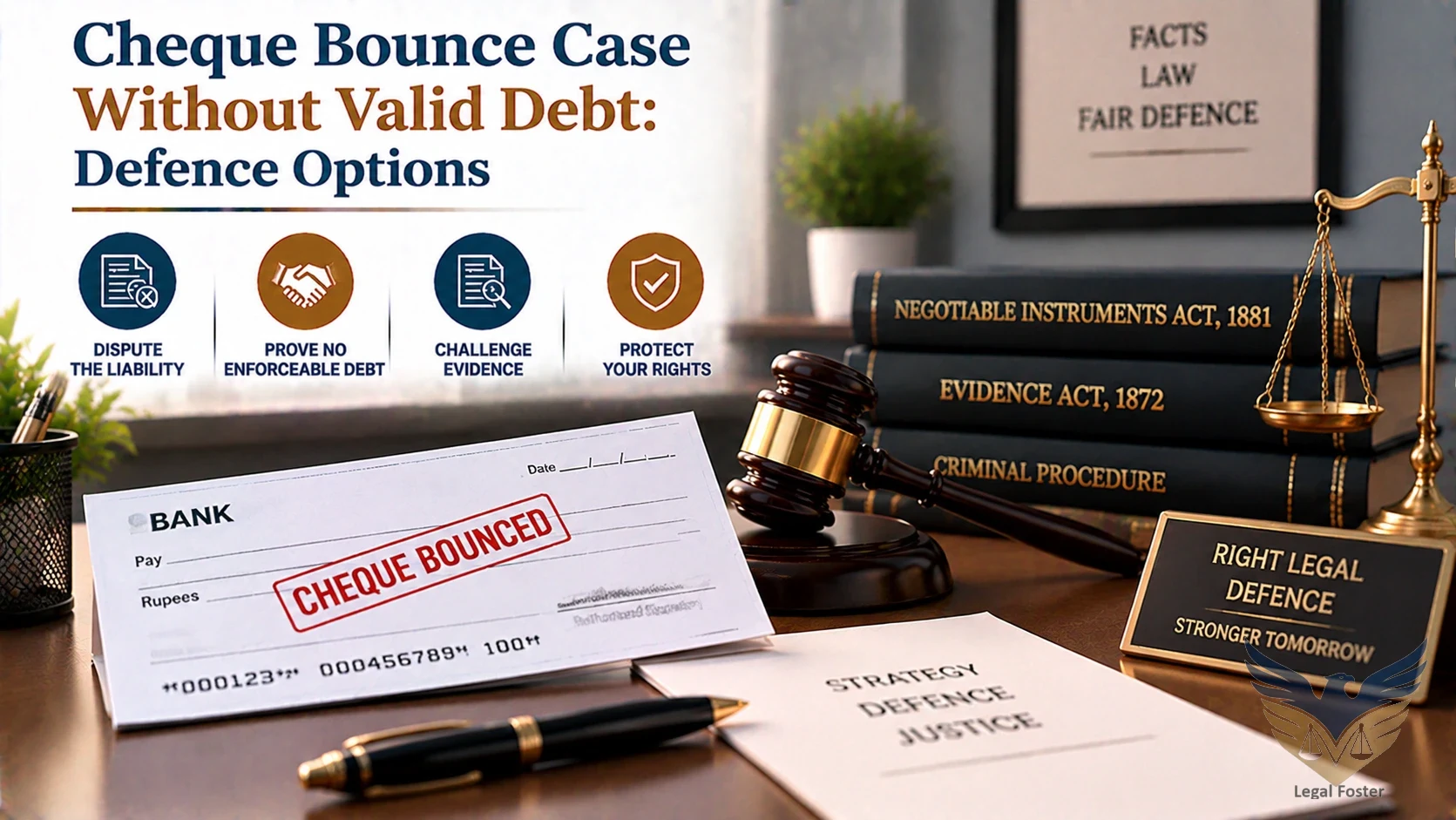
Cheque Bounce Case Without Valid Debt: Understanding Defence Options
A cheque can be signed by drawer itself and can also be drawn upon a valid bank account. However, what if we dig out the aspect of whether the cheque in question was issued for discharge of a lawful debt or liability. This is exactly one of the situations which crop up in many cheque bounce cases.
It may be issued on a security cheque. Or may be a loan which you claim you did not owe. Or may be issued against a running account or an account in advance or part paid or even in some familial relationships. There are numerous situations where you might be served a cheque bounce notice and you think that conviction is definitely looming around the corner for you. But that may not be how law stands.
As discussed above in this article, section 138 gets attracted only when a cheque which gets bounced was issued towards payment of a legally enforceable debt or liability. Even though there arises a presumption in favour of the holder u/s 139 NI Act 1881, this presumption is rebuttable if a probable defense is raised. Whether it be on the basis of documents, or on the grounds of certain situations, or even by using the evidence against the complainant himself.
Cheque bounce case defenses should always be revolving around the transaction. Whenever you are dealing with a cheque bounce case whether in Delhi NCR or any other part of India try and connect your defense to the transaction involved payments made and the circumstances surrounding the transaction.
Whenever advocate BK Singh gets any cheque bounce under section 138 NI act case he always verifies the status of the transaction. Whether you owe anything to that transaction or how much do you owe. Did you paid earlier or what was the reason behind issuing the cheque and so on.
What is the relevance of Legally enforceable debt?
A cheque issued must be towards payment of a lawful debt or liability , Section 138 NI act 18 81. Hon'ble supreme court has on many occasions emphasis the fact that when cheque is issued for payment of a lawful debt or liability, it becomes vital ingredient of a offence u/s 138.
Lets take a example where the cheque is issued by a businessman to transact some work with some other person but later on that deal got cancelled and he was not supposed to pay anything legally. This kind of situation will come across our eyes when we sit to decide a matter under section 138.
It's common for cases to involve a running account between two individuals, where a cheque issued for a particular figure might have been preceded by other payments before it was cashed. So the question of lawfully enforceable debt as on that date arises.
This is whereonly Advocate BK Singh will dig out the entire transaction rather than peeking into one single cheque and coming to a conclusion.
Quick Facts
As discussed above section 138 NI Act 1881 deals with dishonour of cheques under certain situations.
- There must exist some debt or liability which is enforceable under law.
- Presumption is drawn under section 139 for what consideration the cheque was taken for.
- Accused can rebut such a presumption by establishing a defence on balance of probability which is most likely.
- Partial payment can influence the legal character of a cheque prior to it being presented for payment. This has been discussed by Hon'ble Supreme Court in case of Dashrathbhai Trikambhai Patel Vs Hitesh Mahendrabhai Patel.
- Notice period and time for filing complaint still remains relevant.
- There might be chance for settlement / compoundable nature as well depending upon the facts of case.
What is Legally enforceable Debt?
If a person owes money today to someone and can be recovered under a contract/liability then it is a debt. This definition can be more wider than just loan. Honble Supreme court has stated that Debt or other liability can be an obligation created by law for which one assumes liability in certain conditions. The emphasis would be to see if there is liability which is enforceable by law and not restricted to see that the cheques amount was drawn out to the drawer.
Hence when the Accused pleads that money was initially with some other person the defence may not hold. The undertaking / Contract/ Transaction and the agreement needs to be scrutinized.
When the accused is able to prove that money was not payable or money was repaid before presenting the cheque/ amount was lesser than that of cheque, etc can help you establish your defence.
What Is the Legal Framework for This Defence?
The most important act is the Negotiable Instruments Act 1881. It's mainly Sections 118, 138, 139, 140, 142, 143, 143A, 145 and 147. According to India Code section 138 is used for dishonor of cheque and section 139 provides presumption to the holder.
There are many criteria that must be fulfilled under section 138. One being the cheque should be dishonored within it's due validity period. Next there needs to be a legal notice issued within the stipulated time once cheque is dishonored. After that the drawer should fail to pay the amount due within the given time period of legal notice. Many times it's been held by the Supreme Court that the time duration of 15 days is very important when issuing the legal notice.
Section 139 becomes crucial in case of defences. The moment you are given a statutory presumption the accused person has to prove his defences. Just by saying that there was no dues would not save him from this presumption.
He/She can bring forth his/her arguments on basis of preponderance of probability and does not need to prove it beyond reasonable doubts like a criminal offence. Either from his evidence or from complainants evidences.
Hence Advocate Bk Singh suggests to retain the whole deal instead of just looking at the bounced cheque.
Which Situations Can Support a No-Debt Defence?
Amount Paid Off
It could be shown by bank statement / UPI / Receipt / Ledger / Written acknowledgement etc. That a portion or full amount of what is being claimed has been paid off.
Date can also play a role here. If the payment took place prior to the cheque being dishonoured, the debt due could be less than what the cheque amount reflects at point of dishonour.
Amount Didn't Arise From Transaction
Cheques can be given during course of business discussions, for advance purposes or to secure a deal that might not have taken place. It's important to know the law between parties and if any debt was created prior to the date of dishonour.
If any part of the debt was paid off.
As per the judgement by Hon'ble SC in case Dashrathbhai Trikambhai Patel we can say that this section will come into play if the debt was reduced due to any reason. Hon'ble court has discussed in this regard that at that particular stage amount should be due. It also mentions the provision about how endorsement should be done if part of amount is paid.
Amount doesn't tally with books of accounts.
If there are book of accounts maintained with your client many issues can arise like pending bills, debit notes, returns, interest charges etc. In case there has been adjustment which is not mentioned you may want to check through them.
Security Cheque
As I stated earlier labelling a cheque as Security cheque alone will not help you out in most of the cases. We would need to look at what was agreed upon while giving the cheque and if any debt existed at the time of dishonour.
So keep these points in mind while saying that it was a security cheque.
How Is the Defence Process Usually Handled?
Step 1: Factual Reconstruction
BK Singh may start off by going through the cheque, bank return memo, statutory notice, complaint, transaction supporting documents and history of payment or expected payment.
Step 2: Documentary Picture
Bank statements, invoice copies, agreements, account books, email exchanges, WhatsApp conversations, receipts, settlement letters and any other material document may reveal what transpired.
Step 3: Legal Response
Depending on whether the matter is at notice stage, or whether summons have been issued; or whether a trial is pending; or whether this is an appeal or proceeding before a superior court, the legal response will be different.
At the right stage, the remedy may include defending against the complaint made out, disproving the complainant’s version of events through admissible evidence, examination and cross examination, written submissions (applications) to the court, final submissions (arguments) or even settlement. Which path is taken depends on what the record shows.
Note for clients in Delhi NCR: Sometimes court jurisdiction is important too. Since Cheque dishonour proceedings may be initiated before the competent Magistrate court having territorial jurisdiction (as per the statute and applicable Supreme Court rulings) please ensure the proper forum is determined based on facts. Just because a party resides in a particular court’s vicinity does not make that court the correct forum.
Documents to be preserved:
An accused person in a cheque bounce case should not destroy or casually dispose of evidence of transactions.
They may include:
- Copy of cheque and bank return
- Notice under law and its delivery proof.
- Section 138 complaint and summones if already issued.
- Bank statement during the period.
- Loan documents/invoices/Purchase order/service agreement
- Cash receipts and proof of payments (credit cards, cashless, NEFT/RTGS).
- Party’s Ledger and account reconciliation
- Email/ WhatsApp/other messages which will be relevant to your case
- Written settlement offers/ acknowledgements of receipts.
- Any other document which sets out the reason for issuance of cheque.
- Documents related to dispute including material evidence on cancellation, termination or failure of consideration.
Preserve electronic evidence in its original form as much as possible. Don’t selectively delete messages just because they are inconvenient. The full conversation could be relevant.
When Do You Need a Lawyer?
Seek legal counsel if you have received a Section 138 notice, got served with a summons, cheque was given as an earnest/ security or advanced part-payment, underlying transaction was rescinded or order was cancelled, or if the demanded amount seems wrong.
It also makes sense to have your documents reviewed by a lawyer if the complainant files papers with inconsistent dates or amounts or descriptions of the transaction.
If your case is already pending, take along the entire case file (including all documents relating to the transaction) to your lawyer and not just the cheque. Your lawyer will need all the facts surrounding the transaction to determine if your defence is one of debt, amount, notice, limitation, jurisdiction or evidence or something else entirely.
How Can Cheque Bounce Lawyer Help You?
Have a dispute relating to dishonor of cheque? Cheque Bounce Lawyer handles legal services for cheque bounce cases, including 138 NI Act filing & defense, Legal Notice, Summonets related help, Mediation & Settlement, Appeals & evidence based preparation. We have listed our Cheque Bounce defence related services here on the website.
When confronted with a claim for payment that you believe is incorrect or inflated, whether because you dispute the existence of a legally enforceable debt or you dispute the amount of such a debt, the best place to begin is not with a formulaic checklist of defenses. Cheque Bounce Advocate BK Singh will review the documents of the transaction, payment history and procedural posture of the matter and advise you of your legal options.
If you are located in Delhi, Noida, Greater Noida, Ghaziabad, Gurugram and Faridabad, feel free to seek help. However our website deals with cheque bounce matters from across India.
Frequently Asked Questions
Is it possible to defend cheque bounce if there was never any debt at all legally?
Yes.It can be defended if the facts and evidence taken together in the particular case support any defence. Section 138(1) is subject to a condition that there should exist a legally enforceable debt or liability and Section 139 merely raises a statutory, rebuttable presumption as to the existence of the facts. The accused will have to raise some probable defence as to his evidentiary position and the surrounding circumstances of the case.
Does a cheque signed by the Accused automatically prove the debt?
No. Although the cheque signed by the drawer will attract statutory presumptions under Section 139, this is rebuttable and evidence as to the surrounding transaction will always be relevant in every case.
Is it possible to defend cheque bounce if cheque was delivered as “security” against the debt?
Evidence as to the surrounding transaction will remain relevant in every case. A cheque delivered as “security” will not by itself make a complaint under Section 138 non- manufacturable and the Court will have to see if there did exist a legally enforceable liability in favour of the complainant when the cheque was presented.
If I paid some amount due before presenting the cheque, can I defend cheque bounce?
Yes, payment of part amount due before cheque presentation can become quite relevant in law. The Apex Court has clearly laid down that for the cheque to satisfy the requirement of Section 138 it must be the legally enforceable debt or liability of the drawer when the cheque is presented and has also specifically dealt with subsequent part-payment of an amount due prior to the presentation of cheque.
Will bank statements help in cheque bounce defence?
Cheque bounce defence bank statements can help show previous payments made by you or account movements or can sometimes help highlight inconsistencies with the amount stated as being due by the complainant. Whether or not they will be of any value will depend upon the facts.
Can I defend cheque bounce if the underlying transaction was cancelled?
Cancellation is often relied upon where (usually between drawer and payee/ collection co debtor) the underlying transaction was cancelled, rescinded or terminated and therefore the liability which the cheque represented never became legally enforceable. Sometimes the liability will become enforceable and is subsequently extinguished by payment or other means. It will be necessary to look at the actual contract and entire history of the transaction.
Do I have to prove that there was no debt in existence as part of my cheque bounce defence?
No, the accused is not required to prove his defence in every case by giving evidence in person. In fact in several decisions the Apex Court has reiterated that the accused is entitled to raise a probable defence by calling the attention of the Court to the evidentiary situation and surrounding circumstances of the case including material adduced by either side.
Can you settle a cheque bounce case once it is filed?
Yes, it is possible to settle a cheque bounce case even after the drawer has been accused of committing an offence and the complainant has initiated proceedings. Offences under the NI Act are compoundable (ie allowed to be settled) (see Section 147) subject to following the prescribed procedure laid down by law and depending on the facts of the case.
What sort of terms should be recorded for settling cheque bounce case?
Since each case will be different depending on the facts what terms should be recorded will differ. Take Print and keep copy of the exact terms discussed and eventually signed by the parties.
What should I do upon receiving a Section 138 notice?
Take prompt legal advice upon receiving a section 138 cheque bounce notice from a lawyer. Do not ignore the notice. Preserve the notice itself (ie envelope or delivery receipt upon which it was delivered), cheque details, bank memo and all documents related to the entire transaction.
Can Advocate BK Singh help with cheque bounce defence?
Advocate BK Singh - Cheque Bounce Lawyer can help you with your cheque bounce legal issue. We offer advice and assistance to parties involved in cheque dishonour disputes. Our legal services include assistance with cheque bounce analysis, sending legal notices, cheques, suits in court, negotiating settlement and other Section 138 legal issues.
Conclusion
A cheque bounce complaint cannot be judged solely on the face of cheque. Its underlying legally enforceable liability is the heart of a Section 138 proceeding. If the amount was paid, transaction failed, liability was reduced , cheque was issued for different purpose or complainant’s story is at odds with documentary evidence, these are facts that merit careful legal consideration.
Don’t destroy doccuments, ignore notices or think that a single line such as “security cheque” will fix everything. Preserve the record and seek advice sooner rather than later.
Advocate BK Singh can review the documents, point out the legal issues involved and advise you on the defence or settlement option available to you depending upon the facts of your case.