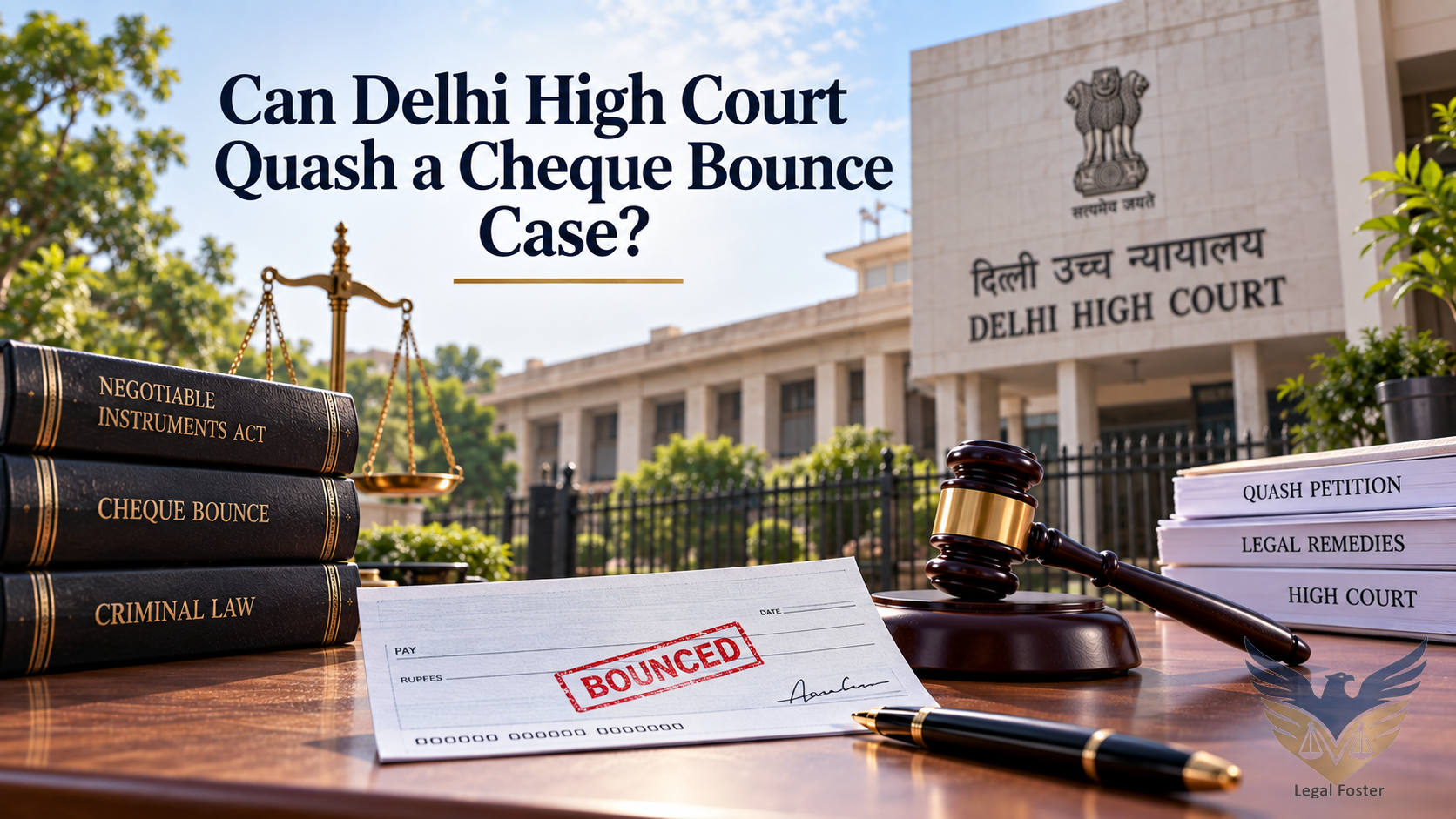
Can Delhi High Court Quash Your Cheque Bounce Case?
It certainly can. However, quashing is not available as of right, even if both the accused and complainant want the matter terminated.
There comes a point in every cheque dishonour complaint where the accused understands that court proceedings can go on for years. There are multiple court dates where nothing happens. Relationships are destroyed. Family members can get anxious. If there are business disputes, there can be pending negotiations with customers, lenders or business partners that hinge upon the pending criminal complaint.
Everyone wants a criminal matter to go away as soon as possible. This is why many wonder: Can Delhi High Court quash my cheque bounce case?
Yes, they absolutely can, but there's more to it.
How quashing a cheque bounce case is different Quashing a complaint filed under Section 138 NI Act, 18 81 is vastly different from defending yourself at trial. It is also different from settling the matter with the complainant.
BK Singh Advocate talks to many clients about evaluating all of their legal options. Some want to know if their cheque bounce complaint even has any legal merit to defend. Some want to know how the High Court can really quash their case. Others learn that settling or compounding their cheque bounce case is their best option.
The one thing many people miss is that even if your complainant is willing to settle with you, that does not mean the High Court will dismiss your cheque bounce case. A settlement may be grounds to have the complainant drop the matter from court, but you must show the High Court why your case should be quashed.
Why you should consider quashing in Delhi in 2026?
India has millions of broken commercial transactions, personal loans, business payments and contractual agreements that turn into cheque dishonour complaints.
It doesn’t take long for a single bad transaction to open the door to years of litigation.
When accused in Delhi, most defendants care about more than just the face value of the cheque. They worry about the hectic schedule of court appearances, accumulating legal costs and what uncertainty brings to their family. A business will have downtime and lost opportunities while fighting a case. Clients often want to know how to stop a cheque bounce case as soon as possible.
The ability to compound a cheque bounce case doesn’t begin and end with Section 147 NI Act.
As previously mentioned, the Delhi High Court has inherent powers under Section 528 BNSS, 2023. Every legal strategy you consider should be reviewed under the criteria of: will it apply to my situation and help get the charges dropped?
Cheque bounce facts every Delhi defendant should know.
Quick Facts About Cheque Bounce Quashing
- Court: The Delhi High Court has inherent powers to quash petty criminal proceedings in appropriate cases.
- Applicable cheque law: Section 138 Negotiable Instruments Act, 18 81.
- Compounding: Offences punishable under the NI Act are specifically made compoundable under Section 147 NI Act, 18 81.
- Applicable scheme: BNSS, 20 23 would govern proceedings arising out of the new scheme of CrPC, subject to savings.
- Quashing: Section 144 is a discretionary remedy and cannot be claimed as of right.
- Compromise: While a bona fide compromise would have a significant impact on the Court’s decision to utilise its inherent powers, it would lead to different legal remedies depending on the facts and what you ask for.
- Outcome: Take home point – Every fact situation dealing with cheque bounce must be determined by its own set of facts, documents, pleadings and history.
What Does “Quashing” of a Cheque Bounce Case Actually Mean?
Simply put quashing means that the High Court will invoke its inherent jurisdiction to stop criminal proceedings from continuing any further in cases where allowing the continuation of such proceedings would be legally unsustainable or would otherwise be an abuse of the process of the Court.
That is different from an accused person asking the Magistrate to believe him and accept that the complainant will not be able to prove the offence.
The Trial Court is perfectly capable of dealing with the matter before it. When you approach the High Court with a quashing petition you are asking the High Court to intervene (in a higher sphere) and stop the proceedings from continuing on a legal ground.
The difference is important to understand because quashing is not a process for replacing a trial in cases where the accused only disputes the version of facts given by the complainant.
For this reason Advocate BK Singh first reviews the complaint, cheque, return memo, statutory notice, underlying transaction, pleadings and procedural history before deciding if seeking High Court remedy is even worth your time.
On What Grounds Can the Delhi High Court Quash a Cheque Bounce Case?
As the above points out different Courts have recognized different grounds for quashing in different circumstances. There is no magic checklist that can be applied to every case to see if your case will get quashed.
The High Court will have to look at the complaint and the complete facts and circumstances of the case to decide if allowing the proceeding to continue would be an abuse of the inherent jurisdiction vested in the High Court. Different facts become relevant depending on how your case unfolded.
Cheque Case Quashed as Complaint Did Not Disclose Required Ingredients to Establish Offence
If the Complaint states that an offence was committed but when read at its face value, the complaint itself does not disclose the ingredients necessary to constitute that offence, then you may be able to seek appropriate High Court intervention.
Once again such an argument would have to be made by way of the pleadings and based on the record. You can’nt file a quashing petition and try to substitute what actually occurred with what you think should have been stated.
Quashing in cases where allowing continuation of proceeding would amount to abuse of process
The largest category of cases where quashing is sought involves situations in which allowing the criminal proceeding to continue would amount to an abuse of the process of the Court.
For example in one recent decision the Supreme Court looked at a cheque-related dispute where there were two parallel prosecutions pending regarding the same underlying liability. The Supreme Court held that allowing the later proceeding to continue would amount to abuse of process.
This does not mean that every time there are 2 complaints filed the second will be quashed. You would have to look at the relationship between the cheques, the underlying liability, the parties and the proceedings.
Cheque Bounce Case Quashed as Parties Settled their Dispute
One of the most common scenarios where accused persons think of High Court quashing is where there has been a settlement of the underlying dispute.
The NI Act specifically allows for offences to be compounded. Compound is a legal term that essentially means settled.
If there has been a settlement of the underlying dispute it should be reduced to writing and reflect the deal that the parties have actually entered into. Depending on the facts and the stage of the proceedings, it may be possible to compound before the court or seek High Court quash out. The two are not the same and should be treated differently.
Quashing Based on Some Legal Defect in the Proceeding
The complaint was filed in the wrong Court or maybe that the Court did not have jurisdiction for some other reason. These are examples of defects that can be picked up from the record alone.
Cases like this would have to be examined carefully as not every defect would be sufficient. The inherent powers of the High Court are meant to be used to prevent the abuse of the process of the Court and to ensure that the ends of justice are met. It is not a playground to conduct a trial within a trial on disputed evidence.
Can Cheque Bounce Case be Quashed After Settlement?
NO. Merely because there has been a settlement, orders of quashing do not rain from heavens.
Let this be the first and possibly the single most important thing that an accused needs to know.
Offences under the NI Act can be compounded under Section 147 of the NI Act. But whether compounding or some other legal relief should follow the settlement would depend on various factors including what stage the proceedings are at, what exactly was agreed as part of the settlement, how have the parties been conducting themselves and what relief they are actually asking for.
Take the example of a business dispute. Three cheque bounce complaints are filed against you. You and the complainant later settle and agree that you will pay him a certain amount by way of installments. Merely because you sign a compromise on that effect, does not mean that the complaint filed against you in Court shall automatically disappear.
The said compromise would first have to brought to the notice of the Court that is dealing with the case (or High Court as the case may be) in the manner prescribed by law.
Advocate BK Singh will help you decide if compounding, filing of an application in the High Court or some other legal avenue is the most suitable course of action.
What Is the Difference Between Quashing, Compounding and Acquittal?
Simply put, they are different remedies and care should be taken not to confuse them.
| Remedy | Basic concept | Typical relevance |
|---|---|---|
| Quashing | Court pulls up Court which initiated proceedings i.e. High Court quashes the proceedings,if the facts and law so justify. | Highly fact and ground specific. |
| Compounding | The parties directly compound the offence if it is compoundable | High importance as offences under NI Act are compoundable. |
| Acquittal | The accused is acquitted of the offence after trial. | Usual remedy after trial |
| Settlement | The parties settle among themselves. | Could lead to compounding or some other remedy. |
Which remedy is applicable would depend on the stage of the case and the actual facts.
Who Needs Advice On Delhi High Court Quashing?
As a general rule if the accused:
- finds themselves facing a cheque bounce complaint in Delhi;
- has already appeared before the Magistrate;
- faces several complaints arising out of the same underlying business relationship;
- has entered into a bona fide settlement with the complainant;
- has documentary evidence of a fundamental flaw in the basis of the complaint; and
- has concerns that the criminal proceedings may continue even if the underlying dispute has been resolved; or
- whose case involves allegations in the complaint that, taken at face value, may not actually constitute the offence complained of.
Businesses should exercise particular caution where more than one cheque, invoices, running account, security cheque or settlement is involved.
The Facts. One document does not tell the whole story.
What Is the General Legal Route for Seeking Quashing?
Approaching the High Court
Usually starts with a review of the current criminal record and legal grounds upon which you seek relief.
The complaint, cheque, bank return memo, statutory notice and any reply, documents which support the transaction relied upon by the parties and orders passed by the trial court will typically need to be reviewed. Legal position is then considered on the actual facts alleged rather than speculation as to what may or may not have occurred.
If it is considered that a High Court petition is justified, the matter is filed in the Delhi High Court along with a relevant record and statements of grounds. The complainant and other interested parties will usually be given a chance to be heard. The court will then determine whether the facts of the case are such that it warrants intervention.
Quashing is a remedy for justice. It is not to be viewed as a way of circumventing trial just because a criminal complaint is something the accused would rather not deal with.
Documents to review before Quashing Petition filing:
Typically your lawyer will want to review documents that show the cheque details and reason for dispute.
Please make sure to provide –
- Documents proofing The Transaction
- Copy of cheque
- Bank return memo
- Statutory notice by complainant
- Service of notice proof
- Cheque bounce complaint
- Order(s) of summons / passed by court
- Copy of reply to notice, if any.
- Agreement(s)/contract(s) between parties.
Documents that proof the transaction between the parties such as –
- Invoice /invoices
- Account statements / receipts
- Payments made
- Correspondence
- Records of settlement if any.
Any other supporting document that explains why the cheque was issued for liability.
If there are multiple proceedings obtained in the matter, make sure you get a copy of those proceedings and any orders.
Always provide all the documents. Your lawyer will not be able to give you an accurate legal opinion by selectively reviewing documents.
At what point should you seek a lawyer for a bounced cheque issue?
Lawyers can add value to your case when you have already received a summons/complaint is served/pending/or multiple cheques are involved/or settlement talks have commenced/or the accused has doubts that there is some legitimate issue with the way the case has been handled.
Sometimes the transaction is disputed and the reason for the cheque bounce is connected to the invoices, loan agreement, business account, security cheque or prior compromise.
If you want to approach Delhi High Court “BK Singh” can review your entire record instead of just listening to your side of the story and opining based on cheque number/amount.
We will go through the record that is available to you and explain to you whether the matter can be defended at trial court, settled & compounded or whether High Court remedies are available.
How can a lawyer specializing in cheque bounce cases assist you before the Delhi High Court?
We concentrate on providing legal help to those affected by cheque dishonour disputes related to friends, family, businesses and commercial transactions.
Once Advocate “BK Singh” has reviewed the complaint, documents, facts of the case, procedural history and settlement posture we can advise you whether approaching Delhi High Court is your correct course of action and what relief you can ask for.
As mentioned previously, you will be clearly advised on what can and cannot be done. If filing a petition to quash is not possible for legal reasons we will tell you that. We will also let you know if there is an alternate remedy that can be pursued based on the facts of your specific case.
Whether you are in Delhi or anywhere else in India, our advice will be the same. Cheque dishonour cases come from all over such as Ghaziabad, Noida, Greater Noida, Gurugram, Faridabad, Meerut, Hapur, Lucknow, Kanpur, Prayagraj, Varanasi, Agra, Jaipur, Chandigarh, Mumbai, Pune, Bengaluru, Hyderabad, Chennai, Kolkata or Ahmedabad.
Frequently Asked Questions
Q1. Can Delhi High Court quash cheque bounce case?
Ans. Yes. High Court have powers to quash the proceedings under its inherent jurisdiction if legal parameters for granting such relief are satisfied. Quashing is not mandatory and depends on facts and record. Quashing is discretionary relief which can be granted by Court.
Q2. Can cheque bounce case be quashed after settlement?
Ans. No, not always. Offences under NI Act are compoundable under Section 147 NI Act. However, the procedure to be followed and the relief available will depend on facts and stage of cheque bounce case.
Q3. Under which section Delhi High Court have inherent powers in relation to BNSS?
Ans. Section 528 Bharatiya Nagarik Suraksha Sanhita, 20 23. preserves the inherent powers of the High Court.
Q4. Can High Court quash cheque bounce case after summons is issued?
Ans. It depends on facts and legal grounds upon which high Court is sought to be invoked. The issuance of summons is only one fact and does not by itself provide the answer to the question.
Q5. Can High Court quash all cheque bounce cases issued for cheque issued for same transaction?
Ans. No. Not necessarily. Courts have on occasions quashed multiple cheques for same liability against same party. However each set of facts needs to be analysed on the complaints filed.
Q6. Can High Court quash cheque bounce case if we have given security cheque?
Ans. No. Firstly there is no principle of law that says if cheque which is a security cheque then only quashing can be done. Reason for which cheque was issued and circumstances of receipt & presentation are relevant facts.
Q7. Can complainant recall cheque bounce case after he has agreed for settlement?
Ans. Procedure will depend on facts. While offences under NI Act are compoundable, one way to dispose off the matter would be to show legal settlement.
Q8. If High Court quashes the cheque bounce case against me does that mean I am acquitted?
Ans. No. If Accused is acquitted means he was convicted and found not guilty. Quashing is an intervention by the High Court to halt the proceedings.
Q9. Can lawyer in Delhi High Court guarantee you that your cheque bounce case will be quashed?
Ans. No prudent lawyer who knows law will guarantee quashing. High Court will decide the application based on law and facts.
Q10. What documents should one carry for consultation of cheque bounce case being quashed?
Ans. Cheque, Bank return memo, Statutory notice, Complaint, Court orders, supporting documents of transaction, settlement and any correspondence will be needed.
Conclusion
Cheque bounce case has been filed against me, can Delhi High Court quash it?
Just because you have been charged with a cheque bounce case, it does not automatically mean that the Delhi High Court will quash your case. Quashing is available at the High Court’s discretion but can be granted in certain situations based on law and facts. Thinking that your cheque bounce case will go away if you ignore it is not the best legal strategy. Some options that may be available to you include defending your case at trial, compounding the offence (if eligible) or asking the High Court to quash the complaint.
Contact Delhi High Court lawyer Advocate BK Singh to see what options are available to you and if the facts of your cheque bounce case are suited to seeking relief from Delhi High Court. This post is intended only for general information purposes. This article should not be construed as legal advice.