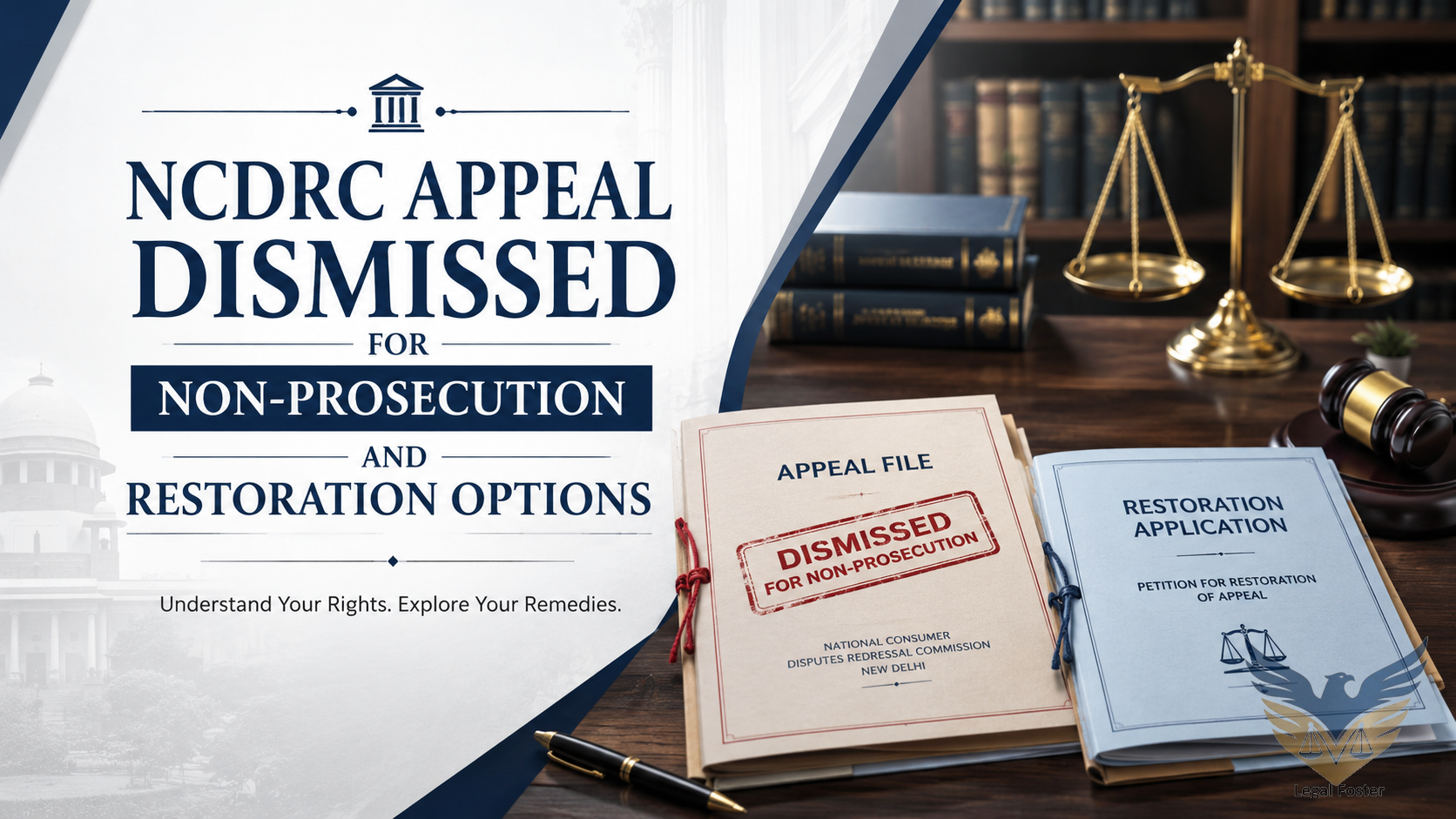
Can an NCDRC Appeal Dismissed for Non-Prosecution Be Restored?
It’s been months. Years even. Your appeal has been pending forever at the NCDRC and today is the day. The day of the hearing you missed. You either didn’t see the cause list. Or you changed counsel. Or you were sick that day. Or any number of reasons you found yourself absent on a hearing listed in front of NCDRC but somehow missed when going through your pleadings/calendar. At last you click on the order. Dismissed for non prosecution. Or dismissed in default.
No worries. Or, wait. Yes worries. Okay fear a little. But those two little words do not mean the NCDRC meticulously reviewed every pleading filed in your matter then determined your entire appeal to be absolutely worthless. A dismissal in default could simply mean that counsel or party failed to appear/prosecute before the Tribunal.
There have been multiple actual cases filed before the NCDRC that discuss dismissal of appeals for want of prosecution and subsequent application for restoration following such defaults.
Is your appeal simply restored? Not quite.
Orders dismissed by NCDRC for non prosecution.
The National Commission was vested with Statutory Express powers Under Consumer Protection Act, 2019 Order passed by National Commission can be reviewed under Section 60 of CPA. If any order is passed by compensation is not the subject matter ex parte an application can be made to NCDRC under Section 61 of CPA. Order for setting aside such order. Basically if your appeal was dismissed for non prosecution you have multiple options. But here not all choices would apply.
Your choice of remedy would depend on the verbatim of order of dismissal, nature of proceedings & facts surrounding default.
You’ve spent months or years litigating against builder, insurer, bank, hospital, seller or service provider. You shouldn’t have to face getting your NCDRC Appeal thrown out just because you were a day late and didn’t show up. No one wants to file an application in court and make matters worse. Have Advocate BK Singh review your order of dismissal to see if you can file an application for restoration, recall or review of the order or perhaps another legal remedy is available to you.
Why does NCDRC Dismissal for Non Prosecution Matter in 2026?
Appeals to NCDRC are drafted against orders made by the State Consumer Commissions because NCDRC has appellate jurisdiction over those orders as per Section 58(1)(a)(iii) of the Consumer Protection Act, 2019. Therefore, an Appeal to NCDRC becomes an important course of action for litigants residing in Delhi NCR, Uttar Pradesh, Maharashtra, Rajasthan, Karnataka, Telangana, West Bengal and numerous other States spread across India.
But what happens after NCDRC dismisses your appeal for default? Some people tend to just wait around and avoid reviewing the order. But that will never help your case. You’ll want to know what date the order was dismissed. Why did the Bench say you failed to appear. Were you given prior opportunities to show cause as to why your appeal should not be dismissed. This is why!
If you show up every other date than what happened on the date of dismissal won’t matter. But if there has been a continual pattern of non-compliance with filing of documents then an order dismissed for no appearances could have a different issue for relief than an order dismissed where the party continuously didn’t follow court directions.
Advocate BK Singh will first look at the procedural history of your matter in comparison to the specific reasons stated in the order passed. He will not make an assumption that because NCDRC dismissed your appeal there is only one generic solution to get your appeal restored.
Readers who may have been specifically affected by an NCDRC dismissal for want of prosecution can refer to this blog's example on fileding a Restoration Application with NCDRC. Notice that even this blog states that filing an Application for restoration/ recall is a method used often to restore appeals dismissed for default. But similar to above you would still want to confirm what statutory basis applies and whether limitation would bar your application by reviewing both the order and current law.
NCDRC Appeal Restoration Quick Facts
- Dismissal for non prosecution is different from a dismissal on merits.
- NCDRC has the power to review an order passed by itself Under Section 60.
- Application under section 60 for review needs to be made within 30 days from the date of order.
- NCDRC has the power to set aside an order passed by itself ex parte under Section 61.
- Section 67 does not allow Appeal to SC against every order passed by NCDRC.
- Evidence causative of absence/ default would be relevant.
- Requesting restoration/ recall of the order is not expected to be a right just because consumer dispute favored the appellant.
What Does Restoration of an NCDRC Appeal Mean?
Strictly speaking restoration means you are asking that the proceeding that was dismissed due to procedural default be restored so it may continue from where it left off. And for that purpose only is restoration granted.
The Application for restoration of the proceeding does not try your consumer dispute on merits.
If Insurance company files appeal to NCDRC against repudiation of huge insurance claim then ordinarily consumer dispute in regard to restoration application would be tried as to why the appeal was dismissed from the active list?
Or why the appeal was not heard in spite of being listed.
And not whether the insurer was legally in the right when he repudiated the claim.
Similarly whether the builder should have got possession of an apartment from the buyer is not tried when restoring the appeal for default.
The fact that builder had an emergency on the date fixed for hearing becomes ipso facto a reason to restore the appeal.
Reason for non-prosecution/application for restoration is a separate issue than the merits of the consumer dispute.
Therefore Advocate BK Singh would distinguish three questions :
- What exactly was dismissed?
- What were the reasons for default?
- What statutory remedy is available.
What Law Applies to Appeals dismissed from Non Prosecution from NCDRC?
NCDRC Appeals Under Section 58 Appellate Jurisdiction
Section 58(1)(a)(iii) mentions that National Commission shall have jurisdiction to entertain an appeal against orders of the State Commissions. With these sentences it can be safely be established that NCDRC has power of appellate jurisdiction.
NCDRC Power to Review Appeals
Section 60. Power of National Commission and State Commission to review any order.
“(1) The National Commission or State Commission may review any order made by it
Where there is discovered is reasonable ground and where no appeal is pending.”
If any order is passed by the Supreme Court ex parte then the aggrieved party can file an application to set aside the order under Section 61 CPC.
“ Section 61. Order of National Commission or State Commission passed ex parte.-Where an order is passed by the National Commission ex parte, Commission may, on application made byaggrieved party and on such terms as it thinks fit, set aside the order.”
The language of Section 61 is liberally worded in the sense that it expressly provides the procedure to file an application to set aside an NCDRC order which was passed ex parte i. e. where youparty wasn’t present.
But again a dismissal for non prosecution still needs to be analyzed whether such situation would fit under Section 61. The language used in Section 61, prior hearings (if any) and the overall procedural posture of the dismissal would become important.
BK Singh can analyze whether the Application that you have casually thought of as a “ Restoration application” legally would instead be a Recall application, setting aside application or even a Review petition based on the facts. See blog page discussing possible remedies following dismissal of an NCDRC Review Petition for another example of how the wording of the dismissal order impact what procedural remedy is available.
Can every NCDRC Appeal Dismissed be Restored?
The sentence, “When order passed as prayed” should not be assumed. Whether NCDRC has the liberty to entertain such relief would be dependent on what provisions were invoked for dismissal, nature of the underlying order, reasons for default and complete history of the proceedings.
Here’s an example highlighted from several cases passing through the Rajasthan High Court. Appeal was pending at NCDRC. Appeal got dismissed for want of prosecution. Restoration application was filed by the appellant. Surprise surprise. The Restoration Application was dismissed.
Can you guess what Litigation happened after that? People constantly assume that they can file a “motion for restoration” and magic happens.
A pattern of absconding from the proceedings, refusing to accept notices, defects with the notice only you know about. Disregard to previous orders passed by the court or completely frivolous reasons would doom such applications.
Conversely, if facts are supported by documentary evidence of genuine medical illness, misprinting issue at the printer’s or any other reasonable cause then perhaps your situation would merit different review.
BK Singh will first analyze the fact whether your application is even congruous with the NCDRC order dismissing your appeal.
Documents To Gather After your Appeal Gets Dismissed
Your documents should ideally speak for itself in relation to both the proceeding and the reason for default. But here is general evidence/document checklist:
Copy of NCDRC Order dismissing the Appeal. (Certified/ download from NCDRC site)
Pleading showing complete case number along with appeal number & State Commission Order passed
- Copy of any previous orders from NCDRC/hearing history (if any)
- Cause list for day in question/order was passed
- Emails/conversation with previous counsel.
- Hospital records etc. (only if your default is for illness).
- Travel records/Travel got cancelled only if reason for default is truly because of COVID travel restrictions.
- Printing issue/filing issue if applicable.
- Vakalatnama previously filed and information on previous counsel. (if at any point counsel was changed)
- If any orders were issued by the Registry after dismissing your appeal then copy of those.
- Dateheet/chronological order of events.
NCDRC also on their website explaining Restoration Services mentions the order of dismissal, any documents that support reason for absence and listing documents as some of the documents that can be used. So Advocate BK Singh would first determine if your explanation of the default matches the evidence you provided vs your little client there saying he “missed the hearing by mistake. ”
When should you consult a NCDRC Lawyer?
When exactly. When the order of dismissal has only been passed recently, you no longer have a lawyer representing you, a large amount of money/complaint/ dismissal compensation is at stake or a previous interim relief that you received from NCDRC is about to be lost.
You should consult BK Singh when:
Order has excessive Non-appearances against you. Order was dismissed by Registry because you delayed too much in filing restoration. You had absolutely no clue that your hearing was even scheduled at NCDRC. You and your Former Lawyer are having a debate over if you properly received notice. Restoration/ Recall/ Restoration Petition has been filed already. Review Petition was already filed and dismissed by NCDRC.
BK Singh can pull up your case history.
How Can Advocate BK Singh help you?
BK Singh can review your entire case history rather than looking at your last order of dismissal in isolation. If you would like general information about our services or previous lawyers not helping you in general see our certified Consumer Court Lawyer in Delhi page on how we can assist you with consumer complaints, appeals, revision petitions and documents filed in Indian Consumer courts.
What happens if NCDRC rejects Restoration Application?
The next step therefore would depend on which jurisdiction NCDRC passed the underlying order. Did NCDRC pass the order in appeal ? Or was the order passed by NCDRC in its Revisional jurisdiction.
Section 67 has only created a statutory appeal to Supreme Court against certain orders of NCDRC. Section 67 did not create a statutory Supreme Court appeal against every order no matter what type of jurisdiction NCDRC was exercising.
Therefore Section 67 only allows a statutory Supreme Court appeal against certain orders passed by NCDRC under Section 58(1)(a)(i) or (ii) i. e. when NCDRC was exercising appellate jurisdiction.
If NCDRC was exercising its revisional jurisdiction then Section 67 would not apply since NCDRC cannot hear appeals against its own orders.
The Supreme Court has not reversed its own decision yet in Universal Sompo General Insurance Co. Ltd. v. Suresh Chand Jain.
In one of the passing orders on March 20th, 20 25 where NCDRC had passed a order exercising its revisional jurisdiction, Supreme Court gave liberty to approach the High Court in appropriate proceedings rather than allow the SLP to be filed directly in Supreme Court.
Since you now know that WHERE NCDRC passed the order matters. Whether the appeal was deleted from the active list in NCDRC appeal jurisdiction or in NCDRC’s revisional jurisdiction would dictate the forum to challenge the order.
BK Singh would have to review not only what order the NCDRC passed on restoration but where the underlying NCDRC proceeding was filed as well. Was it an appeal? Was it a revision?
Was it filed as an original Consumer proceeding in NCDRC.
How Can NCDRC Lawyers help if your appeal was dismissed?
Handling a dismissal order involves much more than copying your facts of the consumer complaint and pasting them into another application.
Filing an NCDRC Appeal for Hearing requires reviewing the dismissal order, going through the listings, Sorting out evidence and finally getting that matter ready to file along with the correct application in the correct forum. Our website has information on our law firm. We handle consumer law related matters from NCDRC complaints,appeals to filing revision petitions and paperwork in consumer courts.
BK Singh would first determine if the law even favors granting your application for restoration. If you have general concerns regarding your legal representation see our credentials page for information on who BK Singh is. Otherwise we can review your matter.
BK Singh would determine whether the law and facts support filing an application for restoration,recall or review of the order. BK Singh will review limitation bar if any, prior procedural defaults that you may have caused (if any) and whether a new trial would impact any previous interim orders passed by NCDRC (if any)
Note: No one can guarantee you that your appeal will be restored at NCDRC simply because he files the application on your behalf. All legal advice would be tailored to the specific facts of your case.
Frequently Asked Questions
1. What can I do if my appeal was dismissed from NCDRC for non prosecution?
Yes. You can ask for restoration. But only under certain circumstances. An easy analysis would be to get your order dismissing your appeal from NCDRC for non prosecution reviewed.
Restoration of an appeal is neither automatic nor granted as a right to the parties. Section 60 allows review of an order only for the limited reason of “ error apparent on face of the record”. Section 61 specifically allows for setting aside of an NCDRC order passed ex parte.
2. What should I do after NCDRC order dismissing my appeal?
Get a certified copy of the order, check the cause-list history and write down evidence documenting why you defaulted/ didn’t appear. BK Singh will review whether you can file an application for restoration/ recall, review or some other remedy is available.
3. Restoration to an appeal has to be done within 30 days of dismissal, right?
No. Restore does not arise from the same section each time. Review application can be filed under Section 60 within 30 days of order.
But if you are filing a standalone application for recall or restoration of the order then the statutory basis of that application would need to be determined depending on the provision as well as the facts of the order.
4. Once my appeal has been restored, do I automatically win?
No. Generally the reason for asking for restoration only requests for the continuance of the proceeding. If you won the restoration battle of your appeal then you will have to litigate why your appeal should be successful on merits.
You will have to prove your appeal based on evidence and the consumer laws that apply to your unique facts.
5. I missed my NCDRC hearing because I was sick........
Sickness can be grounds enough. Medical records and exact dates would still need to be established. The Commission does not have to believe you 110% but must analyze whether your reason for non-appearance merits granting you some sort of relief.
6. I heard there was no hearing at NCDRC because my lawyer was unavailable...
All fact situations would need to be reviewed. Did the court send notice? Was there even a cause-list entry that day? What has happened in previous hearings if any.
BK Singh would review if the facts surrounding your non-appearance on your behalf due to your counsel are supported by the actual record of what happened.
Simply making a statement that your counsel was unavailable will not suffice. Evidence and correspondence would be needed.
7. Why should I file a fresh complaint instead of asking for restoration?
Filing fresh complaints are not a decision to take lightly. And should not be viewed as an alternative to properly responding to a dismissal.
Limits, Maintenability and impact of the previous dismissal on the fresh appeal would all need to be reviewed.
8. Can I review an order of dismissal just because I don't want it to be dismissed?
No. You must first identify if there was an error made when passing the order.
If so, was the error apparent on face of the record? Section 60 does not allow you to re-try all disputed issues again. It only allows the NCDRC to review an order at their own discretion if a specific limited condition is satisfied.
9. Can I appeal to the Supreme Court against NCDRC order dismissing my appeal?
No. Section 67 only applies to orders passed by NCDRC in its original jurisdiction. When it comes to Appeals or Revisional orders passed by NCDRC you have been instructed by the Supreme Court to approach the High Court with jurisdiction.
This has been clearly explained by the Apex Court in Universal Sompo and other judgments.
10. Why should I consult a lawyer before filing an application for Restoration myself?
Because if your application is not granted you now have to file another application with the NCDRC along with paying court fees.
BK Singh can review your NCDRC order of dismissal, the status of the previous hearings, evidence, statute etc. before letting you know if your appeal for non prosecution can be restored, recalled or reviewed or if some other court has jurisdiction to hear your challenge to the order.
Final Thoughts
NCDRC dismissal for non prosecution is cause for concern but not panic. Read beyond the words “dismissed” & “non prosecution” by reading the entire order.
NCDRC has powers to review orders passed by itself and file ex parte proceedings are expressly mentioned under Consumer Protection Act.
Additionally different remedies exist depending on if NCDRC passed the order in original, appellate or revisional capacity.
Quick action allows you to preserve evidence, figure out what exactly happened on the date of your non-appearance and make an informed decision on what legal remedy is available to you.
BK Singh can preserve evidence on your behalf by assessing the dismissal order & history of your NCDRC proceedings before deciding whether restoration, recall, review or filing a separate challenge is appropriate.
About the Author
BK Singh specializes in Consumer disputes/ appeals filed against orders passed in Consumer court proceedings. Example: Revision against order of dismissal of consumer complaint, Consumer appeals, revision proceedings etc. He also handles procedures/applications before Consumer Forum. He reviews the complete record, decides the proper forum to file your application and explains the procedure to be followed and risk involved in layman terms.
He may review the order of NCDRC, previous hearing status, evidence on record, statute etc. before informing you if your appeal cannot be restored because NCDRC dismissed it for non-prosecution.