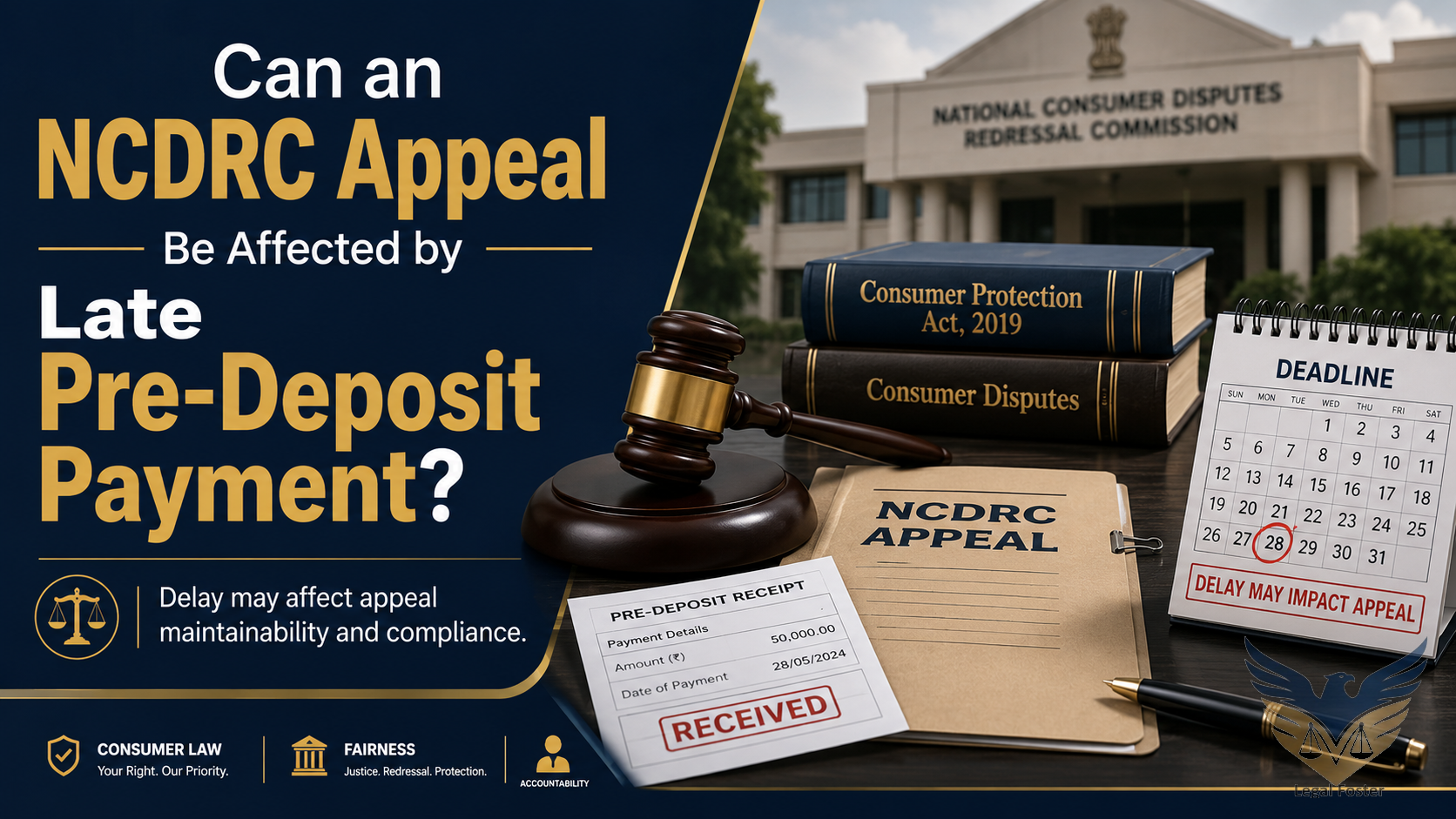
Understand how the mandatory 50% statutory pre-deposit under Section 51 of the Consumer Protection Act, 2019 affects an appeal before the National Consumer Disputes Redressal Commission.
An order from the State Consumer Commission can direct a builder, insurer, hospital, bank, company or another opposite party to refund money or pay compensation. If the party believes that the order is legally incorrect, an appeal may be considered before the National Consumer Disputes Redressal Commission ("NCDRC").
A practical difficulty arises when the NCDRC appeal pre-deposit has not been made even though the State Commission has ordered the appellant to pay an amount.
Section 51(1) of the Consumer Protection Act, 2019 contains a statutory pre-deposit requirement in applicable appeals. Where an appellant has been ordered to pay an amount by the State Commission, the appeal is subject to the prescribed deposit requirement before it can be entertained by the National Commission.
The statutory requirement is commonly confused with the 30-day limitation period for filing an appeal. These are separate procedural issues. Delay in filing raises a limitation question, while non-payment of the required deposit raises a separate compliance and entertainability issue.
Table of Contents
Why Does Delayed NCDRC Pre-Deposit Matter in India in 2026?
The limitation period and pre-deposit requirement operate for different purposes. Section 51(1) provides the appellate framework for challenging certain orders of the State Consumer Commission before the National Commission.
An appeal is ordinarily required to be filed within the statutory period. Where it is filed beyond that period, the National Commission may consider whether sufficient cause has been shown for the delay.
The requirement relating to deposit operates separately where the appellant has been ordered to pay money. Therefore, obtaining relief regarding limitation does not automatically resolve a problem concerning the statutory deposit.
The rule applies to NCDRC appeals irrespective of whether the underlying dispute originated in Delhi NCR, Mumbai, Bengaluru, Hyderabad, Chennai, Kolkata, Pune, Jaipur, Lucknow or another part of India.
Quick Facts
- An appeal under Section 51(1) ordinarily carries a 30-day limitation period.
- Delay may require an application explaining sufficient cause.
- Where the appellant has been ordered to pay an amount, the statutory pre-deposit requirement must be examined.
- Statutory pre-deposit and interim stay are separate legal issues.
- Filing an appeal does not automatically stay execution of the State Commission order.
- An interim stay may itself be subject to conditions depending on the facts and the Commission's order.
- Revision, second appeal and other proceedings should not automatically be treated as identical to a first appeal under Section 51(1).
What Does Section 51 of the Consumer Protection Act Require?
Section 51 of the Consumer Protection Act, 2019 deals with appeals to the National Commission from certain orders passed by State Consumer Commissions.
The provision prescribes a limitation period for filing an appeal. Delay can raise a separate question of sufficient cause and condonation.
Where the appellant has been ordered to pay an amount, the statutory pre-deposit requirement must be satisfied for the appeal to be entertained.
The deposit requirement must therefore be distinguished from the question of whether the appeal itself has been filed within limitation.
Another issue that often causes confusion is the difference between the statutory deposit and a monetary condition that may be imposed while considering an application for interim stay.
Does Filing the Appeal Stop Execution Without the Deposit?
The simple filing of an appeal should not be assumed to automatically stay operation or execution of the State Commission's order.
An appellant may have filed the appeal but still face execution unless the competent forum has specifically granted interim protection. This distinction becomes particularly important where the State Commission has directed a refund, compensation or another monetary payment.
Example
A company may file an appeal against an order directing refund of money. Management may assume that the appeal itself has stopped the consumer from executing the order.
If no stay has actually been granted, the appeal and execution proceedings may continue on separate tracks.
The appeal papers, stay application, proof of deposit and status of any execution proceedings should therefore be examined together rather than in isolation.
Documents and Evidence Checklist
A delayed or disputed pre-deposit issue should be examined with the complete record of the State Commission and NCDRC proceedings.
The operative portion of the State Commission's order is especially important because the exact amount directed to be paid can affect the calculation of the statutory deposit.
When Should You Consult an NCDRC Lawyer?
Legal review becomes particularly important where the 30-day appeal period is running, the NCDRC Registry has raised an objection concerning the deposit, the Commission has fixed a deadline for compliance or execution proceedings have already started.
Another common difficulty is calculation. Parties sometimes assume that every refund, compensation, interest component and cost must automatically be handled in exactly the same way for calculating the deposit.
The correct approach depends upon the operative directions in the particular State Commission order and the procedural nature of the proceeding.
Where limitation and deposit issues are running together, you can also read more about the NCDRC appeal time limit .
How NCDRC Lawyers Can Help
Appeals against State Commission orders may involve limitation, statutory deposits, Registry objections, interim stay applications and existing execution proceedings.
The first question should not be whether a delay will automatically be condoned. The reason for the delay, nature of the proceeding, wording of the State Commission order and stage of the appeal need to be identified.
BK Singh Advocate can assess whether the proceeding is a Section 51(1) appeal, another appellate proceeding, a revision matter or an execution dispute.
NCDRC Lawyers can review the State Commission order, dates of filing, deposit requirement and procedural record before the available course of action is considered.
Frequently Asked Questions
1. Do I have to make a 50% pre-deposit for all NCDRC cases?
No. The Section 51(1) requirement discussed here applies where an appellant has been ordered to pay an amount by the State Commission. Revision, second appeal and other types of proceedings should be examined separately.
2. How much pre-deposit is required in an NCDRC appeal?
In an appeal falling within the relevant proviso to Section 51(1), the statutory requirement is 50% of the amount ordered to be paid by the State Commission. The operative part of the order should be read carefully when calculating the amount.
3. Can NCDRC waive the 50% pre-deposit because of financial hardship?
Financial hardship by itself should not be assumed to remove a mandatory statutory pre-deposit requirement where the particular appeal falls within the applicable provision.
4. Does the 30-day appeal period begin after making the pre-deposit?
No. The limitation period for the appeal and the statutory pre-deposit requirement are separate procedural matters. Delay in filing and non-compliance with the deposit condition therefore need separate examination.
5. What if the NCDRC Registry objects to my pre-deposit?
Read the defect or scrutiny objection carefully and note any compliance date. The issue may relate to non-payment, incorrect calculation, missing proof of payment or another procedural defect concerning the deposit.
6. Does filing an NCDRC appeal automatically stay the State Commission order?
No. Filing an appeal does not itself mean that operation or execution of the State Commission order has been stayed. Interim protection normally requires a separate order.
7. Can NCDRC require more than the statutory deposit while granting stay?
The statutory pre-deposit requirement and conditions that may be imposed while considering interim stay are separate. A stay order can therefore involve additional conditions depending on the facts and the Commission's directions.
8. Can execution continue while my appeal or deposit issue is pending?
An appeal should not be treated as an automatic stay. Unless interim protection has actually been granted, the status of execution proceedings should be checked separately.
9. Is a 50% pre-deposit required if my State Commission complaint was dismissed?
Where the appellant has not been ordered to pay an amount, the applicability of the statutory deposit provision may be different. The actual order and nature of the proceeding should be examined before applying the rule mechanically.
10. When should I speak to a lawyer after a State Commission order?
The appeal should be reviewed promptly because limitation, preparation of appellate papers, deposit calculation, Registry requirements and possible interim relief can all become time-sensitive.
Conclusion
A delayed pre-deposit in an NCDRC appeal should not be treated as a minor procedural detail. Where the statutory requirement under Section 51(1) applies, the deposit issue can directly affect whether the appeal can be entertained.
The State Commission order, memorandum of appeal, filing date, deposit memo, Registry objections and any execution proceedings should therefore be reviewed together. BK Singh Advocate can examine these documents before the procedural position and available course of action are assessed.
Need Review of an NCDRC Appeal?
If your State Commission order involves a monetary award, delayed appeal, pre-deposit objection, stay application or execution proceedings, the complete appellate record can be reviewed before further steps are considered.
Consult NCDRC Lawyers