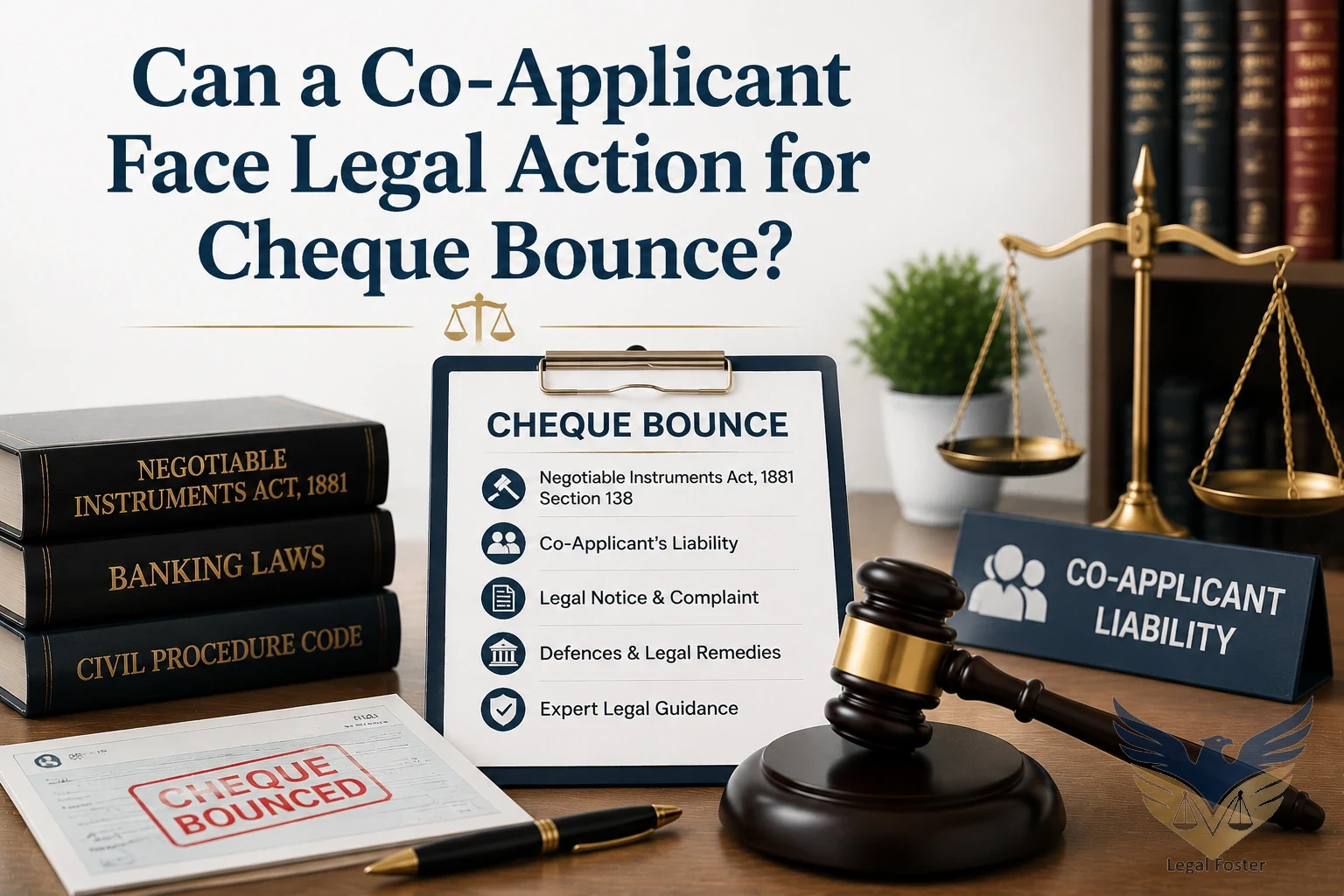
Can a Co-Applicant Face Legal Action for Cheques Issued From a Joint Loan Account?
When an individual writes cheques against a common loan account / company partnership transaction or expense that is shared between parties, cheque bounce creates monetary and legal implications for all parties involved. In the case of a cheque bounce dispute as a co-applicant / co-borrower, you may have certain questions about your rights as well as liabilities.
Defence Against Co-Borrower Cheque Bounce revolves around the provisions of law under NI Act, liability, purpose of cheque and transactions between the parties.
Often, co-applicants are unaware of the consequences of a notice sent under Section 138 NI Act , 18 81 until it has progressed into late stages of litigation. They believe that just because they have signed as a co-borrower on the loan documents, they are liable for every cheque that the other party may have issued. This may not be true in every scenario. Liability is determined by examining the facts, evidence, contracts and intent of the parties when the cheque was issued.
Advocate BK Singh offers assistance and explains to people and businesses in India about their legal standing when cheques issued to them get dishonored, the defences they can plead and why it is critical to act immediately.
Cheque bounce is a time-sensitive legal issue and affects your credibility as well as your financial position. So, when an individual receives a notice or a Section 138 complaint from the other party, they should seek help at the earliest. There are procedural requirements for every legal notice and plea and courts work on timelines.
In this article, we will discuss the laws that apply to co accused in cheque bounce cases, problems faced by co-applicants, documents that can aid you, risks of not consulting a lawyer in time and situations where you need to hire an advocate.
Co-Borrower Cheque Bounce Laws – Important Things To Know In 2026
The personal loan industry is booming, with increasing number of individuals applying for business loans and money transfers for family needs. This has led to lots of cases related to disputes between co-borrowers.
Someone can be a co-borrower on the loan because of the lending requirements, his business needs or might have borrowed money for someone else by being a guarantor. When the loan comes to the repayment phase and cheques get dishonoured, the issuer starts giving excuses and claims that he was never liable to pay.
Court will not look at whose name is on the loan agreement papers and will dig deep to find out why that cheque was issued. For what purpose the cheque was issued? Was there any legitimate debt or any payment was promised? What did the borrower tell the lender? Were there any emails or SMS conversations regarding the money?
Advocate BK Singh had helped many clients fight off defenses against cheque bounce cases based on joint loans. Some even approach us when already served with a notice by the court.
If one becomes aware in time, he/she will have a clear understanding if there is any liability or the matter is only of not honouring the contract amongst the borrowers.
Quick Facts
Section 138 of NI Act deals with dishonour of cheque.
There are certain statutory conditions which must be fulfilled to initiate cheque bounce complaint.
Merely being co borrower cannot be treated as absolute evidenc e to conclude all issues.
What court examines is whether there was a legal obligation enforceable by law and facts of each case.
There are prescribed replies to the notice as well as complaint lodged before the Court.
Evidence becomes very important in cases of documentary evidence.
Fact situation in each case of co borrower disputes are different.
What Is Cheque Bounce Defence For Co-Borrower?
Understanding how a cheque dishonour allegation stacks up against a co borrower from a legal standpoint can be useful. Is he legally liable under the facts and circumstances that surround that particular cheque transaction?
A cheque bounce case is instituted when a cheque is issued towards a debt or legally enforceable liability which has been returned by the bank as unpaid. The payee can initiate the complaint post fulfilling the statutory notice requirement.
For co-borrowers, the crucial aspect that comes into play is whether the cheque was issued by that particular person, was he legally liable for the said liability and what are the documents which reflect their association with said transaction.
Does NI Act Apply To All Borrowers Equally?
Section 138 of the NI Act, 18 81 penalises the criminal offence of cheque bounce. However, there are certain prerequisites that must be satisfied in most cases before proceeding with a criminal prosecution.
Things that the complainant will have to prove include:
- A cheque was issued.
- The cheque was presented to the bank within the time frame.
- The cheque was dishonoured as there were insufficient funds.
- A statutory notice demanding payment was served after the cheque was dishonoured.
- No payment was received from the issuer within the time specified in the notice.
In case of cheques issued by co- borrowers, additional questions of liability are involved. In such cases, the court will assess the loan agreement, who had the responsibility to repay the loan, correspondence and involvement of all persons against whom the case is filed.
All co-borrowers need to understand that their mere association with a financial liability does not make them liable for every action related to cheque transactions.
Document Proofs Checklist
Normally documents will provide you clue to resolve the issue. Following are the few documents which can help you in any dispute.
- Loan documents.
- Documents which show co borrower.
- Cheque Copy.
- Bank return memo.
- Legal notices received/sent.
- Evidence of payment, if any.
- Pass book statements.
- Any communication (records) between parties.
- Partnership/deed/Bussiness if any.
BK Singh Advocate always advice to his clients to keep all the documents safely as a small parameter will flip the entire liability and defences.
When to Consult a Cheque Bounce Lawyer?
Consult a lawyer if:
- You have been sent a cheque bounce notice.
- Your co-applicant has been implicated in the complaint.
- Someone else issued you the cheque for the transaction
- There is dispute related to the parties liable for the loan.
- Received legal notice from court.
- You want to negotiate a settlement.
Hire a lawyer to review the documents, explain the legal remedies available to you and understand the situation.
How ChequeBounceLawyer and Advocate BK Singh Can Assist?
Cheque bounce cases involving co-applicants need to be analyzed carefully as every loan involves different facts.
At Cheque Bounce Lawyer , We will provide legal assistance to our clients who are facing cheque dishonour lawsuits including loan disputes involving co-applicants.
Analyzing the documents, understanding the legal standing and help clients take informed decision as per the law is what we specialize in.
Advocate BK Singh knows that every fraudulent transaction must be investigated rather than focusing on the bounced cheque.
FAQ
Ans. Liability of a co-borrower is analyzed on facts, documents and nature of transaction for which cheque was issued. Liability of each person involved in the transaction is looked into separately.
Ans. Automatic liability would not arise in all situations. Based on the transaction and evidence the law would have to look into the role of each person before arriving at legal position.
Ans. The offences related to cheque dishonour are generally dealt under Section 138 of NI Act, 18 81 (“NI Act”) in India.
Ans. Person who received the notice of cheque bounce should read it carefully and collect all the documents related to the transaction. One should understand his legal position clearly before taking any further step.
Ans. Parties to dispute can always explore the possibility of a settlement (if any as per law and court proceedings).
Ans. Fact that persons are loan co borrowers is not conclusive of situations related to cheque liability. Cheque transaction and related facts would have to be examined.
Ans. Loan agreement, copy of cheque, payment entries, cheque bounce notice and call details would help you understand the facts.
Ans. Business owners can face difficulties like discontinuation of business, reputation, monetary planning etc. from cheque bounce complaint.
Ans. Yes, such notices/ directions from the court should be taken seriously and you must take requisite legal action.
Ans. Advocate BK Singh will help you understand various aspects related to cheque dishonour such as liability involved, documents which will be needed and other legal stuff when two or more persons have been involved as co borrowers.
Conclusion
As every matter is fact specific, we cannot give a YES or NO straight answer to your question. Only because he has been associated with loan/consumer finance does not make him immune to claim Cheque bounce defense. Intended purpose of cheque given, facts of the case & evidence will play a major role.
BK Singh Advocate -at-Law helps individuals & businesses in their cheque bounce matter in a realistic matter oriented manner. We strive to explain the legal matters to you in simple terms and represent you in the most responsible way.
Reach out to us at the earliest, so that we can guide you at the initial stage itself and you do not have to struggle defending yourself in a Cheque bounce case as a co borrower.