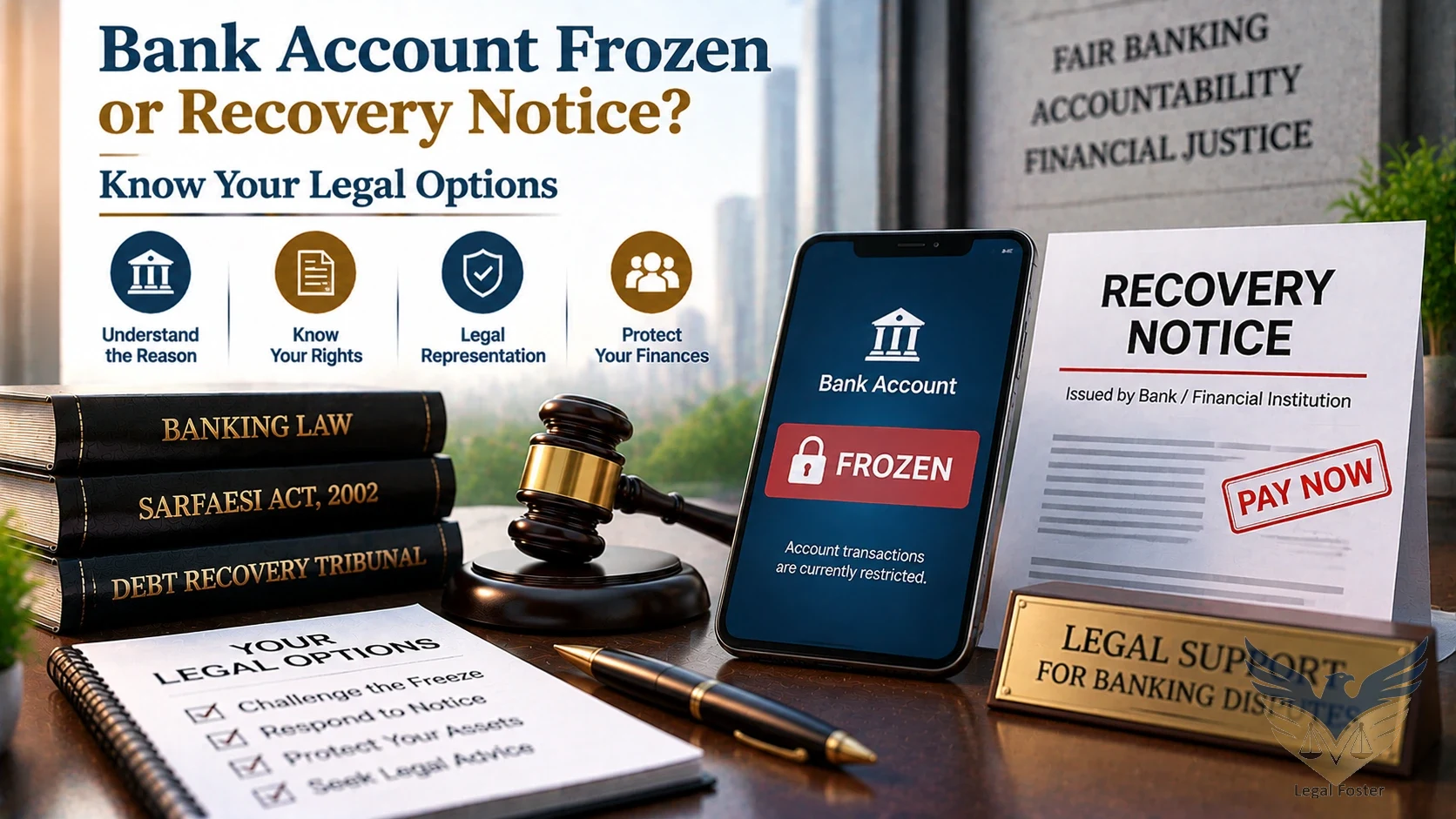
Bank Account Frozen or Recovery Notice Received? Understanding Your Legal Options
Frozen bank accounts can wreak havoc in your life in a matter of a few hours. When an account is frozen, salary becomes inaccessible, EMIs do not get paid, business transactions don’t go through and family expenses are affected. Recovery notice scares you further: will they send lawyers at your door step, will they call you every day, will they tarnish your reputation or can they actually do what they threaten to?
Stay calm if your bank has frozen your account or sent you a recovery notice. The first step is to know your legal recourse. You should understand why the bank has issued notice, whether due process was followed by the bank, what documents you should preserve and what legal reply can help you protect your money/assets/credit score/mental peace.
Banks send recovery notices to account holders for unpaid loan EMIs, credit card dues, business loan defaulters, guarantor liability, secured loan account or disputed transactions. Banks may freeze accounts due to loan defaults, lie on accounts, cyber complaints against you, tax notice to your bank account, compliance with regulatory instruction or may have initiated internal fraud risk controls. Each reason requires a different solution.
You have 3 problems if you have received a recovery notice or bank has frozen your account in Delhi NCR, Noida, Ghaziabad, Gurugram, Faridabad, Meerut, Lucknow, Jaipur, Mumbai, Bengaluru, Hyderabad, Chennai, Kolkata or any other city in India. 1) Your money is stuck, 2) You are beginning to panic and 3) You don’t have much time before things start to affect you badly. Advocate BK Singh & Advocate Sadhna Singh work with borrowers and account holders to understand the legalities of the recovery notice, draft a legal reply to bank and negotiate with bank for a settlement without giving false promises.
Account Frozen or Received Recovery Notice in India
Why Doing Nothing May Cost You More Than Money?
Your account gets frozen. You don’t only lose access to your bank account. Your capability to pay rent gets affected, salary gets withheld from your account, you cannot pay vendors, send your children to school, get treated in the hospital, pay GST, EMI of your loan gets deducted and business transactions come to a halt. Recovery notices can invite threats of illegal settlement, legal proceedings, notice to recover secured assets or additional collection process.
Many Indians skip reading the 1st notice. They wait for the bank to issue them another notice. Thats not a smart move. Banks/NBFCs/financial institutions maintain records of reminders sent, demand notices issued, overdue classified, marked as NPA, intimation to guarantors and recovery notices. Sometimes the inertia from the borrower is interpreted as coercion.
Traders, self-employed professionals, small business owners, salary loan borrowers, new entrepreneurs and guarantors are most impacted in Delhi NCR as these cities support a large volume of business. A single frozen current account can stop numerous outgoing transactions. A single recovery notice for a secured loan can risk your property.
Wisest borrowers read every notice. They identify the loan/transaction under dispute, cross check bank’’s mentioned cause vs what actually happened from their end and take an informed action. Advocate BK Singh & Advocate Sadhna Singh have realized over the years that spending a few minutes understanding your documents can reduce conflicts and provide a better opportunity for legal negotiation.
Some Facts For Borrowers/Account Holders To Note Quickly
- Bank account freeze can happen because of loan default, lien marking, court order, cyber complaint, tax notice, regulatory notice or internal risk trigger.
- Recovery notice can lead to legal notice, property attachment, and recovery measures depending on loan type.
- Recovery of secured loans start through SARFAESI Notice if the loan is mortgage backed or asset secured.
- Recovery of unsecured loans typically happen through demand notices, settlement calls, arbitration (if agreed to in loan contract), civil recovery lawsuits or other legal processes.
- Borrowers should preserve loan documents such as bank statements, loan agreement, sanction letter, notices received, proof of payment and all correspondence.
Don’t let recovery agents abuse you, threaten you, shame you publicly or use unlawful pressure. Understand what the bank can do legally.
Legal options depend on specific facts. They differ from loan to loan depending on amount, type of loan, stage of the recovery process, documents and borrower behaviour.
What Does Bank Freeze or Recovery Notice Mean?
When your account gets frozen, you aren’t able to operate your account (fully/partially). You won’t be able to withdraw funds from your account. You won’t be able to transfer to another account. You won’t be able to do debit transactions from your account. You are not able to see your available balance. Sometimes, only lien amount is frozen against the account. Other times your entire account gets frozen.
A recovery notice means that bank/NBFC/financial institution has asked borrower/guarantor/mortgager to clear the dues. It can be for any kind of loan - personal loans, credit cards, business loans, auto loans, home loans, loan against property, MSME loans or overdraft accounts.
Legally speaking, has bank/NBFC/financial institution followed the procedure agreed to when the loan was sanctioned? Do they have a statute (law) under which they’ve sent you a notice to repay the loan? Did they follow the due process like sending you a demand notice? Did they obtain a court order? Did they receive a cyber instruction? Did the bank/NBFC use their recovery mechanism? Borrowers must try and figure out what exact law the bank is pulling up against them. Many borrowers panic and end up saying the wrong things or accepting EMIs which they can’t really afford.
Visit our truthful page on How to deal with bank accounts get frozen due to loan default to learn how to tackle account freeze problems.
What Laws Applies To Bank Recovery & Account Freeze?
When bank recovers dues or freezes account in India, more than one law may apply. The relevant laws and legal remedies depends on the reasons for freezing and type of loan.
Secured loans are commonly subject to SARFAESI Act, 2002. Section 13(2) of SARFAESI empowers banks to issue demand notice when a secured loan becomes NPA. This notice gives borrower 60 days to pay the overdue amount or raise an objection. If borrower doesn’t respond, bank can start recovery process toward taking possession of secured assets.
If borrower wants to challenge any measure taken by bank under SARFAESI, they must approach Debt Recovery Tribunal under Section 17, after bank has initiated action under Section 13(4). Section 17 is not a casual customer grievance process. Documents, dates and evidence of bank actions are important.
Unsecured loans and credit cards recoveries happen through demand notices, arbitration (if contract permits), recovery lawsuits, reporting to credit bureaus, or settlement negotiations. Review the recovery notice for principal, interest amount, charges and fees mentioned. Validate limitation date on overdue payment and identify any wrongly added entries in the notice.
If you receive abusive calls or messages from recovery agents, keep log of calls, messages, visit dates and agent names. Recovery agents are expected to follow professional standards of conduct. Understand your rights against recovery misconduct.
Read our verified page on dealing with SARFAESI notices for practical takeaways on SARFAESI legal defense.
Can Bank Freeze Your Account Without Reason?
Ideally bank should provide a reason for freezing your account. They might not explain it verbally at the bank branch but you can ask for written response. That response document becomes important because it defines your next course of legal remedy.
If the bank says your account is frozen due to cyber complaint, they will likely mention the instruction came from local police, cyber crime cell, or another investigating agency. If the bank says your account is frozen due to loan, they may refer to your loan contract and mention lien rights, set-off clause, overdue payments or internal recovery department instructions. If the bank says due to tax notice/regulatory notice, they will likely mention the name of the department or authority who communicated with the bank.
Do not rely only on verbal response. Ask for a communication on bank branch letterhead, email id confirmation, note on account status, lien amount and department/authority behind the freeze. It is better to send a calm written request than arguing with bank staff multiple times.
Advocate BK Singh & Advocate Sadhna Singh can help you figure out if the freeze is related to loan recovery, cyber complaint received by bank, legal direction from a court or tax department, or something else mentioned in the banking contract.
Who Should Read This Article As Urgent?
Freezing of account or receipt of a recovery notice is urgent when it affects your daily life, business operations, assets, salary payments, reputation or legal rights. Taking action quickly can preserve more of your legal options.
Salaried individuals should treat this as urgent if your salary accounts are frozen or auto-debits are failing. Small business owners should treat this as urgent if your current account or overdraft account is frozen or vendor payments/GST payments are getting blocked. Guarantors should read this notice carefully and not assume the bank will only speak to the main borrower.
Home owners should read this notice carefully if it references your home loan account, loan against property account, or mortgage against business loan. A secured creditor has more powerful recovery options than a normal unsecured lender.
Students, parents, senior citizens, freelancers and small traders face undue stress when recovery calls start. They hope someone will explain what the law allows. Do not fall for emotional promises. Write down facts, gather your loan documents and reach out to a lawyer. Advocate BK Singh & Advocate Sadhna Singh consistently recommend clients take a written, factual response strategy rather than an emotional one.
What Should You Do In First 24 To 72 Hours?
- Step 1: Secure Information. Visit bank branch or write to bank customer care. Ask them why the account was frozen. Request them to provide the reason for freeze, lien amount, copy of notice received, loan details, contact person and department handling the freeze.
- Step 2: Secure Documents. Gather all the loan related documents. Have the loan agreement, sanction letter, loan repayment schedule, EMI debit transaction proof, bank account statements, credit card statements, any recovery notices received, all emails/SMS alerts you received from bank/NBFC, settlement offers and any payment receipts. If bank has wrongly added charges to your account, highlight them.
- Step 3: Don’t Make unrealistic promises because of panic. Some borrowers immediately offer to pay the entire amount. They later default on that promise because they can’t afford it. That destroys your credibility with bank.
You can now decide how you will respond to bank. If it is a default related issue, you may decide to propose settlement, send objection on incorrect calculations, request bank statement, or send a legal notice. If SARFAESI is involved, the borrower has less time to respond. If cyber complaint or authority has frozen account, you must respond to that authority too.
Visit our verified article on Loan Recovery by Banks for more information on how borrowers can seek bank loan recovery legal help in India.
Spotting Risks in Fine Print of Recovery Notices
Read each recovery notice carefully. Start with the amount mentioned at the bottom. Go back to the top of the notice and note the lender name, borrower name, guarantor name, loan account number and date of default. Don’t stop there.
- Are they mentioning SARFAESI Act, Section 13(2)?
- Is the property secured asset, under mortgage, marked for possession or symbolic possession?
If YES, then it’s time to read the article carefully. Banks can initiate possession of secured assets if default loan becomes NPA. Don’t wait for banks to send possession notice.
- Is it a personal loan or credit card?
- Does the total amount include unreasonable interest, charges, insurance, late fees or duplicate transactions?
Call up bank and ask for loan statement. Don’t simply accept the total figure in recovery notice.
Guarantor receives many recovery notices for loans he didn’t utilise. If you are a guarantor, read that notice. Bank can come after guarantor too depending on facts.
Advocate BK Singh & Advocate Sadhna Singh specialize in breaking down what banks/NBFCs/recovery agents can do legally. We go beyond what they say in intimidating letters.
Documents You Should Organise Now
Gathering right documents early can strengthen your position during dispute. Borrowers who throw hands up in air lack paperwork.
Documents to keep safe:
- Loan sanction letter and loan agreement
- EMI schedule and payment record
- Bank statements of loan account and recovery account
- Credit card statements, if any
- Recovery notice or demand letter received
- Emails and SMS alerts from bank/NBFC
- Settlement offer and payment receipts
- Call log and recovery agent messages
- Proof of job loss/income disruption/busniess loss
- Property documents related to home loans/loan against property/security against business loans
- Guarantee documents, if any
- Copy of complaint filed with bank/RBI portal/cyber cell/police
- Copies of any court/tribunal/authority order if received
That’s a lot of paperwork. But don’t delete WhatsApp chats, emails or SMS messages. Screenshot them but keep original records too. If a recovery agent calls you and threatens, write down date, time, number, name of person and exact words he used.
Note On Time Limits
Every legal action relating to bank has a time window. While normal demand notice may give you time to communicate, SARFAESI notice has fixed 60 days to respond before bank may start next measure. Account freeze issue may require immediate attention since it impacts daily transactions.
Waiting till the last day to act isn’t smart. Banks have internal processes, dedicated recovery teams and legal departments. Trying to write a strong reply on last day may backfire.
Talking early gives borrower chance to discuss loan settlement, payment plans, buyback amounts or contest incorrect entries for unsecured loans. Delay can lead to property takeover for secured loans. Cyber/complaint related freezes may take longer to unlock if the bank needs to coordinate with the authority.
A reasonable window to understand problem and act is: 1) understand the stated reason, 2) gather all related documents, 3) calculate the true amount payable and 4) take lawful advice before making admissions or promises. Advocate BK Singh & Advocate Sadhna Singh recommend borrowers reach out early so they can choose a lawful option based on facts and stage of bank action.
Typical Mistakes By Borrowers That Make Things Worse
Ignored the notice because phone calls are annoying. Recovery notices are different from phone calls. Written legal demand for repayment means bank has started recovery process.
Agreed to pay the full amount without checking calculations. Ask for principal, interest amount, charges and fees breakdown. Remember banks add interest, penal charges, bounce charges, recovery fees.
Paid cash to recovery agents. Don’t do this. Every payment you make must be traceable and recorded.
Made emotional complaints to bank without showing documents. Narratives work better than verbal complaints. Attach account number, show dates and bank statements.
Lost hope and changed phone numbers to avoid calls. This will not stop recovery agents from contacting you. Some borrowers even sign blank papers or settlement letters in exchange of lifting freeze.
Ignored recovery notice thinking it’s only for borrower. If you are a guarantor read that notice carefully. Being a guarantor means bank can recover from you depending on loan agreement and facts.
Mixed your salary account with business transactions. When one account gets frozen imagine what happens to second account which has your business money. Keep your transactions clean.
Negotiate a Loan Settlement After Recovery Notice?
Short answer: YES. Loan Settlement is possible in most loan recovery matters. But its not a guaranteed right. Bank can listen to you and accept settlement offer depending on loan type, past default history, value of security, borrower’s repayment capacity, account categorisation and internal recovery policies.
Whatever settlement you agree upon should be documented in writing. Oral settlement runs risks. You must ask for written settlement terms, total payable amount, payment schedule, waiver details, effect on credit bureau, loan closure letter and no-dues certificate.
Don’t think that because you paid ?3 lakhs or ?5 lakhs as settlement, bank will automatically close loan account. Written settlement letter should specify what happens after payment is made. In case of secured loans, release of property and charge removal process should also be mentioned.
Visit homepage of Loan Settlement Lawyer for broader context of service.
Advocate BK Singh & Advocate Sadhna Singh help clients review loan settlement letters so there are no future misunderstandings.
Can I File Complaint Against Recovery Agents Harassing Me?
Just because bank wants to recover dues doesn’t mean you can be harassed. Banks can call you, send text messages or initiate lawful recovery process. They cannot abuse you, threaten you, shame you in public, pretend to be police, call your family members, disturb you at workplace or use intimidation.
Document everything. Save call audio where possible, screenshot messages, save visit dates and agent name. Don’t abuse them back. Send written complaint to bank grievance cell. That creates a proper record.
You may file a legal complaint for serious misconduct. This isn’t an advice to counter threat with counter threats. Lawful recovery can be challenged. Unlawful recovery tactics should stop. Borrowers have rights against recovery misconduct.
Advocate BK Singh & Advocate Sadhna Singh counsel clients on separation of 2 matters: legitimate repayment dispute and wrongful recovery conduct.
Frozen Salary Account Or Business Account? Act Quickly!
If your salary account gets frozen, you’ll find it difficult to pay monthly rents, children’s school fees or medical emergencies. Write to bank immediately and ask if entire balance is frozen or just lien amount. Borrowers have access to withdraw essential portion of their salary account when bank mark lien. Ask if you can withdraw essential expenses amount from your account.
For business owners, frozen account is bigger problem. Defaulting vendors, cheque bounce, GST non-payment, payroll problems and delay in debt recovery from customers are few consequences. Identify the exact reason why bank froze account. Is it loan default? Cyber complaint? Tax notice? Court order? Internal bank risk?
Don’t divert funds to your relatives account and hide money. That invites more trouble. Ask bank what they can do to unlock your account. Write to them. Seek legal advice.
Every business facing account freeze issue in Delhi NCR, Delhi, Noida, Ghaziabad, Gurugram, Faridabad, Meerut, Lucknow, Jaipur, Bangalore, Mumbai, Pune, Hyderabad or Chennai should act now. Don’t allow banking problem to turn into bigger business dispute.
Should You Talk To A Lawyer About Bank Freeze & Recovery?
Talk to lawyer when it affects your salary account/business account/assets/EMI payments/daily expenses. Legal advice is recommended when bank sends SARFAESI notice, threatens to attach property, demands huge amount which you believe is incorrect, contacts you as guarantor, or refuses to provide reason in writing. Lawyers can help you spot technical defects in recovery process and strengthen your response.
You must also talk to lawyer if recovery agents are harassing you, bank has frozen your account without providing proper notice, bank has offered settlement but wants you to immediately sign on dotted lines, or asks you to pay cash to recovery agents.
You have right to understand difference between banks’ lawful demands, unfair harassment, negotiated settlement and true legal risk. Advocate BK Singh & Advocate Sadhna Singh work with borrowers to provide practical legal advice without bombarding them with calls.
LoanSettlementLawyer in Videos
LoanSettlementLawyer.in can guide you on topics such as identifying legal risk behind bank freeze/recovery notices, deciding whether to offer settlement to bank, negotiation communication with bank/NBFC, documenting dispute with bank, tackling recovery harassment and exercising your rights with lending institutions.
Image source: Image Results
FAQs
Here are answers to most common questions. Please subscribe our channel if you find these videos helpful.
1. Can bank freeze account for loan default?
Answer: If your account get’ s frozen, bank should give you reason why they cannot let you operate your account. Bank can put a lien on your account if contract/terms allow it. Loan agreement,may allow set off on other accounts. Repayment capability matters. Court order or legal requirement can allow account freeze. Don’ t ignore bank if they freeze your account. Ask bank for reason in writing.
2. What should I do if my bank account is frozen?
Answer: Ask bank to provide reason for freeze in writing. Start gathering your bank statements. Put together all notices you have received from bank. Preserve all correspondence. Don’ t make panic admissions because your bank account is frozen. Speak to lawyer without delay if your salary account/ business account is frozen.
3. Is recovery notice equal to loan recovery/ loan recovery by court?
Answer: No. Recovery notice is generally demand notice for payment. It can result in loan recovery or they can initiate civil recovery by court lawsuit. They can do SARFAESI. They can initiate arbitration(if your loan contract allows for arbitration) or they can negotiate a settlement.
4. What is SARFAESI notice against my loan ?
Answer: Banks start SARFAESI when your loan account becomes NPA Account. They initiate SARFAESI process by sending you recovery demand notice under Section 13(2). You get 60 days from date of notice to clear your dues. You can also send bank an objection in 60 days.
5. Can I settle loan after I get recovery notice?
Answer: Yes. You can always attempt to settle loan. Banks are under no compulsion to negotiate recovery. Lot of factors play a role. Ultimately you need to get written settlement from bank on terms which are favourable to you.
6. Can they come to my house to recover loan ?
Answer: Loan recovery agents can call you. They can send text messages. They can also visit your home. Recovery agents can’ t abuse you. They can’ t threaten you. They can’ t shame you in public. They can’ t call your family members. They can’ t disturb you at your workplace. Police intimidation is not allowed.
7. Can guarantor get recovery notice?
Answer: Yes. If borrower has defaulted on repayment and your loan documents allow bank to recover from guarantor. Bank can issue recovery notice to guarantor. Guarantor risk is higher if borrower is self employed.
8. Can salary account be frozen?
Answer: If bank has legal right to freeze your salary account they will tell you why they can’ t let you operate your account. Don’ t ignore reason why bank has send you notice. If you are unable to pay your essential expenses because of account freeze. Take legal advice.
9. Which documents I should show lawyer?
Answer: Show lawyer all documents related to loan. If your account is frozen show bank statements. Show everything. Don’ t leave anything behind.
10. Can I dispute wrong recovery amount?
Answer: Yes. You have right to dispute. Just make sure you create proof.
Don’t Cry Because Your Account Is Frozen. Gather Documents and Act Now.
Every Account Freeze or Recovery Notice Situation is unique. Borrowers are panicked because they don’t understand why bank has reversed their decision. Banks can negotiate settlement, there is no rule prohibiting it. When you take instant action you allow borrower an opportunity to steer the process.
Gather all possible information to find out the reason for freeze or recovery notice. Try to understand the reason behind bank action by reviewing all the documents related to your loan. Figure out if your case is related to unsecured loan recovery, secured loan SARFAESI notice, liability on guarantee, cyber fraud/complaint received by bank or some legal notice received from court or tax department. Take a legal stand while beginning your reply in writing.
Advocate BK Singh & Advocate Sadhna Singh have represented borrowers all over India facing bank recovery notices, loan default notices, legal notices from bank’s attorneys, issuing complaints against erroneous transactions, understanding legal documents and negotiating with banks. Some of our clients have lived in Delhi NCR, Delhi, Noida, Ghaziabad, Gurugram, Faridabad, Meerut, Lucknow, Jaipur, Bangalore or Mumbai, Pune, Hyderabad and Chennai. Visit our law firm service pages for more information on practical solutions our Loan Settlement Lawyer can provide.