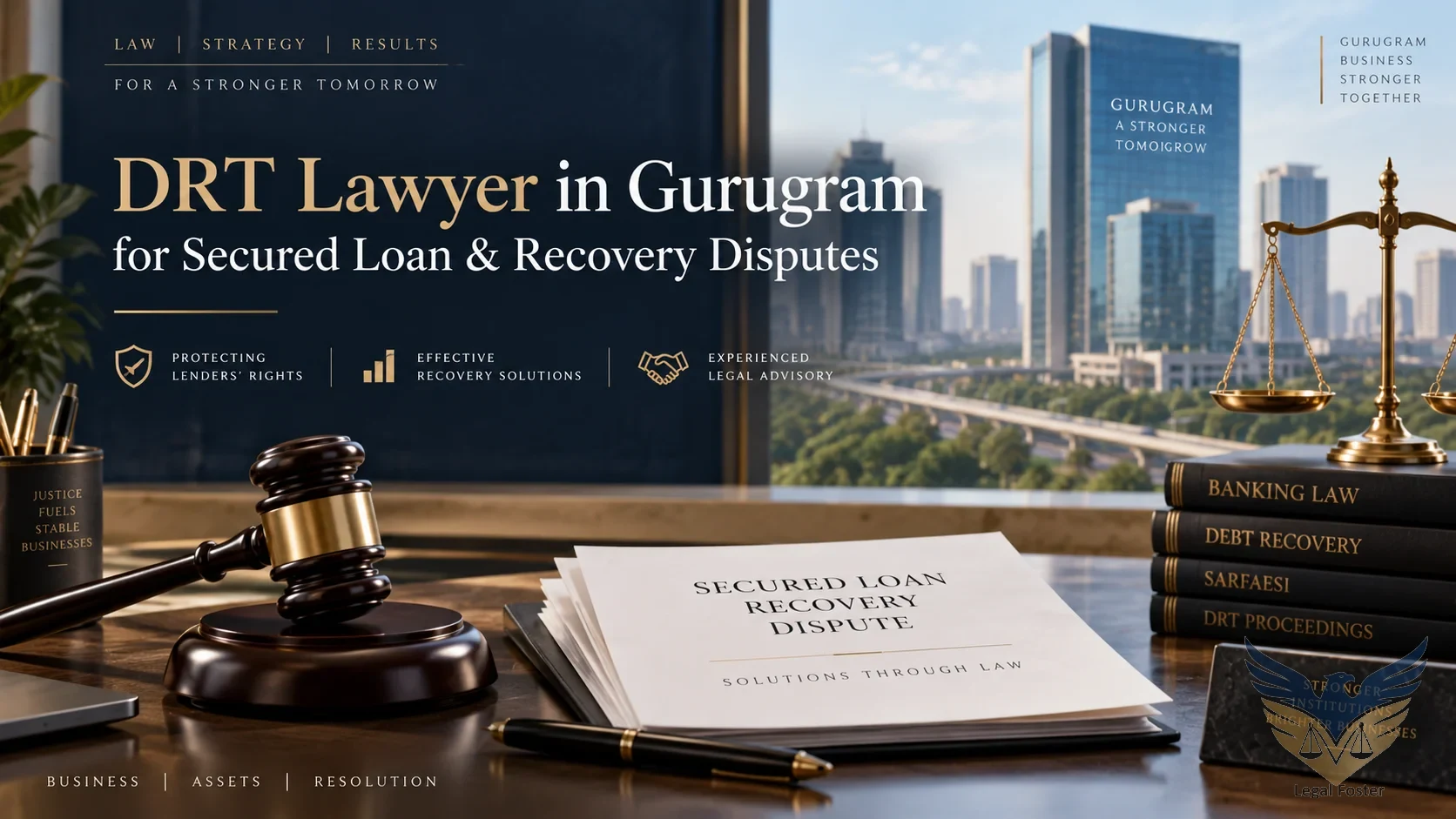
DRT Lawyer in Gurugram for Secured Loan and Recovery Disputes
Nobody wants to get a bank recovery notice. Your home can be lost. A business property can have possession proceedings started or you can get an auction notice when you are already short of money.
If a loan goes into dispute in Gurugram there is often confusion for borrowers. Usually because there is crossover between Secured property, business loans, personal guarantees, SARFAESI and Debt Recovery Tribunal.
That’s why having a DRT Lawyer in Gurugram can explain to you exactly which legal process the bank can exercise. This alone could save a borrower weeks if not months of unnecessary running around.
BK Singh Advocate can assist borrowers, guarantors, property owners and MSMEs as well as business facing bank recovery and secured loans disputes. Sometimes filing a case is required but BK Singh Advocate will firstly map out the loan, documents, notice issued, security provided, recovery stage and possible remedy before deciding how best to proceed.
Just because a borrower gets a SARFAESI notice (demanding money) doesn’t mean an auction is going to happen. Similarly writing a settlement letter to the bank won’t stop them from taking recovery actions in all scenarios.
A borrower needs to understand each stage of the bank recovery process has different legal rights and remedies. SARFAESI actions are invoked differently to DRT Recovery proceedings. Borrowers in Gurugram facing recovery action need to know at what stage the bank has progressed to.
BK Singh Advocate has a whole dedicated DRT Lawyer Gurgaon page to assist borrowers and other parties facing bank recovery issues in Gurugram as well as rest of Delhi NCR.
BK Singh Advocate will typically start with a document review rather than hearing the details over the phone. This not only saves time but allows BK Singh Advocate to understand whether the issue is a demand notice, possession notice, auction notice, DRT case, Recovery Officer case, appeal or even if we can help.
Why Does DRT Legal Help Matter in Gurugram in 2026?
Gurugram houses many residential projects as well as commercial projects. There are professionals, startups, MSME’s and corporate businesses operating in Gurugram. Hence a secured loan could be associated with a residential house apartment, commercial building, industrial property, machinery or any other asset of value.
Not only can a recovery matter affect a borrower. If involved, commercial guarantors or personal guarantors can get affected. Businesses can suffer if commercial assets are involved. Family can suffer if its a house where the bank is trying to enforce upon.
A borrower Googling for “Gurgaon DRT lawyer” online should also not assume that all recovery matters go to one tribunal seated in Gurugram. The Forum & territorial jurisdiction would be governed by the law under which the transaction & proceeding was initiated. Matters invoking DRT proceedings for Haryana can get transferred to the suitable DRT bench as per jurisdictional matrix valid at that point of time.
As stated on DRT Lawyer’s Gurugram service page, Borrowers can face SARFAESI notices, possession suits, auction issues, DRT petitions and DRAT appeals.
BK Singh Advocate can help borrowers understand whether the matter concerns SARFAESI enforcement, banks’ original recovery petition, an appeal against DRT order, execution proceedings or any other related matter.
Quick Facts for Secured Borrowers
What Is a DRT Matter for a Secured Borrower?
A DRT matter broadly consists of two streams
- Recovery proceedings initiated by banks/ certain financial institutions
- Proceedings initiated against banks/ certain financial institutions
under enactments such as Recovery of Debts and Bankruptcy Act, 1993 (RDB Act) and SARFAESI Act, 2002 (SARFAESI).
Please note that Streams 1 & 2 cannot be read in substitution for each other.
Whereas under RDB Act, the bank/ financial institution files an application before DRT for recovery of an eligible debt and DRT itself adjudicates the claim and issue recovery certificate where necessary; SARFAESI is a totally different enactment. Under SARFAESI, a qualifying secured creditor can enforce his security interest in accordance with the statute i.е. the SARFAESI Act and Security Interest Enforcement Rules, 2002 without any intervention of the Courts/Tribunal save as and when provided for under the statute. The borrower would have a remedy only after the action covered under Section 13(4) and Section 17 of the SARFAESI Act provides such statutory remedy before the DRT.
BK Singh Advocate goes through the actual notice always before recommending to the sender which stream would be applicable in his case. A notice casually sent as “bank notice” can be anything starting from a demand notice to a possession notice to auction publication to DRT summons to Recovery Officer letter etc.
What Happens After a SARFAESI Demand Notice?
A Demand Notice Under Section 13(2) normally gives the borrower sixty days to cure the default mentioned in the notice. Before sending out any response/request/curing the default, the borrower should analyze the loan account, the security documents, the payments made, the interest charged and any other related document.
Section 13(3A) gives the borrower right to make a representation/set out objections. Such representation would be considered by the secured creditor and reasons would have to be given for refusal where such representation is denied.
Any such response should be supported by facts. If a borrower believes that payments were not given credit to, the description of the security is inaccurate, details on the account are disputed or some other legal dispute is present, he should hold on to all supporting documents.
Financial difficulty can also be a commercial issue. A borrower may want to consider restructuring/regularisation/settlement where it makes commercial sense but such an offer would not stop you legally from proceeding.
BK Singh Advocate can study the notice and the associated loan documents to help the borrower determine if he should make a representation, discuss a settlement or take some other legal action.
Can a Borrower Approach the DRT After Possession Action?
Yes. Provided certain statutory preconditions are satisfied. Section 17 of SARFAESI ACT empowers a person to file remedy against measures specified under Section 13(4).
Time is of essence. Borrowers need to file at the earliest when they are aware of the date and nature of measure being challenged instead of waiting till date of auction/possession.
DRT has powers to inquire into validity of measures taken by secured creditor under SARFAESI Act and award relief if statutory preconditions are satisfied. Mere filing of application under Section 17 does not automatically stay auction/possession. Application for interim relief needs to be made which is granted only on facts.
Considering there is a limitation of 45 days to file an application under Section 17, preservation of documents become very important. Orders passed by DRT and practise points of various tribunals turn upon issues like dates; service records; nature of measure being challenged.
Our Dedicated SARFAESI Section 17 Services offered through DRT Lawyers will enable borrowers to have a dedicated team fighting such disputes.
BK Singh Advocate can help you review notice trail and advise if Section 17 remedy is available to you.
What Documents Should a Secured Borrower Preserve?
You’ll be amazed how many times a full file of documents flips a recovery suit. NOTE : Scan complete documents files. DO NOT send loose screenshots.
Loan Documents
- sanction letter, loan agreement, loan renewals, loan restructuring letters, guarantee documents, mortgage deed etc.
- Bank statements, loan account statements, receipts of payments, transaction statements, any letter/chat related to disputed credits.
SARFAESI documents
- Notice under Section 13(2), borrower’s representation under Section 13(3A), secured creditor’s reply to representation, notice of possession, notice of auction, newspaper publication etc.
Documents related to property
- Title documents, mortgage documents, mutation documents, lease documents, any other document related to property which has been offered as security.
- OTS, Bank Emails, receipts, settlement letters, any email/chat related to restructuring should be archived safely and chronologically.
Tribunal documents
If already started, keep summons, applications, replies, affidavits, interim orders, final orders passed, correspondence from Recovery officer.
When Should a Borrower Consult a DRT Lawyer?
First Warning sign is receipt of SARFAESI demand notice, possession notice or auction notice issued by bank. It is at this stage that the borrower needs to think about getting legal advice.
Need of legal assistance arises when borrower receives summons from DRT, copy of an OA, notices from Recovery Officer or any order requiring a reply to be sent within a certain time.
Another Warning sign is when you are not sure about status of security. Wherever a house, commercial property, factory, machinery or any other asset has been provided as security, the consequences of a recovery proceeding can be serious.
Even if you are a guarantor, do not think that it is somebody else’s problem. Depending upon the terms of the guarantee and the law governing the guarantee, the guarantor can be exposed to significant risk.
BK Singh Advocate can help you even before you enter into any settlement and you as a borrower want to understand your legal position before parting with money.
How Can DRT Lawyer Help Borrowers in Gurugram?
DRT Lawyer provides legal representation for DRT matters, SARFAESI related problems, secured asset enforcement, bank recovery suits, guarantor issues and loan settlement.
According to their website’s Gurugram page, it provides service to borrowers, guarantors, proprietors, business and MSME’s who are facing bank recovery problems occurring in Gurgaon as well as Delhi NCR.
BK Singh Advocate takes on board a recovery dispute beginning with what documents you have and where you are at in the proceedings. This can range from analysis of notices received, explaining your legal remedy and drafting of proper pleadings, response to proceedings, filing for interim relief if legally possible or assisting with an appeal.
Frequently Asked Questions
1. What kind of legal services does a DRT Lawyer in Gurugram provide?
BK Singh assists borrowers, guarantors, businesses and individuals facing bank recovery, SARFAESI and DRT matters. Services range from document review, legal advice, conducting tribunal processes, filing requests for interim relief, appeals and assisting in negotiation of possible settlement.
2. Can Advocate BK Singh help if I receive a SARFAESI demand notice?
Yes. Advocate BK Singh can assist you by reviewing the SARFAESI demand notice received, other relevant documents & account history. This would allow you understand your options to respond or remedies available. Most remedies are time sensitive so it’s best to understand your options early.
3. How much time do you generally get when you receive notice under Section 13(2)?
If you have received a SARFAESI Section 13(2) demand notice, generally you have about 60 days to clear the outstanding liability indicated in the notice. Read your account details and understand what legal responses you can make within this time frame.
4. Is it too early to speak to a DRT Lawyer after receiving a notice under Section 13(2)?
Since Section 17 SARFAESI remedy talks about actions initiated under section 13(4) and not the notice issued under section 13(2), it may be too early to contact a lawyer depending on your circumstances. Please reach out to a lawyer and explain the facts so far. A lawyer can advise you on the best remedy based on what actions have been initiated by the bank.
5. How does Section 17 SARFAESI remedy work?
Section 17 allows a person aggrieved by any of the actions taken by the bank under Section 13(4) to file an application before the DRT. Such Section 17 application is however subject to certain statutory conditions and limitation i. statutory conditions must be fulfilled and generally should be made within 45 days from the date of action complained of.
6. Can a notice of auction be stopped at DRT?
Yes. DRT can consider any application filed before it for interim relief such as suspending the auction. Based on facts of the case, DRT may grant temporary relief. However, DRT will not stop the auctioning just because a borrower files an application. A borrower has to specifically request DRT to grant the interim relief of suspending the auction.
7. Can my home loan property be attached if I default?
The SARFAESI Act permits banks to enforce their security interests without court intervention. If the conditions are fulfilled and your property was properly given as collateral to the lender, SARFAESI can be used to seize a residential property too. However please consult a lawyer to review your specific set of documents before concluding. Type of security provided, law governing the security and facts would need to be reviewed.
8. Can I consult a DRT Lawyer in Gurugram if I am a Guarantor?
Yes. If you are a guarantor and bank has started recovery action against you, then speaking to lawyer about your rights and remedies is recommended. BK Singh Advocate helps Guarantors understand guarantee, underlying loan, security and recovery action taken to understand potential liability and remedies available.
9. Can small businesses use DRT to resolve bank disputes?
MSME borrower can encounter legal difficulties with secured loans for business purposes, working capital loans, guarantees provided, collateral documents, and recovery action initiated by banks. Please consult a lawyer to explain legal remedies based on your specific situation and loan documents. Facts and stage of recovery action would matter.
10. If I make an OTS proposal to bank will they stop recovery?
Until a resolution is achieved or agreed upon by the parties, legally nothing stops the bank from continuing with recovery actions. Sending an OTS proposal is usually a negotiation tactic. Bank and borrower need to agree on binding terms/conditions/triggers or receive a stay from a court/tribunal in order to stop recovery action. Until an application is made to statutorily approved forums and a decision is issued, recovery will continue.
Conclusion
Issued bank recovery notices rarely get resolved just because the borrower freaks out or keeps quiet or suddenly deposits the payment. The borrower needs to know what the bank has done / can do legally, what timeline applies and whether settling or fighting makes business sense.
It also matters if the borrower is facing SARFAESI enforcement, DRT recovery proceeding or DRAT appeal. Particularly in Gurugram. The solution depends on the agreement, where the process is at and the facts.
BK Singh Advocate can help debtors, guarantors, property owners and businesses challenge recovery notices, navigate DRT proceedings, SARFAESI actions and auctions, and file for interim relief.