Supreme Court Calls for Swift Disposal of Dowry and Cruelty Cases With 10 Directions
Directions include time-bound framing of charges, scrutiny of cases pending beyond three years & bolstering support for women
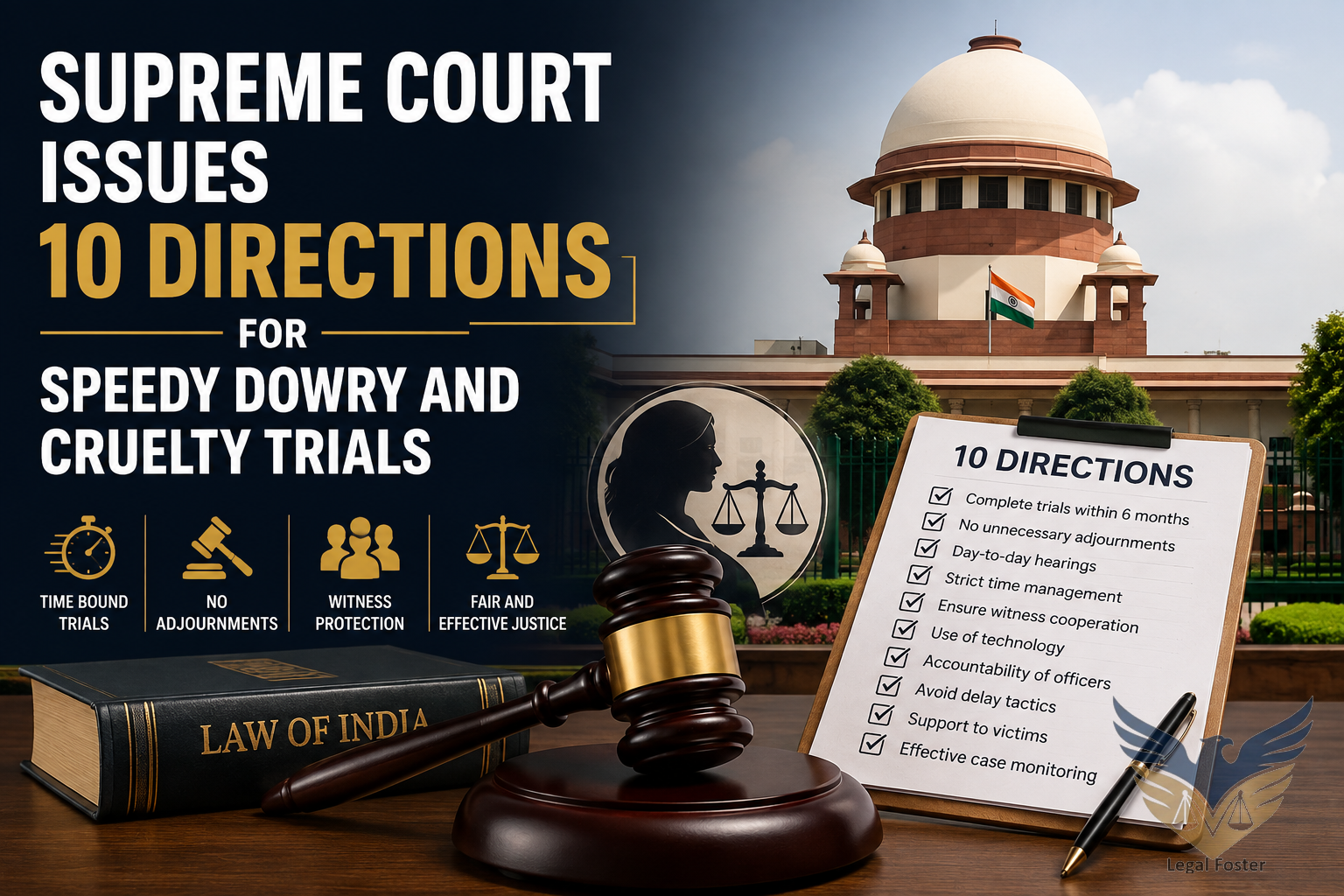
The Supreme Court last week issued directions to courts and state governments aimed at expediting trials in dowry-related cases and ensuring better enforcement of laws relating to dowry deaths and cruelty against women.
Issuing ten directions, a Bench of Justices Sanjay Karol and AG Masih ordered on August 20 that the institutional support infrastructure for victims should be strengthened, courts should treat dowry cases as priority ones, trials should be conducted on a time-bound basis, and so on.
Here are the key directions:
Priority: Dowry cases
Courts exercising jurisdiction in respect of offences under Sections 304B (dowry death) and 498A (cruelty to wife) of the Indian Penal Code, 1860 (“IPC”) — equivalent to Sections 80 and 85 of the Bharatiya Nyaya Sanhita, 2023 (“BNS”) — should, so far as possible, deal with such cases as cases of priority.
Monitoring of pending cases
District judiciaries should identify cases pending for more than three years under these provisions, especially those pending for the stage of framing of charges or recording of evidence, and monitor their movement on a periodic basis.
Time-bound trial
Trial courts should endeavour to frame charges within a period of 60 to 90 days from the receipt of the chargesheet. The recording of evidence shall begin within a reasonable time after framing of charges and thereafter shall be conducted continuously or on day-to-day basis, as far as practicable.
Limitation on adjournments
Courts should discourage unnecessary adjournments and specifically record reasons for granting the same. However, if counsel for the accused is repeatedly absent without sufficient cause, the Court may appoint a legal aid counsel or amicus to represent such accused.
Witness calendars
After framing of charges, trial courts should prepare calendar for examination of material witnesses and investigators should see that summons are served on witnesses well in advance and witnesses are also produced before courts as required.
Digital scrubbing
High Courts should endeavour to customise their existing court-management system to enable tracking of stage-wise pendency of dowry cases and generation of alerts in respect of old matters.
Review by High Courts
High Courts should review old pending criminal appeals, revisions, petitions filed under Section 482 CrPC/Section 528 BNSS and bail matters wherein dowry related offences are involved, especially in cases where the trial proceedings are stayed.
Training programmes and specialised prosecution
States and High Courts should regularly conduct training programmes for judges, judicial officers, police officials, prosecutors, protection officers and counsellors. States should consider appointing specialised prosecutors having experience in offences against women to exclusively deal with such cases.
Awareness & support mechanisms
States and Union Territories should take steps to strengthen support mechanisms such as one stop centres, family counselling centres, women help desks, victim assistance mechanism, women help lines and online grievance redressal systems. States should conduct sustained awareness programmes focusing on evils of dowry and alcoholism, gender equality, constitutional values and rights of women.
Periodic review
High Courts should submit a compliance report on a periodic basis until such time the State of pendency of cases and disposal of cases under these provisions is substantially reduced. States/Union Territories should assist the High Courts by providing necessary data/statistics and must themselves file status report at periodic intervals until further orders.
Court wants details of pendency and disposal of cases
The Court said that the reports filed by High Courts should specifically contain details regarding case pendency and disposal, the stage of cases pending for more than three years, awareness campaigns undertaken and their impact, status of appointment of dowry prohibition officers, etc. “States may provide details of training programmes conducted for judicial officers, police officers, prosecutors etc. aimed at ensuring speedier trial and resolution of cases,” the Court added.
Monitoring the judgment in State of UP v. Ajmal Beg
Issuing these directions, the Bench said that these directions were issued while monitoring compliance of its December 20,25 judgment in State of Uttar Pradesh v. Ajmal Beg.
Referring to its December judgment, the Court observed that “there are frequent instances where allegations regarding dowry are made and some old kitchens are being dug out which cause humiliation to many innocent persons.”
As we had reported, the December 20 judgment dealt with the deaths of married women where demands had allegedly been made for cash, bicycles, wrist watches, garments and cosmetics. In Ajmal Beg, a Bench headed by Chief Justice of India DY Chandrachud had noted that despite its efforts to clamp down on dowry deaths and transfer of dowry belongings, dowry continued to be prevalent in society. It had called for strict enforcement of the Dowry Prohibition Act, 1961 and sensitisation of people about dowry.
“A consistent and sustained effort by all stakeholders is required to deal with this evil that has crept into our society. Dowry prohibition officers ought to be appointed, trained and made available to citizens of India who need assistance in cases relating to dowry harassment,” the Court had said.
Ajmal Beg case: Death after demands for colour TV, motorcycle & Rs 15,000 allegedly made
That case related to the death of a 20-year-old woman who got married 14 months before she died. At the time of her marriage, her husband Ajmal and his family had allegedly demanded a colour television, a motorcycle and ₹15,000 from her parents. Her family registered a First Information Report under Sections 304B (dowry death) and 498A (husband and relatives harass wife for dowry) IPC after her death.
The trial court convicted Ajmal and his mother Jamila Beg under Sections 304B and 498A IPC and sentenced them to imprisonment. The Dowry Prohibition Act was also invoked. The Allahabad High Court later acquitted them.
The Supreme Court then restored their convictions, observing that “considering the material on record, we are of the considered view that the High Court was not correct in setting aside the conviction of the appellant”. Once these convictions were restored by the top court, the Court initiated suo motu proceedings to review law relating to dowry death and related offences.
Delayed trials: Took 24 years for Supreme Court to conclude Ajmal Beg case
Last week’s order notes that the original case began in 2001 when an FIR was filed. “The matter proceeded from a FIR until final conclusion of appeals took 24 years,” the Bench observed.
“As noted by this Court while disposing of appeals, the conclusion of the matter is indeed delayed justice but it is justice nonetheless,” the Court said and added that these directions were being issued “so that no one has to suffer for decades together before justice is meted out”.
The Bench also reminded governments that it had passed directions relating to conducting awareness campaigns and appointment of dowry prohibition officers in its December judgment. “Affidavits/assistance were filed by several High Courts, States/UTs towards compliance with the aforesaid directions,” the Bench noted on August 20.
“We have consolidated the material received from the States/UTs and High Courts and gone through the same for our purpose of perusing the same,” the Bench added.