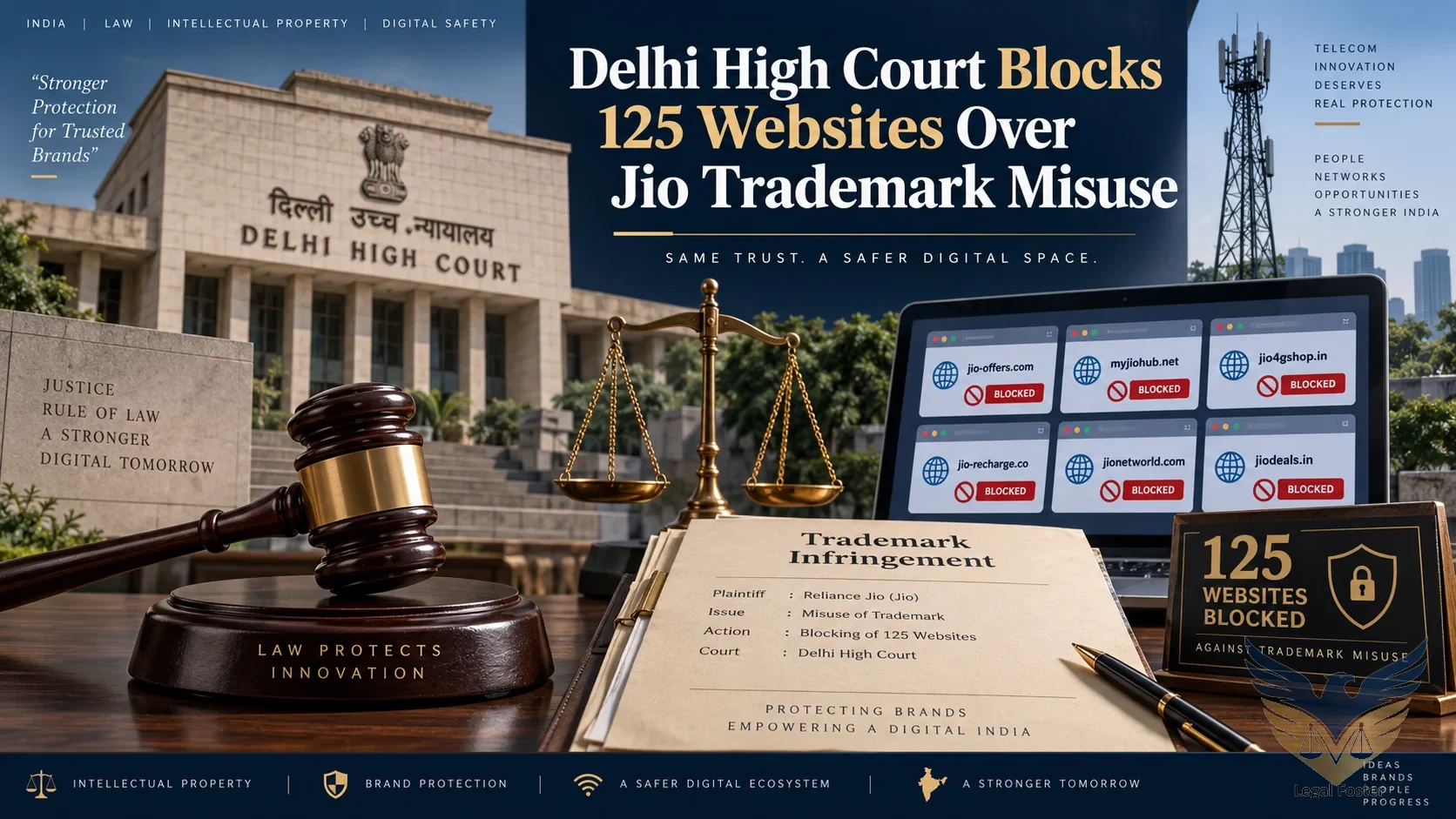
Delhi High Court Blocks 125 Websites Over Unauthorized Use of Jio Trademark
125 websites providing lottery, gaming services suspended for violating Jio Trademark
125 websites providing lottery and gaming services were suspended by Delhi High Court for violating Reliance Industries Limited’s (RIL) Jio trademark.
The websites and domain names offering the services were allegedly infringing RIL’s registered trademark “Jio”. Justice Purushaindra Kumar Kaurav passed the interim order on October 7.
Justice Kaurav noted that prima facie the legal test for determining rogue websites, as laid down by the Delhi High Court previously, has been satisfied.
Justice Kaurav also ordered Google to remove one webpage which infringed the Jio trademark and was hosted on its Blogger platform.
Meena and a number of defendants including namesdomain registrars, Google, MeitY and DoT were made party to the trademark infringement suit filed by RIL.
RIL asserted exclusive statutory and common law rights over the Jio trademark which was registered. The Plaintiff alleged that Defendants were unlawfully using the Jio mark by incorporating it into their domain names.
It further stated that defendants operating the following websites: jiolotteryi. com, jiolotterylogin.com, jiolotterygame.com, jiolottery.club and jiolottery.store, among others were using trademarks such as “JIO”, “JIO LOTTERY” and “JIO LOTTERY GAME”.
RIL claimed that these domains offered lottery, gaming, payments services and operated in related fields. Thus, Defendants’ use of these marks were either identical or deceptively similar to Plaintiff’s registered trademarks.
According to Plaintiff, this would cause confusion and deception for customers while dealing with Defendants.
Upon perusing the content of the websites, the Court found that prima facie the criteria for determining rogue websites, as explained in Delhi High Court’s decision in UTV Software Communication Ltd. v. 13 37X. to and others was satisfied.
The Court quoted the aforementioned decision stating that determining whether a website is rogue should be a qualitative approach.
The qualitative approach focuses on evaluating the main objective and impact of the website instead of merely identifying what percentage of content on the website is infringing.
The Court acknowledged that blocking specific URLs might prove ineffective as website operators may switch to a different URL to avoid the prohibition.
In the suit at hand, the learned Judge restrained Defendant Meena from operating any domain name or mark which is identical or deceptively similar to Plaintiff’s Jio mark.
Further, Defendant domain name registrars were directed to suspend all the websites and accounts mentioned in the Annexure to the order till further orders.
The Annexure lists 126 web addresses, however, it includes mirror websites, websites that redirect to other websites and websites that share similar web structure.
Thus, orders were passed to suspend 125 websites and pass a separate direction for Google to take down a webpage.
The domain names incorporate registration and web hosting services of NameCheap, Go Daddy, Dynadot, Spaceship and several others.
Placing reliance on Section 82(1) of the Commercial Courts Act, the Court granted Reliance Industries exemption from the requirement of pre-institution mediation.
It issued summons in the suit and fixed the interim application for further hearing on November 30.