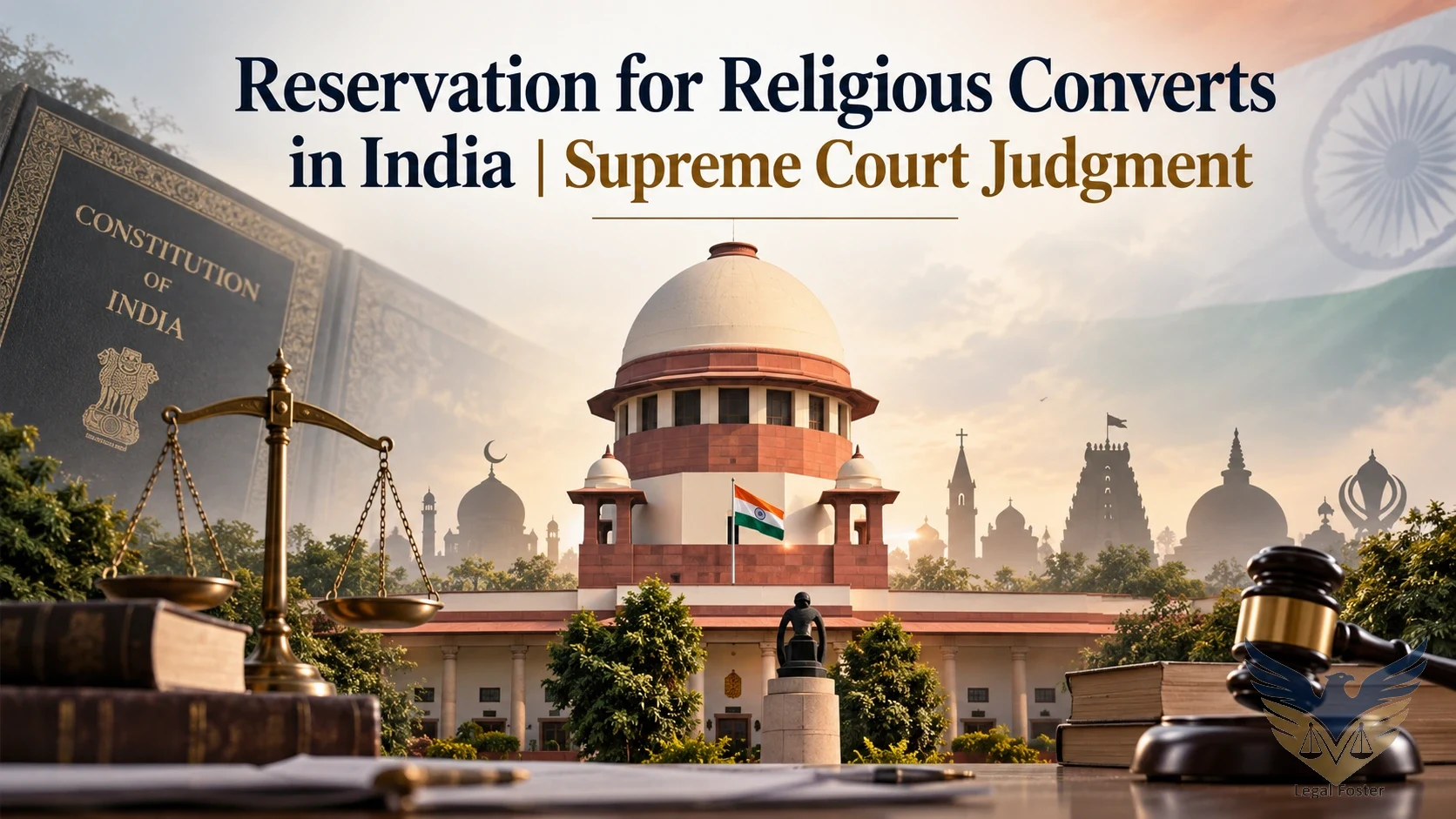
Reservation for Religious Converts: Revisiting the Debate on Substantive Equality in India
If a person changes religion they must not be given benefit of reservation by virtue of their previous social identity or on joining the community of the new religion. It should be based on sound reasons why the person is still socially backwards.
The Supreme Court while affirming the Madras High Court judgment held that by becoming Muslim one is not entitled to claim for a seat in any of the 7 Muslim communities declared as Backward Class(BC).
Paramasivam (known as Sameer Ahmed after conversion) hails from Thoothukudi district Tamil Nadu. After changing his religion from Hinduism to Islam in the year 2015 he wanted to be brought under one of the Muslim Community that are declared as Backward Class by the Government of Tamil Nadu. However the authorities refused to issue community certificate to him. He challenged this before Madras High Court. High Court struck down the government order issued by Government of Tamil Nadu which allowed any person changing from BC, MBC, DC and SC who convert to Islam to be considered as BC (Muslim). Government of Tamil Nadu approached the Supreme Court by filing an appeal against the high court verdict.
Bench comprising of Justice Prashant Kumar Mishra and Justice Sri Chandrasekhar framed the following question for consideration: Can a person who belong to a BC, MBC, DC and SC before converting to Islam be entitled to the status of a BC(Muslim) and thereby the benefits accruing out of that status.
It was held by the Court that a person who has converted from the Hindu fold to another non Hindu fold can not claim for benefit under Article 16(4) merely on the social backwardness which may be attached to his previous social identity. A community certificate is issued only after ascertaining whether a person has been coming from that backward class by line of descent. Court also took note of past decisions by Supreme Court which has stated that social backwardness and educational backwardness can only be decided with reference to article 16(4) read with the status of the community a person belongs to. A person converting to Islam can not be considered as member of that BC class unless he proves that he is accepted by that community.
This case poses more than a dispute of Community Certificate. There are many questions that arise when we think about our society. First of all what happens to identity of a person who has left one set of community and cannot become a part of all the communities that come under another religion. Take the instance of a person who has converted to Islam from SC. He would not be eligible for any of the communities that exists within Islam and which enjoys reservation. So what happens to such person. It is no longer a question of religion but social identity which has not been recognized by law.
Will the person not be socially backward once he converts. Conversion to Islam or any other religion may not make you free of the shackles which were imposed upon you due to your previous social identity.
In the case of Chinthada Anand the appellant was a pastor and he was from the community of Madiga which was declared as Scheduled Caste. He was called by name of his caste when he was abused. It was said that caste is a birth mark which one can not escape by merely changing his religion. Supreme Court dismissed the appeal by stating that the appellant when he converted to Christianity his caste which he was enjoying came to an end in eyes of law. So the appellant was not able to avail of the benefits of SC/ST Act.
It was also held in the case of CM Arumugam that when a person gives up Hinduism and converts to Christianity he loses his caste status and does not require to be protected by law anymore.
Both Islam and Christianity were socially divided into caste system although theologically there is no concept of higher and lower castes in them. It is here that Indra Sawhney came to play a vital role. A 9 judge bench in Indra sawhney observed that "there are many occupational groups and sects and denominations amongst the Non Hindus who by history have fallen into a state of backwardness. They too form backward class of persons within the meaning of Art. 16(4)". A person converting to these religions can not take with them the disadvantages they have undergone before conversion.
Court in present judgment has taken one step ahead by accepting that there may be some disadvantages that remain even after one converts to another religion. Though it said that it can not be used as a reason to grant benefits under reservation. Why did court take this stance. Social backwardness occurs due to the very nature of community one belongs to which in turn derives its strength from caste. Thereby making a fine distinction from earlier judgments.
Supreme Court in case of Soosai v. UOI put the onus on the converts of Christian faith to show that they still suffer caste discrimination. In case of S Anbalagan when petitioner was able to show that though he belonged to a caste he didn't cease to be part of it when he converted to Christianity. As petitioner was re-converted to Hinduism and was recognised as member of Scheduled Caste all through his life he was eligible to contest elections from SC reserved constituencies.
When deciding the case of G Michael it was held by Madras High Court that "it can be stated as general proposition that by conversion one is expelled from his caste; that means there will be no caste for him".
Held that by previous social identity one can not become member of any backward class in other religion where caste doesn't find theological significance. Here the court recognises petitioner as a Muslim but not his social identity which the petitioner failed to get recognition from the Court.
This observation from Court fails to make out a significant aspect. Once we come to conclusion that social disadvantage accompanies a convert then that social reality exists irrespective of it being related to caste or some theological writings. Caste is a social construct by nature and gets theological background to continue its practice in a society. So when caste takes the form of a social construct it affects people in other social systems as well. One cannot choose to not experience this social construct even after converting to a religion and if one does then there will be repercussions of doing so.
Karukku by Bama states how caste made its way into the fold of Christianity and things haven't changed much. Reports like the ones done by Hindu's shows how caste practice has continued in the fold of Christianity.
One thing that stands out from previous judgments is that in this case petitioner was trying to claim to be part of one of 7 Muslim Community declared as back wards by Government of Tamil Nadu. Which makes us realise that you are a part of a religion but can't be a part of any of the communities that exist under that religion. Once you convert you leave behind the community you belong to and enter a new religion. You can't seek to enter any of the communities that exist under that religion or avail of reservation by virtue of converting. Even if you suffer from social and educational backwardness after converting to Islam. You are not going to be benefited by reservation as it is established that by birth one is part of that community.
So what is position of a person who converts to Islam. Suppose you are doing so to get dignity and equal treatment and respect in society or for any other reason. Sure you can achieve that by converting to another religion but it will not help you overcome social and educational backwardness. As you were backward due to caste which you now don't have. You can't assume that now you have lead a better life by giving up your previous life and entering into a new one. You were getting benefits as per constitution and when you convert to Islam those benefits cease to exist.
If we start neglecting social and educational factors after a person converts then it goes against the spirit of social justice. Or if we allow him to keep taking benefit of his old identity there are practical issues that arise. So social reality and law clash each other. We need to find a solution for it.
But courts may not be the right forum for it. Recognizing the problem at hand won't help someone get into a category or be classified under one that exists. Courts can decide on what a provision says and if classification can be made under a provision. But can not make a new category under reservation which will be a function of state. Indra sawhney itself states that body appointed to make determination of backwardness should be allowed to do its job.
If a person changes religion they must not be given benefit of reservation by virtue of their previous social identity or on joining the community of the new religion. It should be based on sound reason why the person is still socially backwards. What reservation should do is help people who have been socially deprived from getting access to opportunities in terms of education and jobs. But if the disadvantage of person existed before conversion and continues to exist after. Then they must be given reservation to help them overcome those impediments. This will help social justice work in a greater capacity.